Abstract
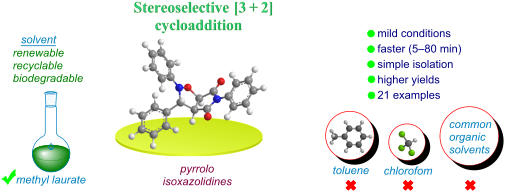
In the present study, 21 fused isoxazolidines were synthesized in yields ranging from good to excellent. Methyl laurate was identified as the easily accessible optimal solvent medium for the reaction, and the related compounds were obtained through straightforward isolation techniques in a relatively short time frame (5–80 minutes). A comprehensive investigation was conducted utilizing various web platforms, encompassing ecological and environmental risk assessments, toxicity, pesticide similarity, and biodegradability of methyl laurate in comparison with a series of conventional organic solvents, water, some fatty acids and their derivatives. The findings of this investigation revealed that methyl laurate exhibited better green solvent properties when evaluated against other solvents.
Graphical Abstract
Introduction
It is an established fact that a significant number of conventional organic solvents, which are widely utilized in both industrial and academic contexts, have deleterious effects on human and environmental health [1-3]. There is an ongoing and intensive research effort to identify new biocompatible alternatives to replace these existing solvents and many of the criteria that a solvent must meet to be considered green have been well defined in different sources [4,5]. In order to fulfil this requirement, a considerable number of green solvents of various classes have been developed for a range of applications, including the extraction of natural compounds [6-9], food analysis [10-12], pharmacology [13-15], and organic synthesis [16-19]. Despite the advent of environmentally friendly green solvents that have been discovered to be applicable in numerous modern organic chemical transformations, difficulties often arise in the recovery and reuse of these solvents following the completion of the reaction. Moreover, some of these solvents have been observed to degrade under conditions that are particularly severe [20]. For instance, although ionic liquids are well-known green solvent alternatives with superior properties compared to conventional organic solvents, their recovery from the reaction medium can be quite troublesome [21,22]. It is evident that this class of solvents may be accompanied by a number of drawbacks. For instance, they are frequently expensive, exhibit negligible or non-existent biodegradability, and there is a lack of data concerning their potential toxicity. Conversely, while water is regarded as a promising biocompatible solvent alternative in numerous chemical transformations, there are several challenges associated with product isolation that must be addressed [23]. Consequently, it is evident that the endeavor to identify an optimal green solvent for both industrial and academic applications must persist.
In the modern world, one of the main goals of an increasing number of chemists interested in the design and synthesis of versatile organic molecules is to develop atom-efficient, multicomponent, low-cost, and environmentally benign synthetic strategies for these molecules. In the context of these strategies, it would be judicious to consider cycloaddition reactions of the [3 + 2] type, a field in which Smith and Huisgen are recognized as pioneers [24,25]. In the field of heterocyclic chemistry, the [3 + 2] type of cycloaddition reaction is a widely employed method for the formation of the five-membered isoxazolidine ring motif, which displays a range of biologically active properties [26-30]. It is notable that the fused pyrrolo-isoxazolidines represent a particularly versatile class of heterocyclic compounds and intermediates, which have been demonstrated to exhibit a wide range of biological activities [26,28,31-35]. The validity of the atom-efficient methodology under discussion has been demonstrated in experimental research; its efficacy in facilitating the rapid formation of multifunctional complex molecules being in contradistinction to the time- and labor-intensive nature of traditional multistep synthesis strategies. For instance, this methodology has been demonstrated to be highly advantageous in the synthesis of numerous pharmaceutical compounds, biological probes, insecticides, alkaloids, and other intricate natural compounds consisting of a combination of isoxazolidine rings [36-41]. It has been demonstrated that such cycloaddition reactions are also employed in the efficient preparation of biologically active molecules, including nucleosides, β-lactam class antibiotics, peptides, and amino acids, as well as sugars (Figure 1) [42-48].
![[1860-5397-21-184-1]](/bjoc/content/figures/1860-5397-21-184-1.svg?scale=2.0&max-width=1024&background=FFFFFF)
Figure 1: Versatile compounds via cycloaddition reactions.
Figure 1: Versatile compounds via cycloaddition reactions.
More specifically cycloaddition reactions of nitrones (1,3-dipoles) with N-aryl-substituted maleimides (electron-poor dipolarophiles) are a highly popular and versatile method for the formation of regio- and stereoselective pyrrolo-isoxazolidine-fused ring scaffolds. From the standpoint of organic chemistry, it is evident that these compounds can be efficiently converted into a variety of versatile organic intermediates through the application of ring-opening reactions [49-52]. In addition to the aforementioned useful properties, the current methods for the preparation of such cyclic compounds and/or their fused cyclic systems typically necessitate the use of toxic solvents, including chloroform, benzene, toluene etc. [32,53-59]. Indeed, the selection of conventional organic solvents, including benzene, toluene and chloroform, for the [3 + 2] cycloaddition reactions between nitrones and diverse dipolarophiles has not been predicated on any criteria other than their inertness [60]. Conversely, certain studies have reported that the effects of organic solvents in such reactions are negligible, and that an increase in solvent polarity results in a decrease in rate constants. This phenomenon is attributed to the lower polarity of the transition state in comparison to that of the initial compounds [61]. Furthermore, these methods often require harsh reaction conditions, prolonged reaction times, and laborious purification techniques [62-64]. Synthesis of pyrrolo-isoxazolidines utilizing nitrosoarenes via the multicomponent strategy is indeed feasible [65,66]. In a similar manner, Chakraborty obtained diastereomer products, primarily in cis configuration, from the cycloaddition reaction of a fluoro or a furyl-based nitrone with some maleimides via a mechanochemical route in a solvent-free medium [67,68]. The development of environmentally friendly green methodologies for the preparation of heterocyclic compounds via such cycloaddition reactions is a significant and ongoing research area that should not be overlooked [69]. However, these methods are accompanied by the inevitability of long reaction times or the use of toxic organic solvents. Such negative aspects encountered during the synthesis of these compounds prompted us to seek alternative, environmentally benign, renewable, and reusable solvents [70]. It is therefore a basic tenet of Green Chemistry to replace the conventional organic solvents, which are flammable and generate toxic volatile components and are costly, with readily accessible and biocompatible alternatives [71]. Indeed, the utilization of eco-friendly bio-based solvents in a multitude of organic chemical transformations [72-74], industrial processes [5,75,76], and pharmaceutical applications [13,77] has recently gained significant prevalence. In view of the aforementioned considerations, the focus of our current research is on more environmentally friendly 1,3-dipoar cycloaddition reactions of nitrones with N-arylmaleimides to synthesize a series of pyrrolo-isoxazolidines.
In this context, an investigation was conducted into the potential of vegetable oils and certain derivatives to serve as biocompatible solvents in cycloaddition reaction contexts. This investigation involved a comparative analysis of these vegetable oils and derivatives with water and a range of commonly employed organic solvents in organic transformations.
Results and Discussion
The requisite starting compounds, nitrones 1a–f and a selection of N-substituted maleimide derivatives 2b–d were successfully synthesized in accordance with procedures previously documented in the literature (Scheme 1) [28,78-85]. In this study, the reaction between simple starting compounds C,N-diphenylnitrone and N-phenylmaleimide was selected as the model cycloaddition reaction. A series of bio-based materials were subsequently employed to ascertain the most appropriate green solvent for the specified cycloaddition reaction, with the findings presented in Table 1. As evidenced by the data presented in the table, the majority of the selected vegetable oils and their two derivatives are viable candidates for use as solvents in the proposed reaction. Concurrently, the reaction was carried out in a solvent-free environment, and the product yields obtained in two distinct time periods are presented in Table 1 (entries 11 and 12). As can be deduced from these results, the reaction is found to be more sluggish in a solvent-free environment. Therefore, as evidenced in Table 1 (entries 8 and 9), methyl laurate is the most suitable solvent candidate for the reaction between nitrones and maleimides. Accordingly, methyl laurate, which facilitates the completion of this reaction in a relatively short time frame (approximately five minutes), was selected as the primary solvent for the isoxazolidine derivatives that are planned to be synthesized in this study.
![[1860-5397-21-184-i1]](/bjoc/content/inline/1860-5397-21-184-i1.svg?scale=2.0&max-width=1024&background=FFFFFF)
Scheme 1: Molecular structures of parent compounds 1a–f, 2a–d and cycloadducts 3a–u.
Scheme 1: Molecular structures of parent compounds 1a–f, 2a–d and cycloadducts 3a–u.
Table 1: Optimization of the [3 + 2] cycloaddition conditions for the synthesis of pyrrolo[3,4-d]isoxazolidine 3a (cis + trans isomers).
![[Graphic 1]](/bjoc/content/inline/1860-5397-21-184-i7.svg?max-width=637&scale=1.0)
|
||||
| Entry | Solvent | Time (min) | Temperature (°C) | Yield (%)a |
| 1 | sunflower oil | 10 | 80 | 89 |
| 2 | coconut oil | 10 | 80 | 91 |
| 3 | olive oil | 10 | 80 | 75 |
| 4 | hazelnut oil | 10 | 80 | 92 |
| 5 | walnut oil | 10 | 80 | 87 |
| 6 | castor oil | 10 | 80 | 53 |
| 7 | oleic acid | 10 | 80 | 87 |
| 8 | methyl laurate | 10 | 80 | 100 |
| 9 | methyl laurate | 5 | 80 | 100 (cis/trans 28:72) |
| 10 | waterb | 10 | 80 | 51 |
| 11 | solvent free | 10 | 80 | 42 |
| 12 | solvent free | 60 | 80 | 53 |
aThe yields were obtained by precipitation of the relevant product from the reaction medium with a suitable solvent. bThe yield was obtained by means of extraction with EtOAc and subsequent precipitation with hexane.
In recent times, research into the evaluation of ecological and environmental risks posed by various organic compounds and solvents has gained increased significance. In silico models have emerged as a valuable tool, offering rapid and cost-effective solutions when experimental data is not readily available, particularly those that are web-integrated [86]. The predicted physical properties of methyl laurate, as determined by the ADMETLab 3.0 platform [87] are illustrated in Figure 2a. Conversely, the oral toxicity values of methyl laurate, in conjunction with toluene and chloroform – two conventional solvents that are commonly employed in [3 + 2] cycloaddition reactions were calculated with ProTox 3.0 (a webserver for the prediction of toxicity of chemicals) [88], as shown in Figure 2b. As illustrated in the figure, the LD50 value, which serves as a measure of the toxicity of these solvents, exhibits the highest value for methyl laurate and can be characterized as the solvent with the lowest toxicity. Furthermore, the results for the organic solvents many of which are not environmentally friendly and widely used in other synthesis reactions have been presented in Figure 3. The solvent potential of these solvents in the [3 + 2] cycloaddition reaction was investigated in the context of this study. As demonstrated in Figure 3, the toxicity class estimated for methyl laurate categorizes it as a potential environmentally friendly solvent. The OSIRIS PropertyExplorer program was employed to conduct toxicity risk assessments of methyl laurate, the results of which demonstrated that this solvent does not possess mutagenic, tumorigenic, irritant, or reproductive properties (Table 2). According to the toxicity risk assessments for solvents in this table, determined using the OSIRIS PropertyExplorer software, sulfolane appears to be a safe solvent and its use is recommended for certain purposes in some studies [89]. However, the toxicity of sulfolane has been mentioned in some other studies [90,91]. Moreover, as illustrated in the Table 2, only methyl oleate and methyl laurate, in conjunction with sulfolane, were categorized as entirely risk-free based on the four pertinent toxicity parameters. In the context of cycloadditions, the conventional solvents that are typically employed as reaction media encompass a range of options, including tetrahydrofuran (THF) (a problematic solvent, p), dioxane (considered hazardous, h), benzene (designated as highly hazardous, hh), toluene (p), chloroform (hh), acetonitrile (p), sulfolane (h), and DMSO (p) according to the guidelines outlined in the CHEM21 solvent selection guide [92].
![[1860-5397-21-184-2]](/bjoc/content/figures/1860-5397-21-184-2.svg?scale=2.0&max-width=1024&background=FFFFFF)
Figure 2: a) Radar view of the physical properties of methyl laurate. b) Oral toxicity values of methyl laurate, toluene, and chloroform, respectively.
Figure 2: a) Radar view of the physical properties of methyl laurate. b) Oral toxicity values of methyl laura...
![[1860-5397-21-184-3]](/bjoc/content/figures/1860-5397-21-184-3.svg?scale=2.0&max-width=1024&background=FFFFFF)
Figure 3: The oral toxicity values of all the solvents utilized in the present study obtained with ProTox 3.0.
Figure 3: The oral toxicity values of all the solvents utilized in the present study obtained with ProTox 3.0....
![[Graphic 2]](/bjoc/content/inline/1860-5397-21-184-i8.png?max-width=637&scale=1.0)
![[Graphic 3]](/bjoc/content/inline/1860-5397-21-184-i9.png?max-width=637&scale=1.0)
![[Graphic 4]](/bjoc/content/inline/1860-5397-21-184-i10.png?max-width=637&scale=1.0)
![[Graphic 5]](/bjoc/content/inline/1860-5397-21-184-i11.png?max-width=637&scale=1.0)
![[Graphic 6]](/bjoc/content/inline/1860-5397-21-184-i12.png?max-width=637&scale=1.0)
![[Graphic 7]](/bjoc/content/inline/1860-5397-21-184-i13.png?max-width=637&scale=1.0)
![[Graphic 8]](/bjoc/content/inline/1860-5397-21-184-i14.png?max-width=637&scale=1.0)
![[Graphic 9]](/bjoc/content/inline/1860-5397-21-184-i15.png?max-width=637&scale=1.0)
![[Graphic 10]](/bjoc/content/inline/1860-5397-21-184-i16.png?max-width=637&scale=1.0)
![[Graphic 11]](/bjoc/content/inline/1860-5397-21-184-i17.png?max-width=637&scale=1.0)
![[Graphic 12]](/bjoc/content/inline/1860-5397-21-184-i18.png?max-width=637&scale=1.0)
![[Graphic 13]](/bjoc/content/inline/1860-5397-21-184-i19.png?max-width=637&scale=1.0)
![[Graphic 14]](/bjoc/content/inline/1860-5397-21-184-i20.png?max-width=637&scale=1.0)
![[Graphic 15]](/bjoc/content/inline/1860-5397-21-184-i21.png?max-width=637&scale=1.0)
![[Graphic 16]](/bjoc/content/inline/1860-5397-21-184-i22.png?max-width=637&scale=1.0)
![[Graphic 17]](/bjoc/content/inline/1860-5397-21-184-i23.png?max-width=637&scale=1.0)
![[Graphic 18]](/bjoc/content/inline/1860-5397-21-184-i24.png?max-width=637&scale=1.0)
![[Graphic 19]](/bjoc/content/inline/1860-5397-21-184-i25.png?max-width=637&scale=1.0)
![[Graphic 20]](/bjoc/content/inline/1860-5397-21-184-i26.png?max-width=637&scale=1.0)
![[Graphic 21]](/bjoc/content/inline/1860-5397-21-184-i27.png?max-width=637&scale=1.0)
![[Graphic 22]](/bjoc/content/inline/1860-5397-21-184-i28.png?max-width=637&scale=1.0)
![[Graphic 23]](/bjoc/content/inline/1860-5397-21-184-i29.png?max-width=637&scale=1.0)
![[Graphic 24]](/bjoc/content/inline/1860-5397-21-184-i30.png?max-width=637&scale=1.0)
![[Graphic 25]](/bjoc/content/inline/1860-5397-21-184-i31.png?max-width=637&scale=1.0)
![[Graphic 26]](/bjoc/content/inline/1860-5397-21-184-i32.png?max-width=637&scale=1.0)
![[Graphic 27]](/bjoc/content/inline/1860-5397-21-184-i33.png?max-width=637&scale=1.0)
![[Graphic 28]](/bjoc/content/inline/1860-5397-21-184-i34.png?max-width=637&scale=1.0)
![[Graphic 29]](/bjoc/content/inline/1860-5397-21-184-i35.png?max-width=637&scale=1.0)
![[Graphic 30]](/bjoc/content/inline/1860-5397-21-184-i36.png?max-width=637&scale=1.0)
![[Graphic 31]](/bjoc/content/inline/1860-5397-21-184-i37.png?max-width=637&scale=1.0)
![[Graphic 32]](/bjoc/content/inline/1860-5397-21-184-i38.png?max-width=637&scale=1.0)
![[Graphic 33]](/bjoc/content/inline/1860-5397-21-184-i39.png?max-width=637&scale=1.0)
![[Graphic 34]](/bjoc/content/inline/1860-5397-21-184-i40.png?max-width=637&scale=1.0)
![[Graphic 35]](/bjoc/content/inline/1860-5397-21-184-i41.png?max-width=637&scale=1.0)
![[Graphic 36]](/bjoc/content/inline/1860-5397-21-184-i42.png?max-width=637&scale=1.0)
![[Graphic 37]](/bjoc/content/inline/1860-5397-21-184-i43.png?max-width=637&scale=1.0)
![[Graphic 38]](/bjoc/content/inline/1860-5397-21-184-i44.png?max-width=637&scale=1.0)
![[Graphic 39]](/bjoc/content/inline/1860-5397-21-184-i45.png?max-width=637&scale=1.0)
![[Graphic 40]](/bjoc/content/inline/1860-5397-21-184-i46.png?max-width=637&scale=1.0)
![[Graphic 41]](/bjoc/content/inline/1860-5397-21-184-i47.png?max-width=637&scale=1.0)
![[Graphic 42]](/bjoc/content/inline/1860-5397-21-184-i48.png?max-width=637&scale=1.0)
![[Graphic 43]](/bjoc/content/inline/1860-5397-21-184-i49.png?max-width=637&scale=1.0)
![[Graphic 44]](/bjoc/content/inline/1860-5397-21-184-i50.png?max-width=637&scale=1.0)
![[Graphic 45]](/bjoc/content/inline/1860-5397-21-184-i51.png?max-width=637&scale=1.0)
![[Graphic 46]](/bjoc/content/inline/1860-5397-21-184-i52.png?max-width=637&scale=1.0)
![[Graphic 47]](/bjoc/content/inline/1860-5397-21-184-i53.png?max-width=637&scale=1.0)
![[Graphic 48]](/bjoc/content/inline/1860-5397-21-184-i54.png?max-width=637&scale=1.0)
![[Graphic 49]](/bjoc/content/inline/1860-5397-21-184-i55.png?max-width=637&scale=1.0)
![[Graphic 50]](/bjoc/content/inline/1860-5397-21-184-i56.png?max-width=637&scale=1.0)
![[Graphic 51]](/bjoc/content/inline/1860-5397-21-184-i57.png?max-width=637&scale=1.0)
![[Graphic 52]](/bjoc/content/inline/1860-5397-21-184-i58.png?max-width=637&scale=1.0)
![[Graphic 53]](/bjoc/content/inline/1860-5397-21-184-i59.png?max-width=637&scale=1.0)
![[Graphic 54]](/bjoc/content/inline/1860-5397-21-184-i60.png?max-width=637&scale=1.0)
![[Graphic 55]](/bjoc/content/inline/1860-5397-21-184-i61.png?max-width=637&scale=1.0)
![[Graphic 56]](/bjoc/content/inline/1860-5397-21-184-i62.png?max-width=637&scale=1.0)
![[Graphic 57]](/bjoc/content/inline/1860-5397-21-184-i63.png?max-width=637&scale=1.0)
![[Graphic 58]](/bjoc/content/inline/1860-5397-21-184-i64.png?max-width=637&scale=1.0)
![[Graphic 59]](/bjoc/content/inline/1860-5397-21-184-i65.png?max-width=637&scale=1.0)
![[Graphic 60]](/bjoc/content/inline/1860-5397-21-184-i66.png?max-width=637&scale=1.0)
![[Graphic 61]](/bjoc/content/inline/1860-5397-21-184-i67.png?max-width=637&scale=1.0)
![[Graphic 62]](/bjoc/content/inline/1860-5397-21-184-i68.png?max-width=637&scale=1.0)
![[Graphic 63]](/bjoc/content/inline/1860-5397-21-184-i69.png?max-width=637&scale=1.0)
![[Graphic 64]](/bjoc/content/inline/1860-5397-21-184-i70.png?max-width=637&scale=1.0)
![[Graphic 65]](/bjoc/content/inline/1860-5397-21-184-i71.png?max-width=637&scale=1.0)
A series of risk assessments was conducted, including ecological and environmental risk assessments, as well as pesticide similarity and biodegradability assessments of methyl laurate in comparison with toluene and chloroform, respectively (Figure 4, Figure 5, and Figure 6). These assessments were performed using the ChemFREE web platform [86].
![[1860-5397-21-184-4]](/bjoc/content/figures/1860-5397-21-184-4.png?scale=2.0&max-width=1024&background=FFFFFF)
Figure 4: Ecological, environmental risk assessments, pesticide similarity and biodegradability assessments of methyl laurate.
Figure 4: Ecological, environmental risk assessments, pesticide similarity and biodegradability assessments o...
![[1860-5397-21-184-5]](/bjoc/content/figures/1860-5397-21-184-5.png?scale=2.0&max-width=1024&background=FFFFFF)
Figure 5: Ecological, environmental risk assessments, pesticide similarity and biodegradability assessments of toluene.
Figure 5: Ecological, environmental risk assessments, pesticide similarity and biodegradability assessments o...
![[1860-5397-21-184-6]](/bjoc/content/figures/1860-5397-21-184-6.png?scale=2.0&max-width=1024&background=FFFFFF)
Figure 6: Ecological, environmental risk assessments, pesticide similarity and biodegradability assessments of chloroform.
Figure 6: Ecological, environmental risk assessments, pesticide similarity and biodegradability assessments o...
According to the ecological risk assessments for some species based on the data shown in these figures, methyl laurate does not pose a risk to 4 species, while chloroform and toluene do not pose a risk to 3 species (please see the green colored icons). In terms of environmental risk factors, the persistence of methyl laurate in soil, sediment and water, with the exception of air, is significantly lower than that of the other two solvents (values are calculated in days). In addition, it can be seen that out of these three solvents, only methyl laurate is readily biodegradable on the basis of environmental risk factors (in the OECD 301C modified MITI (I) test, a substance can be considered ready biodegradable if 60% of the substance is mineralized in 28 days (in terms of ThOD)). On the other hand, pesticide-likeness radar, "According to Hao's pesticide-likeness rule“ [93], the radar plot gives an integrated measure of six properties of chemicals, which performs more comprehensive qualitative analysis to exclude chemicals with properties most probably incompatible with an acceptable bioavailable profile. As the molecules of methyl laurate contain more rotatable bonds than the molecules of the other two solvents, this value was slightly higher in the pesticide-likeness radar. Moreover, molecular complexities, pesticide-likeness scores, RDL, GAU, QEX scores are quantitative assessment methods, which rely on some of the physicochemical properties are relevant, accessible, and easy to compute. A high score indicates a higher potential for chemicals to become new pesticides (the data obtained with ChemFREE for the other 13 solvents used in the study are given in Supporting Information File 1, Figure S1). In addition to the calculations already outlined, a series of toxicity properties of methyl laurate were calculated using ADMETLab 3.0 in comparison with common organic solvents and some green solvents. The obtained results were visualized with a cylinder chart in Figure 7. Indeed, a significant proportion of the experimentally measured Green Chemistry parameters for methyl laurate are consistent with the predictions of various software or web platforms, and in some cases, even demonstrate that certain toxicity parameters of methyl laurate are more environmentally friendly. As demonstrated in the relevant literature, methyl laurate has been shown to be non-toxic to the acute oral route and to not induce mutagenic effects in the S. typhimurium reversion assay [94]. In the course of the experiments conducted with methyl laurate, no irritant effects on the skin of human subjects were detected. However, evidence of ocular irritation at very low levels was obtained. Furthermore, it has been determined that 100–69% of methyl laurate is readily biodegraded aerobically following a 30-day period. The utilization of certain fatty acid methyl esters, including but not limited to methyl laurate, has found application in a variety of direct and indirect food additive applications [94].
![[1860-5397-21-184-7]](/bjoc/content/figures/1860-5397-21-184-7.png?scale=2.0&max-width=1024&background=FFFFFF)
Figure 7: Various toxicity parameters of methyl laurate and a series of other solvents calculated by ADMETLab 3.0.
Figure 7: Various toxicity parameters of methyl laurate and a series of other solvents calculated by ADMETLab...
The Hansen solubility parameter is a numerical expression that quantifies a molecule's cohesive energy density from non-polar, polar, and hydrogen-bonding interactions. It is a widely utilized tool in the field of molecular science for predicting the miscibility of solutes with solvents, as well as the miscibility of solutes within themselves, based on the fundamental principle of "like dissolves like" [95]. The location of the selected common organic solvents in the 3D Hansen space is shown in Figure 8a. The distribution of these selected solvents with other organic solvents in the 3D Hansen solubility space is determined by three Hansen solubility parameters (HSPs): dispersion (δD), polarity (δP), and hydrogen bonding (δH). As is well established, information about their similarity in solubility properties can be obtained from the distance between solvents. The identification of problematic and non-problematic solvents is facilitated by the size and color of the specific sphere representing a particular solvent. As demonstrated by the figure, the position of methyl laurate (with values of δD = 16, δP = 2.1 and δH = 5.3) can be found in the middle of the model spheres belonging to nonpolar and polar protic or polar aprotic solvents, which had previously been widely favored in cycloaddition reactions. These values reveal the similarity in solubility properties of the solvents. Furthermore, the evidence suggests that the majority of these solvents is hazardous and their utilization is to be avoided. As demonstrated in Figure 8a, the color of the spheres of the customary proportional solvents employed in [3 + 2] cycloadditions is red or yellow, thereby substantiating the potential hazard associated with their utilization as a solvent in the aforementioned reactions. For the solute component C,N-diphenylnitrone, the dispersion, polarity, and hydrogen bonding values for nitrone were determined as δD = 16.6, δP = 7.6 and δH = 8.7. Figure 8b clearly shows the position of the solute in the Hansen space. The “Green Solvent Selection Tool“ was utilized to ascertain these three parameters [95]. For the purpose of this study, a series of solvents in which C,N-diphenylnitrone dissolves was determined through experimental means (at 22 °C) in our laboratory (Figure 8c). An experiment was conducted in which a series of organic solvents and water were subjected to solubility tests. For the purposes of this experiment, approximately 15 mg of nitrone was mixed with 1 mL of solvent in a 10 mL test tube at room temperature (22 °C). As demonstrated in Figure 8c, the solvents under consideration are all effective in facilitating the dissolution of nitrone. However, under identical conditions, the nitrone was not fully soluble in solvents such as water, diethyl ether, petroleum ether, triethylene glycol, diethanolamine, and glycerol. Then, these solvents were selected with the known functional solvent(s) of our solute icon in this tool and following the update, the parameter values given above for the relevant nitrone were readily obtained. As can be seen from the figure, methyl laurate is a good alternative to competing toxic organic solvents that are good solvents for this compound.
![[1860-5397-21-184-8]](/bjoc/content/figures/1860-5397-21-184-8.svg?scale=2.0&max-width=1024&background=FFFFFF)
Figure 8: a) Visualization of the localization of conventional organic and bio-based solvents in the Hansen space. b) Position of the nitrone in the Hansen space. c) Organic solvents that can dissolve C,N-diphenylnitrone (experimentally determined).
Figure 8: a) Visualization of the localization of conventional organic and bio-based solvents in the Hansen s...
As well-known the Hildebrand solubility parameter (HSP, δT) has been defined as a measure of the cohesive energy density of a material, thus facilitating prediction of the solubility of a solute in a solvent [96].
![[1860-5397-21-184-i3]](/bjoc/content/inline/1860-5397-21-184-i3.svg?max-width=590&scale=1.18182)
Methyl laurate has been found to have HSPs that are in close proximity to those that have been predicted for nitrone, with a δT (the Hildebrand solubility parameter or the total Hildebrand parameter) of approximately 17. This finding indicates that methyl laurate is a suitable solvent for nitrone, which has a δT of around 20. On the other hand, the radius of interaction (Ra) is a critical factor in the assessment of solute solubility in a solvent, particularly in the context of HSPs [97,98]. It facilitates estimation of the extent of interaction between a solute and solvent, as determined by their respective solubility parameters. Consequently, the difference between the HSPs values can be utilized to calculate the Ra value between the nitrone and methyl laurate. In order to calculate the Ra value between the nitrone and methyl laurate, it is recommended to employ the following equation (n = nitrone, ml = methyl laurate):
![[1860-5397-21-184-i4]](/bjoc/content/inline/1860-5397-21-184-i4.svg?max-width=590&scale=1.18182)
According to Equation 2, Ra was calculated to be approximately ≈ 6.57 MPa1/2. The radius of interaction (Ro) for a typical small organic molecule, such as the nitrone, is estimated to be approximately 7.5 MPa1/2 which value is usually determined for solute molecules [97,99]. The relationship between Ra and Ro is denoted by the term relative energy difference (RED).
![[1860-5397-21-184-i5]](/bjoc/content/inline/1860-5397-21-184-i5.svg?max-width=590&scale=1.18182)
In the absence of any energy difference, the RED number is equivalent to 0. RED numbers that are less than 1 indicate high affinity, whilst RED numbers that are equal to or close to 1 represent a boundary circumstance. RED numbers that are progressively higher demonstrate increasingly lower affinities. Accordingly, when the values are substituted,
![[1860-5397-21-184-i6]](/bjoc/content/inline/1860-5397-21-184-i6.svg?max-width=590&scale=1.18182)
It is evident that, given the RED value of approximately 0.876, which is less than 1, the nitrone is likely to dissolve in a methyl laurate solvent. Methyl laurate is a medium-sized molecule that exhibits a combination of polar and non-polar characteristics, arising from the ester group and the non-polar hydrocarbon chain, respectively. The nitrone contains a polar functional group (N–O) and two aromatic rings, which serve to generate both polar and dispersion forces. Consequently, these findings indicate that fatty acid methyl esters may possess considerable promise as environmentally friendly solvents for cycloaddition reactions. Moreover, as pointed out by Gil et al., the δP and δH values for methyl esters of saturated fatty acids decrease with increasing chain length [100]. Consequently, the capacity of methyl laurate molecules to direct electric charge and hydrogen bonding is greater than that of methyl esters with longer chains.
Despite the proposal of a number of laborious green production processes for certain of the organic solvents selected for consideration in this study, they are still commercially produced using fossil reserves through conventional processes [101,102]. It is imperative to ascertain not only the cost-effective production processes of green solvents but also their static permeability, polarizability, solubility, viscosity, diffusivity, thermal behaviour and volumetric, surface or critical physicochemical properties that determine their interaction with other molecules in their environment [103]. It is evident that the dipole moment, a physical parameter which is macroscopic in nature, can be evaluated in order to characterize solvent polarity. The value calculated for methyl laurate is shown in Table S1 in Supporting Informaiton File 1 and is in good agreement with the values of other organic solvents commonly used in cycloaddition reactions. It may thus be considered an ideal solvent for nitrones and N-substituted maleimides, which possess varying degrees of polarity. The observation that methyl laurate exhibits no propensity for hydrogen bonding between its own molecules, yet functions as an H-bonding acceptor for other molecules, has the potential to facilitate free volume in the cycloaddition reaction medium for suitable substrates. This may, in turn, result in a favourable enhancement of the reaction rate. As demonstrated in Supporting Information File 1, Table S1, entries 14–16, the polarizability of fatty acid derivatives is greater than that of other solvents, resulting in their enhanced dispersing power. Consequently, the attraction to dissolved molecules is also stronger.
Gu and Jérôme proposed a set of 12 criteria (availability, price, recyclability, grade, synthesis, toxicity, biodegradability, performance, stability, flammability, storage, renewability) with a view to defining the concept of green solvents [71]. Methyl laurate, predicted as the main potential green solvent in this study, fulfils almost all of the above criteria. For example, it can be synthesized easily and with high efficiency through the biodiesel production process, it can be reused, it is stable under storage conditions, it can be obtained from renewable resources, it is biodegradable, non-flammable etc. It is widely acknowledged that conventional organic solvents present significant challenges, primarily due to the fact that many of these solvents are volatile organic compounds, due to their high vapour pressures. Consequently, the examination of the vapour pressures of the solvents to be selected for utilization in organic reactions provides significant insights into their volatility. As demonstrated in Figure 9, the vapour pressures of fatty acids and their derivatives are comparatively low when compared to other solvents. Table 3 presents a summary of the physicochemical parameters, biodegradabilities, and percentage yields of compound 3a in each of the solvents that were considered in the current study. Furthermore, as indicated in Table 3, the vapour pressures of the solvents at a reaction temperature of 80 °C suggest their suitability to be used in cycloaddition processes, superseding the utilization of other volatile solvents. A subsequent examination of the yields obtained for the cycloaddition product 3a in Table 3 demonstrates that, in accordance with the expectations, the reaction rate is slower in polar solvents. It is hypothesized that the slightly higher yields in water are probably due to hydrophobic effects [61]. Conversely, while the yields of cycloaddition reactions conducted in toluene and chloroform are satisfactory (Table 3), both solvents are classified as highly toxic. The European regulation regarding the 'Registration, Evaluation, Authorization and Restriction of Chemicals' (REACH) has led to limitations on the use of chlorinated solvents, toluene, DMF etc., with the implementation of particular prerequisites [89]. The double bond present in oleic acid and methyl oleate may be disadvantageous for these solvents in comparison to methyl laurate. The potential isomerization and reactivity of this double bond can pose significant challenges, particularly in cycloadditions or other organic transformations that necessitate extended cycloaddition processes and elevated temperatures.
![[1860-5397-21-184-9]](/bjoc/content/figures/1860-5397-21-184-9.png?scale=2.0&max-width=1024&background=FFFFFF)
Figure 9: Vapour pressures of the solvents used (values retrieved from the Chemeo molecular database).
Figure 9: Vapour pressures of the solvents used (values retrieved from the Chemeo molecular database).
Table 3: The physicochemical parameters, toxicities, and yields of 3a obtained in the used solvents.
| Solvent | Vapour pressure (kPa)a | Boiling point (°C)a | Flash point (°C)a | Hazard statement | Dipol moment (D)b | Atom economy (ref. [104]) (%)c |
Biodegrad-
abilityd |
Yield of 3a (%)e |
| benzene | 101.33 | 80 | −12 | highly flammable | 0.00 | – | non readily | 54 |
| toluene | 38.87 | 111 | 4.4 | highly flammable | 0.27 | – | non readily | 84 |
| chloroform | 190.00 | 61 | 9.7 | non flammable | 1.35 | – | non readily | 74 |
| THF | 134.90 | 65 | −21 | highly flammable | 1.71 | 80 | readily | 21 |
| dioxane | 64.54 | 101 | 12 | highly flammable | 0.45 | – | readily | 16 |
| EtOAc | 111.76 | 77 | −4 | highly flammable | 1.89 | 96 | readily | 26 |
| sulfolane | 0.04 | 287 | 176 | non flammable | 4.50 | – | readily | 37 |
| MeCN | 96.34 | 82 | 5.56 | highly flammable | 3.22 | – | readily | 42 |
| DMF | 9.90 | 153 | 58 | flammable | 3.57 | – | non readily | 14 |
| DMSO | 2.00 | 189 | 87 | non flammable | 4.22 | 72 | readily | 34 |
| EtOH | 108.42 | 78 | 12 | highly flammable | 1.59 | 51 | non readily | 68 |
| MeOH | 182.61 | 64 | 12 | highly flammable | 1.54 | 100 | non readily | 34 |
| water | 47.37 | 100 | – | non flammable | 1.77 | – | non readily | 51 |
| methyl oleate | 0.0005 | 351 | 180 | non flammable | 1.74 | – | readily | 88 |
| oleic acid | 0.08 | 360 | 189 | non flammable | 1.69 | – | readily | 87 |
| methyl laurate | 0.06 | 262 | 134 | non flammable | 1.64 | 88 | readily | 100 |
aValues retrieved from the Chemeo molecular database (vapour pressure at 80 °C). bValues calculated with Gaussian. cCalculated value for the production of solvent. dThe relevant results were obtained with ChemFREE web platform. eYield obtained at the end of 10 minutes reaction time.
With a boiling point in excess of 260 °C, methyl laurate has the potential to function as a green solvent in a wide range of organic reactions that necessitate elevated temperatures. Furthermore, the oxidative stability index of methyl laurate at temperatures of 80 °C and 110 °C is greater than 40 (h), and the oxidation onset temperature is 198.5 °C which is better than those of methyl oleate [105]. In the case of castor oil, although all of the starting material was converted into the respective cycloadduct, the yield of the product was found to be lower than that observed in other solvents (Table 1, entry 6). This was primarily attributable to the utilization of a hexane/diethyl ether mixture in the isolation of the cycloadduct through precipitation, given that castor oil is insoluble in hexane. The solvent dissolves the product together with castor oil, causing it to pass to the filtrate phase and thereby reducing the amount present. In order to remain faithful to the principles of Green Chemistry, this study did not employ column chromatography for the isolation and purification of the products of interest from the reaction mixture. Otherwise, the yield of the reaction conducted in a castor oil medium would be similar to that of the other reactions. Furthermore, the rapid realization of the cycloaddition reaction in a non-polar solvent, such as methyl laurate, indicates that it proceeds via a non-polar mechanism. The lower polarity of the activated complex in comparison to the starting compounds supports the higher reaction rate in an non-polar solvent such as methyl laurate [61,106]. The 28:72 exo/endo (cis/trans) isomer ratio (Table 1, entry 9), obtained in this cycloaddition reaction indicates that the endo transition state is more stable, and that the thermodynamically more stable trans isomer is the major product in the reaction proceeding diastereoselectively through this transition state (Scheme 2). Meanwhile, the diastereomeric ratio of interest can be determined by integrating the 1H NMR spectra, in particular by selecting the appropriate signal pairs (one from each diastereomer) belonging to the respective cycloaddition product. An example of these selected protons (trans-H6a and cis-H6a) is shown in Figure 10 for the compound 3a.
![[1860-5397-21-184-i2]](/bjoc/content/inline/1860-5397-21-184-i2.svg?scale=2.0&max-width=1024&background=FFFFFF)
Scheme 2: Endo and exo stereoisomeric approaches of nitrone 1a and maleimide 2a in [3 + 2] cycloaddition reaction.
Scheme 2: Endo and exo stereoisomeric approaches of nitrone 1a and maleimide 2a in [3 + 2] cycloaddition reac...
![[1860-5397-21-184-10]](/bjoc/content/figures/1860-5397-21-184-10.svg?scale=2.0&max-width=1024&background=FFFFFF)
Figure 10: Signals of protons used in the calculation of the diastereomeric ratios (cis/trans) of cycloaddition products 3a–u.
Figure 10: Signals of protons used in the calculation of the diastereomeric ratios (cis/trans) of cycloadditio...
Conversely, when these two reagents were heated in toluene, the ratio of cis/trans diastereoisomers was observed to be 1:1 [107], indicating that a remarkable diastereoselectivity can be achieved when methyl laurate is used as a solvent. The predominance of the trans isomer can be attributed to the stabilizing of secondary orbital interactions in the endo transition state, which results in the formation of this product, in contrast to the exo transition state [53,108]. In this case, the most significant factor is the π–π interaction (π–π stacking) between the phenyl rings substituted on the nitrogen atoms of both maleimide and nitrone [109]. The most significant evidence confirming the interactions that determine the diastereoselectivity observed here is that the cis diastereomer is the major addition product in the dipolar cycloaddition reaction using N-methyl,C-phenylnitrone and N-methylmaleimide [110]. Furthermore, although mono- and bifunctional N-methylnitrones exhibit higher cycloaddition reaction rates than their N-phenyl analogues, their impact on selectivity is diminished [111]. It is well established that nitrones prepared from aromatic aldehydes exhibit a Z-configuration [112,113] and it appears that endo-coupling of the Z-configured C,N-diphenylnitrone with maleimide is more favorable. Indeed, the distribution of the cis/trans product is also found to be significantly influenced by the nature of the substituents present in the 1,3-dipole and/or dipolarophile and therefore, in some cases, cis-diastereoselectivity arises [85,114-117]. For instance, in the [3 + 2] cycloaddition reactions examined in earlier studies, intramolecular H-bonding, facilitated by the amide or alcohol functionality present in the nitrone structure, results in elevated cis or trans diastereoselectivity [85,111]. Furthermore, the [3 + 2] cycloaddition reactions of nitrones with electron-poor dipolarophiles, such as N-phenylmaleimide, is controlled by the HOMO FMO of the nitrone. Consequently, it can be deduced that HOMOnitrone–LUMON-phenylmaleimide interactions will be more pronounced in a non-polar methyl laurate environment (Scheme 2) [118].
In contrast, a limited number of studies have documented the occurrence of analogous cycloaddition reactions in water [62,108,113-121]. However, it should be noted that the isolation procedures employed in these studies to obtain the product from the aqueous reaction medium are time-consuming and inefficient. In this study, when water was used as a solvent, a similar problem was encountered to the one mentioned below, and the yield of the product was significantly reduced. The compounds employed in these studies are typically devoid of elongated hydrocarbon chains and in certain instances, bis-nitrone compounds have been employed as 1,3-dipoles. Furthermore, the reactions are known to be completed within approximately 3–4 or 20–32 hours at ambient temperature. Argyropoulou et al., obtained the cycloadduct products in relatively low yields (69%) from the reaction of hydrophobic nitrones with methyl acrylate over a 24-hour period in an aqueous suspension medium, in which hydrophobic effects are also involved [122]. In a further study conducted within an aqueous environment, it was possible to obtain the associated products resulting from the cycloaddition reactions of non-hydrophobic nitrones with ethyl cinnamate derivatives. These products were achieved with a yield of 78–85% within 12 hours, operating at 100 °C under conditions catalyzed by γ-cyclodextrin [123]. An attempt was made to synthesize compound 3a in water under the reaction conditions specified in Table 1, entry 10. TLC analysis after 10 minutes revealed the presence of the starting nitrone in the reaction medium. The isolation of the product was achieved through extraction with EtOAc, followed by drying over anhydrous Na2SO4. The solvent was then evaporated, and the residue was triturated with hexane to precipitate the targeted product. However, at this stage, the product became excessively adhesive to the walls of the reaction vessel, thereby making it difficult to precipitate. Following the completion of these steps, the desired addition product was obtained in a yield of 51%. In the event of water being utilized as the solvent, the primary factor contributing to the low reaction yield over the specified timeframe is the low solubility of both reactants in water. Furthermore, it is acknowledged that the well-documented hydrogen bonding and hydrophobic effects do not exert a favorable influence on the reaction. This result suggests that methyl laurate may be a superior green solvent candidate for such reactions compared to water. Furthermore, it is evident that the initial compounds with a high degree of hydrophobic character may result in significant solubility issues within an aqueous environment.
A series of studies were conducted with the objective of recovering and reusing the solvents utilized in the reaction and product isolation (Figure 11). To this end, a specific volume of hexane was introduced into the medium at the conclusion of the reaction, after which the product was precipitated and filtered under vacuum. The residue was then subjected to a subsequent wash with a volume of hexane, and the filtrate was transferred into a flask and concentrated at 45 °C using a rotary evaporator. The experimental conditions were such that 55% of the hexane was recovered, along with 99% of the methyl laurate. The methyl laurate that was recovered was then used as the reaction medium on four more occasions. The following report summarizes the findings of studies conducted on the recovery of solvents utilized in the aforementioned reaction (Figure 11). In addition, the completion of the cycloaddition reaction can be readily monitored through the utilization of Fourier-transform infrared (FTIR) spectroscopy and/or thin-layer chromatography (TLC) analysis (Figure 12). In order to verify the purity of the recovered methyl laurate at the conclusion of the reaction, a number of chromatographic (TLC), spectroscopic (FTIR) and GC–MS analyses were performed (Figures S2, S3, and S4 in Supporting Information File 1). Although a trace amount of impurity was observed on the TLC plate, the FTIR spectrum of the methyl laurate recovered after the reaction revealed that it had almost the same purity level as the methyl laurate before the reaction. This degree of purity is also clearly confirmed by the GC–MS spectrum of the recovered methyl laurate. However, if desired, the methyl laurate can be readily purified by vacuum distillation at the end of the reaction and safely reused.
![[1860-5397-21-184-11]](/bjoc/content/figures/1860-5397-21-184-11.svg?scale=2.0&max-width=1024&background=FFFFFF)
Figure 11: Results of studies on the recovery of solvents used in the reaction.
Figure 11: Results of studies on the recovery of solvents used in the reaction.
![[1860-5397-21-184-12]](/bjoc/content/figures/1860-5397-21-184-12.svg?scale=2.0&max-width=1024&background=FFFFFF)
Figure 12: Simplified scheme describing the reaction monitoring and solvent recovery.
Figure 12: Simplified scheme describing the reaction monitoring and solvent recovery.
The synthesis of the corresponding cycloaddition products 3a–u was achieved by heating equimolar amounts of nitrone and maleimide in methyl laurate at 80 °C for the times indicated in Table 4. The corresponding products were readily isolated as a mixture of diastereoisomers by precipitation from the reaction medium with the addition of solvents such as hexane, octane or a diethyl ether/hexane mixture. As Welton asserts, the environmental friendliness of a chemical process is contingent upon the properties of the solvent, which must facilitate practical isolation of the product at the end of the process [124].
Table 4: Synthesized pyrrolo[3,4-d]isoxazolidines 3a–u (cis + trans isomers).
| Compound | Structure | Time (min) | cis/trans ratio | Yield (%)a |
| 3a |
![[Graphic 66]](/bjoc/content/inline/1860-5397-21-184-i72.svg?max-width=637&scale=1.0)
|
5 | 28:72 | 100 |
| 3b |
![[Graphic 67]](/bjoc/content/inline/1860-5397-21-184-i73.svg?max-width=637&scale=1.0)
|
10 | 29:71 | 100 |
| 3c |
![[Graphic 68]](/bjoc/content/inline/1860-5397-21-184-i74.svg?max-width=637&scale=1.0)
|
10 | 29:71 | 100 |
| 3d |
![[Graphic 69]](/bjoc/content/inline/1860-5397-21-184-i75.svg?max-width=637&scale=1.0)
|
10 | 29:71 | 100 |
| 3e |
![[Graphic 70]](/bjoc/content/inline/1860-5397-21-184-i76.svg?max-width=637&scale=1.0)
|
60 | 47:53 | 90 |
| 3f |
![[Graphic 71]](/bjoc/content/inline/1860-5397-21-184-i77.svg?max-width=637&scale=1.0)
|
60 | 9:91 | 86 |
| 3g |
![[Graphic 72]](/bjoc/content/inline/1860-5397-21-184-i78.svg?max-width=637&scale=1.0)
|
60 | 37:63 | 100 |
| 3h |
![[Graphic 73]](/bjoc/content/inline/1860-5397-21-184-i79.svg?max-width=637&scale=1.0)
|
40 | 33:67 | 89 |
| 3i |
![[Graphic 74]](/bjoc/content/inline/1860-5397-21-184-i80.svg?max-width=637&scale=1.0)
|
60 | 34:66 | 83 |
| 3j |
![[Graphic 75]](/bjoc/content/inline/1860-5397-21-184-i81.svg?max-width=637&scale=1.0)
|
80 | 16:84 | 86 |
| 3k |
![[Graphic 76]](/bjoc/content/inline/1860-5397-21-184-i82.svg?max-width=637&scale=1.0)
|
80 | 20:80 | 89 |
| 3l |
![[Graphic 77]](/bjoc/content/inline/1860-5397-21-184-i83.svg?max-width=637&scale=1.0)
|
80 | 33:67 | 92 |
| 3m |
![[Graphic 78]](/bjoc/content/inline/1860-5397-21-184-i84.svg?max-width=637&scale=1.0)
|
20 | 40:60 | 94 |
| 3n |
![[Graphic 79]](/bjoc/content/inline/1860-5397-21-184-i85.svg?max-width=637&scale=1.0)
|
30 | 43:57 | 100 |
| 3o |
![[Graphic 80]](/bjoc/content/inline/1860-5397-21-184-i86.svg?max-width=637&scale=1.0)
|
10 | 31:69 | 88 |
| 3p |
![[Graphic 81]](/bjoc/content/inline/1860-5397-21-184-i87.svg?max-width=637&scale=1.0)
|
30 | 29:71 | 89 |
| 3q |
![[Graphic 82]](/bjoc/content/inline/1860-5397-21-184-i88.svg?max-width=637&scale=1.0)
|
20 | 40:60 | 96 |
| 3r |
![[Graphic 83]](/bjoc/content/inline/1860-5397-21-184-i89.svg?max-width=637&scale=1.0)
|
10 | 42:58 | 96 |
| 3s |
![[Graphic 84]](/bjoc/content/inline/1860-5397-21-184-i90.svg?max-width=637&scale=1.0)
|
10 | 37:63 | 100 |
| 3t |
![[Graphic 85]](/bjoc/content/inline/1860-5397-21-184-i91.svg?max-width=637&scale=1.0)
|
10 | 44:56 | 97 |
| 3u |
![[Graphic 86]](/bjoc/content/inline/1860-5397-21-184-i92.svg?max-width=637&scale=1.0)
|
60 | 33:67 | 99 |
aIsolated yields.
As previously stated, the process of following the cycloaddition reactions within the scope of this study by means of FTIR spectroscopy is a relatively simple and practical task. The data obtained from the FTIR monitoring of the cycloaddition reaction between C,N-diphenylnitrone (1a) and N-phenylmaleimide (2a) carried out as a model reaction are given in Figure 13. As illustrated in Figure 13a, the superimposed spectra of C,N-diphenylnitrone and N-phenylmaleimide are presented. Figure 13b shows the spectrum of methyl laurate, which was utilized as a solvent. Figure 13c presents the spectrum of the reaction mixture, collected from the reaction medium after one hour had elapsed since the beginning of the reaction. Figure 13d shows the spectrum of the initial reaction mixture and the mixture collected from the reaction medium after five minutes. Figure 13e presents the spectrum of the isolated product 3a. As demonstrated in Figure 13c and 13d, the signal attributed to the C=N stretching of starting nitrone 1a, observed at 1548 cm−1, disappears. This finding suggests that the nitrone is fully consumed by the end of the five-minute reaction period.
![[1860-5397-21-184-13]](/bjoc/content/figures/1860-5397-21-184-13.png?scale=2.0&max-width=1024&background=FFFFFF)
Figure 13: a) The superimposed spectra of C,N-diphenylnitrone and N-phenylmaleimide. b) The spectrum of methyl laurate. c) The spectrum of the reaction mixture, collected from the reaction medium after one hour had elapsed since the beginning of the reaction. d) The spectrum of the initial reaction mixture and the mixture collected from the reaction medium after five minutes. e) The spectrum of the isolated product 3a.
Figure 13: a) The superimposed spectra of C,N-diphenylnitrone and N-phenylmaleimide. b) The spectrum of methyl...
In academic and industrial communities alike, there is a high level of interest in catalytic methods of Green Chemistry that allow stereoselective transformations [125-128]. It is imperative to develop stereoselective synthetic methods for cycloaddition reactions. In this study, a series of natural organic compounds from diverse classes and an acetonide [129] derivative were selected for investigation, with a focus on their potential catalytic effects in relation to the alteration of cis/trans product distribution under optimized [3 + 2] cycloaddition conditions. The primary strategy for the selection of these compounds as catalysts is predicated on their capacity to function as H-bond acceptors and/or H-bond donors. As has been documented in previous research, imine-based templates or [2]rotaxane that possess an amide functionality have been observed to exhibit notable trans diastereoselectivity in the context of cycloaddition reactions [130-135]. For this purpose, equivalent amounts of nitrone 1a and maleimide 2a were reacted with 5 mol % catalyst (Table 5) under the cycloaddition conditions determined in Table 1, entry 9. As illustrated in Table 5, the product yields obtained from the reactions are presented alongside the observed cis/trans diastereoisomer ratios in the presence of the respective catalysts. However, upon examination of the 1H NMR spectra of compound 3a synthesized in the presence of the relevant catalysts, it was found that these catalyst molecules had no significant effect on the cis/trans diastereoisomer distribution.
Table 5: Catalyst survey for the synthesis of 3a (cis + trans isomers).
![[Graphic 87]](/bjoc/content/inline/1860-5397-21-184-i93.svg?max-width=637&scale=1.0)
|
|||
| Entry | Catalyst (5 mol %) | cis/trans ratio | Yield (%)a |
| 1 | without catalyst | 28:72 | 100 |
| 2 |
![[Graphic 88]](/bjoc/content/inline/1860-5397-21-184-i94.svg?max-width=637&scale=1.0)
ᴅʟ-menthol |
29:71 | 96 |
| 3 |
![[Graphic 89]](/bjoc/content/inline/1860-5397-21-184-i95.svg?max-width=637&scale=1.0)
brucine |
28:72 | 92 |
| 4 |
![[Graphic 90]](/bjoc/content/inline/1860-5397-21-184-i96.svg?max-width=637&scale=1.0)
ʟ-histidine hydrochloride monohydrate |
30:70 | 94 |
| 5 |
![[Graphic 91]](/bjoc/content/inline/1860-5397-21-184-i97.svg?max-width=637&scale=1.0)
ʟ-cysteine hydrochloride monohydrate |
29:71 | 96 |
| 6 |
![[Graphic 92]](/bjoc/content/inline/1860-5397-21-184-i98.svg?max-width=637&scale=1.0)
ʟ-tryptophan methyl ester hydrochloride |
25:75 | 93 |
| 7 |
![[Graphic 93]](/bjoc/content/inline/1860-5397-21-184-i99.svg?max-width=637&scale=1.0)
glycine |
31:69 | 94 |
| 8 |
![[Graphic 94]](/bjoc/content/inline/1860-5397-21-184-i100.svg?max-width=637&scale=1.0)
ᴅʟ-camphor |
31:69 | 99 |
| 9 |
![[Graphic 95]](/bjoc/content/inline/1860-5397-21-184-i101.svg?max-width=637&scale=1.0)
1,2;4,5-di-O-isopropylidene-β-ᴅ-fructopyranose |
31:69 | 92 |
| 10 |
![[Graphic 96]](/bjoc/content/inline/1860-5397-21-184-i102.svg?max-width=637&scale=1.0)
cholesterol |
31:69 | 92 |
aIsolated yields.
Conclusion
In conclusion, the present study reveals that methyl laurate is an excellent biocompatible solvent candidate for [3 + 2] cycloaddition reactions between nitrones and N-aryl-substituted maleimides. Methyl laurate meets most of the criteria for a readily available green solvent compared to the other 15 potential solvents compared. It is demonstrated that the toxicity prediction tools employed in the present study also indicate that methyl laurate is a more appropriate and eco-friendly solvent. Furthermore, a multitude of alternative vegetable oils could also be considered as green reaction media for such reactions. The pyrrolo-isoxazolidines targeted for synthesis in this Green Chemistry methodology were obtained as cis/trans diastereoisomer pairs in short reaction times and in very good yields. Despite the acknowledged fact that cycloaddition reactions remain unaffected by the solvent, this study demonstrates that the solvent can exert a substantial influence on the diastereomeric product distribution in such organic transformations. A series of studies were conducted on natural compounds selected for use as catalysts within the scope of this work. These studies revealed that there was no significant alteration to the ratio of diastereoisomers when the respective catalysts were utilized. In summary, methyl laurate is a solvent that has attracted attention as a potential alternative to conventional organic solvents on account of its environmentally friendly properties. The material is biodegradable, non-toxic and derived from renewable resources, thus making it a sustainable choice for a variety of applications. The primary benefit of this solvent lies in its reduced volatility and toxicity, characteristics that surpass many of the organic solvents evaluated in this study. Consequently, it presents itself as a promising reaction medium for [3 + 2] cycloaddition reactions, a process that conventional solvents may hinder due to their potential environmental or health implications.
Experimental
All reagents and solvents were purchased from Merck (Merck, Darmstadt, Germany), Sigma-Aldrich (St. Louis, MO), or Acros Organics (Thermo Fisher Scientific, Geel, Belgium) and used without further purification. Thin-layer chromatography was performed using silica gel (60 F254, Merck, Darmstadt, Germany) plates. Melting points were recorded using a Büchi melting point B-540 apparatus (Büchi Labortechnik AG in Flawil, Switzerland). The IR spectra were measured by Spectrum Two FT-IR spectrometer (PerkinElmer, Massachusetts, USA). The NMR spectra were measured using Bruker ultrashield plus biospin 400 MHz NMR spectrometer and chloroform-d (CDCl3) or hexadeuterodimethyl sulfoxide (DMSO-d6) as a solvent. Chemical shifts (δ) are reported in ppm and J values in hertz. The elemental analyses were performed using a Leco CHNS-932 elemental analyzer (Saint Joseph, MI, USA). An Agilent 7890A gas chromatograph coupled with a 5975C mass spectrometer was used to analyze recovered methyl laurate. Chromatographic analysis of the methyl laurate dissolved in MeOH was performed in an HP-5MS fused silica capillary column (0.25 µm, 0.25 mm × 30 m). Helium (99.999%) was used as carrier gas with a constant flow rate of 1.0 mL min−1.
Representative procedure for cycloaddition reactions
To a 50 mL single-necked flask, (0.1 g, 0.51 mmol) of C,N-diphenylnitrone, (0.09 g, 0.52 mmol) of N-phenylmaleimide and 1 mL of methyl laurate were added. The flask was attached to a reflux cooler and heated in an oil bath with stirring for a period of five minutes, until the internal temperature reached 80 °C. The reaction mixture rapidly precipitates to form a white solid product. The results of the FTIR and TLC analysis indicate that the starting compounds have been completely consumed. Subsequently, the reaction mixture was cooled to room temperature and hexane was added with rapid stirring, allowing the cycloaddition product to precipitate as a mixture of cis and trans diastereoisomers in the form of a white solid. The precipitate was then washed with a small quantity of hexane and dried in open air. The resulting mixture of isomers was subjected to direct NMR analysis, without any additional purification or separation steps.
Supporting Information
| Supporting Information File 1: Characterization data, copies of NMR spectra, additional Table and Figures. | ||
| Format: PDF | Size: 5.7 MB | Download |
Data Availability Statement
All data that supports the findings of this study is available in the published article and/or the supporting information of this article.
References
-
Ikeda, M. Toxicol. Lett. 1992, 64–65, 191–201. doi:10.1016/0378-4274(92)90189-q
Return to citation in text: [1] -
Mckee, R. H.; Adenuga, M. D.; Carrillo, J.-C. Crit. Rev. Toxicol. 2015, 45, 273–365. doi:10.3109/10408444.2015.1016216
Return to citation in text: [1] -
Cvjetko Bubalo, M.; Vidović, S.; Radojčić Redovniković, I.; Jokić, S. J. Chem. Technol. Biotechnol. 2015, 90, 1631–1639. doi:10.1002/jctb.4668
Return to citation in text: [1] -
de Jesus, S. S.; Filho, R. M. Renewable Sustainable Energy Rev. 2020, 133, 110289. doi:10.1016/j.rser.2020.110289
Return to citation in text: [1] -
Calvo-Flores, F. G.; Monteagudo-Arrebola, M. J.; Dobado, J. A.; Isac-García, J. Top. Curr. Chem. 2018, 376, 18. doi:10.1007/s41061-018-0191-6
Return to citation in text: [1] [2] -
Choi, Y. H.; Verpoorte, R. Curr. Opin. Food Sci. 2019, 26, 87–93. doi:10.1016/j.cofs.2019.04.003
Return to citation in text: [1] -
Kumar, S. P. J.; Prasad, S. R.; Banerjee, R.; Agarwal, D. K.; Kulkarni, K. S.; Ramesh, K. V. Chem. Cent. J. 2017, 11, 9. doi:10.1186/s13065-017-0238-8
Return to citation in text: [1] -
Janicka, P.; Płotka-Wasylka, J.; Jatkowska, N.; Chabowska, A.; Fares, M. Y.; Andruch, V.; Kaykhaii, M.; Gębicki, J. Curr. Opin. Green Sustainable Chem. 2022, 37, 100670. doi:10.1016/j.cogsc.2022.100670
Return to citation in text: [1] -
Tzanova, M. T.; Yaneva, Z.; Ivanova, D.; Toneva, M.; Grozeva, N.; Memdueva, N. Foods 2024, 13, 605. doi:10.3390/foods13040605
Return to citation in text: [1] -
Almohasin, J. A.; Balag, J.; Miral, V. G.; Moreno, R. V.; Tongco, L. J.; Lopez, E. C. R. Eng. Proc. 2023, 56, 174. doi:10.3390/asec2023-16278
Return to citation in text: [1] -
Alahmad, W.; Kaya, S. I.; Cetinkaya, A.; Varanusupakul, P.; Ozkan, S. A. Adv. Sample Prep. 2023, 5, 100053. doi:10.1016/j.sampre.2023.100053
Return to citation in text: [1] -
Cannavacciuolo, C.; Pagliari, S.; Frigerio, J.; Giustra, C. M.; Labra, M.; Campone, L. Foods 2023, 12, 56. doi:10.3390/foods12010056
Return to citation in text: [1] -
Kar, S.; Sanderson, H.; Roy, K.; Benfenati, E.; Leszczynski, J. Chem. Rev. 2022, 122, 3637–3710. doi:10.1021/acs.chemrev.1c00631
Return to citation in text: [1] [2] -
Huang, C.; Chen, X.; Wei, C.; Wang, H.; Gao, H. Front. Pharmacol. 2021, 12, 794939. doi:10.3389/fphar.2021.794939
Return to citation in text: [1] -
Huang, W.; Wu, X.; Qi, J.; Zhu, Q.; Wu, W.; Lu, Y.; Chen, Z. Drug Discovery Today 2020, 25, 901–908. doi:10.1016/j.drudis.2019.09.018
Return to citation in text: [1] -
Sheldon, R. A. Green Chem. 2005, 7, 267–278. doi:10.1039/b418069k
Return to citation in text: [1] -
Sheldon, R. A. Curr. Opin. Green Sustainable Chem. 2019, 18, 13–19. doi:10.1016/j.cogsc.2018.11.006
Return to citation in text: [1] -
Clarke, C. J.; Tu, W.-C.; Levers, O.; Bröhl, A.; Hallett, J. P. Chem. Rev. 2018, 118, 747–800. doi:10.1021/acs.chemrev.7b00571
Return to citation in text: [1] -
Yıldırım, A. Beilstein J. Org. Chem. 2024, 20, 1308–1319. doi:10.3762/bjoc.20.114
Return to citation in text: [1] -
Škulcová, A.; Majová, V.; Dubaj, T.; Jablonský, M. J. Mol. Liq. 2019, 287, 110991. doi:10.1016/j.molliq.2019.110991
Return to citation in text: [1] -
Zhou, J.; Sui, H.; Jia, Z.; Yang, Z.; He, L.; Li, X. RSC Adv. 2018, 8, 32832–32864. doi:10.1039/c8ra06384b
Return to citation in text: [1] -
Mai, N. L.; Ahn, K.; Koo, Y.-M. Process Biochem. (Oxford, U. K.) 2014, 49, 872–881. doi:10.1016/j.procbio.2014.01.016
Return to citation in text: [1] -
Vidal, C.; García-Álvarez, J. Green Chem. 2014, 16, 3515–3521. doi:10.1039/c4gc00451e
Return to citation in text: [1] -
Smith, L. I. Chem. Rev. 1938, 23, 193–285. doi:10.1021/cr60075a001
Return to citation in text: [1] -
Huisgen, R. Angew. Chem., Int. Ed. Engl. 1963, 2, 565–598. doi:10.1002/anie.196305651
Return to citation in text: [1] -
Kaur, A.; Singh, B.; Jaggi, A. S. Bioorg. Med. Chem. Lett. 2013, 23, 797–801. doi:10.1016/j.bmcl.2012.11.080
Return to citation in text: [1] [2] -
Chatterjee, A.; Hota, S. K.; Banerjee, M.; Bhattacharya, P. K. Tetrahedron Lett. 2010, 51, 6700–6703. doi:10.1016/j.tetlet.2010.09.111
Return to citation in text: [1] -
Badru, R.; Anand, P.; Singh, B. Eur. J. Med. Chem. 2012, 48, 81–91. doi:10.1016/j.ejmech.2011.11.037
Return to citation in text: [1] [2] [3] -
Ni, M.; Xu, S.; Liu, Z.; Xue, Y.; Xie, W.; Yang, S.; Liu, L.; Bao, X. BioMed Res. Int. 2021, 8889247. doi:10.1155/2021/8889247
Return to citation in text: [1] -
Chiacchio, M. A.; Giofrè, S. V.; Romeo, R.; Romeo, G.; Chiacchio, U. Curr. Org. Synth. 2016, 13, 726–749. doi:10.2174/1570179412666150914195807
Return to citation in text: [1] -
Singh, G.; Kaur, A.; Sharma, V.; Suri, N.; Sharma, P. R.; Saxena, A. K.; Ishar, M. P. S. Med. Chem. Commun. 2013, 4, 972–978. doi:10.1039/c3md00055a
Return to citation in text: [1] -
Ghannay, S.; Kadri, A.; Aouadi, K. Monatsh. Chem. 2020, 151, 267–280. doi:10.1007/s00706-020-02550-4
Return to citation in text: [1] [2] -
Adhreai, A. A. L.; ALSaeedy, M.; Farooqui, M.; Alrabie, A.; Al-Qadsy, I.; Al-Timari, U. J. Mol. Struct. 2022, 1256, 132481. doi:10.1016/j.molstruc.2022.132481
Return to citation in text: [1] -
Mellaoui, M. D.; Zaki, K.; Abbiche, K.; Imjjad, A.; Boutiddar, R.; Sbai, A.; Jmiai, A.; El Issami, S.; Al Lamsabhi, M.; Zejli, H. J. Mol. Struct. 2024, 1308, 138330. doi:10.1016/j.molstruc.2024.138330
Return to citation in text: [1] -
Ghannay, S.; Bakari, S.; Ghabi, A.; Kadri, A.; Msaddek, M.; Aouadi, K. Bioorg. Med. Chem. Lett. 2017, 27, 2302–2307. doi:10.1016/j.bmcl.2017.04.044
Return to citation in text: [1] -
Thakur, S.; Das, A.; Das, T. New J. Chem. 2021, 45, 11420–11456. doi:10.1039/d1nj02023d
Return to citation in text: [1] -
Carruthers, W.; Coggins, P.; Weston, J. B. J. Chem. Soc., Perkin Trans. 1 1991, 611–616. doi:10.1039/p19910000611
Return to citation in text: [1] -
Sheng, C. C.; Nian, L. Z.; Yan, S. J.; Tao, L.; Yan, Z. B. Chin. J. Org. Chem. 2005, 25, 1392–1397.
Return to citation in text: [1] -
Tufariello, J. J.; Asrof Ali, S. J. Am. Chem. Soc. 1979, 101, 7114–7116. doi:10.1021/ja00517a078
Return to citation in text: [1] -
Werner, K. M.; de los Santos, J. M.; Weinreb, S. M.; Shang, M. J. Org. Chem. 1999, 64, 4865–4873. doi:10.1021/jo990266s
Return to citation in text: [1] -
Lin, S.-T.; Wang, C.-H.; Chen, A.-L.; Wang, T.-S. A. Chem. – Eur. J. 2025, 31, e202403184. doi:10.1002/chem.202403184
Return to citation in text: [1] -
Dondoni, A.; Franco, S.; Junquera, F.; Merchán, F. L.; Merino, P.; Tejero, T. J. Org. Chem. 1997, 62, 5497–5507. doi:10.1021/jo9702913
Return to citation in text: [1] -
Merino, P.; Franco, S.; Merchan, F. L.; Tejero, T. Tetrahedron Lett. 1998, 39, 6411–6414. doi:10.1016/s0040-4039(98)01323-9
Return to citation in text: [1] -
Merino, P.; Franco, S.; Merchan, F. L.; Tejero, T. J. Org. Chem. 2000, 65, 5575–5589. doi:10.1021/jo0002689
Return to citation in text: [1] -
Kametani, T.; Nagahara, T.; Honda, T. J. Org. Chem. 1985, 50, 2327–2331. doi:10.1021/jo00213a025
Return to citation in text: [1] -
Kametani, T.; Chu, S.-D.; Honda, T. J. Chem. Soc., Perkin Trans. 1 1988, 1593–1597. doi:10.1039/p19880001593
Return to citation in text: [1] -
Kasahara, K.; Iida, H.; Kibayashi, C. J. Org. Chem. 1989, 54, 2225–2233. doi:10.1021/jo00270a037
Return to citation in text: [1] -
DeShong, P.; Dicken, C. M.; Leginus, J. M.; Whittle, R. R. J. Am. Chem. Soc. 1984, 106, 5598–5602. doi:10.1021/ja00331a033
Return to citation in text: [1] -
Hoogenboom, J.; Zuilhof, H.; Wennekes, T. Org. Lett. 2015, 17, 5550–5553. doi:10.1021/acs.orglett.5b02662
Return to citation in text: [1] -
Brandi, A.; Cardona, F.; Cicchi, S.; Cordero, F. M.; Goti, A. Chem. – Eur. J. 2009, 15, 7808–7821. doi:10.1002/chem.200900707
Return to citation in text: [1] -
Zhong, J.; He, H.; Gao, S. Org. Chem. Front. 2019, 6, 3781–3785. doi:10.1039/c9qo01111k
Return to citation in text: [1] -
Berthet, M.; Cheviet, T.; Dujardin, G.; Parrot, I.; Martinez, J. Chem. Rev. 2016, 116, 15235–15283. doi:10.1021/acs.chemrev.6b00543
Return to citation in text: [1] -
Said, A. I.; El-Emary, T. I. RSC Adv. 2020, 10, 845–850. doi:10.1039/c9ra10039c
Return to citation in text: [1] [2] -
Vretik, L.; Ritter, H. Macromolecules 2003, 36, 6340–6345. doi:10.1021/ma0215565
Return to citation in text: [1] -
Yusuf, M.; Singh, B. Asian J. Chem. 2019, 31, 220–228. doi:10.14233/ajchem.2019.21726
Return to citation in text: [1] -
Guo, S.; Zhang, Z.; Wei, Z.; Zhu, Y.; Fan, X. J. Org. Chem. 2023, 88, 3845–3858. doi:10.1021/acs.joc.3c00117
Return to citation in text: [1] -
Badru, R.; Shah, S.; Singh, B. J. Heterocycl. Chem. 2012, 49, 336–341. doi:10.1002/jhet.794
Return to citation in text: [1] -
Anand, P.; Singh, B. Bioorg. Med. Chem. 2012, 20, 521–530. doi:10.1016/j.bmc.2011.05.027
Return to citation in text: [1] -
Shah, S.; Badru, R.; Singh, B. Synth. Commun. 2013, 43, 1073–1082. doi:10.1080/00397911.2011.622063
Return to citation in text: [1] -
Black, D. S. C.; Crozier, R. F.; Davis, V. C. Synthesis 1975, 205–221. doi:10.1055/s-1975-23713
Return to citation in text: [1] -
Gholami, M. R.; Yangjeh, A. H. J. Chem. Res., Synop. 1999, 226–227. doi:10.1039/a809251f
Return to citation in text: [1] [2] [3] -
Chakraborty, B.; Sharma, P. K. Rasayan J. Chem. 2010, 3, 454–460.
Return to citation in text: [1] [2] -
Molchanov, A. P.; Lukina, V. M.; Efremova, M. M.; Muryleva, A. A.; Slita, A. V.; Zarubaev, V. V. Synth. Commun. 2020, 50, 1367–1374. doi:10.1080/00397911.2020.1738494
Return to citation in text: [1] -
Zhang, Y.; Wang, Q.; Long, Z.; Zuo, Y.; Liu, L.; Yan, L. J. Org. Chem. 2024, 89, 10327–10332. doi:10.1021/acs.joc.4c00744
Return to citation in text: [1] -
Qiu, S.; Cao, T.; Zhu, S. Org. Biomol. Chem. 2021, 19, 3139–3143. doi:10.1039/d1ob00421b
Return to citation in text: [1] -
Purkait, A.; Pal, S. V. S.; Soni, K.; Bhattacharyya, K.; Jana, C. K. Chem. Commun. 2024, 60, 8541–8544. doi:10.1039/d4cc02117g
Return to citation in text: [1] -
Chakraborty, B. J. Heterocycl. Chem. 2020, 57, 477–485. doi:10.1002/jhet.3804
Return to citation in text: [1] -
Chakraborty, B. J. Heterocycl. Chem. 2019, 56, 3414–3422. doi:10.1002/jhet.3736
Return to citation in text: [1] -
Martina, K.; Tagliapietra, S.; Veselov, V. V.; Cravotto, G. Front. Chem. (Lausanne, Switz.) 2019, 7, 95. doi:10.3389/fchem.2019.00095
Return to citation in text: [1] -
Basavanna, V.; Puttappa, S.; Chandramouli, M.; Ningaiah, S. Polycyclic Aromat. Compd. 2023, 43, 9377–9398. doi:10.1080/10406638.2022.2162933
Return to citation in text: [1] -
Gu, Y.; Jérôme, F. Chem. Soc. Rev. 2013, 42, 9550–9570. doi:10.1039/c3cs60241a
Return to citation in text: [1] [2] -
Dandia, A.; Jain, A. K.; Laxkar, A. K. Tetrahedron Lett. 2013, 54, 3929–3932. doi:10.1016/j.tetlet.2013.05.035
Return to citation in text: [1] -
Kong, D.; Dolzhenko, A. V. Sustainable Chem. Pharm. 2022, 25, 100591. doi:10.1016/j.scp.2021.100591
Return to citation in text: [1] -
Abd-Elmonem, M.; Mekheimer, R. A.; Hayallah, A. M.; Elsoud, F. A. A.; Sadek, K. U. Curr. Org. Chem. 2019, 23, 3226–3246. doi:10.2174/1385272823666191025150646
Return to citation in text: [1] -
Diacon, A.; Călinescu, I.; Vinatoru, M.; Chipurici, P.; Vlaicu, A.; Boscornea, A. C.; Mason, T. J. Molecules 2021, 26, 4388. doi:10.3390/molecules26144388
Return to citation in text: [1] -
Clark, J. H.; Farmer, T. J.; Hunt, A. J.; Sherwood, J. Int. J. Mol. Sci. 2015, 16, 17101–17159. doi:10.3390/ijms160817101
Return to citation in text: [1] -
Cue, B. W.; Zhang, J. Green Chem. Lett. Rev. 2009, 2, 193–211. doi:10.1080/17518250903258150
Return to citation in text: [1] -
Zaki, M.; Oukhrib, A.; Akssira, M.; Berteina-Raboin, S. RSC Adv. 2017, 7, 6523–6529. doi:10.1039/c6ra25869g
Return to citation in text: [1] -
Kaur, M.; Singh, B.; Singh, B. World J. Pharm. Pharm. Sci. 2014, 3, 1299–1316.
Return to citation in text: [1] -
Zhong, M.; Sun, S.; Cheng, J.; Shao, Y. J. Org. Chem. 2016, 81, 10825–10831. doi:10.1021/acs.joc.6b01910
Return to citation in text: [1] -
Liard, A.; Nguyen, T.-H.; Djelloul Smir, A. I.; Vaultier, M.; Derdour, A.; Mortier, J. Chem. – Eur. J. 2003, 9, 1000–1007. doi:10.1002/chem.200390102
Return to citation in text: [1] -
Nour El-Din, A. M. Bull. Chem. Soc. Jpn. 1986, 59, 1239–1243. doi:10.1246/bcsj.59.1239
Return to citation in text: [1] -
Parisotto, S.; Boggio, P.; Prandi, C.; Venturello, P.; Deagostino, A. Tetrahedron Lett. 2015, 56, 5791–5794. doi:10.1016/j.tetlet.2015.08.087
Return to citation in text: [1] -
Maiuolo, L.; De Nino, A.; Merino, P.; Russo, B.; Stabile, G.; Nardi, M.; D’Agostino, N.; Bernardi, T. Arabian J. Chem. 2016, 9, 25–31. doi:10.1016/j.arabjc.2015.01.015
Return to citation in text: [1] -
Yıldırım, A.; Kaya, Y. J. Phys. Org. Chem. 2017, 30, e3629. doi:10.1002/poc.3629
Return to citation in text: [1] [2] [3] -
Chen, D.; Liu, Y.; Liu, Y.; Zhao, K.; Zhang, T.; Gao, Y.; Wang, Q.; Song, B.; Hao, G. Nucleic Acids Res. 2024, 52, W450–W460. doi:10.1093/nar/gkae446
Return to citation in text: [1] [2] -
Fu, L.; Shi, S.; Yi, J.; Wang, N.; He, Y.; Wu, Z.; Peng, J.; Deng, Y.; Wang, W.; Wu, C.; Lyu, A.; Zeng, X.; Zhao, W.; Hou, T.; Cao, D. Nucleic Acids Res. 2024, 52, W422–W431. doi:10.1093/nar/gkae236
Return to citation in text: [1] -
Banerjee, P.; Kemmler, E.; Dunkel, M.; Preissner, R. Nucleic Acids Res. 2024, 52, W513–W520. doi:10.1093/nar/gkae303
Return to citation in text: [1] -
Byrne, F. P.; Jin, S.; Paggiola, G.; Petchey, T. H. M.; Clark, J. H.; Farmer, T. J.; Hunt, A. J.; McElroy, C. R.; Sherwood, J. Sustainable Chem. Processes 2016, 4, 7. doi:10.1186/s40508-016-0051-z
Return to citation in text: [1] [2] -
Khan, M. F.; Yu, L.; Achari, G. Environ. Rev. (Ottawa, ON, Can.) 2022, 30, 217–227. doi:10.1139/er-2021-0071
Return to citation in text: [1] -
Tilstam, U. Org. Process Res. Dev. 2012, 16, 1273–1278. doi:10.1021/op300108w
Return to citation in text: [1] -
Prat, D.; Wells, A.; Hayler, J.; Sneddon, H.; McElroy, C. R.; Abou-Shehada, S.; Dunn, P. J. Green Chem. 2016, 18, 288–296. doi:10.1039/c5gc01008j
Return to citation in text: [1] -
Avram, S.; Funar-Timofei, S.; Borota, A.; Chennamaneni, S. R.; Manchala, A. K.; Muresan, S. J. Cheminf. 2014, 6, 42. doi:10.1186/s13321-014-0042-6
Return to citation in text: [1] -
USDA, Agricultural Marketing Service. https://www.ams.usda.gov/sites/default/files/media/Methyl%20laurate.pdf (accessed April 20, 2025).
Return to citation in text: [1] [2] -
Larsen, C.; Lundberg, P.; Tang, S.; Ràfols-Ribé, J.; Sandström, A.; Lindh, E. M.; Wang, J.; Edman, L. Nat. Commun. 2021, 12, 4510. doi:10.1038/s41467-021-24761-x
Return to citation in text: [1] [2] -
Tinjacá, D. A.; Martinez, F.; Peña, M. A.; Jouyban, A.; Acree, W. E., Jr. Liquids (Basel, Switz.) 2023, 3, 469–480. doi:10.3390/liquids3040030
Return to citation in text: [1] -
Hansen, C. Hansen Solubility Parameters: A user's handbook, 2nd ed.; CRC Press: Boca Raton, FL, USA, 2007.
Return to citation in text: [1] [2] -
Wojeicchowski, J. P.; Ferreira, A. M.; Okura, T.; Pinheiro Rolemberg, M.; Mafra, M. R.; Coutinho, J. A. P. Ind. Eng. Chem. Res. 2022, 61, 15631–15638. doi:10.1021/acs.iecr.2c01592
Return to citation in text: [1] -
Ruwoldt, J.; Tanase-Opedal, M.; Syverud, K. ACS Omega 2022, 7, 46371–46383. doi:10.1021/acsomega.2c04982
Return to citation in text: [1] -
De La Peña-Gil, A.; Toro-Vazquez, J. F.; Rogers, M. A. Food Biophys. 2016, 11, 283–291. doi:10.1007/s11483-016-9440-9
Return to citation in text: [1] -
Nightingale, P. D.; Malin, G.; Liss, P. S. Limnol. Oceanogr. 1995, 40, 680–689. doi:10.4319/lo.1995.40.4.0680
Return to citation in text: [1] -
Wijaya, Y. P.; Kristianto, I.; Lee, H.; Jae, J. Fuel 2016, 182, 588–596. doi:10.1016/j.fuel.2016.06.010
Return to citation in text: [1] -
Lomba, L.; Giner, B.; Bandrés, I.; Lafuente, C.; Pino, M. R. Green Chem. 2011, 13, 2062–2070. doi:10.1039/c0gc00853b
Return to citation in text: [1] -
Clark, J. H.; Hunt, A. J.; Topi, C.; Paggiola, G.; Sherwood, J. An Appendix of Solvent Data Sheets. Sustainable Solvents Perspectives from Research, Business and International Policy; Green Chemistry Series; Royal Society of Chemistry: Cambridge, UK, 2017; pp 235–347. doi:10.1039/9781782624035-00235
Return to citation in text: [1] -
Gopinath, A.; Sairam, K.; Velraj, R.; Kumaresan, G. Proc. Inst. Mech. Eng., Part D 2015, 229, 357–390. doi:10.1177/0954407014541103
Return to citation in text: [1] -
Kuznetsov, M. L. Russ. Chem. Rev. 2006, 75, 935–960. doi:10.1070/rc2006v075n11abeh001195
Return to citation in text: [1] -
Hisano, T.; Harano, K.; Matsuoka, T.; Watanabe, S.; Matsuzaki, T. Chem. Pharm. Bull. 1989, 37, 907–911. doi:10.1248/cpb.37.907
Return to citation in text: [1] -
Majhool, A. A.; Khalaf, A. A.; Hasan, I. S.; Kumar, R.; Kaushal, S.; Badru, R. RSC Sustainability 2024, 2, 546–557. doi:10.1039/d3su00396e
Return to citation in text: [1] [2] -
Kaur, A.; Singh, B. J. Heterocycl. Chem. 2014, 51, 1421–1429. doi:10.1002/jhet.1838
Return to citation in text: [1] -
Özkan, H.; Yildirir, Y. J. Heterocycl. Chem. 2010, 47, 954–959. doi:10.1002/jhet.395
Return to citation in text: [1] -
Heaney, F.; Rooney, O.; Cunningham, D.; McArdle, P. J. Chem. Soc., Perkin Trans. 2 2001, 373–378. doi:10.1039/b007164l
Return to citation in text: [1] [2] -
Jarošková, L.; Konopíková, M.; Fišera, Ľ. Chem. Pap. 1994, 48, 35–39.
Return to citation in text: [1] -
Folting, K.; Lipscomb, W. N.; Jerslev, B.; Hatanaka, A.; Munch-Petersen, J. Acta Chem. Scand. 1963, 17, 2138–2139. doi:10.3891/acta.chem.scand.17-2138
Return to citation in text: [1] [2] -
Yıldırım, A. Chem. Heterocycl. Compd. (N. Y., NY, U. S.) 2020, 56, 365–370. doi:10.1007/s10593-020-02668-7
Return to citation in text: [1] [2] -
Umar, A. R.; Tia, R.; Adei, E. Comput. Theor. Chem. 2021, 1195, 113099. doi:10.1016/j.comptc.2020.113099
Return to citation in text: [1] [2] -
Blanáriková, I.; Dugovic, B.; Fišera, L.; Hametner, C.; Prónayová, N. ARKIVOC 2001, No. ii, 109–121. doi:10.3998/ark.5550190.0002.213
Return to citation in text: [1] [2] -
Agirbas, H.; Guner, S.; Budak, F.; Keceli, S.; Kandemirli, F.; Shvets, N.; Kovalishyn, V.; Dimoglo, A. Bioorg. Med. Chem. 2007, 15, 2322–2333. doi:10.1016/j.bmc.2007.01.029
Return to citation in text: [1] [2] -
Molteni, G. Heterocycles 2016, 92, 2115. doi:10.3987/rev-16-848
Return to citation in text: [1] [2] -
Chatterjee, A.; Maiti, D. K.; Bhattacharya, P. K. Org. Lett. 2003, 5, 3967–3969. doi:10.1021/ol035535m
Return to citation in text: [1] -
Chakraborty, B.; Chhetri, M. S.; Kafley, S.; Samanta, A. Indian J. Chem., Sect. B: Org. Chem. Incl. Med. Chem. 2010, 49B, 209–215.
Return to citation in text: [1] -
Hota, S. K.; Chatterjee, A.; Bhattacharya, P. K.; Chattopadhyay, P. Green Chem. 2009, 11, 169–176. doi:10.1039/b812290c
Return to citation in text: [1] -
Coutouli-Argyropoulou, E.; Sarridis, P.; Gkizis, P. Green Chem. 2009, 11, 1906–1914. doi:10.1039/b916765j
Return to citation in text: [1] -
Floresta, G.; Talotta, C.; Gaeta, C.; De Rosa, M.; Chiacchio, U.; Neri, P.; Rescifina, A. J. Org. Chem. 2017, 82, 4631–4639. doi:10.1021/acs.joc.7b00227
Return to citation in text: [1] -
Welton, T. Proc. R. Soc. A 2015, 471, 20150502. doi:10.1098/rspa.2015.0502
Return to citation in text: [1] -
Hu, P.; Wu, X.; Zhang, Y.; Liu, M.; Tao, Y.; Huang, Z.; Chen, F. Green Chem. 2024, 26, 2124–2134. doi:10.1039/d3gc04344d
Return to citation in text: [1] -
Yamamoto, D.; Hirano, I.; Narushima, Y.; Soga, M.; Ansai, H.; Makino, K. Green Chem. 2022, 24, 7162–7170. doi:10.1039/d2gc02205b
Return to citation in text: [1] -
Mortko, C. J.; Garcia-Garibay, M. A. J. Am. Chem. Soc. 2005, 127, 7994–7995. doi:10.1021/ja0508166
Return to citation in text: [1] -
Mohan, M.; Eldhose, S. P.; Sudheendranath, A.; G., J. E.; Deepthi, A. Synthesis 2023, 55, 2526–2536. doi:10.1055/a-2053-2811
Return to citation in text: [1] -
Yıldırım, A. Catal. Lett. 2020, 150, 2566–2571. doi:10.1007/s10562-020-03175-2
Return to citation in text: [1] -
Robertson, C. C.; Mackenzie, H. W.; Kosikova, T.; Philp, D. J. Am. Chem. Soc. 2018, 140, 6832–6841. doi:10.1021/jacs.7b13576
Return to citation in text: [1] -
Kosikova, T.; Mackenzie, H.; Philp, D. Chem. – Eur. J. 2016, 22, 1831–1839. doi:10.1002/chem.201503740
Return to citation in text: [1] -
Kosikova, T.; Hassan, N. I.; Cordes, D. B.; Slawin, A. M. Z.; Philp, D. J. Am. Chem. Soc. 2015, 137, 16074–16083. doi:10.1021/jacs.5b09738
Return to citation in text: [1] -
Robertson, C. C.; Kosikova, T.; Philp, D. J. Am. Chem. Soc. 2020, 142, 11139–11152. doi:10.1021/jacs.0c03527
Return to citation in text: [1] -
Kosikova, T.; Philp, D. J. Am. Chem. Soc. 2019, 141, 3059–3072. doi:10.1021/jacs.8b12077
Return to citation in text: [1] -
Vidonne, A.; Kosikova, T.; Philp, D. Chem. Sci. 2016, 7, 2592–2603. doi:10.1039/c5sc04805b
Return to citation in text: [1]
| 28. | Badru, R.; Anand, P.; Singh, B. Eur. J. Med. Chem. 2012, 48, 81–91. doi:10.1016/j.ejmech.2011.11.037 |
| 78. | Zaki, M.; Oukhrib, A.; Akssira, M.; Berteina-Raboin, S. RSC Adv. 2017, 7, 6523–6529. doi:10.1039/c6ra25869g |
| 79. | Kaur, M.; Singh, B.; Singh, B. World J. Pharm. Pharm. Sci. 2014, 3, 1299–1316. |
| 80. | Zhong, M.; Sun, S.; Cheng, J.; Shao, Y. J. Org. Chem. 2016, 81, 10825–10831. doi:10.1021/acs.joc.6b01910 |
| 81. | Liard, A.; Nguyen, T.-H.; Djelloul Smir, A. I.; Vaultier, M.; Derdour, A.; Mortier, J. Chem. – Eur. J. 2003, 9, 1000–1007. doi:10.1002/chem.200390102 |
| 82. | Nour El-Din, A. M. Bull. Chem. Soc. Jpn. 1986, 59, 1239–1243. doi:10.1246/bcsj.59.1239 |
| 83. | Parisotto, S.; Boggio, P.; Prandi, C.; Venturello, P.; Deagostino, A. Tetrahedron Lett. 2015, 56, 5791–5794. doi:10.1016/j.tetlet.2015.08.087 |
| 84. | Maiuolo, L.; De Nino, A.; Merino, P.; Russo, B.; Stabile, G.; Nardi, M.; D’Agostino, N.; Bernardi, T. Arabian J. Chem. 2016, 9, 25–31. doi:10.1016/j.arabjc.2015.01.015 |
| 85. | Yıldırım, A.; Kaya, Y. J. Phys. Org. Chem. 2017, 30, e3629. doi:10.1002/poc.3629 |
| 86. | Chen, D.; Liu, Y.; Liu, Y.; Zhao, K.; Zhang, T.; Gao, Y.; Wang, Q.; Song, B.; Hao, G. Nucleic Acids Res. 2024, 52, W450–W460. doi:10.1093/nar/gkae446 |
| 87. | Fu, L.; Shi, S.; Yi, J.; Wang, N.; He, Y.; Wu, Z.; Peng, J.; Deng, Y.; Wang, W.; Wu, C.; Lyu, A.; Zeng, X.; Zhao, W.; Hou, T.; Cao, D. Nucleic Acids Res. 2024, 52, W422–W431. doi:10.1093/nar/gkae236 |
| 94. | USDA, Agricultural Marketing Service. https://www.ams.usda.gov/sites/default/files/media/Methyl%20laurate.pdf (accessed April 20, 2025). |
| 94. | USDA, Agricultural Marketing Service. https://www.ams.usda.gov/sites/default/files/media/Methyl%20laurate.pdf (accessed April 20, 2025). |
| 86. | Chen, D.; Liu, Y.; Liu, Y.; Zhao, K.; Zhang, T.; Gao, Y.; Wang, Q.; Song, B.; Hao, G. Nucleic Acids Res. 2024, 52, W450–W460. doi:10.1093/nar/gkae446 |
| 93. | Avram, S.; Funar-Timofei, S.; Borota, A.; Chennamaneni, S. R.; Manchala, A. K.; Muresan, S. J. Cheminf. 2014, 6, 42. doi:10.1186/s13321-014-0042-6 |
| 90. | Khan, M. F.; Yu, L.; Achari, G. Environ. Rev. (Ottawa, ON, Can.) 2022, 30, 217–227. doi:10.1139/er-2021-0071 |
| 91. | Tilstam, U. Org. Process Res. Dev. 2012, 16, 1273–1278. doi:10.1021/op300108w |
| 92. | Prat, D.; Wells, A.; Hayler, J.; Sneddon, H.; McElroy, C. R.; Abou-Shehada, S.; Dunn, P. J. Green Chem. 2016, 18, 288–296. doi:10.1039/c5gc01008j |
| 88. | Banerjee, P.; Kemmler, E.; Dunkel, M.; Preissner, R. Nucleic Acids Res. 2024, 52, W513–W520. doi:10.1093/nar/gkae303 |
| 89. | Byrne, F. P.; Jin, S.; Paggiola, G.; Petchey, T. H. M.; Clark, J. H.; Farmer, T. J.; Hunt, A. J.; McElroy, C. R.; Sherwood, J. Sustainable Chem. Processes 2016, 4, 7. doi:10.1186/s40508-016-0051-z |
| 95. | Larsen, C.; Lundberg, P.; Tang, S.; Ràfols-Ribé, J.; Sandström, A.; Lindh, E. M.; Wang, J.; Edman, L. Nat. Commun. 2021, 12, 4510. doi:10.1038/s41467-021-24761-x |
| 95. | Larsen, C.; Lundberg, P.; Tang, S.; Ràfols-Ribé, J.; Sandström, A.; Lindh, E. M.; Wang, J.; Edman, L. Nat. Commun. 2021, 12, 4510. doi:10.1038/s41467-021-24761-x |
| 96. | Tinjacá, D. A.; Martinez, F.; Peña, M. A.; Jouyban, A.; Acree, W. E., Jr. Liquids (Basel, Switz.) 2023, 3, 469–480. doi:10.3390/liquids3040030 |
| 61. | Gholami, M. R.; Yangjeh, A. H. J. Chem. Res., Synop. 1999, 226–227. doi:10.1039/a809251f |
| 89. | Byrne, F. P.; Jin, S.; Paggiola, G.; Petchey, T. H. M.; Clark, J. H.; Farmer, T. J.; Hunt, A. J.; McElroy, C. R.; Sherwood, J. Sustainable Chem. Processes 2016, 4, 7. doi:10.1186/s40508-016-0051-z |
| 103. | Lomba, L.; Giner, B.; Bandrés, I.; Lafuente, C.; Pino, M. R. Green Chem. 2011, 13, 2062–2070. doi:10.1039/c0gc00853b |
| 71. | Gu, Y.; Jérôme, F. Chem. Soc. Rev. 2013, 42, 9550–9570. doi:10.1039/c3cs60241a |
| 100. | De La Peña-Gil, A.; Toro-Vazquez, J. F.; Rogers, M. A. Food Biophys. 2016, 11, 283–291. doi:10.1007/s11483-016-9440-9 |
| 101. | Nightingale, P. D.; Malin, G.; Liss, P. S. Limnol. Oceanogr. 1995, 40, 680–689. doi:10.4319/lo.1995.40.4.0680 |
| 102. | Wijaya, Y. P.; Kristianto, I.; Lee, H.; Jae, J. Fuel 2016, 182, 588–596. doi:10.1016/j.fuel.2016.06.010 |
| 97. | Hansen, C. Hansen Solubility Parameters: A user's handbook, 2nd ed.; CRC Press: Boca Raton, FL, USA, 2007. |
| 98. | Wojeicchowski, J. P.; Ferreira, A. M.; Okura, T.; Pinheiro Rolemberg, M.; Mafra, M. R.; Coutinho, J. A. P. Ind. Eng. Chem. Res. 2022, 61, 15631–15638. doi:10.1021/acs.iecr.2c01592 |
| 97. | Hansen, C. Hansen Solubility Parameters: A user's handbook, 2nd ed.; CRC Press: Boca Raton, FL, USA, 2007. |
| 99. | Ruwoldt, J.; Tanase-Opedal, M.; Syverud, K. ACS Omega 2022, 7, 46371–46383. doi:10.1021/acsomega.2c04982 |
| 105. | Gopinath, A.; Sairam, K.; Velraj, R.; Kumaresan, G. Proc. Inst. Mech. Eng., Part D 2015, 229, 357–390. doi:10.1177/0954407014541103 |
| 61. | Gholami, M. R.; Yangjeh, A. H. J. Chem. Res., Synop. 1999, 226–227. doi:10.1039/a809251f |
| 106. | Kuznetsov, M. L. Russ. Chem. Rev. 2006, 75, 935–960. doi:10.1070/rc2006v075n11abeh001195 |
| 104. | Clark, J. H.; Hunt, A. J.; Topi, C.; Paggiola, G.; Sherwood, J. An Appendix of Solvent Data Sheets. Sustainable Solvents Perspectives from Research, Business and International Policy; Green Chemistry Series; Royal Society of Chemistry: Cambridge, UK, 2017; pp 235–347. doi:10.1039/9781782624035-00235 |
| 1. | Ikeda, M. Toxicol. Lett. 1992, 64–65, 191–201. doi:10.1016/0378-4274(92)90189-q |
| 2. | Mckee, R. H.; Adenuga, M. D.; Carrillo, J.-C. Crit. Rev. Toxicol. 2015, 45, 273–365. doi:10.3109/10408444.2015.1016216 |
| 3. | Cvjetko Bubalo, M.; Vidović, S.; Radojčić Redovniković, I.; Jokić, S. J. Chem. Technol. Biotechnol. 2015, 90, 1631–1639. doi:10.1002/jctb.4668 |
| 13. | Kar, S.; Sanderson, H.; Roy, K.; Benfenati, E.; Leszczynski, J. Chem. Rev. 2022, 122, 3637–3710. doi:10.1021/acs.chemrev.1c00631 |
| 14. | Huang, C.; Chen, X.; Wei, C.; Wang, H.; Gao, H. Front. Pharmacol. 2021, 12, 794939. doi:10.3389/fphar.2021.794939 |
| 15. | Huang, W.; Wu, X.; Qi, J.; Zhu, Q.; Wu, W.; Lu, Y.; Chen, Z. Drug Discovery Today 2020, 25, 901–908. doi:10.1016/j.drudis.2019.09.018 |
| 49. | Hoogenboom, J.; Zuilhof, H.; Wennekes, T. Org. Lett. 2015, 17, 5550–5553. doi:10.1021/acs.orglett.5b02662 |
| 50. | Brandi, A.; Cardona, F.; Cicchi, S.; Cordero, F. M.; Goti, A. Chem. – Eur. J. 2009, 15, 7808–7821. doi:10.1002/chem.200900707 |
| 51. | Zhong, J.; He, H.; Gao, S. Org. Chem. Front. 2019, 6, 3781–3785. doi:10.1039/c9qo01111k |
| 52. | Berthet, M.; Cheviet, T.; Dujardin, G.; Parrot, I.; Martinez, J. Chem. Rev. 2016, 116, 15235–15283. doi:10.1021/acs.chemrev.6b00543 |
| 85. | Yıldırım, A.; Kaya, Y. J. Phys. Org. Chem. 2017, 30, e3629. doi:10.1002/poc.3629 |
| 114. | Yıldırım, A. Chem. Heterocycl. Compd. (N. Y., NY, U. S.) 2020, 56, 365–370. doi:10.1007/s10593-020-02668-7 |
| 115. | Umar, A. R.; Tia, R.; Adei, E. Comput. Theor. Chem. 2021, 1195, 113099. doi:10.1016/j.comptc.2020.113099 |
| 116. | Blanáriková, I.; Dugovic, B.; Fišera, L.; Hametner, C.; Prónayová, N. ARKIVOC 2001, No. ii, 109–121. doi:10.3998/ark.5550190.0002.213 |
| 117. | Agirbas, H.; Guner, S.; Budak, F.; Keceli, S.; Kandemirli, F.; Shvets, N.; Kovalishyn, V.; Dimoglo, A. Bioorg. Med. Chem. 2007, 15, 2322–2333. doi:10.1016/j.bmc.2007.01.029 |
| 10. | Almohasin, J. A.; Balag, J.; Miral, V. G.; Moreno, R. V.; Tongco, L. J.; Lopez, E. C. R. Eng. Proc. 2023, 56, 174. doi:10.3390/asec2023-16278 |
| 11. | Alahmad, W.; Kaya, S. I.; Cetinkaya, A.; Varanusupakul, P.; Ozkan, S. A. Adv. Sample Prep. 2023, 5, 100053. doi:10.1016/j.sampre.2023.100053 |
| 12. | Cannavacciuolo, C.; Pagliari, S.; Frigerio, J.; Giustra, C. M.; Labra, M.; Campone, L. Foods 2023, 12, 56. doi:10.3390/foods12010056 |
| 32. | Ghannay, S.; Kadri, A.; Aouadi, K. Monatsh. Chem. 2020, 151, 267–280. doi:10.1007/s00706-020-02550-4 |
| 53. | Said, A. I.; El-Emary, T. I. RSC Adv. 2020, 10, 845–850. doi:10.1039/c9ra10039c |
| 54. | Vretik, L.; Ritter, H. Macromolecules 2003, 36, 6340–6345. doi:10.1021/ma0215565 |
| 55. | Yusuf, M.; Singh, B. Asian J. Chem. 2019, 31, 220–228. doi:10.14233/ajchem.2019.21726 |
| 56. | Guo, S.; Zhang, Z.; Wei, Z.; Zhu, Y.; Fan, X. J. Org. Chem. 2023, 88, 3845–3858. doi:10.1021/acs.joc.3c00117 |
| 57. | Badru, R.; Shah, S.; Singh, B. J. Heterocycl. Chem. 2012, 49, 336–341. doi:10.1002/jhet.794 |
| 58. | Anand, P.; Singh, B. Bioorg. Med. Chem. 2012, 20, 521–530. doi:10.1016/j.bmc.2011.05.027 |
| 59. | Shah, S.; Badru, R.; Singh, B. Synth. Commun. 2013, 43, 1073–1082. doi:10.1080/00397911.2011.622063 |
| 6. | Choi, Y. H.; Verpoorte, R. Curr. Opin. Food Sci. 2019, 26, 87–93. doi:10.1016/j.cofs.2019.04.003 |
| 7. | Kumar, S. P. J.; Prasad, S. R.; Banerjee, R.; Agarwal, D. K.; Kulkarni, K. S.; Ramesh, K. V. Chem. Cent. J. 2017, 11, 9. doi:10.1186/s13065-017-0238-8 |
| 8. | Janicka, P.; Płotka-Wasylka, J.; Jatkowska, N.; Chabowska, A.; Fares, M. Y.; Andruch, V.; Kaykhaii, M.; Gębicki, J. Curr. Opin. Green Sustainable Chem. 2022, 37, 100670. doi:10.1016/j.cogsc.2022.100670 |
| 9. | Tzanova, M. T.; Yaneva, Z.; Ivanova, D.; Toneva, M.; Grozeva, N.; Memdueva, N. Foods 2024, 13, 605. doi:10.3390/foods13040605 |
| 36. | Thakur, S.; Das, A.; Das, T. New J. Chem. 2021, 45, 11420–11456. doi:10.1039/d1nj02023d |
| 37. | Carruthers, W.; Coggins, P.; Weston, J. B. J. Chem. Soc., Perkin Trans. 1 1991, 611–616. doi:10.1039/p19910000611 |
| 38. | Sheng, C. C.; Nian, L. Z.; Yan, S. J.; Tao, L.; Yan, Z. B. Chin. J. Org. Chem. 2005, 25, 1392–1397. |
| 39. | Tufariello, J. J.; Asrof Ali, S. J. Am. Chem. Soc. 1979, 101, 7114–7116. doi:10.1021/ja00517a078 |
| 40. | Werner, K. M.; de los Santos, J. M.; Weinreb, S. M.; Shang, M. J. Org. Chem. 1999, 64, 4865–4873. doi:10.1021/jo990266s |
| 41. | Lin, S.-T.; Wang, C.-H.; Chen, A.-L.; Wang, T.-S. A. Chem. – Eur. J. 2025, 31, e202403184. doi:10.1002/chem.202403184 |
| 111. | Heaney, F.; Rooney, O.; Cunningham, D.; McArdle, P. J. Chem. Soc., Perkin Trans. 2 2001, 373–378. doi:10.1039/b007164l |
| 4. | de Jesus, S. S.; Filho, R. M. Renewable Sustainable Energy Rev. 2020, 133, 110289. doi:10.1016/j.rser.2020.110289 |
| 5. | Calvo-Flores, F. G.; Monteagudo-Arrebola, M. J.; Dobado, J. A.; Isac-García, J. Top. Curr. Chem. 2018, 376, 18. doi:10.1007/s41061-018-0191-6 |
| 42. | Dondoni, A.; Franco, S.; Junquera, F.; Merchán, F. L.; Merino, P.; Tejero, T. J. Org. Chem. 1997, 62, 5497–5507. doi:10.1021/jo9702913 |
| 43. | Merino, P.; Franco, S.; Merchan, F. L.; Tejero, T. Tetrahedron Lett. 1998, 39, 6411–6414. doi:10.1016/s0040-4039(98)01323-9 |
| 44. | Merino, P.; Franco, S.; Merchan, F. L.; Tejero, T. J. Org. Chem. 2000, 65, 5575–5589. doi:10.1021/jo0002689 |
| 45. | Kametani, T.; Nagahara, T.; Honda, T. J. Org. Chem. 1985, 50, 2327–2331. doi:10.1021/jo00213a025 |
| 46. | Kametani, T.; Chu, S.-D.; Honda, T. J. Chem. Soc., Perkin Trans. 1 1988, 1593–1597. doi:10.1039/p19880001593 |
| 47. | Kasahara, K.; Iida, H.; Kibayashi, C. J. Org. Chem. 1989, 54, 2225–2233. doi:10.1021/jo00270a037 |
| 48. | DeShong, P.; Dicken, C. M.; Leginus, J. M.; Whittle, R. R. J. Am. Chem. Soc. 1984, 106, 5598–5602. doi:10.1021/ja00331a033 |
| 112. | Jarošková, L.; Konopíková, M.; Fišera, Ľ. Chem. Pap. 1994, 48, 35–39. |
| 113. | Folting, K.; Lipscomb, W. N.; Jerslev, B.; Hatanaka, A.; Munch-Petersen, J. Acta Chem. Scand. 1963, 17, 2138–2139. doi:10.3891/acta.chem.scand.17-2138 |
| 23. | Vidal, C.; García-Álvarez, J. Green Chem. 2014, 16, 3515–3521. doi:10.1039/c4gc00451e |
| 26. | Kaur, A.; Singh, B.; Jaggi, A. S. Bioorg. Med. Chem. Lett. 2013, 23, 797–801. doi:10.1016/j.bmcl.2012.11.080 |
| 27. | Chatterjee, A.; Hota, S. K.; Banerjee, M.; Bhattacharya, P. K. Tetrahedron Lett. 2010, 51, 6700–6703. doi:10.1016/j.tetlet.2010.09.111 |
| 28. | Badru, R.; Anand, P.; Singh, B. Eur. J. Med. Chem. 2012, 48, 81–91. doi:10.1016/j.ejmech.2011.11.037 |
| 29. | Ni, M.; Xu, S.; Liu, Z.; Xue, Y.; Xie, W.; Yang, S.; Liu, L.; Bao, X. BioMed Res. Int. 2021, 8889247. doi:10.1155/2021/8889247 |
| 30. | Chiacchio, M. A.; Giofrè, S. V.; Romeo, R.; Romeo, G.; Chiacchio, U. Curr. Org. Synth. 2016, 13, 726–749. doi:10.2174/1570179412666150914195807 |
| 109. | Kaur, A.; Singh, B. J. Heterocycl. Chem. 2014, 51, 1421–1429. doi:10.1002/jhet.1838 |
| 21. | Zhou, J.; Sui, H.; Jia, Z.; Yang, Z.; He, L.; Li, X. RSC Adv. 2018, 8, 32832–32864. doi:10.1039/c8ra06384b |
| 22. | Mai, N. L.; Ahn, K.; Koo, Y.-M. Process Biochem. (Oxford, U. K.) 2014, 49, 872–881. doi:10.1016/j.procbio.2014.01.016 |
| 26. | Kaur, A.; Singh, B.; Jaggi, A. S. Bioorg. Med. Chem. Lett. 2013, 23, 797–801. doi:10.1016/j.bmcl.2012.11.080 |
| 28. | Badru, R.; Anand, P.; Singh, B. Eur. J. Med. Chem. 2012, 48, 81–91. doi:10.1016/j.ejmech.2011.11.037 |
| 31. | Singh, G.; Kaur, A.; Sharma, V.; Suri, N.; Sharma, P. R.; Saxena, A. K.; Ishar, M. P. S. Med. Chem. Commun. 2013, 4, 972–978. doi:10.1039/c3md00055a |
| 32. | Ghannay, S.; Kadri, A.; Aouadi, K. Monatsh. Chem. 2020, 151, 267–280. doi:10.1007/s00706-020-02550-4 |
| 33. | Adhreai, A. A. L.; ALSaeedy, M.; Farooqui, M.; Alrabie, A.; Al-Qadsy, I.; Al-Timari, U. J. Mol. Struct. 2022, 1256, 132481. doi:10.1016/j.molstruc.2022.132481 |
| 34. | Mellaoui, M. D.; Zaki, K.; Abbiche, K.; Imjjad, A.; Boutiddar, R.; Sbai, A.; Jmiai, A.; El Issami, S.; Al Lamsabhi, M.; Zejli, H. J. Mol. Struct. 2024, 1308, 138330. doi:10.1016/j.molstruc.2024.138330 |
| 35. | Ghannay, S.; Bakari, S.; Ghabi, A.; Kadri, A.; Msaddek, M.; Aouadi, K. Bioorg. Med. Chem. Lett. 2017, 27, 2302–2307. doi:10.1016/j.bmcl.2017.04.044 |
| 110. | Özkan, H.; Yildirir, Y. J. Heterocycl. Chem. 2010, 47, 954–959. doi:10.1002/jhet.395 |
| 20. | Škulcová, A.; Majová, V.; Dubaj, T.; Jablonský, M. J. Mol. Liq. 2019, 287, 110991. doi:10.1016/j.molliq.2019.110991 |
| 107. | Hisano, T.; Harano, K.; Matsuoka, T.; Watanabe, S.; Matsuzaki, T. Chem. Pharm. Bull. 1989, 37, 907–911. doi:10.1248/cpb.37.907 |
| 16. | Sheldon, R. A. Green Chem. 2005, 7, 267–278. doi:10.1039/b418069k |
| 17. | Sheldon, R. A. Curr. Opin. Green Sustainable Chem. 2019, 18, 13–19. doi:10.1016/j.cogsc.2018.11.006 |
| 18. | Clarke, C. J.; Tu, W.-C.; Levers, O.; Bröhl, A.; Hallett, J. P. Chem. Rev. 2018, 118, 747–800. doi:10.1021/acs.chemrev.7b00571 |
| 19. | Yıldırım, A. Beilstein J. Org. Chem. 2024, 20, 1308–1319. doi:10.3762/bjoc.20.114 |
| 24. | Smith, L. I. Chem. Rev. 1938, 23, 193–285. doi:10.1021/cr60075a001 |
| 25. | Huisgen, R. Angew. Chem., Int. Ed. Engl. 1963, 2, 565–598. doi:10.1002/anie.196305651 |
| 53. | Said, A. I.; El-Emary, T. I. RSC Adv. 2020, 10, 845–850. doi:10.1039/c9ra10039c |
| 108. | Majhool, A. A.; Khalaf, A. A.; Hasan, I. S.; Kumar, R.; Kaushal, S.; Badru, R. RSC Sustainability 2024, 2, 546–557. doi:10.1039/d3su00396e |
| 62. | Chakraborty, B.; Sharma, P. K. Rasayan J. Chem. 2010, 3, 454–460. |
| 63. | Molchanov, A. P.; Lukina, V. M.; Efremova, M. M.; Muryleva, A. A.; Slita, A. V.; Zarubaev, V. V. Synth. Commun. 2020, 50, 1367–1374. doi:10.1080/00397911.2020.1738494 |
| 64. | Zhang, Y.; Wang, Q.; Long, Z.; Zuo, Y.; Liu, L.; Yan, L. J. Org. Chem. 2024, 89, 10327–10332. doi:10.1021/acs.joc.4c00744 |
| 60. | Black, D. S. C.; Crozier, R. F.; Davis, V. C. Synthesis 1975, 205–221. doi:10.1055/s-1975-23713 |
| 61. | Gholami, M. R.; Yangjeh, A. H. J. Chem. Res., Synop. 1999, 226–227. doi:10.1039/a809251f |
| 62. | Chakraborty, B.; Sharma, P. K. Rasayan J. Chem. 2010, 3, 454–460. |
| 108. | Majhool, A. A.; Khalaf, A. A.; Hasan, I. S.; Kumar, R.; Kaushal, S.; Badru, R. RSC Sustainability 2024, 2, 546–557. doi:10.1039/d3su00396e |
| 113. | Folting, K.; Lipscomb, W. N.; Jerslev, B.; Hatanaka, A.; Munch-Petersen, J. Acta Chem. Scand. 1963, 17, 2138–2139. doi:10.3891/acta.chem.scand.17-2138 |
| 114. | Yıldırım, A. Chem. Heterocycl. Compd. (N. Y., NY, U. S.) 2020, 56, 365–370. doi:10.1007/s10593-020-02668-7 |
| 115. | Umar, A. R.; Tia, R.; Adei, E. Comput. Theor. Chem. 2021, 1195, 113099. doi:10.1016/j.comptc.2020.113099 |
| 116. | Blanáriková, I.; Dugovic, B.; Fišera, L.; Hametner, C.; Prónayová, N. ARKIVOC 2001, No. ii, 109–121. doi:10.3998/ark.5550190.0002.213 |
| 117. | Agirbas, H.; Guner, S.; Budak, F.; Keceli, S.; Kandemirli, F.; Shvets, N.; Kovalishyn, V.; Dimoglo, A. Bioorg. Med. Chem. 2007, 15, 2322–2333. doi:10.1016/j.bmc.2007.01.029 |
| 118. | Molteni, G. Heterocycles 2016, 92, 2115. doi:10.3987/rev-16-848 |
| 119. | Chatterjee, A.; Maiti, D. K.; Bhattacharya, P. K. Org. Lett. 2003, 5, 3967–3969. doi:10.1021/ol035535m |
| 120. | Chakraborty, B.; Chhetri, M. S.; Kafley, S.; Samanta, A. Indian J. Chem., Sect. B: Org. Chem. Incl. Med. Chem. 2010, 49B, 209–215. |
| 121. | Hota, S. K.; Chatterjee, A.; Bhattacharya, P. K.; Chattopadhyay, P. Green Chem. 2009, 11, 169–176. doi:10.1039/b812290c |
| 122. | Coutouli-Argyropoulou, E.; Sarridis, P.; Gkizis, P. Green Chem. 2009, 11, 1906–1914. doi:10.1039/b916765j |
| 85. | Yıldırım, A.; Kaya, Y. J. Phys. Org. Chem. 2017, 30, e3629. doi:10.1002/poc.3629 |
| 111. | Heaney, F.; Rooney, O.; Cunningham, D.; McArdle, P. J. Chem. Soc., Perkin Trans. 2 2001, 373–378. doi:10.1039/b007164l |
| 5. | Calvo-Flores, F. G.; Monteagudo-Arrebola, M. J.; Dobado, J. A.; Isac-García, J. Top. Curr. Chem. 2018, 376, 18. doi:10.1007/s41061-018-0191-6 |
| 75. | Diacon, A.; Călinescu, I.; Vinatoru, M.; Chipurici, P.; Vlaicu, A.; Boscornea, A. C.; Mason, T. J. Molecules 2021, 26, 4388. doi:10.3390/molecules26144388 |
| 76. | Clark, J. H.; Farmer, T. J.; Hunt, A. J.; Sherwood, J. Int. J. Mol. Sci. 2015, 16, 17101–17159. doi:10.3390/ijms160817101 |
| 13. | Kar, S.; Sanderson, H.; Roy, K.; Benfenati, E.; Leszczynski, J. Chem. Rev. 2022, 122, 3637–3710. doi:10.1021/acs.chemrev.1c00631 |
| 77. | Cue, B. W.; Zhang, J. Green Chem. Lett. Rev. 2009, 2, 193–211. doi:10.1080/17518250903258150 |
| 71. | Gu, Y.; Jérôme, F. Chem. Soc. Rev. 2013, 42, 9550–9570. doi:10.1039/c3cs60241a |
| 130. | Robertson, C. C.; Mackenzie, H. W.; Kosikova, T.; Philp, D. J. Am. Chem. Soc. 2018, 140, 6832–6841. doi:10.1021/jacs.7b13576 |
| 131. | Kosikova, T.; Mackenzie, H.; Philp, D. Chem. – Eur. J. 2016, 22, 1831–1839. doi:10.1002/chem.201503740 |
| 132. | Kosikova, T.; Hassan, N. I.; Cordes, D. B.; Slawin, A. M. Z.; Philp, D. J. Am. Chem. Soc. 2015, 137, 16074–16083. doi:10.1021/jacs.5b09738 |
| 133. | Robertson, C. C.; Kosikova, T.; Philp, D. J. Am. Chem. Soc. 2020, 142, 11139–11152. doi:10.1021/jacs.0c03527 |
| 134. | Kosikova, T.; Philp, D. J. Am. Chem. Soc. 2019, 141, 3059–3072. doi:10.1021/jacs.8b12077 |
| 135. | Vidonne, A.; Kosikova, T.; Philp, D. Chem. Sci. 2016, 7, 2592–2603. doi:10.1039/c5sc04805b |
| 72. | Dandia, A.; Jain, A. K.; Laxkar, A. K. Tetrahedron Lett. 2013, 54, 3929–3932. doi:10.1016/j.tetlet.2013.05.035 |
| 73. | Kong, D.; Dolzhenko, A. V. Sustainable Chem. Pharm. 2022, 25, 100591. doi:10.1016/j.scp.2021.100591 |
| 74. | Abd-Elmonem, M.; Mekheimer, R. A.; Hayallah, A. M.; Elsoud, F. A. A.; Sadek, K. U. Curr. Org. Chem. 2019, 23, 3226–3246. doi:10.2174/1385272823666191025150646 |
| 69. | Martina, K.; Tagliapietra, S.; Veselov, V. V.; Cravotto, G. Front. Chem. (Lausanne, Switz.) 2019, 7, 95. doi:10.3389/fchem.2019.00095 |
| 125. | Hu, P.; Wu, X.; Zhang, Y.; Liu, M.; Tao, Y.; Huang, Z.; Chen, F. Green Chem. 2024, 26, 2124–2134. doi:10.1039/d3gc04344d |
| 126. | Yamamoto, D.; Hirano, I.; Narushima, Y.; Soga, M.; Ansai, H.; Makino, K. Green Chem. 2022, 24, 7162–7170. doi:10.1039/d2gc02205b |
| 127. | Mortko, C. J.; Garcia-Garibay, M. A. J. Am. Chem. Soc. 2005, 127, 7994–7995. doi:10.1021/ja0508166 |
| 128. | Mohan, M.; Eldhose, S. P.; Sudheendranath, A.; G., J. E.; Deepthi, A. Synthesis 2023, 55, 2526–2536. doi:10.1055/a-2053-2811 |
| 70. | Basavanna, V.; Puttappa, S.; Chandramouli, M.; Ningaiah, S. Polycyclic Aromat. Compd. 2023, 43, 9377–9398. doi:10.1080/10406638.2022.2162933 |
| 129. | Yıldırım, A. Catal. Lett. 2020, 150, 2566–2571. doi:10.1007/s10562-020-03175-2 |
| 65. | Qiu, S.; Cao, T.; Zhu, S. Org. Biomol. Chem. 2021, 19, 3139–3143. doi:10.1039/d1ob00421b |
| 66. | Purkait, A.; Pal, S. V. S.; Soni, K.; Bhattacharyya, K.; Jana, C. K. Chem. Commun. 2024, 60, 8541–8544. doi:10.1039/d4cc02117g |
| 123. | Floresta, G.; Talotta, C.; Gaeta, C.; De Rosa, M.; Chiacchio, U.; Neri, P.; Rescifina, A. J. Org. Chem. 2017, 82, 4631–4639. doi:10.1021/acs.joc.7b00227 |
| 67. | Chakraborty, B. J. Heterocycl. Chem. 2020, 57, 477–485. doi:10.1002/jhet.3804 |
| 68. | Chakraborty, B. J. Heterocycl. Chem. 2019, 56, 3414–3422. doi:10.1002/jhet.3736 |
© 2025 Yıldırım and Göker; licensee Beilstein-Institut.
This is an open access article licensed under the terms of the Beilstein-Institut Open Access License Agreement (https://www.beilstein-journals.org/bjoc/terms), which is identical to the Creative Commons Attribution 4.0 International License (https://creativecommons.org/licenses/by/4.0). The reuse of material under this license requires that the author(s), source and license are credited. Third-party material in this article could be subject to other licenses (typically indicated in the credit line), and in this case, users are required to obtain permission from the license holder to reuse the material.