Abstract
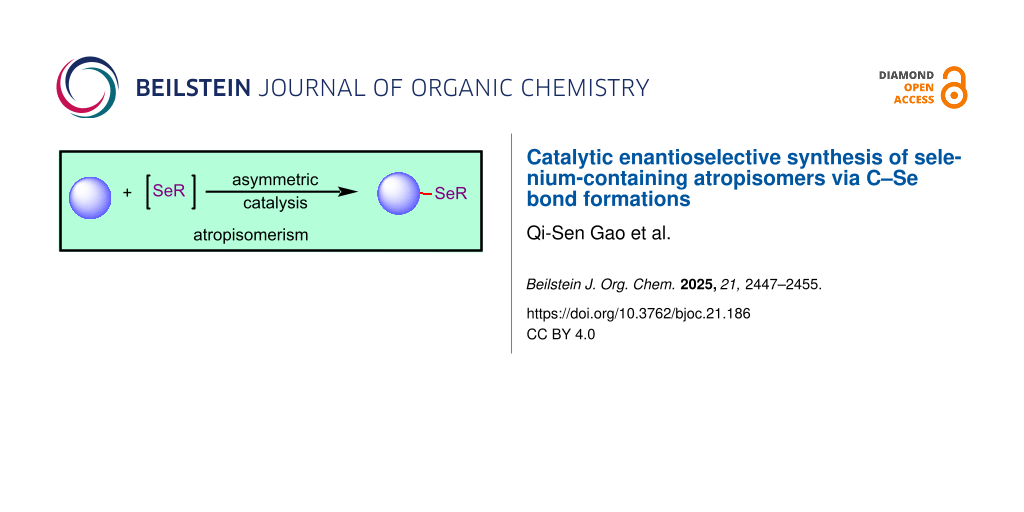
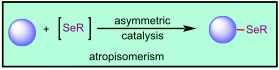
Atropisomers are not only prevalent in biologically active natural products and pharmaceuticals, but they have also garnered increasing attention for their effectiveness as ligands and catalysts in the field of catalytic asymmetric synthesis. Asymmetric catalysis serves as a key strategy for the enantioselective synthesis of atropisomers, and significant progress has been made in recent years. However, selenium-containing atropisomers have long remained underexplored as synthetic targets, and only in recent years have they begun to attract increasing attention from the community. Recently, several synthetic approaches for constructing selenium-containing atropisomers have been reported, such as C–H selenylation of arenes, selenosulfonylation of vinylidene o-quinone methides (VQM), and hydroselenation of alkynes. Nevertheless, a comprehensive review that systematically summarizes these advances is currently lacking. This review aims to provide an overview of recent developments in the catalytic enantioselective synthesis of selenium-containing atropisomers via C–Se bond formation. We hope this review will serve as a valuable reference for researchers interested in further exploring this area.
Graphical Abstract
Introduction
Selenium is an essential trace element for human body [1]. It plays an important role in metabolism. In 1817, the Swedish chemist Berzelius found that red residual mud was attached to the wall and bottom of the lead chamber when roasting pyrite to produce sulfuric acid. After analysis, it was confirmed that there was a new element in it. Referring to the name of tellurium (originally meaning earth), he named it selenium according to the word "Selene" in ancient Greek mythology [2]. Selenium is a non-metallic element, but compared with sulfur of the same main group, selenium has a larger atomic radius, smaller electronegativity, and exhibits certain metallic properties. Due to the special physical and chemical properties of selenium between metal and nonmetal, selenium not only has many applications in industry, but also plays an important role in many fields, such as electronics [3], agriculture [4], environmental protection [5] and cosmetics [6]. Chiral organic selenium-containing compounds also have important applications in organic synthesis and biomedicine [7,8]. These compounds can participate in asymmetric synthesis reactions and construct chiral molecules with specific stereoconfiguration, which is particularly critical for drug synthesis [9]. In the field of organic catalysis, chiral organic selenium-containing compounds can be used as chiral ligands or catalysts to participate in various types of asymmetric reactions, significantly improving the selectivity of reactions (Figure 1) [10-14].
![[1860-5397-21-186-1]](/bjoc/content/figures/1860-5397-21-186-1.svg?scale=2.0&max-width=1024&background=FFFFFF)
Figure 1: Representative examples of chiral selenium-containing compounds.
Figure 1: Representative examples of chiral selenium-containing compounds.
Catalytic asymmetric synthesis is the main method to construct chiral organic selenium-containing compounds. Centrally chiral selenium-containing compounds can be efficiently constructed by catalytic asymmetric hydroselenation, catalytic asymmetric allyl substitution, catalytic asymmetric electrophilic selenylation/cyclization, etc. The research content of this part has already been covered by relevant reviews [15-17], so it is not within the scope of discussion in this review. Axially chiral selenium-containing compounds also play an irreplaceable role in asymmetric catalysis, functional materials, pharmaceutical chemistry and other fields. However, little attention has been paid to these compounds, which led to slow development and a relative lack of catalytic asymmetric synthesis methods. Only recently, methods for the formation of C–Se bonds have been established for the construction of selenium-containing atropisomers. However, there is no comprehensive review to summarize this great progress. In this paper, the catalytic asymmetric synthesis of axially chiral selenium-containing compounds by the formation of C–Se bonds is reviewed from three aspects.
Review
1. Catalytic atroposelective synthesis of selenium-containing atropisomers by transition-metal-catalyzed C–H selenylation reactions
Transition-metal-catalyzed enantioselective C–H activation has emerged as a powerful strategy for the rapid synthesis of functionally enriched axially chiral diaryl compounds. However, due to the potential strong coordination between organoselenium compounds and transition metals, the direct construction of C–Se bonds via metal-catalyzed C–H bond functionalization remains a significant challenge. In 2024, You and co-workers reported a breakthrough in the enantioselective direct C–H selenylation of 1-arylisoquinolines and 2-(phenylselenyl)isoindoline-1,3-diones under rhodium catalysis to afford axially chiral diaryl selenides [18]. In this protocol, AgPF6 was employed as an additive and mesitylene served as the solvent. The reaction was conducted at 60 °C under an argon atmosphere. When 1-(naphthalen-1-yl)benzo[h]isoquinoline derivatives bearing various substituents were used as substrates, the reaction proceeded efficiently, yielding the products with excellent conversion rates (up to 95% yield) and high enantioselectivity (up to 96% ee). Notably, isoquinoline derivatives containing polycyclic naphthalene moieties or ortho-substituted phenyl groups also demonstrated good reactivity and compatibility. DFT calculations indicated that the C–Se bond formation proceeded through an SN2-type nucleophilic substitution mechanism (Scheme 1).
![[1860-5397-21-186-i1]](/bjoc/content/inline/1860-5397-21-186-i1.svg?scale=2.0&max-width=1024&background=FFFFFF)
Scheme 1: Rhodium-catalyzed atroposelective C–H selenylation reported by You’s group [18].
Scheme 1: Rhodium-catalyzed atroposelective C–H selenylation reported by You’s group [18].
In 2025, Li and co-workers reported a highly efficient rhodium-catalyzed enantioselective C–H selenylation reaction of 1-arylisoquinolines with diselenides, employing 3,5-(CF3)2C6H3CO₂Ag and AgSbF6 as additives [19]. When a para-fluorine substituent is present on the naphthalene ring of the substrate, the reaction proceeds with a yield of up to 90% and an enantioselectivity reaching 92% ee. The methodology demonstrates a broad substrate scope, accommodating various polycyclic naphthalene isoquinolines as well as phenyl-substituted benzoisoquinoline derivatives. Two plausible reaction mechanisms were proposed in the study: one involving oxidative addition of Int 4, a five-membered rhodium cyclic intermediate, followed by reductive elimination and the other proceeding via a bimolecular nucleophilic substitution pathway. In both pathways, the active chiral rhodium catalyst is regenerated through a silver salt-mediated recycling, with Ag–SePh being formed as a byproduct (Scheme 2).
![[1860-5397-21-186-i2]](/bjoc/content/inline/1860-5397-21-186-i2.svg?scale=2.0&max-width=1024&background=FFFFFF)
Scheme 2: Rhodium-catalyzed atroposelective C–H selenylation reported by Li et al. [19].
Scheme 2: Rhodium-catalyzed atroposelective C–H selenylation reported by Li et al. [19].
2. Catalytic atroposelective synthesis of selenium-containing atropisomers by spontaneous selenosulfonylation of alkynes
Vinyl selenides, recognized as valuable synthetic intermediates and biologically active compounds, have been demonstrated to exhibit a broad spectrum of biological activities. Among them, the synthesis of β-(selenium)vinyl sulfones can be accomplished via selenosulfonylation reactions initiated by free radicals or cationic species. In 2019, Qin and co-workers reported a methodology enabling the difunctionalization of alkynes through selenosulfonylation of a VQM intermediate under mild reaction conditions [20]. This racemic transformation proceeds without the need for any catalyst or additive, and the reaction yielded the desired product at room temperature with high regioselectivity and stereoselectivity (E/Z ratio >99:1). Notably, when chiral catalyst (cat.1) was used, the reaction afforded the axially chiral product 9 in 43% yield with 84% ee. The proposed mechanism proceeds as follows. Catalyst cat.1 initially engages substrate 7 through hydrogen bonding, forming intermediate Int 7. Subsequently, deprotonation of the naphthol group by quinuclidine yields intermediate Int 8. This intermediate then undergoes nucleophilic attack on the selenium atom in substrate 8, leading to the formation of the VQM intermediate Int 9 and benzenesulfonic acid. Finally, benzenesulfonic acid further reacts with the VQM intermediate to afford product 9, concomitant with regeneration of the catalyst. This protocol provides a promising approach for the enantioselective synthesis of axially chiral styrenes containing both selenium and sulfone functionalities, highlighting the potential for further exploration of expanded catalyst and substrate scopes (Scheme 3).
![[1860-5397-21-186-i3]](/bjoc/content/inline/1860-5397-21-186-i3.svg?scale=2.0&max-width=1024&background=FFFFFF)
Scheme 3: Organocatalytic asymmetric selenosulfonylation of alkynes.
Scheme 3: Organocatalytic asymmetric selenosulfonylation of alkynes.
3. Catalytic atroposelective synthesis of selenium-containing atropisomers by hydroselenation reactions of alkynes
The catalytic enantioselective hydroselenation of alkynes can provide an efficient and direct method for the synthesis of chiral vinyl selenides. However, to date, the enantioselective hydroselenation of alkynes remains underexplored. Building upon recent advances in rhodium-catalyzed asymmetric hydroselenation of olefins, in 2024, Li and co-workers reported an asymmetric hydroselenation reaction of 1-alkynylindoles using a catalytic system based on [Rh(cod)OAc]2 and Mg(NTf2)2 [21]. The Mg(II) salt not only activates the rhodium catalyst but also supplies the necessary NTf2− anion for the reaction system, thereby significantly enhancing the catalytic performance. The developed catalytic system demonstrated high activity, excellent yields (mostly exceeding 85%), mild reaction conditions, broad functional group tolerance, as well as high regioselectivity, (E)-selectivity, and enantioselectivity (up to 99% ee). According to the kinetic study, the alkyne insertion step may be rate-limiting, as it involves the participation of selenol, alkyne, and the rhodium catalyst. The Rh(III) mechanism appears to be more plausible than route B, which can be attributed to the enhanced ion-pairing effect resulting from the higher oxidation state of rhodium (Scheme 4).
![[1860-5397-21-186-i4]](/bjoc/content/inline/1860-5397-21-186-i4.svg?scale=2.0&max-width=1024&background=FFFFFF)
Scheme 4: Rhodium-catalyzed asymmetric hydroselenation of 1-alkynylindoles. *DCE/DCM 2:1 (v/v), −50 °C.
Scheme 4: Rhodium-catalyzed asymmetric hydroselenation of 1-alkynylindoles. *DCE/DCM 2:1 (v/v), −50 °C.
In 2025, Yang, Lu, and co-workers employed bifunctional catalysts, including chiral thiourea derivatives or chiral phosphoric acid, to activate alkynes and selenols through multiple hydrogen-bonding interactions, thereby achieving an enantioselective hydroselenation of alkynes [22]. All products demonstrated complete E-stereoselectivity (E/Z ratio >20:1). Notably, under the same reaction conditions, aliphatic selenols remained unreactive. Density functional theory (DFT) calculations revealed that the rate-determining step involves the nucleophilic attack of the selenium anion in intermediate Int 16 on VQM to form intermediate Int 17. As bifunctional organic catalysts, chiral ureas can synergistically activate both alkynes and selenols, thereby addressing the challenge of overcoming the increased difficulty of racemization caused by the presence of bulky SeR groups (Scheme 5).
![[1860-5397-21-186-i5]](/bjoc/content/inline/1860-5397-21-186-i5.svg?scale=2.0&max-width=1024&background=FFFFFF)
Scheme 5: Organocatalytic atroposelective hydroselenation of alkynes. *Using cat.3, 4 h.
Scheme 5: Organocatalytic atroposelective hydroselenation of alkynes. *Using cat.3, 4 h.
Summary and Outlook
Overall, organic chemists have increasingly focused on the catalytic asymmetric synthesis of selenium-containing atropisomers, and significant progress has been made in recent years. Nevertheless, several limitations and challenges remain. For example, catalytic asymmetric electrophilic selenylation reactions have not yet enabled the effective synthesis of selenium-containing atropisomers. Moreover, the current methodologies are largely restricted to the use of selenium aryl groups. It is our intention to draw the attention of emerging researchers to this field and to promote its continued growth and development.
Data Availability Statement
Data sharing is not applicable as no new data was generated or analyzed in this study.
References
-
Genchi, G.; Lauria, G.; Catalano, A.; Sinicropi, M. S.; Carocci, A. Int. J. Mol. Sci. 2023, 24, 2633. doi:10.3390/ijms24032633
Return to citation in text: [1] -
Berzelius, J. J. Afh. Fys., Kemi Mineral. 1818, 6, 42.
Return to citation in text: [1] -
Kamat, P. V. J. Phys. Chem. C 2008, 112, 18737–18753. doi:10.1021/jp806791s
Return to citation in text: [1] -
Wang, M.; Li, B.; Li, S.; Song, Z.; Kong, F.; Zhang, X. J. Agric. Food Chem. 2021, 69, 15458–15467. doi:10.1021/acs.jafc.1c04992
Return to citation in text: [1] -
Chang, C.; Chen, C.; Yin, R.; Shen, Y.; Mao, K.; Yang, Z.; Feng, X.; Zhang, H. Environ. Sci. Technol. 2020, 54, 3228–3236. doi:10.1021/acs.est.9b06486
Return to citation in text: [1] -
Lv, J.; Ai, P.; Lei, S.; Zhou, F.; Chen, S.; Zhang, Y. J. Trace Elem. Med. Biol. 2020, 62, 126548. doi:10.1016/j.jtemb.2020.126548
Return to citation in text: [1] -
Hou, W.; Dong, H.; Zhang, X.; Wang, Y.; Su, L.; Xu, H. Drug Discovery Today 2022, 27, 2268–2277. doi:10.1016/j.drudis.2022.03.020
Return to citation in text: [1] -
Franchetti, P.; Cappellacci, L.; Sheikha, G. A.; Jayaram, H. N.; Gurudutt, V. V.; Sint, T.; Schneider, B. P.; Jones, W. D.; Goldstein, B. M.; Perra, G.; De Montis, A.; Loi, A. G.; La Colla, P.; Grifantini, M. J. Med. Chem. 1997, 40, 1731–1737. doi:10.1021/jm960864o
Return to citation in text: [1] -
Wirth, T. Angew. Chem., Int. Ed. 2000, 39, 3740–3749. doi:10.1002/1521-3773(20001103)39:21<3740::aid-anie3740>3.0.co;2-n
Return to citation in text: [1] -
Denmark, S. E.; Ryabchuk, P.; Chi, H. M.; Matviitsuk, A. Org. Synth. 2019, 96, 400–417. doi:10.15227/orgsyn.096.0400
Return to citation in text: [1] -
Nishiyori, R.; Mori, T.; Okuno, K.; Shirakawa, S. Org. Biomol. Chem. 2023, 21, 3263–3275. doi:10.1039/d3ob00292f
Return to citation in text: [1] -
Zhang, X.-Y.; Zhu, D.; Huo, Y.-X.; Chen, L.-L.; Chen, Z.-M. Org. Lett. 2023, 25, 3445–3450. doi:10.1021/acs.orglett.3c01002
Return to citation in text: [1] -
You, S.-L.; Hou, X.-L.; Dai, L.-X. Tetrahedron: Asymmetry 2000, 11, 1495–1500. doi:10.1016/s0957-4166(00)00078-1
Return to citation in text: [1] -
Liao, L.; Zhao, X. Acc. Chem. Res. 2022, 55, 2439–2453. doi:10.1021/acs.accounts.2c00201
Return to citation in text: [1] -
Lai, S.; Liang, X.; Zeng, Q. Chem. – Eur. J. 2024, 30, e202304067. doi:10.1002/chem.202304067
Return to citation in text: [1] -
Stadel, J. T.; Back, T. G. Chem. – Eur. J. 2024, 30, e202304074. doi:10.1002/chem.202304074
Return to citation in text: [1] -
Jian, Y.; Singh, T.; Andersson, P. G.; Zhou, T. Molecules 2024, 29, 3685. doi:10.3390/molecules29153685
Return to citation in text: [1] -
Zheng, D.-S.; Xie, P.-P.; Zhao, F.; Zheng, C.; Gu, Q.; You, S.-L. ACS Catal. 2024, 14, 6009–6015. doi:10.1021/acscatal.4c01082
Return to citation in text: [1] [2] -
Wang, Y.; Yu, S.; Li, X. Org. Chem. Front. 2025, 12, 816–823. doi:10.1039/d4qo01905a
Return to citation in text: [1] [2] -
Huang, S.; Chen, Z.; Mao, H.; Hu, F.; Li, D.; Tan, Y.; Yang, F.; Qin, W. Org. Biomol. Chem. 2019, 17, 1121–1129. doi:10.1039/c8ob02967a
Return to citation in text: [1] -
Kang, Y.; Wang, F.; Li, X. ACS Catal. 2024, 14, 13055–13064. doi:10.1021/acscatal.4c03710
Return to citation in text: [1] -
Wang, Y.-X.; Wang, J.-R.; Cui, C.; Wang, Z.; Lu, Y.; Yang, X.-H. ACS Catal. 2025, 15, 4051–4060. doi:10.1021/acscatal.4c07281
Return to citation in text: [1]
| 22. | Wang, Y.-X.; Wang, J.-R.; Cui, C.; Wang, Z.; Lu, Y.; Yang, X.-H. ACS Catal. 2025, 15, 4051–4060. doi:10.1021/acscatal.4c07281 |
| 1. | Genchi, G.; Lauria, G.; Catalano, A.; Sinicropi, M. S.; Carocci, A. Int. J. Mol. Sci. 2023, 24, 2633. doi:10.3390/ijms24032633 |
| 5. | Chang, C.; Chen, C.; Yin, R.; Shen, Y.; Mao, K.; Yang, Z.; Feng, X.; Zhang, H. Environ. Sci. Technol. 2020, 54, 3228–3236. doi:10.1021/acs.est.9b06486 |
| 20. | Huang, S.; Chen, Z.; Mao, H.; Hu, F.; Li, D.; Tan, Y.; Yang, F.; Qin, W. Org. Biomol. Chem. 2019, 17, 1121–1129. doi:10.1039/c8ob02967a |
| 4. | Wang, M.; Li, B.; Li, S.; Song, Z.; Kong, F.; Zhang, X. J. Agric. Food Chem. 2021, 69, 15458–15467. doi:10.1021/acs.jafc.1c04992 |
| 21. | Kang, Y.; Wang, F.; Li, X. ACS Catal. 2024, 14, 13055–13064. doi:10.1021/acscatal.4c03710 |
| 19. | Wang, Y.; Yu, S.; Li, X. Org. Chem. Front. 2025, 12, 816–823. doi:10.1039/d4qo01905a |
| 19. | Wang, Y.; Yu, S.; Li, X. Org. Chem. Front. 2025, 12, 816–823. doi:10.1039/d4qo01905a |
| 10. | Denmark, S. E.; Ryabchuk, P.; Chi, H. M.; Matviitsuk, A. Org. Synth. 2019, 96, 400–417. doi:10.15227/orgsyn.096.0400 |
| 11. | Nishiyori, R.; Mori, T.; Okuno, K.; Shirakawa, S. Org. Biomol. Chem. 2023, 21, 3263–3275. doi:10.1039/d3ob00292f |
| 12. | Zhang, X.-Y.; Zhu, D.; Huo, Y.-X.; Chen, L.-L.; Chen, Z.-M. Org. Lett. 2023, 25, 3445–3450. doi:10.1021/acs.orglett.3c01002 |
| 13. | You, S.-L.; Hou, X.-L.; Dai, L.-X. Tetrahedron: Asymmetry 2000, 11, 1495–1500. doi:10.1016/s0957-4166(00)00078-1 |
| 14. | Liao, L.; Zhao, X. Acc. Chem. Res. 2022, 55, 2439–2453. doi:10.1021/acs.accounts.2c00201 |
| 18. | Zheng, D.-S.; Xie, P.-P.; Zhao, F.; Zheng, C.; Gu, Q.; You, S.-L. ACS Catal. 2024, 14, 6009–6015. doi:10.1021/acscatal.4c01082 |
| 9. | Wirth, T. Angew. Chem., Int. Ed. 2000, 39, 3740–3749. doi:10.1002/1521-3773(20001103)39:21<3740::aid-anie3740>3.0.co;2-n |
| 18. | Zheng, D.-S.; Xie, P.-P.; Zhao, F.; Zheng, C.; Gu, Q.; You, S.-L. ACS Catal. 2024, 14, 6009–6015. doi:10.1021/acscatal.4c01082 |
| 7. | Hou, W.; Dong, H.; Zhang, X.; Wang, Y.; Su, L.; Xu, H. Drug Discovery Today 2022, 27, 2268–2277. doi:10.1016/j.drudis.2022.03.020 |
| 8. | Franchetti, P.; Cappellacci, L.; Sheikha, G. A.; Jayaram, H. N.; Gurudutt, V. V.; Sint, T.; Schneider, B. P.; Jones, W. D.; Goldstein, B. M.; Perra, G.; De Montis, A.; Loi, A. G.; La Colla, P.; Grifantini, M. J. Med. Chem. 1997, 40, 1731–1737. doi:10.1021/jm960864o |
| 6. | Lv, J.; Ai, P.; Lei, S.; Zhou, F.; Chen, S.; Zhang, Y. J. Trace Elem. Med. Biol. 2020, 62, 126548. doi:10.1016/j.jtemb.2020.126548 |
| 15. | Lai, S.; Liang, X.; Zeng, Q. Chem. – Eur. J. 2024, 30, e202304067. doi:10.1002/chem.202304067 |
| 16. | Stadel, J. T.; Back, T. G. Chem. – Eur. J. 2024, 30, e202304074. doi:10.1002/chem.202304074 |
| 17. | Jian, Y.; Singh, T.; Andersson, P. G.; Zhou, T. Molecules 2024, 29, 3685. doi:10.3390/molecules29153685 |
© 2025 Gao et al.; licensee Beilstein-Institut.
This is an open access article licensed under the terms of the Beilstein-Institut Open Access License Agreement (https://www.beilstein-journals.org/bjoc/terms), which is identical to the Creative Commons Attribution 4.0 International License (https://creativecommons.org/licenses/by/4.0). The reuse of material under this license requires that the author(s), source and license are credited. Third-party material in this article could be subject to other licenses (typically indicated in the credit line), and in this case, users are required to obtain permission from the license holder to reuse the material.