Laboratory of Chemical Genomics, School of Chemical Biology and Biotechnology, Peking University Shenzhen Graduate School, Shenzhen 518055, China
Key Laboratory of Bioorganic Chemistry and Molecular Engineering of Ministry of Education and Beijing National Laboratory for Molecular Science, and Peking-Tsinghua Centre for Life Sciences, Peking University, Beijing 100871, China
Laboratory of Chemical Genomics, School of Chemical Biology and Biotechnology, Peking University Shenzhen Graduate School, Shenzhen 518055, China
Key Laboratory of Structure-Based Drug Design & Discovery of Ministry of Education, Shenyang Pharmaceutical University, Liaoning Shenyang 110016, China
1Laboratory of Chemical Genomics, School of Chemical Biology and Biotechnology, Peking University Shenzhen Graduate School, Shenzhen 518055, China
2Key Laboratory of Bioorganic Chemistry and Molecular Engineering of Ministry of Education and Beijing National Laboratory for Molecular Science, and Peking-Tsinghua Centre for Life Sciences, Peking University, Beijing 100871, China
3Shenzhen Bay Laboratory, Shenzhen 518055, China
4Key Laboratory of Structure-Based Drug Design & Discovery of Ministry of Education, Shenyang Pharmaceutical University, Liaoning Shenyang 110016, China
Guest Editor: C. Li Beilstein J. Org. Chem.2025,21, 2470–2478.https://doi.org/10.3762/bjoc.21.189 Received 08 Aug 2025,
Accepted 27 Oct 2025,
Published 10 Nov 2025
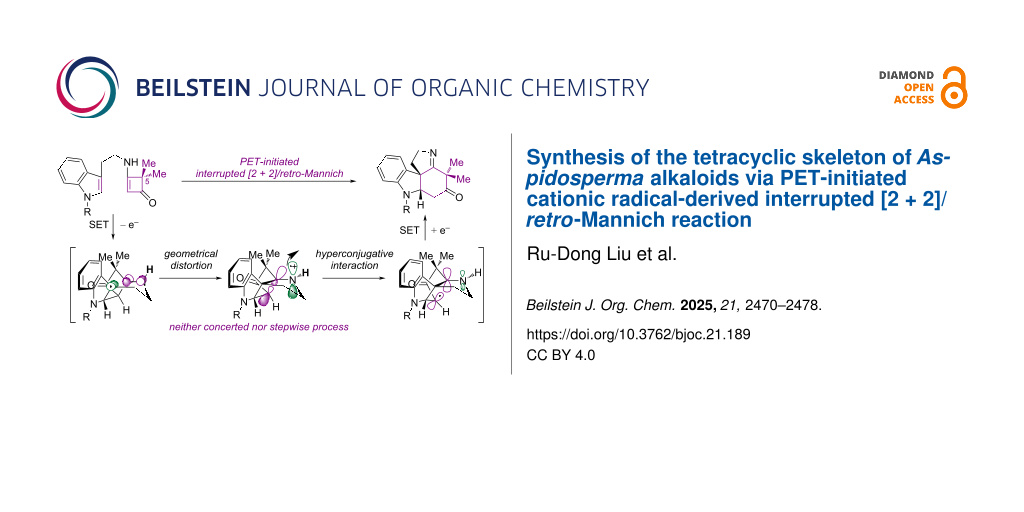
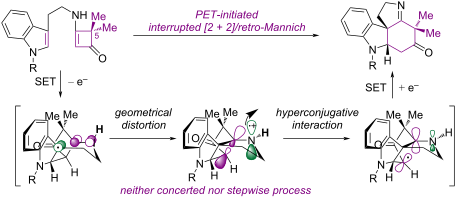
Natural products with topologically complex architectures are important sources in drug discovery. The pursuit of conciseness and efficiency in the total synthesis of natural products promotes continuous innovation and the development of new reactions and strategies. In this work, a PET-initiated cationic radical-derived interrupted [2 + 2]/retro-Mannich reaction of N-substituted cyclobutenone provided a facile approach to the direct construction of the ABCE tetracyclic framework of Aspidosperma alkaloids. DFT calculations showed that the rate-determining step of the key PET reaction involved C19–C12 bond formation and C19–C3 bond cleavage. Investigation of the bond length changes along the IRC path, spin density, and NBO analysis indicated that this process is neither strictly concerted nor stepwise, but falls in between, and involves a formal 1,3-C shift.
Photochemical reactions, which enable the construction of topologically complex architectures from simple building blocks, have attracted considerable attention in recent decades. Numerous approaches to natural product synthesis have been reported in which a photochemical transformation represents a key step [1-3]. In this context, the photochemical [2 + 2] cycloaddition and subsequent fragmentation of the resulting cyclobutane provides a valuable strategy for synthesizing natural and unnatural products from simple building blocks [4]. Three distinct photoinitiated approaches have been established for the formation of the [2 + 2] cycloadducts: direct irradiation [5,6], energy transfer (EnT) [7], and photoinduced electron transfer (PET, or photoredox catalysis) processes [8-10].
Cyclobutenone (A) is a versatile C4 synthon [11] – its [2 + 2] photocyclization yields B, featuring a strained bicyclo[2.2.0]hexane unit [12], which can fragment to form C (Figure 1a) [13,14]. However, competitive C1–C4 bond cleavage under irradiation or heating leads to ketene D, which can undergo cycloaddition with an alkene to yield E. This fragmentation pathway dominates under various conditions (e.g., transition-metal catalysis, nucleophilic addition) and is driven by ring-strain release [11].
Figure 1:
Synthetic plan. a) General model of cyclobutenone bond cleavage; b) our previously reported method; c) plan for indole Aspidosperma alkaloid synthesis; d) naturally occurring Aspidosperma alkaloids; e) ring strain energy of cyclopentene, bicyclo[3.2.0]heptane, cycloheptane, cyclobutene, bicyclo[2.2.0]hexane and cyclohexane.
Figure 1:
Synthetic plan. a) General model of cyclobutenone bond cleavage; b) our previously reported method;...
PET, an alternative to direct excitation and EnT, enables the formation of unique radical intermediates [9,10]. We previously demonstrated the Ir-catalyzed [2 + 2] cyclization/retro-Mannich reaction of a tryptamine-substituted cyclopentenone F, which led to the formation of indoline J (Figure 1b) [15]. Unlike other reported methods [16-18], the PET reaction of F generates the cationic radical G, which initiates formation of H, which has a strained bicyclo [3.2.0]heptane core. Strain release of H triggers a downstream radical-driven retro-Mannich reaction, which ultimately results in the formation of J via reductive quenching of intermediate I.
As part of our current interest in the synthesis of complex natural products via photochemical reactions, we decided to achieve such an unusual bond cleavage (Figure 1a, path A) of cyclobutenone by generating a radical cation species via a PET reaction. The synthetic plan is shown in Figure 1c and includes a PET-initiated [2 + 2] cyclization of the tryptamine-substituted cyclobutenone K to form the radical cation L, which has a highly functionalized and rigid bicyclo[2.2.0]hexane core. Fragmentation of the C3–C19 bond would afford a redox-active intermediate which upon further reductive quenching would lead to the tetracyclic indoline M, which was expected to serve as a common intermediate for the total synthesis of Aspidosperma alkaloids. These alkaloids constitute a large family of structurally complex compounds, which incorporate a pentacyclic ABCDE skeleton (Figure 1d, 1–8) [19-23]. However, the formation of intermediate L is challenging because its ring-strain energy (Figure 1e, 52.1 kcal/mol) is higher than that of its counterpart, i.e. the bicyclo[3.2.0]heptane motif (28.3 kcal/mol) in H[24].
Herein, we report our recent results on the development of a novel strategy for the stereoselective construction of the tetracyclic core of Aspidosperma alkaloids. Our method involves an Ir-catalyzed PET reaction of K for the stereoselective formation of the cis-configured BC bicyclic core with an all-carbon quaternary center [25,26]. Computational studies suggest that the observed tandem PET reaction of K proceeds via an unusual 1,3-C shift to afford M, i.e. through an interrupted [2 + 2] cyclization/retro-Mannich reaction.
Results and Discussion
Conditions optimization
Our study commenced with the evaluation of the proposed PET-based tandem [2 + 2] cyclization/retro-Mannich reaction. We selected compound 10a, which has a spiro-pentacyclic core, as the target to be synthesized via the proposed PET reaction of substrate 9a (Table 1). Substrate 9a can be synthesized from tryptamine and a substituted cyclobutane-1,3-dione according to a published protocol [27].
Table 1:
Conditions screening.a
Entry
Photocatalyst
Solvent
Temp.
Conv./yield (%)
1
FCNIrPic (I)
MeCN
30 °C
100/86b
2
FirPic (II)
MeCN
30 °C
83/26
3
PhFIrPic (III)
MeCN
30 °C
65/43
4
in dark
MeCN
30 °C
<5/n.d.
5
no catalyst
MeCN
30 °C
<5/n.d.
6
FCNIrPic (I)
MeOH
30 °C
84/23
7
FCNIrPic (I)
THF
30 °C
30/20
8
FCNIrPic (I)
DCM
30 °C
59/35
9
FCNIrPic (I)
MeCN
30 °C
86/42c
10
FCNIrPic (I)
MeCN/PhMe
30 °C
67/56c,d
11
FCNIrPic (I)
MeCN
10 °C
100/60
12
FCNIrPic (I)
MeCN
20 °C
100/66
13
FCNIrPic (I)
MeCN
40 °C
90/50
aReaction conditions: A 15 mL glass vial was charged with 9a (0.1 mmol) and a photocatalyst (3.0 mol %) in an appropriate solvent (5.0 mL), and irradiated by two blue LEDs (center wavelength 455 nm; light intensity, 0.21 W/cm2). The yield and conversion were determined by 1H NMR spectroscopy with 1,3,5-trimethoxybenzene as the internal standard. bIsolated yield = 86%. cCbz is replaced by -Boc (9f). dVMeCN/VPhMe = 10:1.
Initially, we focused on identifying catalysts that could promote the proposed PET reaction of 9a on the basis of our previous results [15]. The reaction was performed in MeCN in the presence of photocatalysts under blue light-emitting diode (LED) irradiation at 30 °C. The results are listed in Table 1. Catalysts I[28], II[29], and III[30] gave the desired product 10a, with catalyst I giving the best result (Table 1, entries 1–3). The necessities of irradiation and the presence of a photocatalyst were also defined (Table 1, entries 4 and 5). However, use of the other tested catalysts did not give the desired product under the reaction conditions (see Supporting Information File 1 for details). Next, we evaluated the effects of different solvents on the production of 10a in the presence of catalyst I. Changing the solvent to MeOH, tetrahydrofuran (THF), and dichloromethane (DCM) resulted in decreased yields and substrate conversions, and intense substrate decomposition (Table 1, entries 6–8). These results showed that MeCN is the best solvent for the reaction.
Finally, we investigated the effects of an alternative N-substituent in the indole moiety, and the reaction time and temperature on the photocyclization results. Boc-substituted substrate 9f was subjected to the optimized conditions, which resulted in both a lower conversion and yield (Table 1, entry 9). In contrast, when the reaction of 9f was performed in a mixed MeCN/toluene 10:1 solvent, the conversion of substrate 9f to product 10f decreased, but the yield increased to 56% (Table 1, entry 10) compared with that in entry 9 (42%). These results indicate that Cbz is a more effective protecting group than Boc under the profiled conditions. The effects of the reaction temperature on the outcome of the PET reaction of 9a were investigated. Among the conditions screened (Table 1, entries 11–13), the reaction in MeCN at 30 °C for 24 h gave the best result, namely a quantitative conversion and 90% yield.
Substrate scope
With the optimal conditions in hand, we then explored the substrate scope. Targeting on the total synthesis of Aspidosperma alkaloids, different tryptamine-substituted cyclobutenones 9a–n were prepared and reacted under the optimal conditions. The results are shown in Scheme 1. Substrate 9a, which contains a spiro-cyclopentene moiety, delivered the best result and gave 10a in 86% isolated yield. When C15 or C16 was substituted with a chlorine atom, 10b and 10c were obtained in 70% and 72% yield, respectively. However, when C15 was substituted with a methyl group, the yield of 10d decreased slightly to 63%. Product 10e, which has two contiguous quaternary stereogenic centers at C2 and C12, was obtained in 74% yield without a significant change in the yield, which indicates that steric hindrance at C2 has a limited effect on the reactivity. However, when the steric hindrance of the protecting group was increased by replacing –Cbz with –Boc, the activity of the PET reaction decreased, which resulted in a lower yield of 10f (45%). In the case of substrate 9g, which has a stereogenic centre at C10, photocyclization afforded 10g in moderate yield and with excellent diastereoselectivity (76% yield, dr >20:1). This indicates that the reaction is controlled by the substrate conformation.
To investigate the effects of the spirocyclic ring size on the photocyclization, substrates 9h and 9i were prepared and subjected to the optimal conditions. The PET reaction of 9h with a spiro-cyclohexene unit gave a pair of separable isomers, 10h-1 and 10h-2, in 86% yield and a 1:1 ratio. The reaction of 9i, which bears a spiro-cycloheptene moiety, afforded the annulated product 10i in 67% yield. This indicates that an increase in the spirocyclic ring size negatively affects the photocyclization outcome. We expanded the reaction scope by synthesizing substrates 9j–l, which contain various types of saturated spirocycles. As anticipated, 10j, 10k, and 10l were obtained in moderate yields (57–66%) under the standard reaction conditions. When substrates 9m and 9n, which have a gem-dimethyl and gem-diethyl group, respectively, were used, their PET reactions required a longer reaction time to achieve full conversion. The resulting products 10m and 10n were obtained in yields of 62% and 58%, respectively.
Computational study
The synthesis of (±)-aspidospermidine (1) and (±)-limaspermidine (2) showcased the effectiveness of our strategy for constructing complex monoterpene indole alkaloids [26]. In this work, we turned our attention to investigating the mechanistic intricacies of the key PET reaction for formation of the unique bicyclo[2.2.0]hexane unit present in the proposed intermediate L (Figure 1). In the presence of the excited photocatalyst [FCNIr(III)Pic]*, the substrate participates in an oxidative single-electron transfer (SET) process, which leads to the formation of IN1. The radical cation IN1 served as the reference point for DFT investigations. As illustrated in Figure 2a, facilitated by a favorable radical cation–π interaction [31], IN1 proceeds to the first radical addition transition state (TS1), with an energy barrier of 8.3 kcal/mol. This leads to the formation of benzyl radical IN2, which has a boat-like seven-membered ring. This structural feature may facilitate formation of the C19–C12 bond, even in the presence of critical steric hindrance between the C5 quaternary carbon and the indole moiety.
Figure 2:
Computational study. a) Energy profiles from IN1 to IN3 and spin density of TS2 (isovalue = 0.004), solvated (SMD) Gibbs free energies were calculated at the B3LYP-D3/def2-tzvp//B3LYP/6-31G(d) level in MeCN. b) Spin density of IN4 (isovalue = 0.004). c) IRC analysis of TS2 (red line) and bond-length changes of C19–C3 (yellow line) and C19–C12 (blue line) along IRC path. d) Mayer bond order changes of selected structures along IRC path. e) Spin-density analyses of R-24 and F-10 (isovalue = 0.004). f) NBO analyses of the selected transient structures (isovalue = 0.04).
Figure 2:
Computational study. a) Energy profiles from IN1 to IN3 and spin density of TS2 (isovalue = 0.004),...
Further DFT investigation proved challenging because of the peculiar features that the potential energy surface (PES) exhibits in the rate-determining step, which involves both formation of the C19–C12 bond and cleavage of the C19–C3 bond. This process has an energy barrier of 21.8 kcal/mol via TS2, and results in direct formation of IN3, which can undergo reductive SET in the presence of [FCNIr(II)Pic]−. This leads to the regeneration of [FCNIr(III)Pic] to complete the catalytic cycle and formation of the final product via proton transfer. Intrinsic reaction coordinate (IRC) analysis showed the reaction coordinate connecting the transition state TS2, the reactant (IN2), and the C19–C3 bond cleavage product IN3 wells (Figure 2c).
Possible intermediates with a bicyclo[2.2.0]hexane unit located on the PES minimum were investigated by performing two-dimensional scans of simplified structures to find a minimum. When the nonbonding sp3 orbital of the N atom is positioned antiperiplanar to the adjacent C19–C3 bond, an intermediate IN4 with a bicyclo[2.2.0]hexane unit was successfully located. However, the Gibbs free energy of IN4 (ΔG° = +27.4 kcal/mol) is significantly higher than the activation energy of TS2 (ΔG‡ = 22.4 kcal/mol). This energy difference can be attributed to a subtle discrepancy between the spin localizations of IN4 and TS2. As depicted in Figure 2b, the spin density of IN4 is predominantly concentrated at the benzene ring, whereas in TS2 it is primarily localized at C19, C12, C3, and N9 (Figure 2a) [32]. Therefore, the intermediacy of IN4 was ruled out.
We assume that the overlap between the sp2-hybridized N spin center and σ* (C19–C3) in TS2, and the ring-strain release of the transient bicyclo[2.2.0]hexane unit, play essential roles that enable the reaction to occur. Thus, natural bond orbital (NBO) [33] and Mayer bond order [34,35] analyses were performed to determine the hyperconjugative interactions in the intermediates, transition states, and transient structures along the IRC path (Figure 2c and 2d). In the early stage of this process (Figure 2f, IN2 → R-50 → R-24 → TS2), formation of the C19–C3 bond arises from the orbital overlap between the p orbital of the C19 atom (Figure 2e, R-24) and the π(C3=N9)* orbital. During this process, the bond order of C19–C12 increases, but no significant change is observed for C19–C3. This leads to the formation of a nonbonding p orbital at the N9 atom (Figure 2e, F-10). Further geometrical adjustment and conformational restriction of the transient structure enable the N9 nonbonding p orbital to align parallel to the σ(C19–C3)* orbital (Figure 2f, TS2 → F-10 → F-40 → IN3), which reinforces the hyperconjugative interaction. Facilitated by the bond stretching and bond-angle bending of the transient structure with a pseudo bicyclo[2.2.0]hexane unit, the favorable hyperconjugative interaction ultimately leads to cleavage of the C19–C3 bond (TS2 → IN3) and release of the ring strain.
DFT analysis hereby explains that the orbital symmetry involved in this process does not conform to a sigmatropic rearrangement reaction [36]. Inspection of the changes in the bond lengths (Figure 2c) and Mayer bond orders (Figure 2d) along the IRC path clearly show that C19–C12 bond formation and C19–C3 bond cleavage are asynchronous. On the basis of these premises, we assume that the process IN2 → IN3 is neither strictly concerted nor stepwise [37,38]. This can be attributed to the inherent ring-strain release in the transient structure located on the PES and the hyperconjugative interaction between the N9 nonbonding p orbital and σ(C19–C3)* during geometrical distortions. This ambiguous mechanistic feature suggests an unusual 1,3-C shift, and indicates that this reaction proceeds via a PET-initiated interrupted [2 + 2]/retro-Mannich process.
Conclusion
In summary, a PET-initiated cationic radical-derived interrupted [2 + 2]/retro-Mannich reaction has been developed for constructing the ABCE tetracyclic cores of Aspidosperma alkaloids from tryptamine-substituted cyclobutenones. Importantly, this methodology has already been successfully applied in the total syntheses of (±)-aspidospermidine and (±)-limaspermidine using 10a and 10h as substrates, respectively [26]. The functionalized C5 atom in the formed ABCE tetracyclic core provides potential opportunities for accessing more complex indole alkaloids. The extensive DFT study indicated that the observed PET-initiated cationic radical-derived reaction proceeds via an unconventional formal 1,3-C shift, which is neither concerted nor stepwise. These findings shed light on the mechanistic innovation of a PET-initiated radical-derived reaction that was driven by the ring-strain release.
Supporting Information
Supporting Information File 1:
Experimental procedures, characterization data, NMR spectra, and computational study.
This work was supported by the National Science Foundation of China (Grant Nos. 22171013), Guangdong Natural Science Foundation (Grant Nos. 2020B0303070002), Shenzhen Basic Research Program (Grant No. JCYJ 20180302180215524), Shenzhen-Hong Kong Institute of Brain Science-Shenzhen Fundamental Research Institutions (2024SHIBS0004), Key Laboratory of Structure-Based Drug Design & Discovery of Ministry of Education, Shenyang Pharmaceutical Universit (SY2024KF-02), the research grants from the Major Program of Shenzhen Bay Laboratory, and the Shenzhen Outstanding Talents Training Fund.
Winkler, J. D.; Bowen, C. M.; Liotta, F. Chem. Rev.1995,95, 2003–2020. doi:10.1021/cr00038a010
Return to citation in text:
[1]
Baldwin, J. E. Thermal Cyclobutane Ring Formation. Comprehensive Organic Synthesis; Pergamon Press: Oxford, UK, 1991; Vol. 5, pp 63–84. doi:10.1016/b978-0-08-052349-1.00120-7
Return to citation in text:
[1]
Poplata, S.; Tröster, A.; Zou, Y.-Q.; Bach, T. Chem. Rev.2016,116, 9748–9815. doi:10.1021/acs.chemrev.5b00723
Return to citation in text:
[1]
Großkopf, J.; Kratz, T.; Rigotti, T.; Bach, T. Chem. Rev.2022,122, 1626–1653. doi:10.1021/acs.chemrev.1c00272
Return to citation in text:
[1]
Takahashi, Y.; Okitsu, O.; Ando, M.; Miyashi, T. Tetrahedron Lett.1994,35, 3953–3956. doi:10.1016/s0040-4039(00)76711-6
Return to citation in text:
[1]
Ravelli, D.; Protti, S.; Fagnoni, M. Chem. Rev.2016,116, 9850–9913. doi:10.1021/acs.chemrev.5b00662
Return to citation in text:
[1]
[2]
Chen, P.-h.; Dong, G. Chem. – Eur. J.2016,22, 18290–18315. doi:10.1002/chem.201603382
Return to citation in text:
[1]
[2]
Wiberg, K. B. Angew. Chem., Int. Ed. Engl.1986,25, 312–322. doi:10.1002/anie.198603121
Return to citation in text:
[1]
Paquette, L. A.; Schwartz, J. A. J. Am. Chem. Soc.1970,92, 3215–3217. doi:10.1021/ja00713a066
Return to citation in text:
[1]
Wilson, S. R.; Phillips, L. R.; Pelister, Y.; Huffman, J. C. J. Am. Chem. Soc.1979,101, 7373–7379. doi:10.1021/ja00518a040
Return to citation in text:
[1]
Mu, X.-P.; Li, Y.-H.; Zheng, N.; Long, J.-Y.; Chen, S.-J.; Liu, B.-Y.; Zhao, C.-B.; Yang, Z. Angew. Chem., Int. Ed.2021,60, 11211–11216. doi:10.1002/anie.202101104
Return to citation in text:
[1]
[2]
Schell, F. M.; Cook, P. M. J. Org. Chem.1984,49, 4067–4070. doi:10.1021/jo00195a041
Return to citation in text:
[1]
Winkler, J. D.; Muller, C. L.; Scott, R. D. J. Am. Chem. Soc.1988,110, 4831–4832. doi:10.1021/ja00222a053
Return to citation in text:
[1]
Zhu, M.; Zhang, X.; Zheng, C.; You, S.-L. Acc. Chem. Res.2022,55, 2510–2525. doi:10.1021/acs.accounts.2c00412
and references cited therein.
Return to citation in text:
[1]
Zhao, S.; Sirasani, G.; Andrade, R. B. Aspidosperma and Strychnos alkaloids: Chemistry and biology. The Alkaloids: Chemistry and Biology; Academic Press: Cambridge, MA, USA, 2021; Vol. 86, pp 1–143. doi:10.1016/bs.alkal.2021.05.001
Return to citation in text:
[1]
Pritchett, B. P.; Stoltz, B. M. Nat. Prod. Rep.2018,35, 559–574. doi:10.1039/c7np00069c
Return to citation in text:
[1]
Wang, Y.; Xie, F.; Lin, B.; Cheng, M.; Liu, Y. Chem. – Eur. J.2018,24, 14302–14315. doi:10.1002/chem.201800775
Return to citation in text:
[1]
Saya, J. M.; Ruijter, E.; Orru, R. V. A. Chem. – Eur. J.2019,25, 8916–8935. doi:10.1002/chem.201901130
Return to citation in text:
[1]
Khoury, P. R.; Goddard, J. D.; Tam, W. Tetrahedron2004,60, 8103–8112. doi:10.1016/j.tet.2004.06.100
Ring strain energy calculations were performed in B3LYP-D3/def2-SVP level according to the reported method.
Return to citation in text:
[1]
Quasdorf, K. W.; Overman, L. E. Nature2014,516, 181–191. doi:10.1038/nature14007
Return to citation in text:
[1]
Long, J.; Liu, R.; Mu, X.; Song, Z.; Zhang, Z.; Yang, Z. Org. Lett.2024,26, 2960–2964. doi:10.1021/acs.orglett.4c00540
Return to citation in text:
[1]
[2]
[3]
Brand, S.; de Candole, B. C.; Brown, J. A. Org. Lett.2003,5, 2343–2346. doi:10.1021/ol034701n
Return to citation in text:
[1]
D’Andrade, B. W.; Datta, S.; Forrest, S. R.; Djurovich, P.; Polikarpov, E.; Thompson, M. E. Org. Electron.2005,6, 11–20. doi:10.1016/j.orgel.2005.01.002
Return to citation in text:
[1]
Adachi, C.; Kwong, R. C.; Djurovich, P.; Adamovich, V.; Baldo, M. A.; Thompson, M. E.; Forrest, S. R. Appl. Phys. Lett.2001,79, 2082–2084. doi:10.1063/1.1400076
Return to citation in text:
[1]
Kozhevnikov, V. N.; Zheng, Y.; Clough, M.; Al-Attar, H. A.; Griffiths, G. C.; Abdullah, K.; Raisys, S.; Jankus, V.; Bryce, M. R.; Monkman, A. P. Chem. Mater.2013,25, 2352–2358. doi:10.1021/cm4010773
Return to citation in text:
[1]
Lu, T.; Chen, F. J. Comput. Chem.2012,33, 580–592. doi:10.1002/jcc.22885
Return to citation in text:
[1]
Woodward, R. B.; Hoffmann, R. The conservation of orbital symmetry; Verlag Chemie: Weinheim, Germany, 1970. doi:10.1016/b978-1-4832-3290-4.50006-4
Return to citation in text:
[1]
López, C. S.; Faza, O. N.; Álvarez, R.; de Lera, Á. R. J. Org. Chem.2006,71, 4497–4501. doi:10.1021/jo0603274
Return to citation in text:
[1]
Smentek, L.; Hess, B. A., Jr. J. Am. Chem. Soc.2010,132, 17111–17117. doi:10.1021/ja1039133
Return to citation in text:
[1]
Zhao, S.; Sirasani, G.; Andrade, R. B. Aspidosperma and Strychnos alkaloids: Chemistry and biology. The Alkaloids: Chemistry and Biology; Academic Press: Cambridge, MA, USA, 2021; Vol. 86, pp 1–143. doi:10.1016/bs.alkal.2021.05.001
Khoury, P. R.; Goddard, J. D.; Tam, W. Tetrahedron2004,60, 8103–8112. doi:10.1016/j.tet.2004.06.100
Ring strain energy calculations were performed in B3LYP-D3/def2-SVP level according to the reported method.
Adachi, C.; Kwong, R. C.; Djurovich, P.; Adamovich, V.; Baldo, M. A.; Thompson, M. E.; Forrest, S. R. Appl. Phys. Lett.2001,79, 2082–2084. doi:10.1063/1.1400076
D’Andrade, B. W.; Datta, S.; Forrest, S. R.; Djurovich, P.; Polikarpov, E.; Thompson, M. E. Org. Electron.2005,6, 11–20. doi:10.1016/j.orgel.2005.01.002
Kozhevnikov, V. N.; Zheng, Y.; Clough, M.; Al-Attar, H. A.; Griffiths, G. C.; Abdullah, K.; Raisys, S.; Jankus, V.; Bryce, M. R.; Monkman, A. P. Chem. Mater.2013,25, 2352–2358. doi:10.1021/cm4010773





![[1860-5397-21-189-1]](/bjoc/content/figures/1860-5397-21-189-1.svg?scale=2.0&max-width=1024&background=FFFFFF)
![[Graphic 1]](/bjoc/content/inline/1860-5397-21-189-i2.svg?max-width=637&scale=1.0)
![[1860-5397-21-189-i1]](/bjoc/content/inline/1860-5397-21-189-i1.svg?scale=2.0&max-width=1024&background=FFFFFF)
![[1860-5397-21-189-2]](/bjoc/content/figures/1860-5397-21-189-2.svg?scale=2.0&max-width=1024&background=FFFFFF)