Abstract
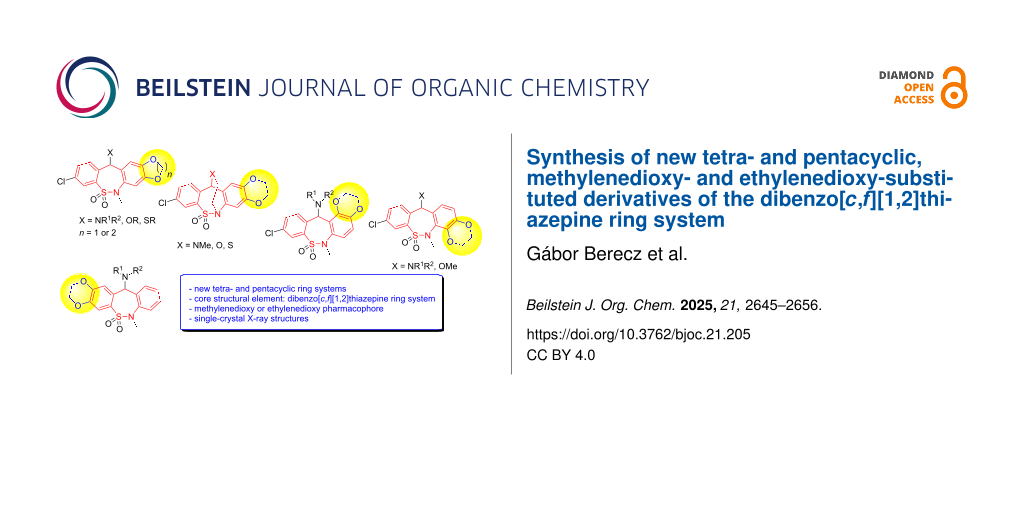
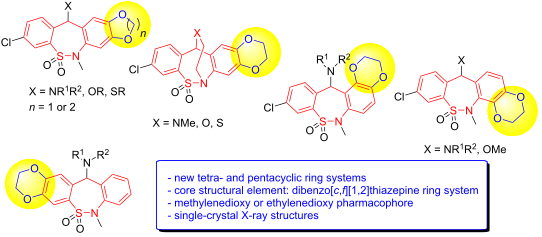
New tetra- and pentacyclic derivatives of the dibenzo[c,f][1,2]thiazepine ring system have been synthesized. The target compounds contain methylenedioxy or ethylenedioxy substituents linked to the benzene ring. The key step for the construction of the ring systems has been implemented by an intramolecular Friedel–Crafts cyclization. Altogether eight new ring systems are described here, five of them are also characterized by single-crystal X-ray diffraction.
Graphical Abstract
Introduction
In our prior report [1] we disclosed the synthesis of new fused ring derivatives of the dibenzo[c,f][1,2]thiazepine skeleton (1, Figure 1) shown by general structure 2. In recent publications we have also reported the synthesis of new ring systems containing a two or three-carbon linker between the nitrogen atom of the thiazepine ring and the nitrogen (3), oxygen (4), or sulfur (5) atom linked to the C(11) atom [2,3].
![[1860-5397-21-205-1]](/bjoc/content/figures/1860-5397-21-205-1.svg?scale=2.0&max-width=1024&background=FFFFFF)
Figure 1: Reported ring systems incorporating the dibenzo[c,f][1,2]thiazepine (1) skeleton.
Figure 1: Reported ring systems incorporating the dibenzo[c,f][1,2]thiazepine (1) skeleton.
In continuation of our efforts to study new ring systems, we decided to synthesize new tetra- and pentacyclic dibenzo[c,f][1,2]thiazepine derivatives containing a 1,3-benzodioxole or, with particular emphasis, a 1,4-benzodioxane moiety. The importance of these structural motifs is well demonstrated in medicinal chemistry by marketed drugs and by compounds that have reached the human clinical development stage in various therapeutic fields. Launched drugs possessing a 1,3-benzodioxole element, shown in Figure 2, are among others the cough suppressant benzylisoquinoline alkaloid noscapine [4,5], the antidepressant paroxetine [6,7], antiparkinsonian agent piribedil [8,9], and tadalafil [10,11], for the treatment of male sexual disfunction. A review published in 2020 [12] gives an excellent overview about the medicinal chemistry of compounds incorporating a 1,4-benzodioxane scaffold variously substituted either on the aliphatic or on the aromatic carbon atoms. In connection with our present work, the latter compounds are of interest, e.g., the marketed drugs eliglustat for the treatment of Gaucher’s disease [13,14] and the antihypertensive agent proroxan [15,16]. Licogliflozin is a sodium-glucose transporter 2 inhibitor developed in several indications: obesity [17], polycystic ovary syndrome [18], and non-alcoholic steatohepatitis (NASH) [19].
![[1860-5397-21-205-2]](/bjoc/content/figures/1860-5397-21-205-2.svg?scale=2.0&max-width=1024&background=FFFFFF)
Figure 2: Drugs exhibiting a 1,3-benzodioxole or 1,4-benzodioxane structural unit marketed or in development.
Figure 2: Drugs exhibiting a 1,3-benzodioxole or 1,4-benzodioxane structural unit marketed or in development.
Results and Discussion
We first aimed to synthesize a new tetracyclic ring system containing the ethylenedioxy moiety attached to positions 8 and 9 of the dibenzo[c,f][1,2]thiazepine (1) core. Given the structural similarity, some analogous methylenedioxy derivatives have been also prepared.
The synthesis of key intermediates 6 and 7 is presented in Scheme 1. The reaction of sulfonyl chloride 9 with 1,3-benzodioxol-5-amine or 2,3-dihydro-1,4-benzodioxin-6-amine gave sulfonamides 10 or 11, respectively. N-Methylation with methyl iodide via compounds 12 and 13 followed by basic hydrolysis afforded carboxylic acids 14 and 15. Ring closure of the latter compounds to tetracyclic derivatives 6 and 7 was carried out in one pot by SnCl4-catalyzed Friedel–Crafts cyclization of the acid chlorides obtained via reaction of 14 and 15 with phosphorus pentachloride. In the reaction of compound 15, regioisomer 8 was also isolated in 2% yield, which represents a new ring system, too. It is interesting to mention that the formation of a similar isomer was not observed in the cyclization reaction of compound 14. The same disparity was observed in the studies of electrophilic substitution reactions of benzo-1,3-dioxoles and benzo-1,4-dioxanes [20].
![[1860-5397-21-205-i1]](/bjoc/content/inline/1860-5397-21-205-i1.svg?scale=2.0&max-width=1024&background=FFFFFF)
Scheme 1: Synthesis of tetracyclic key intermediates 6 and 7. Conditions: i) 1,3-benzodioxol-5-amine (n = 1)/2,3-dihydro-1,4-benzodioxin-6-amine (n = 2), PhNEt2, MeOH, rt, 1 h, 95%/92%; ii) MeI, K2CO3, DMF, 4 h/1 h, 97%/98%; iii) NaOH, MeOH/H2O, reflux, 1 h, 97%/99%; iv) 1. PCl5, DCM, reflux, 8.5 h/9 h; 2. SnCl4, 0–5 °C, 2 h/1 h → rt, 2 h; 76%/84% (8: 2%).
Scheme 1: Synthesis of tetracyclic key intermediates 6 and 7. Conditions: i) 1,3-benzodioxol-5-amine (n = 1)/...
Reduction of ketones 6 and 7 with NaBH4 gave alcohols 16 and 17, which were chlorinated with SOCl2 to result in compounds 18 and 19. Treatment of the latter with the appropriate amines gave amino derivatives 20a, 20c–e, and 21a, 21c–p, respectively (Scheme 2). The structure of compounds 20e and 21g was also confirmed by single-crystal X-ray diffraction (Figure 3).
![[1860-5397-21-205-i2]](/bjoc/content/inline/1860-5397-21-205-i2.svg?scale=2.0&max-width=1024&background=FFFFFF)
Scheme 2: Synthesis of tetracyclic compounds 20 and 21. Conditions: i) NaBH4, DMF, EtOH, rt, 4.5 h/23 h, 95%/98%; ii) SOCl2, DCM, rt, 1.5 h/3.5 h, 100%/94%; iii) 20a,c–e: HNR1R2, dioxane or MeCN, rt, 1 h, 56–84%; 21a,c–p: HNR1R2, dioxane or MeCN, rt, 40 min–3.5 h, 48–93%.
Scheme 2: Synthesis of tetracyclic compounds 20 and 21. Conditions: i) NaBH4, DMF, EtOH, rt, 4.5 h/23 h, 95%/...
![[1860-5397-21-205-3]](/bjoc/content/figures/1860-5397-21-205-3.png?scale=2.0&max-width=1024&background=FFFFFF)
Figure 3: X-ray structures of compounds 20e and 21g.
Figure 3: X-ray structures of compounds 20e and 21g.
We demonstrated the potential utility of the synthesized new ring systems in the field of medicinal chemistry by the synthesis of tetracyclic analogues 20b and 21b of tianeptine (22), an atypical antidepressant drug on the market [21-25], by hydrolysis of esters 20a and 21a (Scheme 3).
![[1860-5397-21-205-i3]](/bjoc/content/inline/1860-5397-21-205-i3.svg?scale=2.0&max-width=1024&background=FFFFFF)
Scheme 3: Synthesis of tianeptine analogues 20b and 21b. Conditions: 20b: NaOH, EtOH/H2O, rt, 25 h, 80%; 21b: NaOH, EtOH/H2O, rt, 19 h, 73%.
Scheme 3: Synthesis of tianeptine analogues 20b and 21b. Conditions: 20b: NaOH, EtOH/H2O, rt, 25 h, 80%; 21b:...
Treatment of chloro derivative 19 with various alcohols afforded ethers 23, while its reaction with 2-(morpholin-4-yl)ethanethiol resulted in thioether 24 (Scheme 4). The structure of compound 23a was proven by single-crystal X-ray diffraction (Figure 4).
![[1860-5397-21-205-i4]](/bjoc/content/inline/1860-5397-21-205-i4.svg?scale=2.0&max-width=1024&background=FFFFFF)
Scheme 4: Synthesis of tetracyclic ethers 23 and thioether 24. Conditions: i) ROH, MeCN, rt, 2–3 h, 38–84%; ii) 2-(morpholin-4-yl)ethanethiol, MeCN, rt, 1 h, 72%.
Scheme 4: Synthesis of tetracyclic ethers 23 and thioether 24. Conditions: i) ROH, MeCN, rt, 2–3 h, 38–84%; i...
![[1860-5397-21-205-4]](/bjoc/content/figures/1860-5397-21-205-4.png?scale=2.0&max-width=1024&background=FFFFFF)
Figure 4: X-ray structure of compound 23a.
Figure 4: X-ray structure of compound 23a.
Starting from compound 7, using methods we have previously developed for the synthesis of related compounds [2,3], we have now prepared new pentacyclic ring systems 25–27 (Scheme 5). Demethylation of 7 followed by alkylation of compound 28 with 1,2-dibromoethane (29), reduction with NaBH4 (30), chlorination with SOCl2 (31) and subsequent treatment with methylamine afforded pentacyclic product 25. Reaction of bromoalkyl derivative 30 with potassium thioacetate gave acetylthio derivative 32, which was cyclized after removal of the acetyl group by intramolecular dehydrative thioetherification [3] to the bridged molecule 26. As regards the synthesis of compound 27, reduction of ketone 28 with NaBH4 (33), chlorination with SOCl2 (34) and treatment with 2-bromoethanol afforded 2-bromoethoxy derivative 35, which was cyclized to target compound 27 by intramolecular N-alkylation reaction. Structures of compounds 25, 26 and 27 have also been confirmed by single-crystal X-ray diffraction (Figure 5).
![[1860-5397-21-205-i5]](/bjoc/content/inline/1860-5397-21-205-i5.svg?scale=2.0&max-width=1024&background=FFFFFF)
Scheme 5: Synthesis of pentacyclic compounds 25–27. Conditions: i) Py·HCl, 180 °C, 27 h, 51%; ii) Br(CH2)2Br, MeCN, K2CO3, reflux, 22 h, 74%; iii) NaBH4, THF/EtOH, rt, 30 min, 99%; iv) SOCl2, DCM, rt, 2.5 h, 90%; v) MeNH2, dioxane, 5 °C, 1.5 h, 25 °C, 20 h, 78%; vi) AcSK, MeCN, Bu4NBr (cat.), rt, 4 h, 84%; vii) 1. K2CO3, MeOH; rt, 30 min, 2. PTSA (cat.), DCM, rt, 1 h, 91%; viii) NaBH4, NaOH, H2O, rt, 69 h, 83%; ix) SOCl2, DCM, rt, 2 h, crude: 100%; x) Br(CH2)2OH, MeCN, rt, 6 h, 61%; xi) K2CO3, MeCN, rt, 5 h, 71%.
Scheme 5: Synthesis of pentacyclic compounds 25–27. Conditions: i) Py·HCl, 180 °C, 27 h, 51%; ii) Br(CH2)2Br,...
![[1860-5397-21-205-5]](/bjoc/content/figures/1860-5397-21-205-5.png?scale=2.0&max-width=1024&background=FFFFFF)
Figure 5: X-ray structures of compounds 25, 26, and 27.
Figure 5: X-ray structures of compounds 25, 26, and 27.
Next, we synthesized some derivatives of new tetracyclic ketone 8 in a way that is already routinely used (Scheme 6): reduction of 8 with NaBH4, followed by chlorination of alcohol 36 with SOCl2 and substitution of chloro derivative 37 with various amines resulted in compounds 38a–c. Tianeptine analogue 38d was obtained by hydrolysis of ester 38c.
![[1860-5397-21-205-i6]](/bjoc/content/inline/1860-5397-21-205-i6.svg?scale=2.0&max-width=1024&background=FFFFFF)
Scheme 6: Synthesis of tetracyclic compounds 38. Conditions: i) NaBH4, DMF/EtOH, rt, 3 h, 89%; ii) SOCl2, DCM, rt, 1.5 h, 94%; iii) 38a–c: R1R2NH, MeCN, rt, 1 h, 79%, 78%, 84%; 38d: 38c, NaOH, EtOH/H2O, rt, 19 h, 82%.
Scheme 6: Synthesis of tetracyclic compounds 38. Conditions: i) NaBH4, DMF/EtOH, rt, 3 h, 89%; ii) SOCl2, DCM...
The synthesis of the new regioisomeric tetracyclic compounds containing the ethylenedioxy moiety attached to positions 7 and 8 of the dibenzo[c,f][1,2]thiazepine (2) core (instead of positions 8 and 9) has also been carried out in the traditional way (Scheme 7). Sulfonamide 39, obtained in the reaction of sulfonyl chloride 9 with 2,3-dihydro-1,4-benzodioxin-5-amine was transformed via intermediates 40‒43 to chloro derivative 44, which was converted with amines to compounds 45 and with methanol to ether 46.
![[1860-5397-21-205-i7]](/bjoc/content/inline/1860-5397-21-205-i7.svg?scale=2.0&max-width=1024&background=FFFFFF)
Scheme 7: Synthesis of tetracyclic compounds 45 and 46. Conditions: i) 2,3-dihydro-1,4-benzodioxin-5-amine, PhNEt2, MeOH, rt, 1 h, 0–5 °C, 1 h, 82%; ii) MeI, K2CO3, DMF, rt, 2 h, 87%; iii) NaOH, MeOH/H2O, reflux, 1 h, 97%; iv) 1. PCl5, DCM, reflux, 9 h; 2. SnCl4, 0–5 °C, 15 h, 86%; v) NaBH4, DMF, EtOH, rt, 3.5 h, 94%; (vi) SOCl2, DCM, rt, 2 h crude: 94%; vii) R1R2NH, dioxane or MeCN, rt, 1 h, 74–85%; viii) MeOH, DCM, rt, 40 min, 76%.
Scheme 7: Synthesis of tetracyclic compounds 45 and 46. Conditions: i) 2,3-dihydro-1,4-benzodioxin-5-amine, P...
Finally, we synthesized related tetracyclic derivatives containing the ethylenedioxy moiety attached to positions 2 and 3 of the dibenzo[c,f][1,2]thiazepine (1) core (Scheme 8). While the amidation (48), N-methylation (49), and hydrolysis (50), as well as the direct amidation of 47 to 49 worked well, the Friedel–Crafts cyclization via the corresponding acyl chloride to the tetracyclic key intermediate 51 could only be carried out with 26% yield, obviously because of incomplete regioselectivity. Reduction of 51 with NaBH4 and subsequent chlorination of alcohol 52 with SOCl2 gave chloro derivative 53, which was treated with amines to afford compounds 54a–e. 7-Aminoheptanoic acid ester derivative 54e was hydrolyzed to tianeptine analogue 54f.
![[1860-5397-21-205-i8]](/bjoc/content/inline/1860-5397-21-205-i8.svg?scale=2.0&max-width=1024&background=FFFFFF)
Scheme 8: Synthesis of tetracyclic compounds 54. Conditions: i) methyl anthranilate, pyridine, 0–5 °C, 4 h, rt, 13 h, 95%; ii) method A: MeI, K2CO3, DMF, rt, 22 h, crude: 99%; iii) method B: methyl N-methylanthranilate, pyridine, 0–5 °C, 2 h, rt, 17 h, 71%; iv) NaOH, MeOH/H2O, reflux, 1 h, crude: 95%; v) 1. SOCl2, DCM, reflux, 8.5 h; 2. AlCl3, 0–5 °C, 1.5 h, reflux, 3 h, 26%; vi) NaBH4, DMF/EtOH, rt, 2 h, 93%; vii) SOCl2, DCM, rt, 2 h, crude: 95%; viii) 54a–e: R1R2NH, dioxane or MeCN, rt, 1–1.5 h, 74–94%; 54f: 54e, NaOH, EtOH/H2O, rt, 20 h, 70%.
Scheme 8: Synthesis of tetracyclic compounds 54. Conditions: i) methyl anthranilate, pyridine, 0–5 °C, 4 h, r...
Conclusion
As continuation of our efforts to develop new ring systems that include the characteristic dibenzo[c,f][1,2]thiazepine tricyclic core, we have synthesized new tetra- and pentacyclic derivatives containing methylenedioxy or ethylenedioxy pharmacophores. The key step of the synthesis of tetracyclic compounds is an intramolecular Friedel–Crafts cyclization. The pentacyclic derivatives were obtained by an ethylene bridging between two heteroatoms of the tetracyclic compounds.
Experimental
Compounds 9 and 47 are commercially available. Compounds 6–8, 10–21, 23–46, and 48–54 are new and they are characterized either below or in Supporting Information File 1 in detail. In cases where a small sample of the material was recrystallized, the solvent of recrystallization is given after the melting point in parentheses. All melting points were determined on a Kofler hot-stage microscope Boëtius PHMK 05 melting point apparatus and are uncorrected. The amorphous character of the compounds exhibiting wide melting ranges (21b, 38d, 54f) were proven by XRPD measurements performed on a PANalytical Empyrean X-ray powder diffractometer at room temperature. Powder samples (without grinding) were placed between two Mylar foils in the sample holder at a reflection–transmission spinner stage (1 rps sample rotation speed) and measured in transmission mode using Cu Kα (1.541874 Å) radiation in the 2.0000–34.9964° 2θ range with 0.0131° 2θ step size and continuous gonio (θ/θ) scan in 1 measurement cycle. 45 kV accelerating voltage and 40 mA anode heating current were used. Diffraction intensity was measured by a PIXcel 3D 1 × 1 area detector. Thermogravimetric (TG) curves of amorphous samples (21b, 38d, 54f) were measured by a TA Instruments Discovery TGA thermogravimetric analyzer in the 30–200 °C temperature range with a 10 °C/min heating rate using 11 to 12 mg sample in a 100 μL platinum pan in 25 mL/min nitrogen atmosphere. Melting properties of the amorphous samples (21b, 38d, 54f) were also studied by a TA Instruments Discovery DSC differential scanning calorimeter in the 25–120 °C temperature range with a 10 °C/min heating rate using 2.5 to 3.0 mg sample in a standard open 40 μL aluminum pan under 50 mL/min nitrogen atmosphere. IR spectra were obtained on a Bruker ALPHA FT-IR spectrometer in KBr pellets or in neat. NMR spectra were recorded at 295 K on a Bruker Avance III HD 600 (600 and 150 MHz for 1H and 13C NMR spectra, respectively) spectrometer equipped with a Prodigy cryo-probehead or a Varian Unity Inova 500 (500 and 125 MHz for 1H and 13C NMR spectra, respectively), or a Varian Unity Inova 400 (400 and 100 MHz for 1H and 13C NMR spectra, respectively), or a Varian Gemini 200 (200 and 50 MHz for 1H and 13C NMR spectra, respectively) spectrometer. The pulse programs were taken from the Bruker software library (TopSpin 3.5) and full 1H and 13C assignments were achieved with widely accepted strategies. 1H assignments were accomplished using general knowledge of chemical shift dispersion with the aid of the 1H–1H coupling pattern. CDCl3 or DMSO-d6 was used as the solvent and tetramethylsilane (TMS) as the internal standard. Chemical shifts (δ) and coupling constants (J) are given in ppm and in Hz, respectively. Coupling constants reported in the 1H NMR spectra are H–H couplings unless otherwise stated (J ≡ JH–H). Three-bond H–H couplings (3J) are aromatic ortho or aliphatic vicinal ones, four-bond ones (4J) are aromatic meta couplings. For the sake of brevity, we use simplified notations unless otherwise stated: COSY for 1H–1H 2D COSY, NOESY for 1H–1H 2D NOESY, HSQC for 1H–13C 2D HSQC, HMQC for 1H–13C 2D HMQC, and HMBC for 1H–13C 2D HMBC. High-resolution mass spectra (HRMS) were recorded on a Bruker Q-TOF MAXIS Impact mass spectrometer coupled with a Waters I-Class UPLC system with a diode array detector. HRMS (TOF MS EI) measurements were performed on an Agilent 2750 GC/Q-TOF mass spectrometer with MSD direct inlet probe. Single-crystal X-ray diffraction (SC-XRD) measurements were carried out on a Rigaku R-Axis Spider diffractometer with an imaging plate area detector using graphite monochromatic Cu Kα radiation. Single crystal X-ray structures were deposited at the Cambridge Crystallographic Data Centre under the following numbers: CCDC 2470493 (20e), CCDC 2470491 (21g), CCDC 2470492 (23a), CCDC 2470490 (25), CCDC 2470489 (26), CCDC 2472402 (27). All reagents were purchased from commercial sources and were used without further purification. Reactions were followed by analytical thin-layer chromatography on silica gel 60 F254 (Merck 105554). Dry-column flash chromatographic purifications were performed on silica gel 60 H (Merck 107736), silica gel 60 (Merck 115111) or aluminum oxide 60 G neutral (Merck 101090) column [26].
9-Chloro-6-methyl-2,3-dihydro[1,4]benzodioxino[6,7-c]benzo[f][1,2]thiazepin-12(6H)-one 7,7-dioxide (7) and 10-chloro-7-methyl-2,3-dihydro[1,4]benzodioxino[6,5-c]benzo[f][1,2]thiazepin-13(7H)-one 8,8-dioxide (8): To the suspension of 15 (31.66 g, 82.5 mmol) in DCM (320 mL), PCl5 (20.82 g, 100 mmol) was added in two portions and the solution obtained was refluxed for 9 h. The solution was cooled to 0–5 °C, and SnCl4 (47.28 g, 182 mmol, 21.2 mL) was added to the reaction mixture. The red suspension obtained was stirred at 0–5 °C for 1 h, then at room temperature for 2 h. It was poured onto a mixture of crushed ice (1500 g) and conc. hydrochloric acid (200 mL). It was stirred while warming to room temperature (ca 3 h). The crystalline product separated was filtered, washed with diluted hydrochloric acid (5%, 2 × 50 mL) and water (2 × 50 mL), then air-dried to give crude 7 (17.6 g of off-white solid). The two-phase filtrate was separated, the strongly acidic aqueous phase was washed with DCM (100 mL), the combined organic phases were dried over Na2SO4, evaporated, and the oily residue was triturated with a little amount of acetone to afford a second crop of crude 7 (8.45 g of pale yellow solid). The two crops were purified by dry-column flash chromatography on a short silica gel column (thickness of the stationary phase: 30 mm, eluent: DCM). After evaporation of the solvent, the residue was triturated with Et2O (50 mL) to give pure 7 (25.30 g, 84%) as colorless crystals. Mp 223‒225 °C (CH3CN/EtOH 1:1 (v/v)); IR (KBr): 1638, 1604, 1574, 1501, 1354, 1300, 1175, 1063, 854 cm−1; 1H NMR (600 MHz, CDCl3): 7.99 (d, 3J = 8.4 Hz, 1H), 7.95 (d, 4J = 2.1 Hz, 1H), 7.86 (s, 1H), 7.66 (dd, 4J = 2.1 Hz, 3J = 8.3 Hz, 1H), 6.83 (s, 1H), 4.35 (m, 2H), 4.30 (m, 2H), 3.24 (s, 3H); 13C NMR (150 MHz, CDCl3): 187.20, 149.26, 142.28, 138.57, 138.06, 135.76, 134.05, 133.80, 133.09, 125.83, 125.27, 120.48, 113.73, 64.95, 64.05, 39.39; COSY: 7.99‒7.66‒7.95, 4.35‒4.30; HSQC (140 Hz): 7.99‒133.80, 7.95‒125.83, 7.86‒120.48, 7.66‒133.09, 6.83‒113.73, 4.35‒64.95, 4.30‒64.05, 3.24‒39.39; HMBC (8 Hz, 140 Hz): 7.99‒(187.20, 138.57, 138.06), 7.95‒(138.57, 134.05, 133.09), 7.86‒(187.20, 149.26, 135.76), 7.66‒(138.57, 134.05, 125.83), 6.83‒(142.28, 135.76, 125.27), 4.35‒149.26, 4.30‒142.28, 3.24‒135.76; EIMS (m/z): [M]+ 365 (1 Cl); HRESIMS (m/z): [M + H]+ calcd. for C16H13ClNO5S, 366.0197; found, 366.0199.
The mother liquors of compound 7 were evaporated in vacuo and the residue was subjected to dry-column flash chromatography (short aluminum oxide column, eluent: heptane/DCM 1:1, DCM) and isomer 8 (0.62 g, 2%) was isolated as pale yellow crystals. Mp 254‒256 °C (CH3CN); IR (KBr): 1665, 1485, 1344, 1111, 1061, 859 cm−1; 1H NMR (500 MHz, CDCl3): 7.96 (d, 4J = 2.0 Hz, 1H), 7.94 (d, 3J = 8.6 Hz, 1H), 7.63 (dd, 4J = 2.1 Hz, 3J = 8.5 Hz, 1H), 7.03 (d, 3J = 8.7 Hz, 1H), 6.92 (d, 3J = 8.7 Hz, 1H), 4.30 (m, 2H), 4.28 (m, 2H), 3.28 (s, 3H); 13C NMR (125 MHz, CDCl3): 189.67, 144.54, 141.91, 140.51, 140.19, 132.98, 132.52, 132.24, 129.40, 129.23, 127.41, 121.61, 121.00, 64.39, 63.90, 39.93; NOE: 3.28‒(7.96, 6.92); HSQC (140 Hz): 7.96‒127.41, 7.94‒132.24, 7.63‒132.52, 7.03‒121.00, 6.92‒121.61, 4.30‒63.90, 4.28‒64.39, 3.28‒39.93; HMQC (140 Hz, 8 Hz): 7.96‒(140.19, 132.52), 7.94‒(140.51, 132.98), 7.63‒(140.19, 132.98, 127.41), 7.03‒(141.91, 129.40), 6.92‒(189.67, 144.54, 129.23), 4.30‒144.54, 4.28‒141.91, 3.28‒129.40; EIMS (m/z): [M]+ 365 (1 Cl); HRESIMS (m/z): [M + H]+ calcd. for C16H13ClNO5S, 366.0197; found, 366.0195.
Ethyl 7-[(9-chloro-6-methyl-7,7-dioxido-2,3,6,12-tetrahydro[1,4]benzodioxino[6,7-c]benzo[f][1,2]thiazepin-12-yl)amino]heptanoate (21a): To a solution of ethyl 7-aminoheptanoate (2.29 g, 13.2 mmol) in CH3CN (15 mL) crude 19 (2.32 g, 6 mmol) was added, the solution obtained was stirred at room temperature for 40 min. It was evaporated in vacuo, the residue was dissolved in DCM (20 mL), washed with water (2 × 15 mL), dried over Na2SO4, and evaporated in vacuo. The oily residue was purified by dry-column flash chromatography on a short aluminum oxide column (thickness of stationary phase: 30 mm, eluent: heptane/DCM 1:1, DCM, DCM/MeOH 100:2). After evaporation of solvents in vacuo 21a (2.87 g, 91%) was obtained as pale yellow oil, which slowly solidified upon standing at ambient temperature. The melt-like hard substance obtained was suspended in DIPE to afford 21a as colorless crystals. Mp 76‒78 °C; IR (KBr): 3314, 2939, 1728, 1510, 1328, 1064, 853, 599 cm−1; 1H NMR (600 MHz, CDCl3): 7.94 (d, 4J = 1.9 Hz, 1H), 7.43 (dd, 4J = 2.1 Hz, 3J = 8.4 Hz, 1H), 7.39 (d, 3J = 8.4 Hz, 1H), 6.92 (s, 1H), 6.83 (s, 1H), 4.85 (s, 1H), 4.24 (s, 4H), 4.11 (q, 3J = 7.1 Hz, 2H), 3.35 (s, 3H), 2.46 (t, 3J = 7.0 Hz, 2H), 2.27 (t, 3J = 7.5 Hz, 2H), 1.83 (br s, 1H), 1.60 (m, 2H), 1.47 (m, 2H), 1.30 (m, 2H), 1.29 (m, 2H), 1.25 (t, 3J = 7.1 Hz, 3H); 13C NMR (150 MHz, CDCl3): 173.73, 143.63, 143.29, 140.79, 137.13, 134.12, 132.70, 131.96, 131.11, 130.73, 128.39, 117.57, 117.00, 65.35, 64.31, 64.23, 60.17, 48.12, 38.68, 34.20, 29.87, 28.95, 26.92, 24.79, 14.22; COSY: 7.94‒7.43‒7.39, 4.11‒1.25, 2.46‒1.47‒1.30‒1.29‒1.60‒2.27; HSQC (140 Hz): 7.94‒128.39, 7.43‒131.96, 7.39‒130.73, 6.92‒117.00, 6.83‒117.57, 4.85‒65.35, 4.24‒64.31, 4.24‒64.23, 4.11‒60.17, 3.35‒38.68, 2.46‒48.12, 2.27‒34.20, 1.60‒24.79, 1.47‒29.87, 1.30‒26.92, 1.29‒28.95, 1.25‒14.22; HMBC (8 Hz, 140 Hz): 7.94‒(137.13, 134.12, 131.96), 7.43‒(137.13, 134.12, 128.39), 7.39‒(140.79, 134.12, 65.35), 6.92‒(143.29, 132.70), 6.83‒(143.63, 131.11, 65.35), 4.85‒(140.79, 137.13, 132.70, 131.11, 130.73, 111.57, 48.12), 4.24‒(143.63, 64.23), 4.24‒(173.73, 14.22), 3.35‒131.11, 2.46‒(65.35, 29.89, 26.92), 2.27‒(173.73, 28.95, 24.79), 1.60‒(173.73, 34.20, 28.95, 26.92), 1.47‒(48.12, 28.95, 26.92), 1.30‒(29.87, 28.95), 1.29‒26.92, 1.25‒60.17; ESIMS (m/z): [M + H]+ 523 (1 Cl); HRESIMS (m/z): [M + H]+ calcd for C25H32ClN2O6S, 523.1664; found, 523.1668.
7-[(9-Chloro-6-methyl-7,7-dioxido-2,3,6,12-tetrahydro[1,4]benzodioxino[6,7-c]benzo[f][1,2]thiazepin-12-yl)amino]heptanoic acid (21b): To a solution of ester 21a (2.615 g, 5 mmol) in EtOH (30 mL), NaOH (0.240 g, 6 mmol) dissolved in water (7.5 mL) was added and the solution was stirred at room temperature for 19 h. Water (15 mL) was added to the yellow solution and the ethanol was removed by evaporation in vacuo. Water (10 mL) was added and the solution was neutralized with aqueous HCl solution (0.50 mL of conc. HCl dissolved in 10 mL of water, containing 6 mmol of HCl). It was stirred at room temperature for 5 h, the solid product obtained was filtered, washed with water (2 × 3 mL), and air-dried. It was dissolved in acetone (20 mL), the solution was treated with charcoal (0.20 g), and evaporated in vacuo. The residue obtained was triturated with water (10 mL) and dried in vacuo to afford 21b (1.81 g, 73%) as a colorless amorphous solid. Melting range (glass-transition range): 84–92 °C (Kofler–Boëtius, 2 °C/min), 72–84 °C (DSC, 10 °C/min); IR (KBr): 3421, 2932, 1710, 1508, 1321, 1066 cm−1. 1H NMR (500 MHz, CDCl3): 7.94 (s, 1H), 7.46 (m, 2H), 6.90 (s, 1H), 6.89 (s, 1H), 6.71 (br s, 2H), 5.05 (s, 1H), 4.23 (m, 4H), 3.27 (s, 3H), 2.49 (m, 1H), 2.42 (m, 1H), 2.24 (t, 3J = 7.3 Hz, 2H), 1.56 (m, 2H), 1.47 (m, 2H), 1.27 (m, 4H); 13C NMR (125 MHz, CDCl3): 178.33, 144.09, 143.09, 140.53, 134.88, 134.72, 132.30, 132.18, 131.77, 129.17, 128.29, 118.79, 116.39, 65.14, 64.27, 64.25, 47.30, 38.74, 34.69, 28.92, 28.87, 26.79, 24.89 ; ESIMS (m/z): [M + H]+ 495 (1 Cl); HRESIMS (m/z): [M + H]+ calcd for C23H28ClN2O6S, 495.1351; found, 495.1352.
6-(2-Bromoethyl)-9-chloro-2,3-dihydro[1,4]benzodioxino[6,7-c]benzo[f][1,2]thiazepin-12(6H)-one 7,7-dioxide (29): To a suspension of 28 (9.85 g, 28 mmol) in CH3CN (140 mL), K2CO3 (11.61 g, 84 mmol, 3 equiv) was added and the yellow suspension was stirred at room temperature for 30 min. 1,2-Dibromoethane (26.3 g, 140 mmol, 12.1 mL, 5 equiv) was added, and the reaction mixture was refluxed for 22 h. The suspension was cooled to room temperature, the insoluble part was filtered, washed with CH3CN (2 × 30 mL). After evaporation of the solvent in vacuo, the oily residue was subjected to a dry-column flash chromatography on a short silica gel column (thickness of stationary phase: 40 mm, eluent: heptane, heptane/DCM 1:1, DCM). After evaporation of the solvents, the residue was triturated with Et2O to give 29 (9.56 g, 74%) as colorless crystals. Mp dec from 177 °C (CH3CN); IR (KBr): 1498, 1362, 1295, 1178, 1071, 580 cm−1; 1H NMR (500 MHz, CDCl3): 8.07 (d, 3J = 8.4 Hz, 1H), 7.98 (d, 4J = 2.1 Hz, 1H), 7.85 (s, 1H), 7.67 (dd, 4J = 2.2 Hz, 3J = 8.4 Hz, 1H), 6.87 (s, 1H), 4.35 (m, 2H), 4.30 (m, 2H), 4.00 (t, 3J = 7.1 Hz, 2H), 3.37 (t, 3J = 7.0 Hz, 2H); 13C NMR (125 MHz, CDCl3): 186.42, 149.13, 142.84, 139.67, 138.95, 134.24, 133.51, 133.18, 132.94, 126.81, 125.80, 121.08, 113.85, 64.95, 64.05, 53.17, 27.90; EIMS (m/z): [M]+ 457 (1 Br, 1 Cl); HRESIMS (m/z): [M + H]+calcd for C17H14BrClNO5S, 457.9459; found, 457.9459.
9-Chloro-14-methyl-2,3-dihydro-12H-12,6-(epiminoethano)[1,4]benzodioxino[6,7-c]benzo[f][1,2]thiazepine 7,7-dioxide (25): To a stirred and cooled solution of MeNH2 (1.96 g, 63 mmol, 15 equiv) in dioxane (17.5 g), 31 (2.01 g, 4.2 mmol) was added at 5 °C and the thin suspension obtained was stirred at 5 °C for 1.5 h and at 25 °C for 20 h. After evaporation of the solvent in vacuo, the solid residue was dissolved in DCM (60 mL) and water (30 mL). The phases were separated. The organic phase was washed with water (30 mL), dried over Na2SO4, and evaporated in vacuo. The residue was purified by dry-column flash chromatography on a short silica gel column (thickness of stationary phase: 30 mm, eluent: heptane/DCM 1:1, 1:2, DCM, DCM/MeOH 100:1). After evaporation of the solvents, the residue was triturated with CH3CN to afford 25 (1.29 g, 78%) as colorless crystals. Mp dec from 221 °C (CH3CN); IR (KBr): 1506, 1335, 1305, 1163, 1064 cm−1; 1H NMR (400 MHz, CDCl3): 7.88 (d, 4J = 2.2 Hz, 1H), 7.44 (dd, 4J = 2.2 Hz, 3J = 8.2 Hz, 1H), 7.23 (d, 3J = 8.3 Hz, 1H), 6.98 (s, 1H), 6.76 (s, 1H), 4.50 (s, 1H), 4.20 (m, 4H), 4.03 (m, 1H), 3.61 (m, 1H), 3.23 (m, 1H), 2.62 (m, 1H), 2.42 (s, 3H); 13C NMR (100 MHz, CDCl3): 145.36, 143.81, 143.56, 135.28, 134.84, 133.58, 131.82, 131.46, 130.25, 127.65, 119.37, 117.75, 73.33, 64.27, 64.12, 49.64, 49.42, 43.49; COSY: 7.88‒7.44‒7.23, (4.03, 3.61)‒(3.23, 2.62); NOESY (0.3 s): 7.23‒(7.44, 4.50), 6.76‒4.50; HSQC (145 Hz): 7.88‒127.65, 7.44‒131.82, 7.23‒133.58, 6.98‒119.37, 6.76‒117.75, 4.50‒73.33, 4.20‒(64.27, 64.12), 4.03‒49.66, 3.61‒49.66, 3.23‒49.42, 2.62‒49.42, 2.42‒43.49; HMBC (145 Hz, 8 Hz): 7.88‒(135.28, 131.82, 130.25), 7.44‒(135.28, 133.58, 130.25, 127.65), 7.23‒(145.36, 135.28, 131.82, 130.25, 127.65, 73.33), 6.98‒(143.81, 134.84, 131.46), 6.76‒(143.81, 143.56, 73.33), 4.50‒(145.36, 134.84, 133.58, 131.46, 130.25, 117.75, 49.42, 43.49), 4.20‒(143.81, 143.56, 64.27, 64.12), 4.03‒131.46, 3.61‒(145.36, 131.46, 49.42), 3.23‒(73.33, 49.66, 43.49), 2.62‒(73.33, 43.49), 2.42‒(73.33, 49.42); NOE (500 MHz, 2 s): 7.88‒(7.44, 7.23, 6.98, 6.76, 4.50, 4.02, 3.23), 7.23‒(7.44, 4.50, 3.23, 2.42); ESIMS (m/z): [M + H]+ 393 (1 Cl); HRESIMS (m/z): [M + H]+ calcd for C18H18ClN2O4S, 393.0670; found, 393.0675.
Supporting Information
| Supporting Information File 1: Experimental procedures and characterization of compounds 6, 10–19, 20a–e, 21c–p, 23a–e, 24, 26–28, 30–37, 38a–d, 39–44, 45a–c, 46–53, 54a–f. 1H and 13C NMR spectra of all new compounds. 2D NMR spectra of compounds 6–8, 12, 21a, 21b, 25–27, 30, 32, 38b, 42, 50, 51, 54e. | ||
| Format: PDF | Size: 22.5 MB | Download |
| Supporting Information File 2: Crystallographic information files, checkcif and structure report files for compounds 20e, 21g, 23a, 25–27. | ||
| Format: ZIP | Size: 8.1 MB | Download |
Acknowledgements
The authors are grateful to Mrs. Erika Koren-Ausländer for technical assistance in the synthetic reactions, to Mrs. Mónika Mezővári for LC-MS and HRMS TOF EI, and to Mr. Péter Kővágó for IR and NMR measurements.
Funding
This work was prepared in the framework of 2020-1.1.2-PIACI-KFI-2020-00039 project with the support of the Ministry of Culture and Innovation, from the National Research, Development and Innovation Fund (Hungary). The authors acknowledge financial support from the National Research, Development and Innovation Office of Hungary (NKFIH/OTKA K 142266).
Data Availability Statement
All data that supports the findings of this study is available in the published article and/or the supporting information of this article.
References
-
Berecz, G.; Dancsó, A.; Németh, D. R.; Kiss, L.; Simig, G.; Volk, B. Synthesis 2022, 54, 3874–3882. doi:10.1055/s-0040-1719885
Return to citation in text: [1] -
Berecz, G.; Dancsó, A.; Lauritz, M. T.; Simig, G.; Volk, B. Tetrahedron 2023, 134, 133300. doi:10.1016/j.tet.2023.133300
Return to citation in text: [1] [2] -
Berecz, G.; Szabó, D.; Dancsó, A.; Lauritz, M. T.; Kiss, L.; Simig, G.; Volk, B. Eur. J. Org. Chem. 2024, 27, e202400835. doi:10.1002/ejoc.202400835
Return to citation in text: [1] [2] [3] -
Singh, H.; Singh, P.; Kumari, K.; Chandra, A.; Dass, S. K.; Chandra, R. Curr. Drug Metab. 2013, 14, 351–360. doi:10.2174/1389200211314030010
Return to citation in text: [1] -
Li, Y.; Li, S.; Thodey, K.; Trenchard, I.; Cravens, A.; Smolke, C. D. Proc. Natl. Acad. Sci. U. S. A. 2018, 115, E3922–E3931. doi:10.1073/pnas.1721469115
Return to citation in text: [1] -
Engelstoft, M.; Hansen, J. B. Acta Chem. Scand. 1996, 50, 164–169. doi:10.3891/acta.chem.scand.50-0164
Return to citation in text: [1] -
Wagstaff, A. J.; Cheer, S. M.; Matheson, A. J.; Ormrod, D.; Goa, K. L. Drugs 2002, 62, 655–703. doi:10.2165/00003495-200262040-00010
Return to citation in text: [1] -
Duncton, M. A. J.; Roffey, J. R. A.; Hamlyn, R. J.; Adams, D. R. Tetrahedron Lett. 2006, 47, 2549–2552. doi:10.1016/j.tetlet.2006.02.047
Return to citation in text: [1] -
Millan, M. J.; Cussac, D.; Milligan, G.; Carr, C.; Audinot, V.; Gobert, A.; Lejeune, F.; Rivet, J.-M.; Brocco, M.; Duqueyroix, D.; Nicolas, J.-P.; Boutin, J. A.; Newman-Tancredi, A. J. Pharmacol. Exp. Ther. 2001, 297, 876–887. doi:10.1016/s0022-3565(24)29611-7
Return to citation in text: [1] -
Daugan, A.; Grondin, P.; Ruault, C.; Le Monnier de Gouville, A.-C.; Coste, H.; Kirilovsky, J.; Hyafil, F.; Labaudinière, R. J. Med. Chem. 2003, 46, 4525–4532. doi:10.1021/jm030056e
Return to citation in text: [1] -
Borthwick, A. D. Chem. Rev. 2012, 112, 3641–3716. doi:10.1021/cr200398y
Return to citation in text: [1] -
Bolchi, C.; Bavo, F.; Appiani, R.; Roda, G.; Pallavicini, M. Eur. J. Med. Chem. 2020, 200, 112419. doi:10.1016/j.ejmech.2020.112419
Return to citation in text: [1] -
Shayman, J. A. Drugs Future 2010, 35, 613–620. doi:10.1358/dof.2010.35.8.1505566
Return to citation in text: [1] -
Mistry, P. K.; Lukina, E.; Ben Turkia, H.; Amato, D.; Baris, H.; Dasouki, M.; Ghosn, M.; Mehta, A.; Packman, S.; Pastores, G.; Petakov, M.; Assouline, S.; Balwani, M.; Danda, S.; Hadjiev, E.; Ortega, A.; Shankar, S.; Solano, M. H.; Ross, L.; Angell, J.; Peterschmitt, M. J. J. Am. Med. Assoc. 2015, 313, 695–706. doi:10.1001/jama.2015.459
Return to citation in text: [1] -
Krechetov, S. P.; Nifontova, G. O.; Dolotova, O. V.; Veselov, M. S. Pharm. Chem. J. 2018, 52, 236–240. doi:10.1007/s11094-018-1798-1
Return to citation in text: [1] -
Shabanov, P. D. Rev. Clin. Pharmacol. Drug Ther. 2020, 18, 335–350. doi:10.17816/rcf184335-350
Return to citation in text: [1] -
Zaki, A. M.; Abo-Elnour, D. E.; Abdalla, Y. E.; Hassan, R. Y.; Salama, M. K.; Elboraay, T.; Abdelhaleem, I. A. Diabetes Metab. Syndr. 2022, 16, 102657. doi:10.1016/j.dsx.2022.102657
Return to citation in text: [1] -
Tan, S.; Ignatenko, S.; Wagner, F.; Dokras, A.; Seufert, J.; Zwanziger, D.; Dunschen, K.; Zakaria, M.; Huseinovic, N.; Basson, C. T.; Mahling, P.; Fuhrer, D.; Hinder, M. Diabetes Obes. Metab. 2021, 23, 2595–2599. doi:10.1111/dom.14495
Return to citation in text: [1] -
Harrison, S. A.; Manghi, F. P.; Smith, W. B.; Alpenidze, D.; Aizenberg, D.; Klarenbeek, N.; Chen, C.-Y.; Zuckerman, E.; Ravussin, E.; Charatcharoenwitthaya, P.; Cheng, P.-N.; Katchman, H.; Klein, S.; Ben-Ari, Z.; Mendonza, A. E.; Zhang, Y.; Martic, M.; Ma, S.; Kao, S.; Tanner, S.; Pachori, A.; Badman, M. K.; He, Y.; Ukomadu, C.; Sicard, E. Nat. Med. 2022, 28, 1432–1438. doi:10.1038/s41591-022-01861-9
Return to citation in text: [1] -
Dauksas, V. K.; Purvaneckas, G. V.; Udrenaite, E. B.; Gineityte, V. L.; Barauskaite, A. V. Heterocycles 1981, 15, 1395–1404. doi:10.3987/s-1981-02-1395
Return to citation in text: [1] -
Malen, C.; Poignant, J.-C.; Danrée, B. Nouveaux dérivés tricycliques et leur procédé de preparation. French Pat. Appl. FR 2104728, April 21, 1972.
Return to citation in text: [1] -
Kato, G.; Weitsch, A. F. Clin. Neuropharmacol. 1988, 11 (Suppl. 2), S43–S50.
Return to citation in text: [1] -
Berridge, K. C.; Kringelbach, M. L. Psychopharmacology (Heidelberg, Ger.) 2008, 199, 457–480. doi:10.1007/s00213-008-1099-6
Return to citation in text: [1] -
Gassaway, M. M.; Rives, M.-L.; Kruegel, A. C.; Javitch, J. A.; Sames, D. Transl. Psychiatry 2014, 4, e411. doi:10.1038/tp.2014.30
Return to citation in text: [1] -
El Zahran, T.; Schier, J.; Glidden, E.; Kieszak, S.; Law, R.; Bottei, E.; Aaron, C.; King, A.; Chang, A. Morb. Mortal. Wkly. Rep. 2018, 67, 815–818. doi:10.15585/mmwr.mm6730a2
Return to citation in text: [1] -
Furniss, B. S.; Hannaford, A. J.; Smith, P. W. G.; Tatchell, A. R., Eds. Vogel’s Textbook of Practical Organic Chemistry, 5th ed.; Longman: Harlow, UK, 1989; pp 220–221.
Return to citation in text: [1]
| 26. | Furniss, B. S.; Hannaford, A. J.; Smith, P. W. G.; Tatchell, A. R., Eds. Vogel’s Textbook of Practical Organic Chemistry, 5th ed.; Longman: Harlow, UK, 1989; pp 220–221. |
| 1. | Berecz, G.; Dancsó, A.; Németh, D. R.; Kiss, L.; Simig, G.; Volk, B. Synthesis 2022, 54, 3874–3882. doi:10.1055/s-0040-1719885 |
| 8. | Duncton, M. A. J.; Roffey, J. R. A.; Hamlyn, R. J.; Adams, D. R. Tetrahedron Lett. 2006, 47, 2549–2552. doi:10.1016/j.tetlet.2006.02.047 |
| 9. | Millan, M. J.; Cussac, D.; Milligan, G.; Carr, C.; Audinot, V.; Gobert, A.; Lejeune, F.; Rivet, J.-M.; Brocco, M.; Duqueyroix, D.; Nicolas, J.-P.; Boutin, J. A.; Newman-Tancredi, A. J. Pharmacol. Exp. Ther. 2001, 297, 876–887. doi:10.1016/s0022-3565(24)29611-7 |
| 2. | Berecz, G.; Dancsó, A.; Lauritz, M. T.; Simig, G.; Volk, B. Tetrahedron 2023, 134, 133300. doi:10.1016/j.tet.2023.133300 |
| 3. | Berecz, G.; Szabó, D.; Dancsó, A.; Lauritz, M. T.; Kiss, L.; Simig, G.; Volk, B. Eur. J. Org. Chem. 2024, 27, e202400835. doi:10.1002/ejoc.202400835 |
| 6. | Engelstoft, M.; Hansen, J. B. Acta Chem. Scand. 1996, 50, 164–169. doi:10.3891/acta.chem.scand.50-0164 |
| 7. | Wagstaff, A. J.; Cheer, S. M.; Matheson, A. J.; Ormrod, D.; Goa, K. L. Drugs 2002, 62, 655–703. doi:10.2165/00003495-200262040-00010 |
| 3. | Berecz, G.; Szabó, D.; Dancsó, A.; Lauritz, M. T.; Kiss, L.; Simig, G.; Volk, B. Eur. J. Org. Chem. 2024, 27, e202400835. doi:10.1002/ejoc.202400835 |
| 4. | Singh, H.; Singh, P.; Kumari, K.; Chandra, A.; Dass, S. K.; Chandra, R. Curr. Drug Metab. 2013, 14, 351–360. doi:10.2174/1389200211314030010 |
| 5. | Li, Y.; Li, S.; Thodey, K.; Trenchard, I.; Cravens, A.; Smolke, C. D. Proc. Natl. Acad. Sci. U. S. A. 2018, 115, E3922–E3931. doi:10.1073/pnas.1721469115 |
| 20. | Dauksas, V. K.; Purvaneckas, G. V.; Udrenaite, E. B.; Gineityte, V. L.; Barauskaite, A. V. Heterocycles 1981, 15, 1395–1404. doi:10.3987/s-1981-02-1395 |
| 2. | Berecz, G.; Dancsó, A.; Lauritz, M. T.; Simig, G.; Volk, B. Tetrahedron 2023, 134, 133300. doi:10.1016/j.tet.2023.133300 |
| 3. | Berecz, G.; Szabó, D.; Dancsó, A.; Lauritz, M. T.; Kiss, L.; Simig, G.; Volk, B. Eur. J. Org. Chem. 2024, 27, e202400835. doi:10.1002/ejoc.202400835 |
| 21. | Malen, C.; Poignant, J.-C.; Danrée, B. Nouveaux dérivés tricycliques et leur procédé de preparation. French Pat. Appl. FR 2104728, April 21, 1972. |
| 22. | Kato, G.; Weitsch, A. F. Clin. Neuropharmacol. 1988, 11 (Suppl. 2), S43–S50. |
| 23. | Berridge, K. C.; Kringelbach, M. L. Psychopharmacology (Heidelberg, Ger.) 2008, 199, 457–480. doi:10.1007/s00213-008-1099-6 |
| 24. | Gassaway, M. M.; Rives, M.-L.; Kruegel, A. C.; Javitch, J. A.; Sames, D. Transl. Psychiatry 2014, 4, e411. doi:10.1038/tp.2014.30 |
| 25. | El Zahran, T.; Schier, J.; Glidden, E.; Kieszak, S.; Law, R.; Bottei, E.; Aaron, C.; King, A.; Chang, A. Morb. Mortal. Wkly. Rep. 2018, 67, 815–818. doi:10.15585/mmwr.mm6730a2 |
| 15. | Krechetov, S. P.; Nifontova, G. O.; Dolotova, O. V.; Veselov, M. S. Pharm. Chem. J. 2018, 52, 236–240. doi:10.1007/s11094-018-1798-1 |
| 16. | Shabanov, P. D. Rev. Clin. Pharmacol. Drug Ther. 2020, 18, 335–350. doi:10.17816/rcf184335-350 |
| 18. | Tan, S.; Ignatenko, S.; Wagner, F.; Dokras, A.; Seufert, J.; Zwanziger, D.; Dunschen, K.; Zakaria, M.; Huseinovic, N.; Basson, C. T.; Mahling, P.; Fuhrer, D.; Hinder, M. Diabetes Obes. Metab. 2021, 23, 2595–2599. doi:10.1111/dom.14495 |
| 13. | Shayman, J. A. Drugs Future 2010, 35, 613–620. doi:10.1358/dof.2010.35.8.1505566 |
| 14. | Mistry, P. K.; Lukina, E.; Ben Turkia, H.; Amato, D.; Baris, H.; Dasouki, M.; Ghosn, M.; Mehta, A.; Packman, S.; Pastores, G.; Petakov, M.; Assouline, S.; Balwani, M.; Danda, S.; Hadjiev, E.; Ortega, A.; Shankar, S.; Solano, M. H.; Ross, L.; Angell, J.; Peterschmitt, M. J. J. Am. Med. Assoc. 2015, 313, 695–706. doi:10.1001/jama.2015.459 |
| 19. | Harrison, S. A.; Manghi, F. P.; Smith, W. B.; Alpenidze, D.; Aizenberg, D.; Klarenbeek, N.; Chen, C.-Y.; Zuckerman, E.; Ravussin, E.; Charatcharoenwitthaya, P.; Cheng, P.-N.; Katchman, H.; Klein, S.; Ben-Ari, Z.; Mendonza, A. E.; Zhang, Y.; Martic, M.; Ma, S.; Kao, S.; Tanner, S.; Pachori, A.; Badman, M. K.; He, Y.; Ukomadu, C.; Sicard, E. Nat. Med. 2022, 28, 1432–1438. doi:10.1038/s41591-022-01861-9 |
| 12. | Bolchi, C.; Bavo, F.; Appiani, R.; Roda, G.; Pallavicini, M. Eur. J. Med. Chem. 2020, 200, 112419. doi:10.1016/j.ejmech.2020.112419 |
| 10. | Daugan, A.; Grondin, P.; Ruault, C.; Le Monnier de Gouville, A.-C.; Coste, H.; Kirilovsky, J.; Hyafil, F.; Labaudinière, R. J. Med. Chem. 2003, 46, 4525–4532. doi:10.1021/jm030056e |
| 11. | Borthwick, A. D. Chem. Rev. 2012, 112, 3641–3716. doi:10.1021/cr200398y |
| 17. | Zaki, A. M.; Abo-Elnour, D. E.; Abdalla, Y. E.; Hassan, R. Y.; Salama, M. K.; Elboraay, T.; Abdelhaleem, I. A. Diabetes Metab. Syndr. 2022, 16, 102657. doi:10.1016/j.dsx.2022.102657 |
© 2025 Berecz et al.; licensee Beilstein-Institut.
This is an open access article licensed under the terms of the Beilstein-Institut Open Access License Agreement (https://www.beilstein-journals.org/bjoc/terms), which is identical to the Creative Commons Attribution 4.0 International License (https://creativecommons.org/licenses/by/4.0). The reuse of material under this license requires that the author(s), source and license are credited. Third-party material in this article could be subject to other licenses (typically indicated in the credit line), and in this case, users are required to obtain permission from the license holder to reuse the material.