Abstract
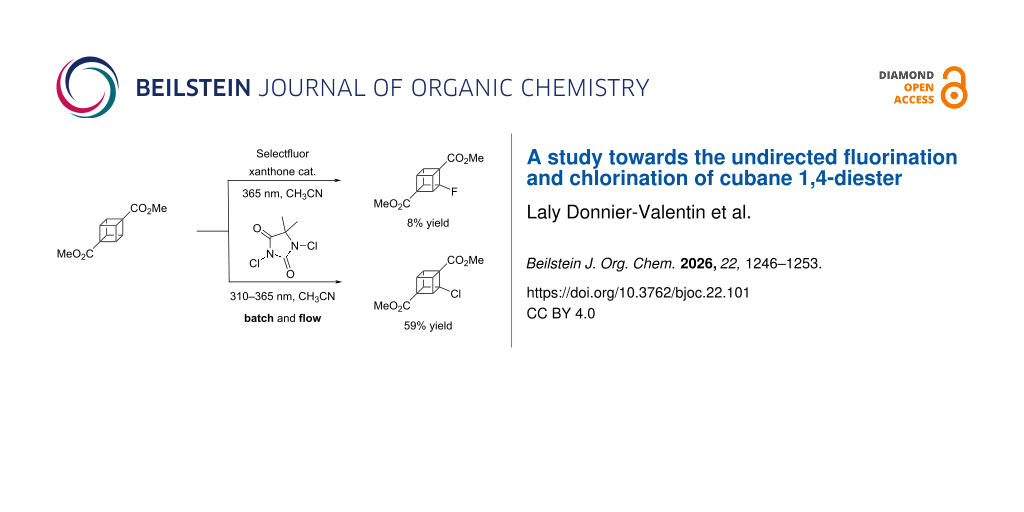
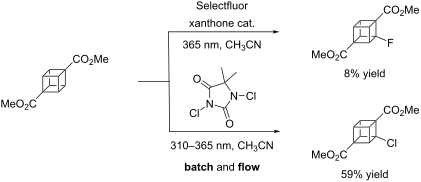
A study towards the undirected C–H fluorination and chlorination of cubane 1,4-diester is described using a user-friendly reagent such as Selectfluor and 1,3-dichloro-5,5-dimethylhydantoin under photoinduction. While the fluorocubane 1,4-diester is formed in low yield (8% yield) due to loss of material, the chlorocubane 1,4-diester was on the other hand prepared in 59% yield without the need for any photocatalyst. Moreover, a proof-of-concept of the chlorination of this strained scaffold was demonstrated using flow technology.
Graphical Abstract
Introduction
The strained cubane scaffold serves as a three-dimensional bioisosteric alternative to benzene, sharing similar dimensions but lacking π-character [1]. Functionalization of the commercially available cubane 1,4-diester is a critical step to obtain isosteres of trisubstituted benzene rings in molecules of interest. Of note, molecules incorporating the cubane motif often exhibit enhanced solubility, metabolic stability, nonspecific binding, and biological activity compared to their aromatic counterparts [2-5].
Among the functionalization strategies, halogenation – particularly fluorination and chlorination – represents a powerful tool for modulating physicochemical properties of aromatic rings, including acidity, halogen bonding, metabolic stability, and solubility [6,7]. The chlorocubane motif can be found in biomolecules with interesting biological properties like the cubyl analogues of diflubenzuron and of moclobemide (Scheme 1a) [8].
![[1860-5397-22-101-i1]](/bjoc/content/inline/1860-5397-22-101-i1.svg?scale=2.0&max-width=1024&background=FFFFFF)
Scheme 1: Undirected fluorination and chlorination of cubane 1,4-diester 1.
Scheme 1: Undirected fluorination and chlorination of cubane 1,4-diester 1.
As 1,4-disubstituted halocubane derivatives are prepared by halodecarboxylation, the synthetic routes to 1,2,4-trisubstituted halocubanes are lengthier, requiring prior carboxylation of cubane 1,4-diester [9,10].
As an alternative route, halogenation by hydrogen abstraction of cubane 1,4-diester remains difficult. The presence of ester groups gives rise to strong C–H bonds (103 kcal·mol−1) to the framework. While studying the formation of cubyl radicals, Della and Walton observed the deactivation of cubane 1,4-diester toward hydrogen abstraction compared to cubane and alkylcubane [11].
Accordingly, the undirected C–H fluorination or chlorination of cubane 1,4-diester 1 requires harsh conditions (Scheme 1b). The C–H fluorination of 1 was initially reported by Lagodzinskaya in the presence of F2 in 40% yield [12]. Elsewhere, Kaleta disclosed the photoinduced C–H chlorination of 1 in 68% yield using an excess of t-BuOCl in CCl4 [13].
When one aims to selectively monohalogenate cubane 1,4-diester, there is a threefold challenge entailing 1) incomplete conversion, leading to potentially co-eluting mixtures of starting material and halocubane 1,4-diester, 2) polyhalogenation and, 3) degradation of the strained carbon cage.
We wish to describe herein our efforts to perform the C–H fluorination and chlorination of cubane 1,4-diester under user-friendly conditions using readily available reagents and solvents (Scheme 1c).
Results and Discussion
Fluorination of cubane 1,4-diester
The study began with the design of a new approach to the fluorocubane 1,4-diester 2 by the undirected fluorination of the commercially available cubane 1,4-diester with Selectfluor instead of fluorine gas. Selectfluor I and II, are practical sources of electrophilic fluorine, employed in undirected C–H fluorination of (cyclo)alkanes [14] involving HAT mechanisms with [15-19] or without photocatalysts [20-22] (Scheme 2).
![[1860-5397-22-101-i2]](/bjoc/content/inline/1860-5397-22-101-i2.svg?scale=2.0&max-width=1024&background=FFFFFF)
Scheme 2: Undirected fluorination of (cyclo)alkanes with Selectfluor reagents.
Scheme 2: Undirected fluorination of (cyclo)alkanes with Selectfluor reagents.
Exposing cubane 1,4-diester to Selectfluor I or II in the presence of peroxydisulfate salts upon heating or under photoactivation led to the isolation of a small amount of fluorocubane 2 (ca. 5% yield) alongside variable amounts of remaining starting material, an important loss of material being noted (Scheme 3).
![[1860-5397-22-101-i3]](/bjoc/content/inline/1860-5397-22-101-i3.svg?scale=2.0&max-width=1024&background=FFFFFF)
Scheme 3: Fluorination of 1 with Selectfluor I or II and peroxydisulfate.
Scheme 3: Fluorination of 1 with Selectfluor I or II and peroxydisulfate.
Slightly more side products were noted in the crude of the reaction with Selectfluor II. Therefore, the first generation of reagent was preferred for the rest of the study. To mitigate degradation, milder conditions were sought using photocatalysis. While attempts to perform the fluorination with tetracyanobenzene, benzophenone, or TBADT were unsuccessful [23], the photocatalyst xanthone (20 mol %) at 300 or 350 nm gave slightly better results (Table 1). In the best scenario, however, 2 was isolated in 8% yield amid partial conversion (ratio 1:2 = 1:6). It must be noted that the separation of 2 from the starting material is challenging and achieving higher conversion was detrimental to the mass balance.
Table 1: Photoinduced fluorination of 1 and deviations from these conditions.
![[Graphic 1]](/bjoc/content/inline/1860-5397-22-101-i6.svg?max-width=637&scale=1.0)
|
|||
| entry | deviations | 2 | 4 |
| 1a | 300 nm, CH3CN/H2O 1:1, 16 h | 8%a | 8%a |
| 2b | without Selectfluor I, 16 h | – | tracesb |
| 3 | 300 nm without Selectfluor I, 16 h | – | not detectedb |
| 4 | Selectfluor I (6 equiv), 85 °C, 16 h without xanthone and hν | tracesb | not detectedb |
| 5 | Selectfluor I (6 equiv), 300 nm, CH3CN/H2O 1:1, 24 h without xanthone | tracesb | tracesb |
| 6 | 300 nm in CD3CN/H2O 1:1, 16 h | 8%a | 4-d3, 5%a |
aIsolated yield; binspection of the crude reaction by 1H NMR spectroscopy (300 MHz).
As a possible explanation of the degradation, we isolated 2-acetylcubane 1,4-diester 4 in variable amounts (up to 8% yield), the highest amount being obtained when operating the C–H fluorination at 300 nm in CH3CN/H2O (Table 1, entry 1). At this wavelength, the mass balance is lower than at 365 nm. The acetylated product 4 may originate from the reaction of the cubyl radical with acetonitrile followed by hydrolysis of the resulting imine/enamine. Since acetyl, or the parent imine, can be fluorinated with Selectfluor I, it is possible that the fluorination of acetyl 4 or its imine precursor also occurred, followed by degradation. The uncontrolled C–H acetylation of fluorocubane 2 may take place as well. Note that no conversion was observed when operating in methanol instead of acetonitrile (not shown) which is consistent with previous studies on C–H fluorination using the reagent [20,21].
To understand the reaction parameters inducing the formation of 4, cubane 1,4-diester 1 was exposed to xanthone (0.2 equiv) purposely without Selectfluor I at 365 nm (Table 1, entry 2). Acetyl 4 was observed as traces in the crude of the reaction. The compound was not detected when carrying out the same experiment at 300 nm (Table 1, entry 3).
Furthermore, attempting the C–H fluorination upon heating (Table 1, entry 4, Selectfluor I (6 equiv), CH3CN, 85 °C, 16 h) without photocatalyst led to traces of 2 while 4 was not detected. At 300 nm and without Xanthone (Table 1, entry 5), traces of 2 and 4 were observed. Performing the C–H fluorination of 1 in CD3CN/H2O (Table 1, entry 6, 300 nm) confirmed that the cubane scaffold reacts to a small extend with the solvent since 4-d3 was isolated (5% yield) alongside 2 (8% yield).
In summary, the fluorination of cubane 1,4-diester was investigated with Selectfluor I or II with or without a photocatalyst, leading to a small amount (8% yield) of fluorocubane 1,4-diester. As a possible explanation for the low mass balance, the formation of acetyl 4 hints to side reactions with the solvent. This observation motivated us to develop a strategy for the fluorodeiodination of iodocubanes with Selectfluor allowing a directed installation of the fluorine atom [24].
Chlorination of cubane 1,4-diester
Pursuing the halogenation of cubane 1,4-diester 1 with mild reagents, we sought to carry out the undirected chlorination of the material. After a screening of conditions, we identified reactions parameters inducing the smooth chlorination of 1. As detailed in Scheme 4, N-chlorosuccinimide (NCS) was combined with photoexcited (300 nm) peroxydisulfate sodium salts to form chlorocubane 3 in 40% yield after 24 h of reaction (ratio 1/3 of 1:2.3, estimated by 1H NMR spectroscopy).
![[1860-5397-22-101-i4]](/bjoc/content/inline/1860-5397-22-101-i4.svg?scale=2.0&max-width=1024&background=FFFFFF)
Scheme 4: Undirected photoinduced chlorination of 1.
Scheme 4: Undirected photoinduced chlorination of 1.
The contrast with the fluorination of 1 is noteworthy: there was no important loss of material and, probably related, the acetyl product 4 was not detected in the crude of the chlorination reaction.
From this initial result, we carried out an optimization of the reaction parameters (Table 2). Performing the experiment at 365 nm (Table 2, entry 2) was slightly better (44% yield) while increasing the concentration ([1] = 0.1 mol/L, Table 2, entry 3) enhanced the ratio 1/3 (1:2 to 1:2.6) and yield (52%). On the other hand, a higher concentration (Table 2, entry 4) was unfavorable. Unexpectedly, it was found that the use of sodium peroxydisulfate was slightly detrimental (Table 2, entry 5) and operating without the oxidant led to 3 in 57% yield (ratio 1/3 = 1:4.5). Solvent screening revealed that acetonitrile gave a better result than chlorinated solvents or acetone (Table 2, entries 6–9). Eventually, 1,3-dichloro-5,5-dimethylhydantoin (DCDMH) was found to be slightly more efficient than NCS (Table 2, entry 10), giving 3 in 59% yield (ratio 1/3 = 1:3.2). The separation of 3 from the starting material is challenging and attempts to achieve higher conversion resulted in negative mass balance.
Table 2: Chlorination reaction of 1.
![[Graphic 2]](/bjoc/content/inline/1860-5397-22-101-i7.svg?max-width=637&scale=1.0)
|
||||||
| entry | reactant |
HAT reagent
(1 equiv) |
solvent | [1] (mol/L) |
ratio
1/3a |
yield
(isolated) |
| 1b | NCSc | Na2S2O8 | CH3CN | 0.05 | 1:2.3 | 40% |
| 2d | NCSc | Na2S2O8 | CH3CN | 0.05 | 1:2 | 44% |
| 3d | NCSc | Na2S2O8 | CH3CN | 0.1 | 1:2.6 | 52% |
| 4d | NCSc | Na2S2O8 | CH3CN | 0.2 | 1:1.9 | 48% |
| 5d | NCSc | – | CH3CN | 0.1 | 1:4.5 | 57% |
| 6d | NCSc | – | CH2Cl2 | 0.1 | 1:1.2 | nd |
| 7d | NCSc | – | acetone | 0.1 | nr | |
| 8d | NCSc | – | DCE | 0.1 | nr | |
| 9d | NCSc | – | CHCl3 | 0.1 | nr | |
| 10d | DCDMHe | – | CH3CN | 0.1 | 1:3.2 | 59% |
aEstimated by 1H NMR spectroscopy. b300 nm; c1.2 equiv; d365 nm; e0.7 equiv.; nr: no reaction; nd: not determined; DCE: 1,2-dichloroethane.
We next sought to develop the chlorination reaction in flow conditions (in a Vapourtec® R-series) as a proof-of-concept with aims both to (i) scale up and (ii) to evaluate the impact of the tR (residence time) on the amount of polychlorocubane products (Table 3). In batch, small amounts of polychlorocubanes were detected and we were curious to examine whether these products could be suppressed.
Table 3: Chlorination reaction of 1 in flow.
![[Graphic 3]](/bjoc/content/inline/1860-5397-22-101-i8.svg?max-width=637&scale=1.0)
|
|||||
| entry | flow rate Q (mL/min) | solvent | T (°C) | tR (min) |
ratio
1/3a |
| 1b,c | 0.4 | CH3CN | 28 | 25 | – |
| 2b,c | 0.4 | CH3CN/CH2Cl2 10:1 | 28 | 25 | 1:0.42 |
| 3b,c | 0.4 | CH3CN/CH2Cl2 4:1 | 28 | 25 | 1:0.82 |
| 4c,d | 0.22 | CH3CN | 30 | 45 | 1:1.32 |
| 5d,e | 0.33 | CH3CN | 28 | 30 | 1:1.13 |
aEstimated by 1H NMR spectroscopy; bpartial precipitation; c365 nm; dheating at 30 °C and sonication of the solution of 1 (c = 0.1 M); e310 nm.
It was noted that when using CH3CN as solvent, the substrate 1 partially precipitated in the tube (flow rate 0.4 mL/min, Table 3, entry 1). Therefore, a co-solvent CH2Cl2 was introduced (Table 3, entries 2 and 3) and even though partial solubilization of 1 was achieved, low amounts of 3 were formed. After 45 min of residence, chlorocubane 3 became the major product (ratio 1/3 = 1:1.32) when using a pre-heated and sonicated initial solution of 1 in CH3CN (Table 3, entry 4). However, small amounts of polychlorinated cubanes were detected. A similar setting was tested at 310 nm (Table 3, entry 5) which led to the isolation of 3 in 41% yield (61% based on remaining starting material).
While the chlorination of 1 was achieved by Kaleta using a large excess of t-BuOCl (16–32 equiv) under photoactivation [13], the utility of the current method involving DCDMH (0.7 equiv) is noteworthy. Since the photolysis of NCS has been described by MacMillan at 450 nm to release chlorine radicals (Cl•) [25], a tentative mechanism proposal would imply that N-centered and chlorine radicals are similarly released by photolysis of DCDMH or of molecular chlorine contained as traces in the reagent (Scheme 5). When the experiment was conducted in the dark, no chlorination occurred. Propagating the chain, the radicals will in turn engage in cubane HAT to give HCl (BDE = 102 kcal·mol−1), a process observed in other contexts [26].
![[1860-5397-22-101-i5]](/bjoc/content/inline/1860-5397-22-101-i5.svg?scale=2.0&max-width=1024&background=FFFFFF)
Note that HAT activation of cubane is a challenging transformation (BDE = 103 kcal·mol−1) performed here with stable and available reagents DCDMH or NCS. The generation of cubyl radicals from cubane 1,4-diester traditionally requires photoexcited strong and unstable oxidants, such as t-BuOX (X = Cl [13], I [27]), or tetra-n-butylammonium decatungstate (TBADT) [28-33].
The reaction of HCl with DCDMH would generate molecular chlorine [34], which by reaction with cubyl radicals may subsequently form chlorocubane and regenerate Cl•. An alternative and parallel pathway may involve the reactivity of the N-centered radical chlorodimethylhydantoin (CDMH) [35], which could form the cubyl radical by HAT and regeneration of the N-centered radical species (CDMH•) after its reaction with DCDMH [36].
Conclusion
Mild conditions were developed to perform undirected fluorination and chlorination of the commercially available cubane 1,4-diester, which will be of interest for the synthesis of substituted benzene isosteres. Whilst the fluorination protocol was limited in efficiency compared to the fluorodeiodination strategy, user-friendly reagents and solvents were successfully employed for the chlorination reaction. The transformation was performed in batch and we demonstrated a proof-of-concept flow implementation. These advances should facilitate the incorporation of chlorocubyl motifs into molecules in various fields of investigation spanning pharmaceuticals, functional materials, and crop science.
Supporting Information
| Supporting Information File 1: Experimental section and copies of spectra. | ||
| Format: PDF | Size: 1.6 MB | Download |
Funding
We are very grateful to the ANR (CERES, ANR-21-CE07-0048) and to the Région Normandie for fellowships to L. D-V, R. H and Q. F-R. This work has been partially supported by Université de Rouen Normandie, INSA Rouen Normandie, Centre National de la Recherche Scientifique (CNRS), Labex SynOrg (ANR-11-LABX-0029), Carnot Institute I2C, the graduate school for research XL-Chem (ANR-18-EUR-0020 XL CHEM) and by Région Normandie. The authors gratefully acknowledge the European Regional Development Fund. B.L. acknowledges the Research Foundation Flanders (FWO, Belgium) for an Odysseus Type I grant (G0F5621N).
Data Availability Statement
All data that supports the findings of this study is available in the published article and/or the supporting information of this article.
References
-
Chalmers, B. A.; Xing, H.; Houston, S.; Clark, C.; Ghassabian, S.; Kuo, A.; Cao, B.; Reitsma, A.; Murray, C.-E. P.; Stok, J. E.; Boyle, G. M.; Pierce, C. J.; Littler, S. W.; Winkler, D. A.; Bernhardt, P. V.; Pasay, C.; De Voss, J. J.; McCarthy, J.; Parsons, P. G.; Walter, G. H.; Smith, M. T.; Cooper, H. M.; Nilsson, S. K.; Tsanaktsidis, J.; Savage, G. P.; Williams, C. M. Angew. Chem., Int. Ed. 2016, 55, 3580–3585. doi:10.1002/anie.201510675
Return to citation in text: [1] -
Auberson, Y. P.; Brocklehurst, C.; Furegati, M.; Fessard, T. C.; Koch, G.; Decker, A.; La Vecchia, L.; Briard, E. ChemMedChem 2017, 12, 590–598. doi:10.1002/cmdc.201700082
Return to citation in text: [1] -
Reekie, T. A.; Williams, C. M.; Rendina, L. M.; Kassiou, M. J. Med. Chem. 2019, 62, 1078–1095. doi:10.1021/acs.jmedchem.8b00888
Return to citation in text: [1] -
Wiesenfeldt, M. P.; Rossi-Ashton, J. A.; Perry, I. B.; Diesel, J.; Garry, O. L.; Bartels, F.; Coote, S. C.; Ma, X.; Yeung, C. S.; Bennett, D. J.; MacMillan, D. W. C. Nature 2023, 618, 513–518. doi:10.1038/s41586-023-06021-8
Return to citation in text: [1] -
Diepers, H. E.; Walker, J. C. L. Beilstein J. Org. Chem. 2024, 20, 859–890. doi:10.3762/bjoc.20.78
Return to citation in text: [1] -
Wang, M.; Ruskin, J.; Marques, J.; Garrison, N.; Lectka, T. Chem. Rev. 2025, 125, 9382–9428. doi:10.1021/acs.chemrev.5c00363
Return to citation in text: [1] -
Champagne, P. A.; Desroches, J.; Hamel, J.-D.; Vandamme, M.; Paquin, J.-F. Chem. Rev. 2015, 115, 9073–9174. doi:10.1021/cr500706a
Return to citation in text: [1] -
Houston, S. D.; Fahrenhorst-Jones, T.; Xing, H.; Chalmers, B. A.; Sykes, M. L.; Stok, J. E.; Farfan Soto, C.; Burns, J. M.; Bernhardt, P. V.; De Voss, J. J.; Boyle, G. M.; Smith, M. T.; Tsanaktsidis, J.; Savage, G. P.; Avery, V. M.; Williams, C. M. Org. Biomol. Chem. 2019, 17, 6790–6798. doi:10.1039/c9ob01238a
Return to citation in text: [1] -
Bashir‐Hashemi, A. Angew. Chem., Int. Ed. Engl. 1993, 32, 612–613. doi:10.1002/anie.199306121
Return to citation in text: [1] -
Collin, D. E.; Kovacic, K.; Light, M. E.; Linclau, B. Org. Lett. 2021, 23, 5164–5169. doi:10.1021/acs.orglett.1c01702
Return to citation in text: [1] -
Della, E. W.; Head, N. J.; Mallon, P.; Walton, J. C. J. Am. Chem. Soc. 1992, 114, 10730–10738. doi:10.1021/ja00053a008
Return to citation in text: [1] -
Eremenko, L. T.; Oreshko, G. V.; Lagodzinskaya, G. V. Spectrochim. Acta, Part A 2001, 57, 1663–1672. doi:10.1016/s1386-1425(01)00399-7
Return to citation in text: [1] -
Křížková, A.; Bastien, G.; Rončević, I.; Císařová, I.; Rybáček, J.; Kašička, V.; Kaleta, J. J. Org. Chem. 2024, 89, 11100–11108. doi:10.1021/acs.joc.2c02872
Return to citation in text: [1] [2] [3] -
Yakubov, S.; Barham, J. P. Beilstein J. Org. Chem. 2020, 16, 2151–2192. doi:10.3762/bjoc.16.183
Return to citation in text: [1] -
Lantaño, B.; Postigo, A. Org. Biomol. Chem. 2017, 15, 9954–9973. doi:10.1039/c7ob02402a
Return to citation in text: [1] -
Xia, J.-B.; Zhu, C.; Chen, C. Chem. Commun. 2014, 50, 11701–11704. doi:10.1039/c4cc05650g
Return to citation in text: [1] -
Zhang, X.; Guo, S.; Tang, P. Org. Chem. Front. 2015, 2, 806–810. doi:10.1039/c5qo00095e
Return to citation in text: [1] -
Kee, C. W.; Chin, K. F.; Wong, M. W.; Tan, C.-H. Chem. Commun. 2014, 50, 8211–8214. doi:10.1039/c4cc01848f
Return to citation in text: [1] -
Bloom, S.; Knippel, J. L.; Lectka, T. Chem. Sci. 2014, 5, 1175–1178. doi:10.1039/c3sc53261e
Return to citation in text: [1] -
Yakubov, S.; Stockerl, W. J.; Tian, X.; Shahin, A.; Mandigma, M. J. P.; Gschwind, R. M.; Barham, J. P. Chem. Sci. 2022, 13, 14041–14051. doi:10.1039/d2sc05735b
Return to citation in text: [1] [2] -
Yakubov, S.; Dauth, B.; Stockerl, W. J.; da Silva, W.; Gschwind, R. M.; Barham, J. P. ChemSusChem 2024, 17, e202401057. doi:10.1002/cssc.202401057
Return to citation in text: [1] [2] -
Yakubov, S.; Barham, J. P. Org. Chem. Front. 2025, 12, 3156–3162. doi:10.1039/d5qo00149h
Return to citation in text: [1] -
Xia, J.-B.; Zhu, C.; Chen, C. J. Am. Chem. Soc. 2013, 135, 17494–17500. doi:10.1021/ja410815u
Return to citation in text: [1] -
Fevre-Renault, Q.; Hosaka, M.; Depienne, S.; Heinrich, R.; Hedouin, M.; Oulyadi, H.; Fressigné, C.; Nagasawa, S.; Iwabuchi, Y.; Stuart, A. M.; Linclau, B.; De Paolis, M. Org. Lett. 2026, 28, 4680–4685. doi:10.1021/acs.orglett.6c00557
Return to citation in text: [1] -
Garry, O. L.; Heilmann, M.; Chen, J.; Liang, Y.; Zhang, X.; Ma, X.; Yeung, C. S.; Bennett, D. J.; MacMillan, D. W. C. J. Am. Chem. Soc. 2023, 145, 3092–3100. doi:10.1021/jacs.2c12163
Return to citation in text: [1] -
Bell, J. D.; Murphy, J. A. Chem. Soc. Rev. 2021, 50, 9540–9685. doi:10.1039/d1cs00311a
Return to citation in text: [1] -
Reddy, D. S.; Maggini, M.; Tsanaktsidis, J.; Eaton, P. E. Tetrahedron Lett. 1990, 31, 805–806. doi:10.1016/s0040-4039(00)94632-x
Return to citation in text: [1] -
Hosaka, M.; Nagasawa, S.; Iwabuchi, Y. Eur. J. Org. Chem. 2024, 27, e202401055. doi:10.1002/ejoc.202401055
Return to citation in text: [1] -
Hosaka, M.; Nagasawa, S.; Iwabuchi, Y. Org. Lett. 2024, 26, 658–663. doi:10.1021/acs.orglett.3c04019
Return to citation in text: [1] -
Hong, B.-C.; Indurmuddam, R. R. Org. Biomol. Chem. 2024, 22, 3799–3842. doi:10.1039/d4ob00171k
Return to citation in text: [1] -
Ravelli, D.; Fagnoni, M.; Fukuyama, T.; Nishikawa, T.; Ryu, I. ACS Catal. 2018, 8, 701–713. doi:10.1021/acscatal.7b03354
Return to citation in text: [1] -
Protti, S.; Ravelli, D.; Fagnoni, M.; Albini, A. Chem. Commun. 2009, 7351. doi:10.1039/b917732a
Return to citation in text: [1] -
Tzirakis, M. D.; Lykakis, I. N.; Orfanopoulos, M. Chem. Soc. Rev. 2009, 38, 2609. doi:10.1039/b812100c
Return to citation in text: [1] -
Nishiguchi, A.; Maeda, K.; Miki, S. Synthesis 2006, 4131–4134. doi:10.1055/s-2006-950353
Return to citation in text: [1] -
Artaryan, A.; Mardyukov, A.; Kulbitski, K.; Avigdori, I.; Nisnevich, G. A.; Schreiner, P. R.; Gandelman, M. J. Org. Chem. 2017, 82, 7093–7100. doi:10.1021/acs.joc.7b00557
Return to citation in text: [1] -
A comparison between 1,3-dichloro-2,2-dimethylhydantoin and 1,3-dibromo-2,2-dimethylhydantoin reveals that the reactivity of the first reactant is higher toward cubane C–H bonds under photoinduction (365 nm, CH3CN, 16 h).
Return to citation in text: [1]
| 27. | Reddy, D. S.; Maggini, M.; Tsanaktsidis, J.; Eaton, P. E. Tetrahedron Lett. 1990, 31, 805–806. doi:10.1016/s0040-4039(00)94632-x |
| 26. | Bell, J. D.; Murphy, J. A. Chem. Soc. Rev. 2021, 50, 9540–9685. doi:10.1039/d1cs00311a |
| 13. | Křížková, A.; Bastien, G.; Rončević, I.; Císařová, I.; Rybáček, J.; Kašička, V.; Kaleta, J. J. Org. Chem. 2024, 89, 11100–11108. doi:10.1021/acs.joc.2c02872 |
| 1. | Chalmers, B. A.; Xing, H.; Houston, S.; Clark, C.; Ghassabian, S.; Kuo, A.; Cao, B.; Reitsma, A.; Murray, C.-E. P.; Stok, J. E.; Boyle, G. M.; Pierce, C. J.; Littler, S. W.; Winkler, D. A.; Bernhardt, P. V.; Pasay, C.; De Voss, J. J.; McCarthy, J.; Parsons, P. G.; Walter, G. H.; Smith, M. T.; Cooper, H. M.; Nilsson, S. K.; Tsanaktsidis, J.; Savage, G. P.; Williams, C. M. Angew. Chem., Int. Ed. 2016, 55, 3580–3585. doi:10.1002/anie.201510675 |
| 9. | Bashir‐Hashemi, A. Angew. Chem., Int. Ed. Engl. 1993, 32, 612–613. doi:10.1002/anie.199306121 |
| 10. | Collin, D. E.; Kovacic, K.; Light, M. E.; Linclau, B. Org. Lett. 2021, 23, 5164–5169. doi:10.1021/acs.orglett.1c01702 |
| 13. | Křížková, A.; Bastien, G.; Rončević, I.; Císařová, I.; Rybáček, J.; Kašička, V.; Kaleta, J. J. Org. Chem. 2024, 89, 11100–11108. doi:10.1021/acs.joc.2c02872 |
| 8. | Houston, S. D.; Fahrenhorst-Jones, T.; Xing, H.; Chalmers, B. A.; Sykes, M. L.; Stok, J. E.; Farfan Soto, C.; Burns, J. M.; Bernhardt, P. V.; De Voss, J. J.; Boyle, G. M.; Smith, M. T.; Tsanaktsidis, J.; Savage, G. P.; Avery, V. M.; Williams, C. M. Org. Biomol. Chem. 2019, 17, 6790–6798. doi:10.1039/c9ob01238a |
| 25. | Garry, O. L.; Heilmann, M.; Chen, J.; Liang, Y.; Zhang, X.; Ma, X.; Yeung, C. S.; Bennett, D. J.; MacMillan, D. W. C. J. Am. Chem. Soc. 2023, 145, 3092–3100. doi:10.1021/jacs.2c12163 |
| 6. | Wang, M.; Ruskin, J.; Marques, J.; Garrison, N.; Lectka, T. Chem. Rev. 2025, 125, 9382–9428. doi:10.1021/acs.chemrev.5c00363 |
| 7. | Champagne, P. A.; Desroches, J.; Hamel, J.-D.; Vandamme, M.; Paquin, J.-F. Chem. Rev. 2015, 115, 9073–9174. doi:10.1021/cr500706a |
| 20. | Yakubov, S.; Stockerl, W. J.; Tian, X.; Shahin, A.; Mandigma, M. J. P.; Gschwind, R. M.; Barham, J. P. Chem. Sci. 2022, 13, 14041–14051. doi:10.1039/d2sc05735b |
| 21. | Yakubov, S.; Dauth, B.; Stockerl, W. J.; da Silva, W.; Gschwind, R. M.; Barham, J. P. ChemSusChem 2024, 17, e202401057. doi:10.1002/cssc.202401057 |
| 2. | Auberson, Y. P.; Brocklehurst, C.; Furegati, M.; Fessard, T. C.; Koch, G.; Decker, A.; La Vecchia, L.; Briard, E. ChemMedChem 2017, 12, 590–598. doi:10.1002/cmdc.201700082 |
| 3. | Reekie, T. A.; Williams, C. M.; Rendina, L. M.; Kassiou, M. J. Med. Chem. 2019, 62, 1078–1095. doi:10.1021/acs.jmedchem.8b00888 |
| 4. | Wiesenfeldt, M. P.; Rossi-Ashton, J. A.; Perry, I. B.; Diesel, J.; Garry, O. L.; Bartels, F.; Coote, S. C.; Ma, X.; Yeung, C. S.; Bennett, D. J.; MacMillan, D. W. C. Nature 2023, 618, 513–518. doi:10.1038/s41586-023-06021-8 |
| 5. | Diepers, H. E.; Walker, J. C. L. Beilstein J. Org. Chem. 2024, 20, 859–890. doi:10.3762/bjoc.20.78 |
| 24. | Fevre-Renault, Q.; Hosaka, M.; Depienne, S.; Heinrich, R.; Hedouin, M.; Oulyadi, H.; Fressigné, C.; Nagasawa, S.; Iwabuchi, Y.; Stuart, A. M.; Linclau, B.; De Paolis, M. Org. Lett. 2026, 28, 4680–4685. doi:10.1021/acs.orglett.6c00557 |
| 14. | Yakubov, S.; Barham, J. P. Beilstein J. Org. Chem. 2020, 16, 2151–2192. doi:10.3762/bjoc.16.183 |
| 20. | Yakubov, S.; Stockerl, W. J.; Tian, X.; Shahin, A.; Mandigma, M. J. P.; Gschwind, R. M.; Barham, J. P. Chem. Sci. 2022, 13, 14041–14051. doi:10.1039/d2sc05735b |
| 21. | Yakubov, S.; Dauth, B.; Stockerl, W. J.; da Silva, W.; Gschwind, R. M.; Barham, J. P. ChemSusChem 2024, 17, e202401057. doi:10.1002/cssc.202401057 |
| 22. | Yakubov, S.; Barham, J. P. Org. Chem. Front. 2025, 12, 3156–3162. doi:10.1039/d5qo00149h |
| 35. | Artaryan, A.; Mardyukov, A.; Kulbitski, K.; Avigdori, I.; Nisnevich, G. A.; Schreiner, P. R.; Gandelman, M. J. Org. Chem. 2017, 82, 7093–7100. doi:10.1021/acs.joc.7b00557 |
| 13. | Křížková, A.; Bastien, G.; Rončević, I.; Císařová, I.; Rybáček, J.; Kašička, V.; Kaleta, J. J. Org. Chem. 2024, 89, 11100–11108. doi:10.1021/acs.joc.2c02872 |
| 23. | Xia, J.-B.; Zhu, C.; Chen, C. J. Am. Chem. Soc. 2013, 135, 17494–17500. doi:10.1021/ja410815u |
| 36. | A comparison between 1,3-dichloro-2,2-dimethylhydantoin and 1,3-dibromo-2,2-dimethylhydantoin reveals that the reactivity of the first reactant is higher toward cubane C–H bonds under photoinduction (365 nm, CH3CN, 16 h). |
| 12. | Eremenko, L. T.; Oreshko, G. V.; Lagodzinskaya, G. V. Spectrochim. Acta, Part A 2001, 57, 1663–1672. doi:10.1016/s1386-1425(01)00399-7 |
| 28. | Hosaka, M.; Nagasawa, S.; Iwabuchi, Y. Eur. J. Org. Chem. 2024, 27, e202401055. doi:10.1002/ejoc.202401055 |
| 29. | Hosaka, M.; Nagasawa, S.; Iwabuchi, Y. Org. Lett. 2024, 26, 658–663. doi:10.1021/acs.orglett.3c04019 |
| 30. | Hong, B.-C.; Indurmuddam, R. R. Org. Biomol. Chem. 2024, 22, 3799–3842. doi:10.1039/d4ob00171k |
| 31. | Ravelli, D.; Fagnoni, M.; Fukuyama, T.; Nishikawa, T.; Ryu, I. ACS Catal. 2018, 8, 701–713. doi:10.1021/acscatal.7b03354 |
| 32. | Protti, S.; Ravelli, D.; Fagnoni, M.; Albini, A. Chem. Commun. 2009, 7351. doi:10.1039/b917732a |
| 33. | Tzirakis, M. D.; Lykakis, I. N.; Orfanopoulos, M. Chem. Soc. Rev. 2009, 38, 2609. doi:10.1039/b812100c |
| 11. | Della, E. W.; Head, N. J.; Mallon, P.; Walton, J. C. J. Am. Chem. Soc. 1992, 114, 10730–10738. doi:10.1021/ja00053a008 |
| 15. | Lantaño, B.; Postigo, A. Org. Biomol. Chem. 2017, 15, 9954–9973. doi:10.1039/c7ob02402a |
| 16. | Xia, J.-B.; Zhu, C.; Chen, C. Chem. Commun. 2014, 50, 11701–11704. doi:10.1039/c4cc05650g |
| 17. | Zhang, X.; Guo, S.; Tang, P. Org. Chem. Front. 2015, 2, 806–810. doi:10.1039/c5qo00095e |
| 18. | Kee, C. W.; Chin, K. F.; Wong, M. W.; Tan, C.-H. Chem. Commun. 2014, 50, 8211–8214. doi:10.1039/c4cc01848f |
| 19. | Bloom, S.; Knippel, J. L.; Lectka, T. Chem. Sci. 2014, 5, 1175–1178. doi:10.1039/c3sc53261e |
| 34. | Nishiguchi, A.; Maeda, K.; Miki, S. Synthesis 2006, 4131–4134. doi:10.1055/s-2006-950353 |
© 2026 Donnier-Valentin et al.; licensee Beilstein-Institut.
This is an open access article licensed under the terms of the Beilstein-Institut Open Access License Agreement (https://www.beilstein-journals.org/bjoc/terms), which is identical to the Creative Commons Attribution 4.0 International License (https://creativecommons.org/licenses/by/4.0). The reuse of material under this license requires that the author(s), source and license are credited. Third-party material in this article could be subject to other licenses (typically indicated in the credit line), and in this case, users are required to obtain permission from the license holder to reuse the material.