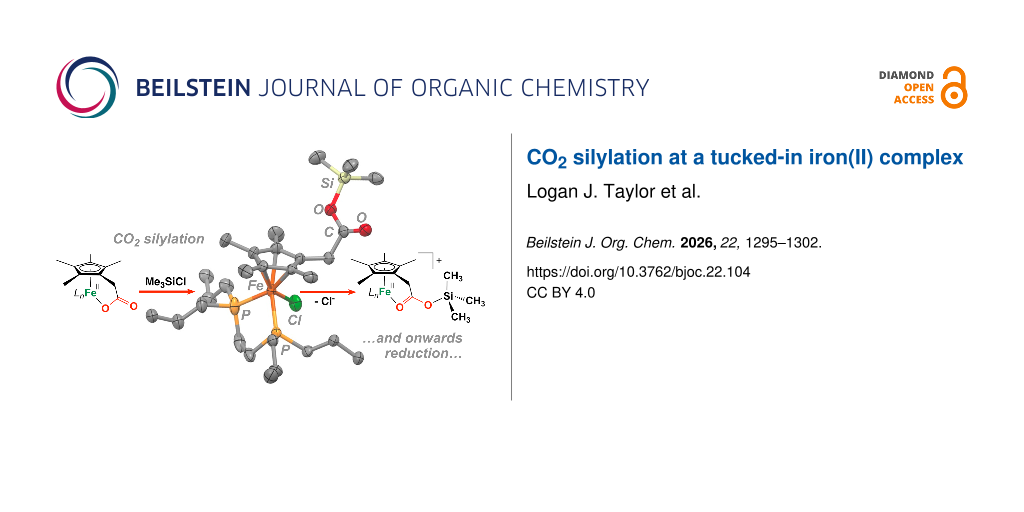
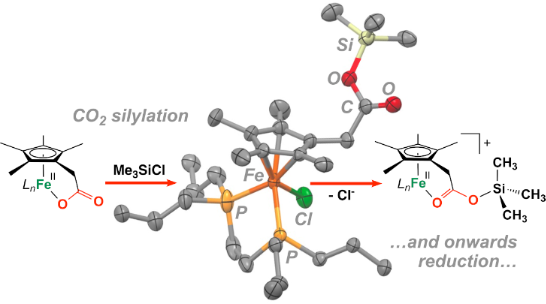
Carbon dioxide (CO2) capture and valorization remain central challenges in sustainable chemistry due to the persistence of CO2 as a major greenhouse gas. Herein, we describe the functionalization of a CO2-activated organometallic complex, [(Cp*–CO2)Fe(diphosphine)] (1; Cp* = C5Me5) in which CO2 is selectively incorporated into the Cp* ligand framework. Treatment of 1 with trimethylsilyl chloride (TMSCl) affords [{Cp*–C(O)–O–TMS}Fe(diphosphine)Cl] (2) via silylation of the Fe–O(CO2) linkage. Chloride abstraction using NaBPh4 generates the putative complex [{Cp*–C(O)–O–TMS}Fe(diphosphine)]+ (3), featuring a labile dative R2C=O→Fe interaction that is readily displaced by acetonitrile to give [{Cp*–C(O)–O–TMS}Fe(diphosphine)(NCCH3)]+ (4). Reduction of the ester functionality in 2 using HBCy2 (Cy = cyclohexyl) provides access to new borylated complexes. Collectively, these results demonstrate the cooperative capture and stepwise CO2 functionalization at a common Cp* ligand framework.
Carbon dioxide (CO2) is a prominent greenhouse gas generated by many natural pathways, including animal respiration and plant death [1], but also increasingly through industrial processes such as the burning of fossil fuels [2]. Greenhouse gases are characterized by their inability to escape Earth’s atmosphere, which in turn prevents the escape of heat – a key contributor to climate change [3]. Fossil fuel-derived CO2 emissions continue to increase, with approximately 43% of annual CO2 emissions remaining in the atmosphere; this has led to a growing interest in CO2 remediation strategies [2]. Organometallic compounds are well-known for their use in CO2 activation, with examples spanning the s- [4,5], p- [6], d- [7,8], and f-blocks [9]. For d-block elements, examples include early [9] to late transition metals [10], with ongoing efforts focused on optimizing CO2 conversion catalysis [11,12] into useful products, such as CO, formaldehyde, methanol, and more [6,9,10].
Of reduction strategies, examples of CO2 hydroboration and hydrosilylation to give bisboryl or silyl ethers have been achieved, which once hydrolyzed provide access to C1-containing synthons. CO2 hydroboration has been demonstrated using a wide range of metals including manganese [13], nickel [14], and palladium [14] to generate borylated analogues of methanol, with various reagents such as pinacolborane (HBPin) [13] and 9-borabicyclo[3.3.1]nonane (9-BBN) [13,14]. Metal-free examples using p-block elements such as silicon [15] and nitrogen [16] have also been shown. Recently, our group contributed to this space, reporting a tucked-in iron complex that reacts with CO2 to give a ferralactone (Scheme 1a and b) [17] which undergoes addition of dicyclohexylborane (HBCy2) to give [(Cp*–BCy2)Fe(diphosphine)H] – a competent catalyst for CO2 dihydroboration using HBCy2[18]. We suggest this reaction occurs via a CO2 B–O templating strategy using a pendent secondary coordination sphere (SCS) borane moiety [18].
Scheme 1:
(a) Catalytic hydroboration by a tucked-in CO2 complex ([18]); (b) CO2 dihydroboration in the presence of excess borane substrate; (c) this work: CO2 silylation and hydroboration via ‘tucked-in’ motif.
Scheme 1:
(a) Catalytic hydroboration by a tucked-in CO2 complex ([18]); (b) CO2 dihydroboration in the presence ...
CO2 (hydro)silylation is complementary to hydroboration, leading to the formation of robust Si–O bonds. Indeed, Leitner and co-workers demonstrated that a cobalt–triazine complex can catalytically produce silylated analogues of formate, methanol, and formaldehyde in the presence of silane, with product selectivity depending on the reaction temperature [19]. Iron has also been shown to hydrosilylate CO2 by Cantat and co-workers, who used different iron(II) phosphine salts to generate formamides and methylamines in the presence of different amines [20]. Other contributions using cobalt pincer complexes [21], NHC-stabilized (NHC = N-heterocyclic carbene) stannyliumylidene complexes [22], and oxorhenium tridentate PNN catalysts [23] to reduce CO2 have also been established. Relevant to this work, a 2022 report by Horáček demonstrated the silylation of CO2 using a titanium ‘tucked-in’ compound in combination with trimethylsilyl chloride (TMSCl) [24]. Building on these precedents, we sought insight into the reactivity of [(Cp*–CO2)Fe(diphosphine)] with a silyl electrophile. The unusual CO2-functionalized Cp*Fe framework provides a rare platform for interrogating how tucked-in motifs participate in reductive transformations with silanes. These studies complement our prior work on hydroboration (Scheme 1b and c) and aim to elucidate broader patterns in base-metal-mediated CO2 reduction chemistry.
Results and Discussion
To begin, [(Cp*–CO2)Fe(dnppe)] (1) [17] was prepared by reaction of the tucked-in complex, [(η6–C5Me4–CH2)FeII(dnppe)] with 1 atm of CO2 at room temperature. Complex 1 has a characteristic 31P NMR spectroscopic signature at δP = 79.1 ppm and a distinct ν(CO) stretch at 1622 cm−1. Treatment of 1 with 1 equiv of trimethylsilyl chloride (TMSCl) yielded a slightly darker purple solution, with a very similar 31P{1H} NMR shift to 1 at δP = 79.0 ppm, which mirrors the value observed for the known complex [Cp*Fe(dnppe)Cl] (δP = 79.4 ppm) (Scheme 2) [25]. Of note, both complex 1 and its tucked-in precursor show no productive reactivity with hydridosilanes such as Ph3SiH. By 1H,29Si HMBC NMR spectroscopy, TMS incorporation was corroborated by the presence of a cross-signal at δH = 0.22 ppm (9H) and δSi = −24 ppm, indicating formation of [{Cp*–C(O)–O–TMS}Fe(dnppe)Cl] (2), having a peripherally silylated CO2 group. Further examination of the 1H NMR spectra confirms Cs symmetry, rendering the functionalized CH2 protons equivalent (δH = 3.49 ppm) (Figure 1a). By LIFDI–MS, 2 displays a molecular ion at m/z = 604.2474 (calcd. m/z = 604.2485 for C28H55O2ClFeP2Si). The structure of 2 was further confirmed by scXRD using purple crystals grown from a saturated pentane solution at −35 °C. The solid-state structure reveals an Fe–Cl bond length of 2.353(1) Å and a Si–O bond length of 1.699(2) Å (Figure 1a, inset). The silylated ester fragment exhibits bond metrics of r(C–C(O)) = 1.509(3) Å, r(C=O) = 1.207(2) Å, and r(C–O) = 1.346(3) Å. The lengths of the C–O and C=O bonds fall within the expected literature range for ester functional groups of 1.35–1.40 Å and 1.1–1.2 Å, respectively [26].
Scheme 2:
Synthesis of the silylated CO2 adduct 2 and subsequent chloride abstraction.
Scheme 2:
Synthesis of the silylated CO2 adduct 2 and subsequent chloride abstraction.
Figure 1:
(a) 2, 1H NMR, C6D6, 400 MHz, 298 K. Inset shows the molecular structure of 2 with ellipsoids drawn at 50% probability. Hydrogen atoms are omitted for clarity; (b) variable-temperature (VT) 31P{1H} NMR for 3 from 298 to 198 K (THF-H8, 243 MHz). Broad signals in 1H NMR baseline of 2 attributed to dnppe CH2 signals.
Figure 1:
(a) 2, 1H NMR, C6D6, 400 MHz, 298 K. Inset shows the molecular structure of 2 with ellipsoids drawn...
Motivated by the clean silylation reactivity of 1, we explored whether removal of the iron-bound Cl ligand in 2 could promote onwards reactivity, potentially enabling interaction between the Fe center and the C=O group. As such, 2 was reacted with sodium tetraphenylborate (NaBPh4) in diethyl ether over 12 hours, affording a cloudy yellow solution. Subsequent analysis by 31P{1H} NMR spectroscopy revealed a broad peak at δP = 71.8 ppm (Δ1/2 = 60 Hz), suggestive of abstraction (Figure 1b). The width of this resonance suggested an equilibrium involving [{Cp*–C(O)–O–TMS}Fe(dnppe)]+, potentially between a carbonyl oxygen-bound and unbound form, or between the bound species and its dinitrogen adduct [{Cp*–C(O)–O–TMS}Fe(dnppe)(N2)]+ (δP = 71.2 ppm for [Cp*Fe(dnppe)(N2)]+, for example). The unbound (N2-free) species adopts a triplet electronic configuration (S = 1) and is higher in energy than its corresponding N2 adduct (S = 0) [27]. These possibilities prompted further investigation by variable-temperature NMR spectroscopy (Figure 1b). Upon cooling to −75 °C, this 31P NMR peak significantly sharpens and moves to δP = 73.5 ppm, which is attributed to the coordination equilibrium, as described above. Further supporting an “on–off” equilibrium in 3, introduction of the weak L–type donor, acetonitrile, provided a 31P NMR resonance at δP = 77.4 ppm; this is similar to the model complex, [Cp*Fe(dnppe)NCCH3]+ (δP = 78.7 ppm) [28], suggesting formation of [{Cp*–C(O)–O–TMS}Fe(dnppe)NCCH3]+ (4) and displacement of the weak R2C=O→Fe interaction (Scheme 2). During efforts to characterize 4, desilylation occurred, likely due to the presence of trace amounts of moisture in the THF or MeCN used, giving 5 (δH = 11.1 ppm) and 0.5 equiv TMS2O (δH = 0.07 ppm) [29] (see Supporting Information File 1). By ESI–MS, 5 displays an [M − H]+ signal at m/z = 496.2309 (calcd. m/z = 496.2322 for C25H46FeO2P2); a signal for 4 was not observed, again highlighting the ease by which the –OTMS group is cleaved.
Like 1, complex 2 also undergoes reduction upon treatment with excess HBCy2. Multinuclear NMR spectroscopic analysis supports the formation of several C2-functionalized Cp* compounds, including the bisborylacetal (6–H), vinyloxyborane (7–H), and ethoxyborane (8–H) complexes where X–H refers to an {Fe–H} species; these were identified in the crude reaction mixture based on characteristic NMR signatures (Scheme 3) and from our previous work independently reacting 1 with HBCy2[18]. These products arise from successive borane additions to the CO2-derived C2 unit, ultimately leading to the formation of ethoxyborane complex 8–H. Unlike 1, the use of the {Fe–Cl} precursor 2 further complicates analysis of the product mixture, possessing several {Fe–Cl}-containing species (X–Cl) in addition to {Fe–H}-containing complexes 6–H and 8–H. By LIFDI–MS of the product mixture, two predominant signals are seen at m/z = 660.4416 (calcd. 660.4423 for C37H71OBFeP2 for 8–H) and m/z = 694.4025 (calcd. 694.4033 for C37H70OBClFeP2 for 8–Cl). Consistent with the strong leaving ability of –OTMS, silylated Cp* complexes were not observed by crude 1H NMR spectroscopy nor LIFDI–MS. The fate of –SiMe3 was not determined, however, TMS signals could be observed between 0.1–0.3 ppm via 1H NMR spectroscopy. Formation of Me3SiH during the synthesis of 6–H/Cl is possible, however, it is highly volatile (bp 6.7 °C) [30], and a characteristic multiplet (δSi–H ≈ 4.0 ppm) [31] was not observed by 1H NMR spectroscopy.
Scheme 3:
Observed reactivity between 1, TMSCl, and HBCy2. Numbers refer to 1H NMR shifts (multiplicity).
Scheme 3:
Observed reactivity between 1, TMSCl, and HBCy2. Numbers refer to 1H NMR shifts (multiplicity).
Overall, this reductive chemistry provides a route to Cp* products in which CO2 serves as a C1 synthon at a silylated iron complex, enabling access to reduced ethyl-functionalized derivatives, albeit with lower selectivity for iron hydride products when compared to previous results using hydroboration of 1[18].
Conclusion
In summary, we have demonstrated that a CO2-functionalized tucked-in iron complex can be stepwise derivatized. Electrophilic silylation with TMSCl functionalizes the Fe–CO2 linkage to afford a silyl ester. Subsequent chloride abstraction suggests generation of a cationic complex featuring a weak, fluxional intramolecular carbonyl O→Fe interaction that is readily displaced by the neutral donor ligand, acetonitrile, highlighting the hemilabile nature of the tethered ester functionality. Preliminary hydroboration studies further demonstrate that the silylated CO2 fragment remains susceptible to downstream desilylation and reduction. Collectively, these results provide new opportunities for the development of organometallic strategies that combine CO2 activation with selective C1–derivatization.
Experimental
General considerations
All experiments were carried out employing standard Schlenk techniques under an atmosphere of dry nitrogen employing degassed, dried solvents. Benzene and THF were tested with a standard purple solution of sodium benzophenone ketyl in tetrahydrofuran to confirm effective moisture removal. Acetonitrile was dried over molecular sieves and degassed by three freeze–pump–thaw cycles [32]. All other reagents were purchased from commercial vendors and used without further purification unless otherwise stated. [(Cp*–CO2)Fe(dnppe)] (1) was prepared according to literature procedures [17].
Physical methods
All NMR data were recorded with a Bruker AVIII HD 400 MHz, a Bruker Neo 600 MHz, or a Varian INOVA 600 instrument. 1H NMR spectra are reported in parts per million (ppm) and are referenced to residual solvent, e.g., 1H (C6D6): δ = 7.16; 13C (C6D6): δ = 128.06; coupling constants are reported in Hz. 11B, 13C, 29Si, and 31P NMR spectra were performed as proton-decoupled experiments (unless explicitly stated otherwise) and are reported in ppm. Selective irradiation experiments (1H 1D TOCSY) were performed by selective irradiating signal of interest using a Bruker Neo 600 MHz instrument. 2D NMR experiments (1H,1H COSY, 1H,13C HSQC) were run using standard acquisition parameters on a Bruker Neo 600 MHz instrument. 1H,29Si HSQC was performed with a Bruker AVIII HD 400 MHz instrument. VT 31P{1H} NMR was performed with a Varian INOVA 600 instrument. Mass spectrometry was carried out with a Thermo Scientific Orbitrap Exploris 120 Instrument.
Preparation of compounds
[(η5–C5Me4–CH2–CO2Si(CH3)3)Fe(dnppe)Cl] (2; C28H55FeO2P2ClSi, MW = 604.6 g/mol): In a glovebox, 1 (23 mg, 0.046 mmol) was dissolved in benzene (2 mL) in a 20 mL scintillation vial. Trimethylsilyl chloride (5.89 μL, 0.046 mmol) was added and the reaction occurred immediately. The mixture was then washed three times with pentane (3 × 2 mL) and filtered through Celite® 545. Removal of volatiles in vacuo gave 2 as a purple solid (11.4 mg, 48%).1H NMR (400 MHz, C6D6, 298 K) δH 3.49 (s, 2H, η5-C5Me4-(CH2)), 2.09 (m, 6H, overlapping CH2 signals), 1.94 (s, 6H, η5-C5Me4-(µ-CH2)), 1.83 (m, 2H, CH2), 1.59 (m, 2H, CH2), 1.45 (s, 6H, η5-C5Me4-(µ-CH2)), 1.30 (m, 10H, CH2 signals), 0.99 (t, JH,H = 7.2 Hz, 6H, P-CH2-CH2-CH3) 0.85 (t, JH,H = 7.2 Hz, 6H, P-CH2-CH2-CH3), 0.22 (s, 9H, Si-(CH3)3); 31P{1H} NMR (162 MHz, C6D6, 298 K) δP 79.0 ppm; 1H,29Si NMR HMBC (400 MHz, C6D6, 298 K) δSi −24 ppm; 13C{1H} NMR (101.5 MHz, C6D6, 298 K) δC 171.7 (s, C5Me4-CH2-CO2), 86.1 (s, C5Me4-CH2-CO2), 79.9 (s, C5Me4-CH2-CO2), 79.1 (s, C5Me4-CH2-CO2), 34.6 (s, CH2), 31.7 (m, CH2), 29.2 (m, CH2), 23.2 (m, CH2), 19.3 (s, CH2), 18.4 (s, CH2), 16.6 (m, CH2), 11.5 (s, CH3), 11.2 (s, CH3), −0.24 (s, Si-(CH3)3; FTIR (ATR, benzene film) ν: 1,716 cm−1 (C=O); HRMS–LIFDI (m/z): [M]+ calcd for C28H55FeO2P2ClSi, 604.2485; found, 604.2474.
[(η5–C5Me4–CH2–CO2Si(CH3)3)Fe(dnppe)][BPh4] (3; C52H72FeO2P2SiB, MW = 888.9 g/mol): In a glovebox, compound 2 (11.4 mg, 0.019 mmol) was dissolved in diethyl ether in a 20 mL scintillation vial. NaBPh4 (6.1 mg, 0.018 mmol, 0.95 equiv) was added and the reaction mixture was stirred for 24 h. Volatiles were removed in vacuo, and the solids washed with pentane (3 × 2 mL), where the residue was then dissolved in THF, filtered through Celite® 545, and volatiles removed in vacuo to afford 3 as a yellow–beige solid (18.3 mg, >99%). 31P{1H} NMR (243 MHz, THF-H8, 298 K) δP 71.8 ppm (br).
[(η5–C5Me4–CH2–CO2Si(CH3)3)Fe(dnppe)NCCD3][BPh4] (4; C54H78FeNO2P2SiB, MW = 929.9 g/mol): In a glovebox, compound 2 (10.6 mg, 0.018 mmol) was placed in a scintillation vial and dissolved in THF–d8. NaBPh4 (6 mg, 0.018 mmol) was then added, followed by the addition of approximately 5 μL of CD3CN, which immediately generated an orange-colored solution. Upon standing for 12 h, compound 4 slowly converted to compound 5, in which the TMS group had been removed to reveal a carboxylic acid. This transformation was supported by the appearance of a new 1H NMR resonance at δH 11.1 ppm (RCO2H), together with a new broadened 31P NMR resonance at δP 77.42 ppm, slightly upfield of that observed for 4 (δP 77.43 ppm). 1H NMR (400 MHz, THF-d8, 298 K) δH 7.28 (m, 8H, o-C6H5 BPh4−), 6.85 (m, 8H, m-C6H5 BPh4−), 6.71 (m, 4H, p-C6H5 BPh4−), 2.98 (s, 2H, η5-C5Me4-(CH2)), 2.07 (m, 4H, overlapping CH2 signals), 1.86 (m, 6H, overlapping CH2 signals), 1.67 (s, 6H, η5-C5Me4-(µ-CH2)), 1.62 (s, 6H, η5-C5Me4-(µ-CH2)), 1.50 (m, 6H, overlapping CH2 signals), 1.23 (m, 4H, overlapping CH2 signals), 1.07 (m, 12H, P-CH2-CH2-CH3), 0.23 (s, 9H, Si-(CH3)3); 31P{1H} NMR (162 MHz, THF-d8, 298 K) δP 77.43 (s, 4), 77.42 (br, 5); 11B{1H} NMR (128 MHz, THF-d8, 298 K) δB −6.5 ppm; HRMS–ESI(+) (m/z): [M − H]+, [5 − H]+ calcd for C25H46FeO2P2, 496.2322; found, 496.2309; FTIR (ATR, acetonitrile film) ν: 2,243 cm−1 (C≡N).
Reduction chemistry to give 6–H/Cl and 8–H/Cl: In the glovebox, complex 2 (8.1 mg, 0.013 mmol) was added to a 20 mL scintillation vial and dissolved in 1 mL of C6D6. HBCy2 (11.9 mg, 0.067 mmol) was then added and the reaction mixture was allowed to stir. Upon stirring overnight (12 h), the solution changed from purple to orange. The product mixture was dried in vacuo giving several reduced products as a yellow oil (>95% conversion of 2 based on 31P{1H} NMR spectroscopy). Due to similarity in polarity, these compounds were inseparable. Treatment of the crude reaction mixture with NaBPh4 (4.2 mg, 0.0123 mmol) to possibly remove any {Fe–Cl} impurities by halide abstraction in Et2O, followed by stirring overnight, afforded a brown solution. Removal of the solvent in vacuo, followed by washing of the resulting solid with pentane (3 × 2 mL) and filtration through Celite® 545, afforded an orange–brown solution. Dissolution of this material in C6D6 resulted in minor amounts (<2 mg) of mostly two isomers having Cp*–CH2CH2OBCy2 connectivity, one an Fe–H (6–H), and the other, an Fe–Cl (6–Cl). 1H NMR (400 MHz, C6D6, 298 K, selected signals) δH 6.18 (t, 3JH–H = 5.0 Hz, 1H, Cp*–CH2CH(OBCy2)2 6–H) [18], 5.43 (t, 3JH–H = 5.0 Hz, 1H, Cp*–CH2CH(OBCy2)2 6–Cl), 4.01 (t, 3JH–H = 7.6 Hz, 2H, Cp*–CH2CH2OBCy2 8–H) [18], 3.95 (t, 3JH–H = 7.6 Hz, 2H, Cp*–CH2CH2OBCy2 8–Cl), 3.04 (d, 3JH–H = 5.0 Hz, 2H, Cp*–CH2CH(OBCy2)2 6–H), 2.89 (d, 3JH–H = 5.0 Hz, 2H, Cp*–CH2CH(OBCy2)2 6–Cl), 2.78 (t, 3JH–H = 7.6 Hz, 2H, Cp*–CH2CH2OBCy2 8–H), 2.61 (t, 3JH–H = 7.6 Hz, 2H, Cp*–CH2CH2OBCy2 8–Cl); 13C{1H} NMR (101 MHz, C6D6, 298 K, selected signals by 1H,13C HSQC) δC 94.42 (Cp*–CH2CH(OBCy2)26–Cl), 94.06 (Cp*–CH2CH(OBCy2)26–H), 65.8 (s; Cp*–CH2CH2–OBCy28–H), 64.18 (s; Cp*–CH2CH2OBCy28–Cl), 37.99 (Cp*–CH2CH(OBCy2)2 6–Cl), 36.40 (Cp*–CH2CH(OBCy2)2 6–H), 31.9 (s, Cp*–CH2CH2OBCy28–H), 29.72 ppm (s, Cp*–CH2CH2OBCy28–Cl); 11B (128 MHz, C6D6, 298 K, selected signals) δB 45–55 ppm (br; (RO)BCy2); 31P{1H} NMR (162 MHz, THF-d8, 298 K) δP 97.8 (d, JH,P = 21.0 Hz, 6–H), 79.0 (s, 6–Cl); HRMS–LIFDI (m/z): [M]+ calcd for 8–H, C37H71BFeOP2, 660.4423; found, 660.4416; [M]+ calcd for 8–Cl, C37H70BClFeOP2, 694.4033; found, 694.4025; [M]+ calcd for 6–H, C49H92B2FeO2P2, 852.6108; found, 852.6102.
Supporting Information
Spectroscopic data for all complexes. CCDC 2575113 contains the supplementary crystallographic data for this paper. These data can be obtained free of charge from The Cambridge Crystallographic Data Centre via https://www.ccdc.cam.ac.uk/data_request/cif.
Supporting Information File 1:
Copies of spectra and crystallography details.
M.W.D. is grateful to Western University, the Council of Ontario Universities for a John C. Polanyi award, the Canadian Foundation for Innovation (LOF–212442), and the Natural Sciences and Engineering Research Council of Canada (NSERC) for Discovery Grants, RGPIN–2020–04480/2026–06650, and Discovery Launch Supplement, DGECR–2020–00183 for funding. L.J.T. thanks NSERC for CGRS–M/D awards.
Author Contributions
Logan J. Taylor: formal analysis; investigation; writing – original draft; writing – review & editing. Marcus W. Drover: conceptualization; formal analysis; funding acquisition; investigation; project administration; supervision; visualization; writing – original draft; writing – review & editing.
Data Availability Statement
All data that supports the findings of this study is available in the published article and/or the supporting information of this article.
References
Anwar, M. N.; Iftikhar, M.; Khush Bakhat, B.; Sohail, N. F.; Baqar, M.; Yasir, A.; Nizami, A. S. Sources of Carbon Dioxide and Environmental Issue. In Sustainable Agriculture Reviews 37; Asiri, A.; Lichtfouse, E., Eds.; Sustainable Agriculture Reviews, Vol. 37; Springer Nature: Cham, Switzerland, 2019; pp 13–36. doi:10.1007/978-3-030-29298-0_2
Return to citation in text:
[1]
Le Quéré, C.; Raupach, M. R.; Canadell, J. G.; Marland, G.; Bopp, L.; Ciais, P.; Conway, T. J.; Doney, S. C.; Feely, R. A.; Foster, P.; Friedlingstein, P.; Gurney, K.; Houghton, R. A.; House, J. I.; Huntingford, C.; Levy, P. E.; Lomas, M. R.; Majkut, J.; Metzl, N.; Ometto, J. P.; Peters, G. P.; Prentice, I. C.; Randerson, J. T.; Running, S. W.; Sarmiento, J. L.; Schuster, U.; Sitch, S.; Takahashi, T.; Viovy, N.; Van Der Werf, G. R.; Woodward, F. I. Nat. Geosci.2009,2, 831–836. doi:10.1038/ngeo689
Return to citation in text:
[1]
[2]
Leonzio, G.; Hankin, A.; Shah, N. Chem. Eng. Res. Des.2024,208, 934–955. doi:10.1016/j.cherd.2024.07.014
Return to citation in text:
[1]
[2]
Morimoto, T.; Nakajima, T.; Sawa, S.; Nakanishi, R.; Imori, D.; Ishitani, O. J. Am. Chem. Soc.2013,135, 16825–16828. doi:10.1021/ja409271s
Return to citation in text:
[1]
Hueffel, J. A.; Rigoulet, M.; Wellig, S.; Sperger, T.; Ward, J. S.; Rissanen, K.; Schoenebeck, F. J. Am. Chem. Soc.2025,147, 26149–26157. doi:10.1021/jacs.5c00441
Return to citation in text:
[1]
Kostera, S.; Peruzzini, M.; Gonsalvi, L. Catalysts2021,11, 58. doi:10.3390/catal11010058
Return to citation in text:
[1]
Das Neves Gomes, C.; Blondiaux, E.; Thuéry, P.; Cantat, T. Chem. – Eur. J.2014,20, 7098–7106. doi:10.1002/chem.201400349
Return to citation in text:
[1]
Zurakowski, J. A.; Drover, M. W. Chem. Commun.2023,59, 11349–11352. doi:10.1039/d3cc03325b
Return to citation in text:
[1]
[2]
[3]
Durfy, C. S.; Zurakowski, J. A.; Drover, M. W. Angew. Chem., Int. Ed.2025,64, e202580961. doi:10.1002/anie.202580961
Return to citation in text:
[1]
[2]
[3]
[4]
[5]
[6]
[7]
Cramer, H. H.; Ye, S.; Neese, F.; Werlé, C.; Leitner, W. JACS Au2021,1, 2058–2069. doi:10.1021/jacsau.1c00350
Return to citation in text:
[1]
Frogneux, X.; Jacquet, O.; Cantat, T. Catal. Sci. Technol.2014,4, 1529–1533. doi:10.1039/c4cy00130c
Return to citation in text:
[1]
Scheuermann, M. L.; Semproni, S. P.; Pappas, I.; Chirik, P. J. Inorg. Chem.2014,53, 9463–9465. doi:10.1021/ic501901n
Return to citation in text:
[1]
Niu, D.; Kostenko, A.; Kelly, J. A.; Sarkar, D.; Xu, H.; Inoue, S. Chem. Sci.2025,16, 4014–4022. doi:10.1039/d4sc07116f
Return to citation in text:
[1]
Mazzotta, M. G.; Xiong, M.; Abu-Omar, M. M. Organometallics2017,36, 1688–1691. doi:10.1021/acs.organomet.7b00223
Return to citation in text:
[1]
Pinkas, J.; Gyepes, R.; Polášek, M.; Mach, K.; Horáček, M. Dalton Trans.2022,51, 10198–10215. doi:10.1039/d2dt01344d
Return to citation in text:
[1]
Zurakowski, J. A.; Brown, K. R.; Drover, M. W. Inorg. Chem.2023,62, 7053–7060. doi:10.1021/acs.inorgchem.3c00427
Return to citation in text:
[1]
Allen, F. H.; Kirby, A. J. J. Am. Chem. Soc.1984,106, 6197–6200. doi:10.1021/ja00333a013
Return to citation in text:
[1]
Hamon, P.; Toupet, L.; Roisnel, T.; Hamon, J.; Lapinte, C. Eur. J. Inorg. Chem.2020, 84–93. doi:10.1002/ejic.201901086
Return to citation in text:
[1]
Zurakowski, J. A.; Durfy, C. S.; Stocek, N. B.; Fanchini, G.; Drover, M. W. Chem. Sci.2024,15, 10359–10365. doi:10.1039/d4sc03292f
Return to citation in text:
[1]
Fulmer, G. R.; Miller, A. J. M.; Sherden, N. H.; Gottlieb, H. E.; Nudelman, A.; Stoltz, B. M.; Bercaw, J. E.; Goldberg, K. I. Organometallics2010,29, 2176–2179. doi:10.1021/om100106e
Return to citation in text:
[1]
Tannenbaum, S.; Kaye, S.; Lewenz, G. F. J. Am. Chem. Soc.1953,75, 3753–3757. doi:10.1021/ja01111a043
Return to citation in text:
[1]
Anwar, M. N.; Iftikhar, M.; Khush Bakhat, B.; Sohail, N. F.; Baqar, M.; Yasir, A.; Nizami, A. S. Sources of Carbon Dioxide and Environmental Issue. In Sustainable Agriculture Reviews 37; Asiri, A.; Lichtfouse, E., Eds.; Sustainable Agriculture Reviews, Vol. 37; Springer Nature: Cham, Switzerland, 2019; pp 13–36. doi:10.1007/978-3-030-29298-0_2
Le Quéré, C.; Raupach, M. R.; Canadell, J. G.; Marland, G.; Bopp, L.; Ciais, P.; Conway, T. J.; Doney, S. C.; Feely, R. A.; Foster, P.; Friedlingstein, P.; Gurney, K.; Houghton, R. A.; House, J. I.; Huntingford, C.; Levy, P. E.; Lomas, M. R.; Majkut, J.; Metzl, N.; Ometto, J. P.; Peters, G. P.; Prentice, I. C.; Randerson, J. T.; Running, S. W.; Sarmiento, J. L.; Schuster, U.; Sitch, S.; Takahashi, T.; Viovy, N.; Van Der Werf, G. R.; Woodward, F. I. Nat. Geosci.2009,2, 831–836. doi:10.1038/ngeo689
Fulmer, G. R.; Miller, A. J. M.; Sherden, N. H.; Gottlieb, H. E.; Nudelman, A.; Stoltz, B. M.; Bercaw, J. E.; Goldberg, K. I. Organometallics2010,29, 2176–2179. doi:10.1021/om100106e
Le Quéré, C.; Raupach, M. R.; Canadell, J. G.; Marland, G.; Bopp, L.; Ciais, P.; Conway, T. J.; Doney, S. C.; Feely, R. A.; Foster, P.; Friedlingstein, P.; Gurney, K.; Houghton, R. A.; House, J. I.; Huntingford, C.; Levy, P. E.; Lomas, M. R.; Majkut, J.; Metzl, N.; Ometto, J. P.; Peters, G. P.; Prentice, I. C.; Randerson, J. T.; Running, S. W.; Sarmiento, J. L.; Schuster, U.; Sitch, S.; Takahashi, T.; Viovy, N.; Van Der Werf, G. R.; Woodward, F. I. Nat. Geosci.2009,2, 831–836. doi:10.1038/ngeo689
Morimoto, T.; Nakajima, T.; Sawa, S.; Nakanishi, R.; Imori, D.; Ishitani, O. J. Am. Chem. Soc.2013,135, 16825–16828. doi:10.1021/ja409271s
8.
Hueffel, J. A.; Rigoulet, M.; Wellig, S.; Sperger, T.; Ward, J. S.; Rissanen, K.; Schoenebeck, F. J. Am. Chem. Soc.2025,147, 26149–26157. doi:10.1021/jacs.5c00441





![[1860-5397-22-104-i1]](/bjoc/content/inline/1860-5397-22-104-i1.svg?scale=2.0&max-width=1024&background=FFFFFF)
![[1860-5397-22-104-i2]](/bjoc/content/inline/1860-5397-22-104-i2.svg?scale=2.0&max-width=1024&background=FFFFFF)
![[1860-5397-22-104-1]](/bjoc/content/figures/1860-5397-22-104-1.svg?scale=2.0&max-width=1024&background=FFFFFF)
![[1860-5397-22-104-i3]](/bjoc/content/inline/1860-5397-22-104-i3.svg?scale=2.0&max-width=1024&background=FFFFFF)