Abstract
Terpenoids exhibit remarkable structural diversity, including highly complex ring-expanded or contracted carbocyclic skeletons. This review aims to explore intriguing examples of such ring-size alterations in all aspects of terpenoid synthesis. The current state-of-the-art regarding proposed biosynthetic pathways for terpenoids with unusual carbon skeleta, occurring either during initial cyclisation or subsequent oxidative tailoring, will be examined and discussed. Where possible, biogenetic relationships of closely related families of natural products will be contextualised by showing the mechanistic rationale for their interconversion. In the second part of this article, the application of bioinspired ring contraction and ring-expansion strategies in relevant natural product syntheses will be presented, demonstrating how synthetic chemistry can help to elucidate plausible biogenetic routes for structurally complex natural products.
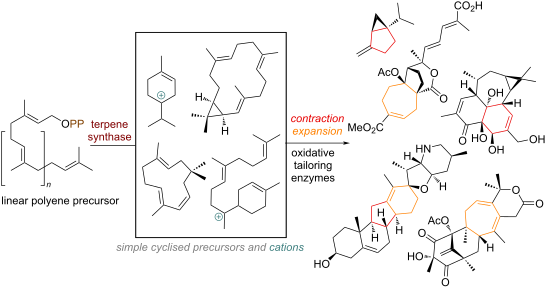
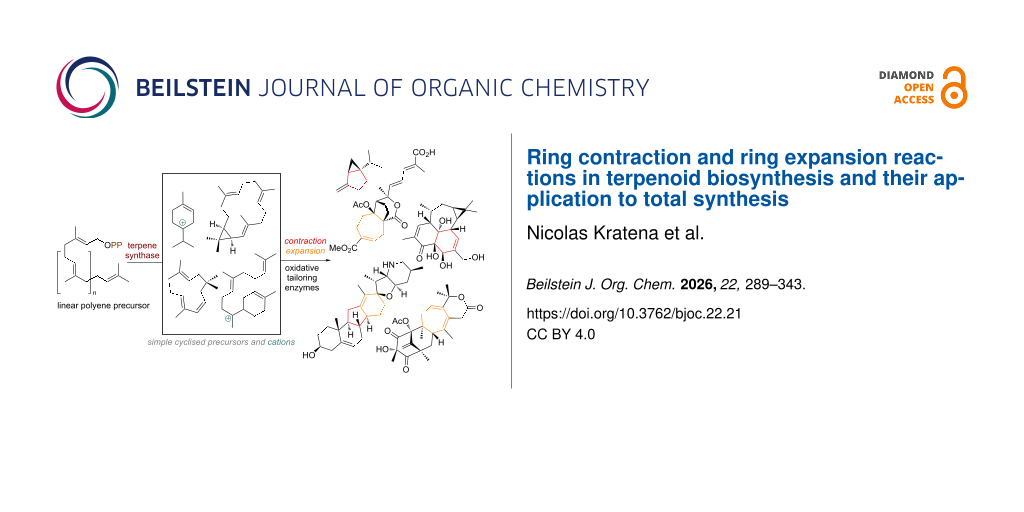
Graphical Abstract
Introduction
The vast richness of structural diversity in terpenoid natural products has fascinated organic chemists for more than a century now [1-5]. With more sophisticated techniques for isolation and characterisation emerging over the decades, thousands of closely related compounds could be identified. Among these, the more structurally interesting, rearranged or highly oxidised members can often only be vaguely traced back to their biogenetic origin based on co-isolation and biochemical intuition. Synthetic approaches can sometimes help to solve these puzzling questions or even result in reassignment of the molecular structure [6-10]. Nevertheless, terpenoids with novel or highly uncommon carbon skeleta continue to attract interest from both biologists and chemists, as they often possess interesting biological properties owing to their unique ring systems, high degree of 3-dimensionality in their structures and oxidation patterns. As obtaining a detailed understanding of a biosynthetic pathway is a dauntingly complex and very labour-intensive process, knowledge about the precise origin of most rearranged terpenoids cannot be secured. Organic synthetic chemistry can help to fill gaps or evaluate, support or revise initially implausible proposed biogenesis routes by attempting to mimic these transformations (= bioinspired or biomimetic synthesis) [11-18]. In general, the biogenesis of unique carbon skeleton terpenoids can be broken down to several stages. First, a linear polyolefin precursor containing multiples of C5 will be assembled. In general, the cyclisation precursor will interact with a cyclase or synthase enzyme and form a “primary reactive species” which undergoes programmed termination to deliver the most common terpene frameworks. In some instances, these enzymes can also effect ring contraction or expansion directly during the initial cyclisation mechanism [19-27]. In many cases though, the ring-altering reaction instead takes place at a later stage of biosynthesis, when the oxidation state of the terpenoids is being adjusted [28-36]. Starting with an already substantial number of these common polycyclic frameworks and adding the almost unlimited variability for oxidative enzymatic C–H functionalisation, it is not surprising that terpenoids with completely unique carbon connectivity and ring systems are still discovered every single year.
In this review article, intriguing examples of apparent ring contraction or expansion reactions of carbocycles in terpenoids, both in biosynthesis and application of similar tactics in the total synthesis, are gathered. Our definition includes both radical and polar ring-size altering reactions, transannular cyclisations of macrocycles and cation-mediated rearrangements where fitting. Goal of this review is to gather and compare mechanistic proposals for the biogenesis of ring-size-altered terpenoids and highlight the utility of strategically including such a step in a natural product synthesis.
To start, an overview of the different classes of enzymes, and thus common mechanisms, of ring-size-altering reactions for terpenes will be presented. In Scheme 1 the four most important manifolds for terpenoid modification in nature are depicted.
![[1860-5397-22-21-i1]](/bjoc/content/inline/1860-5397-22-21-i1.svg?scale=2.0&max-width=1024&background=FFFFFF)
Scheme 1: Mechanistic overview of enzymes involved in ring-size-altering reactions: A: Difference in ionisation mechanism in terpene synthases; B: General mechanism and summarised catalytic cycle of CYP450 oxidations; C: Summarised catalytic cycle of α-KG dependent dioxygenases, example of gibberellin acid biosynthesis; D: Importance of methyltransferases and halogenases in terpene biosynthesis, example of methylation of botryococcene (5).
Scheme 1: Mechanistic overview of enzymes involved in ring-size-altering reactions: A: Difference in ionisati...
Terpene synthase enzymes are centrally important for determining the carbon skeleton and thus family the terpenoid belongs to. These cyclisation enzymes are divided into Class I (active site cleft contains multiple Mg2+-binding motifs which are responsible for the activation of the diphosphate group and ionisation) [25,37] and Class II (ionisation by olefin or epoxide protonation via a carboxylic acid in the active site) [26,38,39] and their reactions thus are mediated by carbocations and olefins, through careful preorganisation of the linear substrate. Alkyl and hydride shifts, stepwise or dyotropic rearrangements have been described to occur during terpene cyclisation, including multiple ring-size modifications.
The CYP450s play a central role for the oxidative functionalisation of terpenes, enabling the rich diversity of secondary metabolites [40,41]. They contain an iron-protoporphyrin core with a cysteine ligand [42] in the axial position, which cycles through different oxidation states (Fe3+/Fe2+/Fe4+) to form highly reactive oxo species which are effective at abstracting closely positioned aliphatic hydrogens via HAT (hydrogen atom transfer) [43]. The resulting alkyl radicals are often rebound to yield terpene alcohols [44-46] or epoxides [47], but other follow-up reactions are possible.
Next, the class of α-KG (ketoglutarate)-dependent dioxygenases also plays an important role, especially for terpenoids, and is therefore included [48,49]. These enzymes exhibit distinctly different Fe-containing active sites, typically consisting of two histidines, a carboxylate ligand (e.g., aspartate) and, of course, the ketoglutarate which is bound both via the C-2 ketone and C-1 carboxylate to form 1 (Scheme 1C). Upon its coordination with oxygen via 2 the ketal structure 3 can decarboxylate [50], generating another high-energy ferryl-oxo species 4 (bound with succinate) which can lead to hydroxylation or carbocation chemistry [51].
Finally, other classes of tailoring enzymes can also act as electrophiles and lead to ring-size modifications via carbocation formation and 1,2-shifts or are otherwise important in their biosynthesis (cf. below for botryococcene (5), Scheme 1D). Methyltransferases, which contain a closely bound S-adenosylmethionine (SAM) as methylating agent in the active site [52,53], and halogenases (e.g., vanadium-catalysed HOX synthesis, see Scheme 1D) [54,55] are of importance in that regard. Apart from these reactions, spontaneous non-enzymatic reactions can also be responsible for triggering ring-size change in terpenoids.
Review
Examples of biosynthetic ring-size adjustments
Ring contractions and expansions of terpenoids with secured biosynthetic routes
The large family of C10-terpenes (monoterpenes) includes many linear compounds but also mono- and bicyclic systems. The variety of structures arises primarily through complex, enzymatically guided polyene cyclisation events of linear precursors, such as geranyl pyrophosphate (GPP, 6). As the goal of this review is to cover mainly skeletal modifications arising from follow up biosynthetic reactions after cyclisation, only selected examples of ring-size altering fundamental steps in polyene cyclisation mechanisms will be presented now. One such example is the formation of the bicyclo[3.1.0]hexane system present in thujane monoterpenes [56] (see Scheme 2A). Starting from geranyl pyrophosphate (6), monoterpene cyclases first build up a 6-membered ring with an exocyclic carbocation, commonly referred to as α-terpinyl cation 6a. From there, a 1,2-hydride shift gives rise to the isomeric terpin-4-yl cation 6b. By way of cyclopropane formation, a different, so called, thujyl cation 6c is conceivable. Elimination then furnishes the ring-contracted 5/3-ring systems from the original cyclohexyl intermediate to give sabinene (7) and α-thujene (8).
![[1860-5397-22-21-i2]](/bjoc/content/inline/1860-5397-22-21-i2.svg?scale=2.0&max-width=1024&background=FFFFFF)
Scheme 2: A: Ring contraction through involvement of carbocationic intermediates in thujane monoterpene biosynthesis; B: Spirocyclisation of a decalin system, initiated from germacrene A (10) during biosynthesis of the sesquiterpenoid β-vetivone B (11); C: Decalin-system ring contraction in pleuromutilin (13) biosynthesis through multiple 1,2-hydride and alkyl shifts.
Scheme 2: A: Ring contraction through involvement of carbocationic intermediates in thujane monoterpene biosy...
Another example of a 6→5 ring contraction can be found in the family of spirocyclic C15-sesquiterpenes, such as β-vetivone B (11, see Scheme 2B) [57-60]. The linear precursor farnesyl pyrophosphate (9) is first cyclised by germacrene A synthase (GAS) to its name-bearing product 10. From here, protonation by vetispiradiene synthase (HVS) gives the eudesmane cation 10a, which is a common intermediate in the biosynthesis of bicyclic sesquiterpenes, e.g., aristocholenes. In this particular enzymatic reaction, the 1,2-alkyl shift of a Wagner–Meerwein rearrangement is responsible for building up the spirocyclic carbon framework and ring contraction (10b). From here, follow up oxidations and olefin isomerisation afford β-vetivone B (11), a constituent of aromatic vetiver oil.
Finally, in the biosynthesis of the antibiotic pleuromutilin (13) [61-63] a similar ring contraction takes place (see Scheme 2C). Cyclisation is initiated via protonation of geranylgeranyl pyrophosphate (GGPP, 12) at the terminal olefin with CpPS (= Clitopilus passeckeranis pleuromutilin synthase), forming the decalin system 12a. A cascade of 1,2-shifts delivers the carbocation 12b which undergoes ring contraction and elimination to give 12c. From here, a second cyclisation towards 12d, 1,5-hydride shift to secondary carbocation 12e and follow-up oxidative decoration of 12f affords the pleuromutilin molecule 13.
A more recently unveiled example of a specific cyclase enzyme effecting a change in ring size during polyene cyclisation was found in pseudolaric acid B (14) biosynthesis [64,65]. In this case, the linear precursor 12 is first cyclised to give intermediate 14a akin to the α-terpinyl cation (see Scheme 3). From here, quantum chemical calculations indicate that the subsequent 1,2-alkyl shift and olefin cyclisation occur in a single, concerted step. This concerted mechanism allows the reaction to bypass a high-energy, non-stabilised secondary carbocation intermediate that would result from a stepwise migration. This pathway is facilitated by the enzyme's active site, where aromatic residues (e.g., Tyr564) are proposed to provide the essential carbocation stabilisation (likely via cation–π interactions) and thus facilitate alkyl migration. The resulting 5,7-bicyclic carbocation 14b is further elaborated and decorated by selective oxidation reactions to build up the family of pseudolaric acids. For example, after a second ring expansion, and additional 5-ring cyclisation by the pendant alkene a new tricyclic carbocation 14c is formed. From here a 1,2-alkyl shift delivers the 7,6,6-ring system of lydicene (15) [66]. Alternatively, a 1,5-hydride shift affords the secondary carbocation 14d which undergoes ring contraction to afford the cyclopropyl-containing natural product neoverrucosanol (16) [67,68].
![[1860-5397-22-21-i3]](/bjoc/content/inline/1860-5397-22-21-i3.svg?scale=2.0&max-width=1024&background=FFFFFF)
Scheme 3: Examples of concerted ring expansions of carbocation intermediates in PxaTPS8-catalysed cyclisations towards fungal diterpenoids in nature and transannular cyclopropyl cyclisation.
Scheme 3: Examples of concerted ring expansions of carbocation intermediates in PxaTPS8-catalysed cyclisation...
Another closely examined example of a similar ring expansion was documented by Abe et al. (see Scheme 4) to occur during the biosynthesis of astellifadiene (17), catalysed by the cyclase EvAS (= Emericella variecolor astellifadiene synthase) [69]. Geranylfarnesyl pyrophosphate (18) is first cyclised through 1,11- and 10,14-connections to the tertiary carbocation 18a, and undergoes the previously described ring expansion, cyclopentane cyclisation (analogous to Scheme 3, see above) to 18b. Elimination affords the triene intermediate 19, followed, once again, by transannular cyclisation to give the tertiary carbocation 19a. A subsequent second ring expansion affords the bridged system cation 19b, which is quenched by a 1,5-hydride shift to finally provide astellifadiene (17).
![[1860-5397-22-21-i4]](/bjoc/content/inline/1860-5397-22-21-i4.svg?scale=2.0&max-width=1024&background=FFFFFF)
Scheme 4: Sequential ring expansions during astellifadiene (17) synthesis reported by Abe and co-workers.
Scheme 4: Sequential ring expansions during astellifadiene (17) synthesis reported by Abe and co-workers.
A distinct and intricate cyclisation cascade was elucidated by Dickschat and co-workers in 2023, describing the biosynthesis of the spirocyclic diterpene spiroluchuene A (20, see Scheme 5), catalysed by the synthase AlTS (Aspergillus luchuensis terpene synthase) [70]. Geranylgeranyl diphosphate (GGPP, 12) is initially cyclised through the well-known 1,10-closure to the cation 20a, followed by a sequence of hydride (20b) and proton shifts to cation 20c, and a second hydride shift to 20d. Subsequent cyclobutane formation via 20e and a ring expansion furnishes cation 20f, which is quenched by deprotonation with cyclopropanation to afford the key neutral intermediate luchudiene (21). One of the olefins in 21 is then reactivated by re-protonation, initiating a second cyclisation sequence that proceeds via cations 21a and 21b. Finally, a remarkable sacrificial carbocyclisation (rupture of the cyclopropane ring) at an aliphatic centre then generates cation 21c, which is quenched by deprotonation to yield spiroluchuene A (20).
![[1860-5397-22-21-i5]](/bjoc/content/inline/1860-5397-22-21-i5.svg?scale=2.0&max-width=1024&background=FFFFFF)
Scheme 5: Cyclobutane ring expansion and sequential ring contractions catalysed by the synthase AITS in the biosynthesis of spiroluchuene A (20).
Scheme 5: Cyclobutane ring expansion and sequential ring contractions catalysed by the synthase AITS in the b...
An illustrative example of a complex cyclisation cascade with multiple ring-size modifications was documented by Dickschat et al. during the biosynthesis of the saturated sesterterpene subrutilane (22, see Scheme 6), catalysed by the cyclase SrS (= Streptomyces subrutilus synthase) [71]. Geranylfarnesyl diphosphate (18) is first cyclised through 1,11- and 10,14-connections to the tertiary carbocation 22a, which undergoes ring expansion (22b) and a 14,18-cyclisation to 22c. A 1,5-hydride shift from the macrocycle generates cation 22d. Subsequent 2,9- and 3,7-cyclisations afford the key carbocation intermediate 22f, which is finally quenched by a deprotonation with concurrent cyclopropanation, effectively contracting a cyclopentane to a cyclobutane, to yield subrutilane (22).
![[1860-5397-22-21-i6]](/bjoc/content/inline/1860-5397-22-21-i6.svg?scale=2.0&max-width=1024&background=FFFFFF)
Scheme 6: Ring expansion and transannular ring contraction of a cyclopentane to cyclobutane in the biosynthesis of the sesterterpene subrutilane (22) catalysed by SrS.
Scheme 6: Ring expansion and transannular ring contraction of a cyclopentane to cyclobutane in the biosynthes...
Based on quantum chemical studies by Tantillo and Hong the biosynthesis of kaurene diterpenes includes interesting, concerted alkyl migration steps [72,73]. Starting from GGPP (12) the class II terpene synthase CPS (= ent-Copalyl diphosphate synthase) catalyses decalin formation through cationic polyene cyclisation of ent-copalyl diphosphate (23) (Scheme 7). From here, different enzymes (e.g., ent-Kaurene synthase) can effect cyclisation of cation 23a to the pimarenyl cation 23b, from which earlier works [74,75] proposed a stepwise cyclisation and alkyl shift to occur. The secondary carbocations which are invoked in this process were found to not be the likely operational intermediates, as calculations showed instead a concerted rearrangement towards the tertiary cation 23c to be more likely. From here, ent-kaurene (24) is obtained directly after elimination. The formation of ent-atiserene (25) involves a more dramatic rearrangement to reach the tertiary carbocation 23d. A triple asynchronous shift occurs, consisting of C12-alkyl (13→16), 1,3-hydride (12→13), and C-13 alkyl shift (16→12). This complex, concerted process directly converts the tertiary cation 23c into the tertiary cation 23d completely avoiding secondary cations and resulting in another 5→6 ring expansion to the bridged system of 25.
![[1860-5397-22-21-i7]](/bjoc/content/inline/1860-5397-22-21-i7.svg?scale=2.0&max-width=1024&background=FFFFFF)
Scheme 7: Computationally elucidated concerted cyclisations/alkyl/hydride shifts during the biosynthesis of the terpenes ent-atiserene (25) and ent-kaurene (24).
Scheme 7: Computationally elucidated concerted cyclisations/alkyl/hydride shifts during the biosynthesis of t...
An early example of a sesquiterpene cyclisation sequence with a ring contraction was documented by Cane et al. during the investigation of epi-isozizaene (26, Scheme 8), catalysed by the synthase EIZS (= Epi-isozizaene synthase) [76]. Farnesyl diphosphate (9) is first ionised and isomerised to (3R)-nerolidyl diphosphate (26a), which undergoes cyclisation to form the bisabolyl cation (26b). A subsequent 1,2-hydride shift yields cation 26c which undergoes spirocyclisation to generate the acorenyl cation (26d). This key intermediate then undergoes a sequence of further cyclisation (26e) and crucial ring contraction via 1,2-alkyl shift to 26f. Methyl migration and quenching by elimination finally afford epi-isozizaene (26).
![[1860-5397-22-21-i8]](/bjoc/content/inline/1860-5397-22-21-i8.svg?scale=2.0&max-width=1024&background=FFFFFF)
Scheme 8: Cyclisation events and 6→5-ring contraction during the construction of epi-isozizaene (26) catalysed by EIZS.
Scheme 8: Cyclisation events and 6→5-ring contraction during the construction of epi-isozizaene (26) catalyse...
Investigative efforts into actinomycetes biosynthesis by Dickschat et al. through deuterium labelling revealed another example for a 4→5 ring expansion which is depicted in Scheme 9 [77]. Intermediate 27 is obtained like shown before (see above, Scheme 4 and Scheme 6), through the enzyme cattleyene synthase (CyS). Next, a concerted ring expansion/ring contraction and additional 2,10-cyclisation delivers the macrocyclic cation 27a. A further 3,6-cyclisation forms the cyclobutane intermediate 27b which can undergo ring expansion via dyotropic rearrangement to give the tetracyclic system of 27c, followed by 1,2-methyl migration (27d) and elimination to furnish cattleyene (28).
![[1860-5397-22-21-i9]](/bjoc/content/inline/1860-5397-22-21-i9.svg?scale=2.0&max-width=1024&background=FFFFFF)
Scheme 9: Transannular cyclisations and 4→5-membered ring expansion through dyotropic 1,2-rearrangement of alkyl and methyl groups in the biosynthesis of cattleyene (28).
Scheme 9: Transannular cyclisations and 4→5-membered ring expansion through dyotropic 1,2-rearrangement of al...
During the investigation of botrydial biosynthesis the groups of Collado, Cane and Viaud could identify a protein titled BcBOT2 (= Botrytiscinerea BOTrydial) with similarity to microbial terpene synthases [78]. Starting from farnesyl pyrophosphate (9) BcBOT2 catalyses a rare, formal [2 + 2] cycloaddition to form the cyclobutyl carbenium ion 29a which undergoes spontaneous ring expansion via 1,2-alkyl shift (see Scheme 10). The secondary carbocation on the 5-membered ring in 29b undergoes additional cyclisation (and ring contraction from a 9-membered ring to a 6/5 bicycle) to give tertiary cation 29c. From here a 1,2-hydride shift leads to intermediate 29d (presilphiperfolan-8-yl cation), a precursor which was invoked to be involved in the biosynthesis of various sesquiterpenes. Two noteworthy examples are given here: either of the two 1,2-alkyl shifts of the cyclohexane accomplishes ring contraction. Following the blue arrow in the structure of 29d (Scheme 10) a second 1,2-methyl migration is required to furnish silphiperfolene (29) [79]. If instead, the bond indicated with the green arrow migrates the triquinane skeleton is assembled. Notably, Yan reported recently [80] that the sesquiterpene α-terrecyclene (30) is formed through the same carbocation 29d, according to the mechanistic proposal by Coates [81]. By interception of the cation with water we arrive at presilphiperfolan-8β-ol (31)
![[1860-5397-22-21-i10]](/bjoc/content/inline/1860-5397-22-21-i10.svg?scale=2.0&max-width=1024&background=FFFFFF)
Scheme 10: Ring expansion in presilphiperfolan-8b-ol (31) biosynthesis and ring contraction of the presilphiperfolan-8-yl cation (29d) towards different sesquiterpene skeleta.
Scheme 10: Ring expansion in presilphiperfolan-8b-ol (31) biosynthesis and ring contraction of the presilphipe...
Dickschat and co-workers reported an example for a ring contraction during the biosynthesis of sodorifen (32) [82]. The cyclisation is triggered by the C-methyltransferase SodC (= pre-sodorifen synthase) which catalyses methyl cation transfer from SAM towards the terminal olefin in 9, a rare event in terpene cyclisation chemistry, resulting in 6,11-ring closure (32a, see Scheme 11). From here, a dyotropic rearrangement can give cation 32c directly, alternatively the mechanism could be enabled by deprotonation through an active-site base (32b) and re-protonation of the cyclopropane moiety (32c). A 1,2-hydride shift, followed by a 1,2-methyl shift towards that same carbon and an elimination, forms the tetrasubstituted double bond in 33, the precursor for sodorifen (32), which is furnished by the class I synthase SodD.
![[1860-5397-22-21-i11]](/bjoc/content/inline/1860-5397-22-21-i11.svg?scale=2.0&max-width=1024&background=FFFFFF)
Scheme 11: Ring contraction via transannular cyclopropanation and opening of cyclopropane in the biosynthesis of the microbial terpene sodorifen (32).
Scheme 11: Ring contraction via transannular cyclopropanation and opening of cyclopropane in the biosynthesis ...
A well-studied example of an oxidative 6→5-membered ring contraction in terpenoid biosynthesis can be found in the formation of the gibberellin family [83,84]. In this instance, the terpene ent-kaurene (34, see Scheme 12) is being oxidised both at one of the methyl groups residing at C-4 and the C-7 methylene to ent-7α-hydroxykaurenoic acid (34a). The hydroxy group in 34a can further engage with a CYP450 enzyme at C-6 (different CYP isoforms responsible in different genii) to form an alkyl radical 34b which upon further SET forms an intermediate carbocation 34c, which collapses under an 1,2-alkyl shift to reveal the key intermediate in gibberellin synthesis, gibberellin A12 aldehyde (35). Alternatively, the ent-kaurene core is known to be likely oxidised at C-1 [85] by a thus far unknown biosynthetic oxidation to deliver a secondary carbocation 35a, which can undergo tandem ring expansion/contraction from the 6,6 to the 7,5 system (35b). After elimination the precursor 36 to the large family of grayanotoxin natural products is reached (grayanotoxin II (37) is depicted exemplarily).
![[1860-5397-22-21-i12]](/bjoc/content/inline/1860-5397-22-21-i12.svg?scale=2.0&max-width=1024&background=FFFFFF)
Scheme 12: The crucial CYP450-catalysed oxidative rearrangement defining the skeleton in gibberellin biosynthesis and selective C-1 oxidation and ring expansion/contraction towards grayanotoxin II (37).
Scheme 12: The crucial CYP450-catalysed oxidative rearrangement defining the skeleton in gibberellin biosynthe...
Another well-studied example of a CYP450-catalysed oxidation triggering a change in ring size was found to occur during the biosynthesis of some brassicicene natural products such as brassicicene I (38) [86]. The 5-8-5 ring system present in these natural products (see Scheme 13) is transformed into a 5/9/5-bridged system through a methylene C-12–H oxidation mediated by the enzyme BscF, triggering a Wagner–Meerwein rearrangement after radical-polar crossover (38a to 38b) and elimination at the bridgehead methyl, resulting in the exo-olefin. The final intermediate 38c is further elaborated by enzymatic oxidation to give brassicicene C (39) from brassicicene I (38).
![[1860-5397-22-21-i13]](/bjoc/content/inline/1860-5397-22-21-i13.svg?scale=2.0&max-width=1024&background=FFFFFF)
Scheme 13: CYP450-mediated oxidation of cyclopentane methylene expanding the 8-membered ring in the biosynthesis of brassicicene natural products.
Scheme 13: CYP450-mediated oxidation of cyclopentane methylene expanding the 8-membered ring in the biosynthes...
In the biosynthesis of aridacin A (40), the initial 6,10-membered bicyclic product 41, after AriE-catalysed polyene cyclisation engages in a HAT with the CYP450 enzyme AriF, abstracting a hydrogen from the C-20 methyl group on the macrocycle [87,88]. The resulting allylic radical 41a can cyclise directly, subsequently giving a different tertiary radical which can get oxidised and quenched by elimination (not depicted in Scheme 14). Alternatively, a SET can occur directly on the methyl radical, delivering allylic carbocation 41b, which cyclises barrierless to give tertiary carbocation 41c. Regioselective, endocyclic elimination delivers the unoxidised terpene precursor 42 towards aridacins.
![[1860-5397-22-21-i14]](/bjoc/content/inline/1860-5397-22-21-i14.svg?scale=2.0&max-width=1024&background=FFFFFF)
Scheme 14: CYP450-mediated oxidation of an exocyclic methyl group to effect transannular cyclisation across the 10-membered macrocycle towards aridacin A (40).
Scheme 14: CYP450-mediated oxidation of an exocyclic methyl group to effect transannular cyclisation across th...
In the rich family of Euphorbia diterpenoids various ring systems are conjectured to be biosynthetically related, such as the casbane, lathyrane, tigliane, and ingenane skeletal [89,90]. The transannular aldol reaction of an oxidised casbene (43, produced from GGPP by casbene synthase, CS) product 44 has been studied closely by the groups of Graham and Hamberger who investigated the BGC present in Jatropha curcas and Euphorbia lathyris, respectively (see Scheme 15) [91-93]. They found that two CYP450 enzymes, CYP71 and CYP726 were primarily responsible for C-4, C-5 and C-8 oxidation of casbene 43 to form intermediate 44 which can isomerise by means of keto–enol tautomerism to give 44a. An additional keto–enol tautomerism allows for the transient formation of 44b, a new enol engaging in an aldol addition towards the highly electrophilic α-diketone moiety. With this, the bicyclic lathyrane skeleton of jolkinol C (45) is assembled selectively from casbene.
![[1860-5397-22-21-i15]](/bjoc/content/inline/1860-5397-22-21-i15.svg?scale=2.0&max-width=1024&background=FFFFFF)
Scheme 15: Non-enzymatic transannular aldol reaction enables the formation of the 5/13/3-tricyclic ring system present in lathyrane diterpenoids from the casbane skeleton.
Scheme 15: Non-enzymatic transannular aldol reaction enables the formation of the 5/13/3-tricyclic ring system...
The large family of indole meroterpenoids [94-98] also contains an interesting, enzyme-mediated ring-expansion reaction. According to the detailed research of their biosynthesis carried out by Oikawa et al. [99,100] the terpenoid penitrem A (46) is formed from PC-M4 (47, see Scheme 16A). This precursor, exhibiting a 5-membered ring annulated onto the indole core, reacts in a HAT reaction under mediation of PtmK, an enzyme possessing an iron(IV)–oxo metal centre, to deliver the methyl-centred radical 47a. From here, the 5→6 ring expansion takes place via radical mechanism giving rise to the stabilised tertiary radical 47b. Oxidation of this radical to the corresponding carbocation and elimination leads to secopenitrem D (48) directly. From here another oxy-cyclisation and aromatic chlorination leads to the most complex member of the indole meroterpenoids, penitrem A (46).
![[1860-5397-22-21-i16]](/bjoc/content/inline/1860-5397-22-21-i16.svg?scale=2.0&max-width=1024&background=FFFFFF)
Scheme 16: A: Oxidative ring expansion of a cyclopentane by incorporation of a methyl group in the biosynthesis of penitrem A (46); B: Ring expansion and rearrangement of the indole moiety in the biosynthesis of sespenine (50).
Scheme 16: A: Oxidative ring expansion of a cyclopentane by incorporation of a methyl group in the biosynthesi...
Another example of a ring expansion reaction, in this case of the aromatic 5-membered ring of an indole, was discovered to be operational in the biosynthetic pathway towards xiamycins and dixiamycins (see Scheme 16B) [28,101-105]. The rearrangements commence by oxidation of C-3 in the indole ring of indosespene (49) by the enzyme XiaF, giving rise to iminium intermediate 49a. Attack of this iminium by the pendant exocyclic olefin affords carbocation 49b, which is quenched by a 1,4-alkyl shift of the aromatic system, and establishment of a C–O double bond at C-12 to give sespenine (50) as the product.
In meroterpenoid biosynthesis, the transformation of andilesin C (51) towards the anditomin skeleton, as investigated by Abe and co-workers, is also an interesting example for ring expansion [106-108]. The PhyH-like dioxygenase AndF abstracts a hydrogen from C-11 of 51 giving rise to secondary alkyl radical 51a (see Scheme 17). An iron(IV)-hydroxy-mediated rebound then results in the hydroxylation of this position. Upon E1 elimination of alcohol 51b, carbocation 51c is generated and undergoes a 1,2-alkyl shift of the ketone moiety, forming a new bridged 7-membered ring (51d), and completing the skeletal adjustment. A final elimination to the exocyclic olefin delivers the complex, caged structure of anditomin (52).
![[1860-5397-22-21-i17]](/bjoc/content/inline/1860-5397-22-21-i17.svg?scale=2.0&max-width=1024&background=FFFFFF)
Scheme 17: Rearrangement and ring expansion in the construction of the complex bridged carbon framework of anditomin (52), mediated by AndF.
Scheme 17: Rearrangement and ring expansion in the construction of the complex bridged carbon framework of and...
Apart from this D-ring expansion of 3,5-dimethylorsellinic acid (DMOA)-derived meroterpenoids, Abe and co-workers were also able to show enzymatically controlled pathways for the B-ring expansion and A-ring spirocyclisation and contraction [109]. From the common precursor preaustinoid A1 (53) a HAT step mediated by the iron(IV)-oxo enzyme PrhA generates a radical (53a) at C-1 of the terpenoid framework (see Scheme 18), resulting in cyclopropanation to give radical 53b. Subsequent cyclopropane opening leads to the ring-expanded B-ring centred, tertiary radical 53c. Finally, abstraction of the allylic hydrogen in this product by an iron(III)-species affords the 6/7/6/6 bridged framework of berkeleydione (54). A different iron(IV)-oxo enzyme AusE is also capable of selectively abstracting the 5α-hydrogen atom, giving rise to alkyl radical 53d, which gets hydroxylated via rebound to give intermediate 53e [110]. Carbocation formation at C-5, followed by a 1,2-alkyl shift and elimination thus furnishes the sister natural product preaustinoid A3 (55), thought to be the precursor to the highly oxidised meroterpenoid acetoxydehydroaustin (56).
![[1860-5397-22-21-i18]](/bjoc/content/inline/1860-5397-22-21-i18.svg?scale=2.0&max-width=1024&background=FFFFFF)
Scheme 18: Ketoglutarate-mediated oxidations of preaustinoid A1 (53) en route to complex meroterpenoids, B-ring expansion via radical skeleton re-shuffling, A-ring contraction via Wagner–Meerwein spirocyclisation.
Scheme 18: Ketoglutarate-mediated oxidations of preaustinoid A1 (53) en route to complex meroterpenoids, B-rin...
Other interesting, proposed ring-size changing reactions in terpenoid biosynthesis
Moving on from these carefully characterised biosynthetic transformations, where often single steps were carried out with specific enzymes or isotope-labelled substrates to prove origin, we now move to the much larger body of speculative biosynthetic relationships. From macrocyclic lathyrane frameworks such as jolkinol C (45), the formation of complex polycyclic tiglianes and ingenanes is also invoked, even though detailed studies have still not been performed [111,112]. The required C-8→C-14 cyclisation would require a C-nucleophile to be present at C-14 (next to the cyclopropyl group), attacking the C-8 ketone (e.g., in 45). While the topological relation of lathyranes and tiglianes is immediately apparent, the mechanism and required pre-functionalisation for the 8-14 cyclisation are not trivial and have thus far not been supported by extensive synthetic model studies [113,114]. Instead, an alternative biosynthetic pathway towards tiglianes from a partly Z-configured casbene precursor 57 was proposed and is depicted in Scheme 19 [115,116]. Crucially after the formation of the 5/13/3-tricyclic system in 58 as before, an oxidation next to the cyclopropane would allow 1,2-migration of the cyclopropyl system after nucleophilic attack by one of the olefins in 59. After a 1,2-hydride shift (59a to 59b) and nucleophilic capture of the tertiary cation to give 60, the full skeleton of tiglianes (e.g., phorbol (61)) would be assembled.
![[1860-5397-22-21-i19]](/bjoc/content/inline/1860-5397-22-21-i19.svg?scale=2.0&max-width=1024&background=FFFFFF)
Scheme 19: Proposed putative biosynthetic formation of the tigliane skeleton from an E,E,Z-triene.
Scheme 19: Proposed putative biosynthetic formation of the tigliane skeleton from an E,E,Z-triene.
An early example of a puzzling ring contraction observed in natural product chemistry was the transformation of santonin (62, see Scheme 20) into the ring-contracted 5-membered compounds lumisantonin (63) and the 5,7-membered ring-expanded guaiane system 64 [117-119]. The mechanism for this photochemical transformation involves transformation of 62 to a diradical at the unsaturated ketone (62a), cyclisation to form an intermediary highly substituted cyclopropane (62b) followed by single-electron transfer to the zwitterionic 62c and rearrangement to either the dense connectivity of lumisantonin (63), or carbocation capture by solvolysis of intermediate 64a to afford isophotosantonins 64. The closely related guaiane natural products are not believed to be synthesised in nature via this mechanism and instead are formed by different termination events during polyene cyclisation of a key intermediate [120,121]. Due to the early discovery of santonin [122-124] in 1830 and the correct elucidation of its structure almost 100 years later, this example with negligible biosynthetic relevance is also included.
![[1860-5397-22-21-i20]](/bjoc/content/inline/1860-5397-22-21-i20.svg?scale=2.0&max-width=1024&background=FFFFFF)
Scheme 20: Photocatalytic tandem ring expansion/contraction of santonin to give photosantonin products and guaiane carbon skeleta.
Scheme 20: Photocatalytic tandem ring expansion/contraction of santonin to give photosantonin products and gua...
The proposed biosynthesis of stelleroids [125,126] features an α-ketol rearrangement leading to a 7→6 ring contraction (see Scheme 21A). After a protonation-induced cyclisation of the bicyclic precursor 65 to the bridged system 65a, and exhaustive oxidation to give intermediate 65b, the structure of stelleroid B (66) is reached by a final 1,2-alkyl shift. The kaurene-derived product crokonoid A (68) was traced back to its co-isolated compound crokonoid B (67) by oxidation, carbocation formation and 1,2-alkyl shift in a semi-pinacol rearrangement [127]. The authors of the isolation report proposed an epoxide 67a as initiating species, but a diol could also serve in this function (see Scheme 21B). Upon formation of the secondary carbocation 67b, a 1,2-alkyl migration is invoked, giving rise to the bridged polycyclic system of 68.
![[1860-5397-22-21-i21]](/bjoc/content/inline/1860-5397-22-21-i21.svg?scale=2.0&max-width=1024&background=FFFFFF)
Scheme 21: A: Proposed biosynthesis of stelleroid B (66) from stelleranoid I (65) by ketol rearrangement; B: oxidation and ring expansion in the biogenesis of crokonoid A (68) from crokonoid B (67).
Scheme 21: A: Proposed biosynthesis of stelleroid B (66) from stelleranoid I (65) by ketol rearrangement; B: o...
Apart from these larger classes of sesquiterpenoids there are many singular examples of rearranged and ring-size-modified kaurene derivates, such as pierisketone B (69) and pierisketolide A (70). These 7,5,6,5-systems were proposed by the group responsible for their isolation [128] to be built up through oxidation of precursor 71 at C-5 and C-6 to give an epoxide 72, which could undergo semi-pinacol rearrangement to the 7-membered ketone 73. From here, a simple follow up oxidation could give both compounds (see Scheme 22A).
![[1860-5397-22-21-i22]](/bjoc/content/inline/1860-5397-22-21-i22.svg?scale=2.0&max-width=1024&background=FFFFFF)
Scheme 22: Singular examples of A,B-ring contractions and expansions in the biosynthesis of sesquiterpenoids euphomilones A (77) and B (78), euphnerin B (76), pierisketone B (69) and pierisketolide A (70).
Scheme 22: Singular examples of A,B-ring contractions and expansions in the biosynthesis of sesquiterpenoids e...
Alternatively, one can imagine an exhaustively oxidised intermediate like 74 undergoing α-ketol rearrangement to directly deliver the hydroxy group at C-6 (acid 75) for intramolecular lactonisation towards pierisketolide A (70). In the biogenesis of euphnerin B (76) and euphomilones A (77) and B (78) the tricyclic precursor 79 was invoked (see Scheme 22B) [129]. This compound could undergo oxidation at the alkene (and C-1) to give intermediate 80, which after oxidative cleavage affords the enolate of diketone 82 which can undergo transannular aldol addition to give either product 77 or 78 after proton exchange. The same intermediate diketone could be theoretically obtained directly from singlet-oxygen-mediated oxidation of the olefin through hydroperoxide 81 and Hock rearrangement [130-132]. Finally, euphnerin B (76) is furnished after 1,2-alkyl shift in 83 towards the C-5 carbocation, to afford the 5,6-spirocycle.
The transformation of these 5/7/6/3-membered systems into the ingenane skeleton was exploited to great effect in multiple independent total syntheses of these molecules (vide infra). It is conceivable that an analogous process, starting with oxidation at the methyl group to form an allylic carbocation, 1,2-hydride shift and finally semi-pinacol rearrangement is also responsible for the re-shuffling of the carbon skeleton in nature. While the connection of casbanes, lathyranes, tiglianes, ingenanes and even jatrophanes has been described and was the subject of previous studies, no detailed studies on the transformations connecting all these families have been performed thus far [133-136]. Novel Euphorbia diterpenoids recently isolated by Wang, Zheng and Yu in 2024 (see Scheme 23A) could be considered “missing links” offering an explanation as to how the strained inside-outside bridgehead of ingenol (85) is formed [137]. Precursor compounds such as euphebranane D (84) could, upon protonation at the exocyclic olefin give a stabilised carbocation 84a/84b. This would allow for the 1,2-alkyl shift and ring expansion to take place, giving ingenol (85). From there, the related ring-expanded diterpenoid euphebranane A (86) was proposedly obtained by 1,2-alkyl shift of 85a to give carbocation 85b and finally 86 by elimination to the diene and epimerisation of the hydroxy group. An alternative mechanistic rationale for the expansion/contraction reaction from the 5/7/7/3-ring system towards a 6/6/7/3-system was proposed by Qiu, Zhou and Yue et al. in the isolation reports of pepluanols A–D [138-140]. Here, a retro-aldol reaction was invoked to cleave the C–C bond rupturing the 5- and 7-membered ring. The C-4 ketone can then enolise in a way that enables selective C-4 to C-14 ketone aldolisation furnishing pepluanol D (87). The same authors also proposed a putative biosynthetic origin for the intriguing 5/4/7/3-ring system of pepluacetal (89) from pepluanol A (88) by olefin isomerisation (88a to 88b) and 1,6-conjugate addition to build up the new 4-membered ring (see Scheme 23B). Finally, acetal formation on the novel carbaldehyde furnished the structure of pepluacetal (89).
![[1860-5397-22-21-i23]](/bjoc/content/inline/1860-5397-22-21-i23.svg?scale=2.0&max-width=1024&background=FFFFFF)
Scheme 23: A: plausible proposed biosynthetic pathway for the tigliane/ingenane skeletal rearrangement and 1,2-shift ring contraction/expansion towards 6/6/7/3 diterpenoids euphebranane A (86) and pepluanol D (87); B: proposed biosynthetic pathway from pepluanol A (88) to give pepluacetal (89).
Scheme 23: A: plausible proposed biosynthetic pathway for the tigliane/ingenane skeletal rearrangement and 1,2...
An interesting example for both the ring expansion and contraction of benzene rings in nature was unveiled during investigations into the biosynthesis of xenovulene A (90, Scheme 24A) [141-143]. The terpenoid precursor 91 and the polyketide precursor 92 are merged to give rise to the tricyclic system of 93. Oxidation of the electron-rich aromatic system in 93a leads to a ring expansion to the tropolone system 94 via 1,2-shift. A similar ring contraction can now take place after keto/enol tautomerism to 94a to deliver dearomatised intermediate 94b which undergoes decarboxylation to give diketone 94c after oxidation. After another 1,2-shift to the 5-membered ring a second formyl equivalent is removed to give the final product xenovulene A (90).
![[1860-5397-22-21-i24]](/bjoc/content/inline/1860-5397-22-21-i24.svg?scale=2.0&max-width=1024&background=FFFFFF)
Scheme 24: A: Multiple ring-size alterations during xenovulene A (90) biosynthesis; B: Ring contraction and rearomatisation in the biosynthesis of cephalotaxus diterpenoids.
Scheme 24: A: Multiple ring-size alterations during xenovulene A (90) biosynthesis; B: Ring contraction and re...
A different mechanism for the ring contraction of the tropolone system in Cephalotaxus diterpenoids was proposed and is depicted in Scheme 24B [144,145]. Starting from a precursor such as 95 it involves a 6π-electrocyclisation, resulting in a highly reactive, transient cyclopropyl ketone 95a which undergoes Baeyer–Villiger oxidation to 95b and finally rearomatisation and esterification to give cephanolide D (96) from fortunolide A (95).
The complex sesquiterpenoid illisimonin A (97, see Scheme 25) was isolated in 2017 and traced back biosynthetically to FPP (9) and the cedrane cation 97a [146]. From here a 1,2-alkyl shift and aqueous quench of the cation 97b, expanding the 5-membered ring into the allo-cedrane carbon framework, furnishes the proposed biogenetic precursor 97c. Following protonation of the bridgehead alcohol, a Wagner–Meerwein rearrangement, and a 1,2-hydride shift builds up the tricyclo[5.2.1.01,6]decane skeleton 98.
![[1860-5397-22-21-i25]](/bjoc/content/inline/1860-5397-22-21-i25.svg?scale=2.0&max-width=1024&background=FFFFFF)
Scheme 25: Proposed biosyntheses of the complex, polycyclic terpenoid illisimonin A (97) and the bridged antroalbocin A (99).
Scheme 25: Proposed biosyntheses of the complex, polycyclic terpenoid illisimonin A (97) and the bridged antro...
The bridged sesquiterpenoid antroalbacin A (99) was isolated in 2018 and traced back to the biogenetic precursor isohumulene oxide (100, see Scheme 25) [147,148]. Cyclisation of 100 by an unknown enzyme builds up the triquinane skeleton, which can be oxidised to the precursor 101. The ring enlargement is then proposedly initiated by protonation of the olefin giving rise to 101a, 1,2-alkyl shift to 101b and elimination to re-form the exocyclic olefin in 99. An elegant bioinspired synthesis of antroalbocin A (99) was reported by Kalesse using a photochemical rearrangement of a 5/5/6 tricyclic system to construct the bridged system [149].
The meroterpenoid siphonodictyal B (102) – presumably formed from a polyene cyclisation of chimeric precursor 103 via decalin formation 103a and 1,2-hydride shift (see Scheme 26) – is transformed into the ring-expanded related terpenoid liphagal (104) [150]. Oxidation of the alkene in 102 may give rise to an oxidised species, such as 105, which is able to undergo Meinwald rearrangement to the ring-expanded ketone 106. From here, epimerisation of the C-8 methyl group and acetalisation to 106a followed by elimination delivers the final natural product liphagal (104).
![[1860-5397-22-21-i26]](/bjoc/content/inline/1860-5397-22-21-i26.svg?scale=2.0&max-width=1024&background=FFFFFF)
Scheme 26: Proposed biogenetic origin for the meroterpenoid liphagal (104) via epoxide-mediated ring expansion.
Scheme 26: Proposed biogenetic origin for the meroterpenoid liphagal (104) via epoxide-mediated ring expansion....
A ring contraction from 6→5 was suggested for the biosynthesis of taiwaniaquinol natural products and is depicted in Scheme 27 [151-156]. The precursor to this family of natural products, 6,7-dehydroferruginol (107), is oxidised both at the benzene core and at the pendant olefin, to give a diol 107a, which can undergo a 1,2-alkyl shift delivering the universal precursor 108. From here, α-oxidation and dearomatisation gives taiwaniaquinone B (109), oxidative deformylation taiwaniaquinol B (110) and methylendioxy cyclisation taiwaniaquinol A (111).
![[1860-5397-22-21-i27]](/bjoc/content/inline/1860-5397-22-21-i27.svg?scale=2.0&max-width=1024&background=FFFFFF)
Scheme 27: Proposed biogenetic origin for the ring-contracted members of the taiwaniaquinol family.
Scheme 27: Proposed biogenetic origin for the ring-contracted members of the taiwaniaquinol family.
The steroidal B-ring contracted compound atheronal B (113, see Scheme 28A) has been the topic of extensive investigation, as it was originally believed to be possibly formed inside the human body through oxidation of cholesterol (112) by endogenous ozone [157,158]. Pratt et al. could show that a cascade reaction, starting with a Schenck ene reaction of cholesterol to form the highly reactive hydroperoxide species 112a was the operational pathway [159-162]. Carbon bond migration in a process called Hock cleavage leads to a cyclic hemiacetal 112b which ring-opens and aldolises (112c) to give the carbaldehyde product atheronal B (113) with a contracted 5-membered B-ring.
![[1860-5397-22-21-i28]](/bjoc/content/inline/1860-5397-22-21-i28.svg?scale=2.0&max-width=1024&background=FFFFFF)
Scheme 28: A: Schenck ene/Hock/Aldol cascade effecting B-ring contraction in atheronal B (113); B: Selective C-17 oxidation and double 1,2-alkyl shift build up the spirocyclic structure of neoabiestrine F (115); C: B-ring contraction of seco-terpenoid fornicatin D (116) to afford the 3/5/6/5-ring system of ganolearic acid (117).
Scheme 28: A: Schenck ene/Hock/Aldol cascade effecting B-ring contraction in atheronal B (113); B: Selective C...
The rearranged triterpenoid neoabiestrine F (115), corresponds to a small family of C-ring-contracted spirocyclic terpenoids which are suspected to originate from a lanostane precursor, such as 114 (see Scheme 28B) [163-165]. By way of selective oxidation at C-17 (possibly through HAT and SET-induced generation of the positive charge as described in other examples above) the C-17-centred carbocation 114a can undergo a cascade rearrangement, consisting of an initial 1,2-methyl migration to 114b, followed by the crucial 1,2-alkenyl migration/spirocyclisation and finally elimination at the exocyclic position to afford cation 114c. Follow-up oxidative tailoring processes, furnishing the side-chain oxidation states of neoabiestrine F (115) could conceivably occur both before or after the rearrangement, though related co-isolates suggest oxidative patterns being in place already prior the change in carbon skeleton [166-172].
The unique 3/5/6/5-ring system present in ganolearic acid A (117, see Scheme 28C) was traced back to the related A-ring seco-terpenoid fornicatin D (116). The suggested reactive pathway consists of an alkene isomerisation from the propenyl-substituent at C-5, followed by protonation of the C-7 alcohol to give intermediate 116a. From here a transannular cyclopropanation affords the cation 116b, which upon nucleophilic attack of water provides 116c. Expulsion of acetone completes the proposed biosynthesis of compound 117 [173,174].
Regarding steroidal products, recently an interesting example of a D-ring expansion from the common cycloartenol ring system to a novel 6/3/6/6/6 skeleton was proposed for the biosynthesis of buxaustroine A (119) from buxenone (118, see Scheme 29A) [175,176]. Formation of a carbocation 118a at C-17 by protonation of the pendant alkene in 118 is followed by cyclopropanation, through deprotonation at the C-18 methyl group. The collapse of the cyclopropyl moiety in 118b reveals a zwitterionic intermediate 118c, which, upon capture of the cation by water and protonation of the enolate, delivers the rearranged natural product 119.
![[1860-5397-22-21-i29]](/bjoc/content/inline/1860-5397-22-21-i29.svg?scale=2.0&max-width=1024&background=FFFFFF)
Scheme 29: A: D-ring expansion of buxenone (118) via cyclopropanation towards buxaustroine A (119); B: Proposed ring expansion via cyclopropane intermediates in duboscic acid (121) biosynthesis; C: Ring-size-altering rearrangement in emericellopsic acid (123) biosynthesis.
Scheme 29: A: D-ring expansion of buxenone (118) via cyclopropanation towards buxaustroine A (119); B: Propose...
An interesting C-ring-expanded triterpenoid was isolated from Duboscia macrocarpa in 2010 and named duboscic acid (121) [177,178]. It was biogenetically traced back to the oleane precursor 120 and proposed to be formed by oxidation of the C-27 methyl group (120a), resulting in first instance in a C-12 functionalised compound 120b with a novel cyclopropane ring connecting C-13 and C-14 (Scheme 29B). Migration of the cyclopropyl into the C-12 position places the enzyme leaving group at C-14 (120c). Finally, attack of a nucleophile towards C-12 of 120c ruptures the cyclopropane ring in a fragmentation reaction, kicking out the leaving group at C-14 in the process and expanding the 6-membered C-ring to furnish the final product 121.
Finally, an example for a concomitant B/C-ring contraction and expansion was recently described for emericellopsic acid (123) and is depicted in Scheme 29C [179]. Hydroxylation at C-7 of the precursor 122 was proposed to take place, the protonation (122a) of which triggers a 1,2-alkyl shift of the C-8/C-9 σ-bond towards C-7 giving a tertiary carbocation 122b which is captured by water as the nucleophile, to yield the product 123.
In 2021, two new structurally unique triterpenoids were isolated from Alstonia scholaris, namely alstoscholarinoids A (124) and B (125) [180,181]. Traced back to oleanolic acid (126), the originally proposed biosynthesis involved decarboxylation towards aegiceradienol (127) for compound 124 and isomerisation towards 128 for compound 125 as depicted in Scheme 30. From here an oxidative cleavage was invoked for both olefins, revealing, e.g., dialdehyde 128a, which can engage in an aldol addition to effect ring contraction. One of the two putative isomers (128b) of the aldol addition is privileged to undergo intramolecular esterification to give alstoscholarinoid B (125). The configuration of the other isomer 128c has been reportedly isolated already in 2002 by Kuo and Chiang [182]. For alstoscholarinoid A (124) an analogous oxidative cleavage and selective aldolisation (127c) was proposed by the isolation team, but the groups of Wu and Kratena [183,184] discovered independently that a cascade of Schenck ene/Hock/Aldol reaction (127a to 127b) offers a more likely explanation for its origin, as it exclusively delivered the correct isomer 124 during bioinspired synthesis (vide infra).
![[1860-5397-22-21-i30]](/bjoc/content/inline/1860-5397-22-21-i30.svg?scale=2.0&max-width=1024&background=FFFFFF)
Scheme 30: Biosynthetic origin of alstoscholarinoids A (124) and B (125) via cascade oxidative rearrangement consisting of Schenck ene/Hock/aldol reaction and intramolecular aldol/transesterification, respectively.
Scheme 30: Biosynthetic origin of alstoscholarinoids A (124) and B (125) via cascade oxidative rearrangement c...
The steroidal alkaloid cyclopamine (129), isolated from various species of the genus Veratrum exhibits rearranged C and D rings (see Scheme 31). From the more classical steroidal alkaloid solanidine (130), which is also present in the same species, a biosynthetic reaction was proposed, starting with oxidation at the C-12 position on the C ring. The oxidised species, epirubijervine 130a, can eliminate diphosphate to give a secondary cation 130b, which undergoes tandem ring expansion/contraction from a 6/5 to the 5/6 system. The resulting tertiary cation 130c is quenched by elimination of the C-13 hydrogen to form an olefin (130d) and furnish cyclopamine (129) [185-188].
![[1860-5397-22-21-i31]](/bjoc/content/inline/1860-5397-22-21-i31.svg?scale=2.0&max-width=1024&background=FFFFFF)
Scheme 31: Biogenetic origin of the hedgehog signalling inhibitor cyclopamine (129) by tandem ring contraction/expansion of solanidine (130) through C-12 oxidation and Wagner–Meerwein rearrangement.
Scheme 31: Biogenetic origin of the hedgehog signalling inhibitor cyclopamine (129) by tandem ring contraction...
Another interesting group of skeleton-modified triterpenoids are 6/5/6/5/6-spiro compounds like spirochensilide A (131, see Scheme 32) [189-191]. They are assumed to be formed by epoxidation of the 8,9-double bond present in a putative oxidised lanostane precursor 132. Meinwald (or semi-pinacol) rearrangement of epoxide 132a would then build up the 6/5/6-spiro system 132b for rings A, B and C. The final product is obtained following an oxidation at C-17, multiple 1,2-methyl shifts (via cations 132c and 132d) and finally elimination to give 132e, with the full skeleton assembled. After selective oxidation of the C-16 position giving 132f, spiroacetal formation and esterification with the side-chain ketone affords spirochensilide A (131).
![[1860-5397-22-21-i32]](/bjoc/content/inline/1860-5397-22-21-i32.svg?scale=2.0&max-width=1024&background=FFFFFF)
Scheme 32: Proposed biogenetic origin of the B-ring contracted spirocyclic triterpenoid spirochensilide A (131).
Scheme 32: Proposed biogenetic origin of the B-ring contracted spirocyclic triterpenoid spirochensilide A (131...
The A-ring-seco triterpenoid holophyllane A (133), first isolated in 2016, is a B-ring contracted triterpenoid with a markedly different proposed biosynthetic origin [192,193]. Starting from the unnamed co-isolate 134, exhaustive oxidation is invoked to take place at the B-ring to form a triol, such as 134a (see Scheme 33A). This can undergo semi-pinacol rearrangement, resulting in the desired 1,2-alkyl shift to form the 5-membered ring in intermediate 134b. Alternatively, an isomerised compound with olefins in positions 7/8 and 14/15 instead of 6/7 and 8/14 could be oxidatively cleaved and undergo aldol condensation. In any case the tertiary alcohol at C-8 is methylated by way of a transmethylating enzyme and SAM (S-adenosylmethionine) to furnish holophyllane A (133).
![[1860-5397-22-21-i33]](/bjoc/content/inline/1860-5397-22-21-i33.svg?scale=2.0&max-width=1024&background=FFFFFF)
Scheme 33: A: Proposed B-ring contraction during the biosynthesis of holophyllane A (133); B: B-ring contraction via aldol condensation of a dialdehyde towards irpexolidal (135); C: C-ring expansion via a cationic decalin system explains the biogenetic origin of ganotheaecolin A (137).
Scheme 33: A: Proposed B-ring contraction during the biosynthesis of holophyllane A (133); B: B-ring contracti...
Such an aldol reaction being responsible for B-ring contraction was reported for the formation of the B-ring-contracted triterpenoid irpexolidal (135) and is depicted in Scheme 33B [194]. The proposed precursor 136, with a hydroxy group at C-7 was thought to undergo elimination to form a 6,7-olefin 136a which can be oxidatively cleaved to, in turn, reveal dialdehyde 136b. Aldol addition towards the C-6 aldehyde and elimination of the aldol adduct to form a 5,6-olefin delivers the product irpexolidal (135).
Finally, as shown in Scheme 33C, an intriguing rearrangement and C-ring expansion was proposed for the biogenesis of the highly rearranged triterpenoid ganotheaecolin A (137) [195,196]. First, the formation of a carbocation 138a at C-10 is suspected, putatively formed by placing a leaving group on the C-5 tertiary hydroxy group of the precursor 138. This intermediate is privileged to undergo a 1,2-alkyl migration expanding the C-ring, giving a different decalin cation 138b. Keto/enol-tautomerism and nucleophilic attack of the enol at C-4/C-5 furnishes the tetracyclic system and a final oxidation at C-9 the product ganotheaecolin A (137).
The two C-ring-contracted compounds phomopsterone B (139) [197-199] and swinhoeisterol B (140) [200,201] were initially proposed to be formed by reactions with ionic mechanism, but it was shown by Heretsch [202] that the skeletal modifications observed in these natural product families can also arise through radical-initiated fragmentations (see Scheme 34). The polar pathway proposed for the dankastarone–phomopsterone family, starts with oxidation (e.g., epoxidation) of the 8,14-olefin in the co-isolate 141 and formation of an allylic cation 141a at C-8. The 1,2-alkyl shift of the C-13/C-14 σ-bond forms the spirocyclic/bridged system 141b, and a final methylation at the side chain by SAM finishes the biosynthesis of phomopsterone B (139). In turn, swinhoeisterol B (140) was suggested to be formed by oxidative cleavage of the 8,14-olefin present in conicasterol (142). The obtained diketone 142a could undergo aldol addition to give intermediate 142b, which upon 1,3-shift of an alkyl group would furnish the carbon skeleton of the product 140. The alternative radical pathway suggested by Heretsch starts from a C-14 hydroxylated compound such as 143, which is oxidised to its alkoxy radical 143a. A β-scission event of this radical can give the C-13-centred radical 143b which undergoes the crucial cyclisation towards C-8 to, in turn, lead to radical 143c. Following a radical quench, this would furnish the skeleton of phomopsterones directly. Alternatively, the radical at C-7 can attack the pendant ketone to form a cyclopropyl alkoxy radical 143d, which ring opens (143e) to build up the seven-membered ring of swinhoeisterol B (140).
![[1860-5397-22-21-i34]](/bjoc/content/inline/1860-5397-22-21-i34.svg?scale=2.0&max-width=1024&background=FFFFFF)
Scheme 34: Radical and ionic/polar mechanisms for the C-ring-contracted triterpenoids phomopsterone B (139) and swinhoeisterol B (140).
Scheme 34: Radical and ionic/polar mechanisms for the C-ring-contracted triterpenoids phomopsterone B (139) an...
The complex rearranged triterpenoid schiglautone A (144), was proposed to be biosynthetically formed starting from anwuweizic acid (145), but the proposed transformations disclosed in the original isolation report [203,204] were considered dubious and are therefore not reproduced in this review. Instead, the proposal by Werner and Kalesse is depicted [205-209]. It is conceivable that, in analogy to related compounds 114 and 131, an initial oxidative event at C-17 (145a) results in the 1,2-methyl group shift (see Scheme 35A). Capture of the tertiary carbocation by a peroxy-species would deliver 145b, which upon C-11 hydroxylation and SN’ substitution by the hydroperoxide could give the advanced intermediate 145c. This substrate would now be versed to undergo a rearrangement, cleaving the C-13/C-14 σ-bond to give the diketone 145d, which is finally oxidised at C-12, next to the ketone to furnish schiglautone A (144).
![[1860-5397-22-21-i35]](/bjoc/content/inline/1860-5397-22-21-i35.svg?scale=2.0&max-width=1024&background=FFFFFF)
Scheme 35: A: Plausible mechanism for the formation of schiglautone A (144) from anwuweizic acid (145); B: Proposed biosynthetic origin of pinnigorgiol E (146) from pinnisterol E (147).
Scheme 35: A: Plausible mechanism for the formation of schiglautone A (144) from anwuweizic acid (145); B: Pro...
The highly modified seco-triterpenoid pinnigorgiol E (146), depicted in Scheme 35B, reportedly undergoes a double A-ring expansion from the 6 to an 8-membered ring from its biosynthetic precursor pinnisterol E (147) [210-213]. The first ring expansion comes by way of α-ketol rearrangement of the C-5 alcohol and C-6 ketone giving intermediate 147a. From here a second 1,2-alkyl shift of the newly formed carbonyl towards the Michael acceptor in the B-ring gives the 8/5-bridged ring system 147b. A final hemiacetal formation furnishes the tricyclic structure of pinnigorgiol E (146).
As a last example, the partly rearranged rhodoterpenoids A–D 148–151, isolated in 2017 and traced back by the authors to the basic triterpenoid α-amyrin (152) [214] are discussed. From 152 an oxidation at C-11 could lead to diene 152a, which upon protonation at C-12 forms a C-13 carbocation 152b. Methyl group migration towards the C-14 cation opens two putative pathways (see Scheme 36). The purple pathway (oleane→taraxerane skeleton) finishes the first rearrangement with elimination from C-15 to give 153. A second protonation event at C-11 would then give C-9 cation 153a, poised for another 1,2-methyl shift and elimination to the 5,10-olefin 153b. Oxidative cleavage and aldol reaction (via Hock mechanism or “normal” giving 153c) leads to the ring-expanded/contracted rhodoterpenoid A (148) and another allylic oxidation at C-16 gives rhodoterpenoid B (149). If the orange pathway is operational, a second 1,2-methyl shift takes place immediately, giving rhodoterpenoid D (151) after elimination and a second dehydrogenation reaction. Oxidative cleavage of the newly formed 5,6-olefin towards 151a and intramolecular aldol addition furnishes rhodoterpenoid C (150).
![[1860-5397-22-21-i36]](/bjoc/content/inline/1860-5397-22-21-i36.svg?scale=2.0&max-width=1024&background=FFFFFF)
Scheme 36: Reported biosynthetic proposal for the formation of B-ring expanded triterpenoids rhodoterpenoids A–D 148–151 from α-amyrin (152).
Scheme 36: Reported biosynthetic proposal for the formation of B-ring expanded triterpenoids rhodoterpenoids A...
Applications of ring-size-altering reactions in the total synthesis of terpenoids
Since the seminal works by Johnson [215-219], Heathcock [220-223], and Majetich [224-226] demonstrated the power of biomimetic reaction design, numerous modern total synthesis projects [11-18,227-237] have sought to leverage or evaluate proposed biosynthetic disconnections, including ring-size-altering rearrangements to great effect [238-242]. In this review, both types of examples will be included: 1) bioinspired strategies, built to test a particular biosynthetic hypothesis and 2) convenient and elegant applications of ring-size-altering reactions in natural product synthesis, regardless of biosynthetic relationship. In this section we aim to review examples in total and bioinspired synthesis which either closely resemble the proposed biosynthetic pathways, or which take inspiration from the principles that were explored in the first part of this review to effect challenging ring-size modifications. Apart from these, selected examples of interesting unrelated ring-contraction strategies (like Wolff-rearrangement) have been included.
The Jia group reported their bioinspired synthesis of euphorikanin A (154) starting from (−)-carene (155), already containing the dimethyl cyclopropane motif [243,244]. Intermediate 156 was reached after 29 linear steps and suggested to be the crucial biosynthetic precursor (protected as its acetate, see Scheme 37A). Treatment with strong alkali cleaved the ester in 156, revealing oxyanion 156a, which underwent a 1,2-alkyl shift in a benzilic acid rearrangement to give the bridged lactone ring of euphorikanin A (154).
![[1860-5397-22-21-i37]](/bjoc/content/inline/1860-5397-22-21-i37.svg?scale=2.0&max-width=1024&background=FFFFFF)
Scheme 37: A: Final reaction step in the synthesis of euphorikanin A (154), benzilic acid-type ring contraction reported by Jia and co-workers; B: bioinspired vinylogous pinacol rearrangement in Baran’s synthesis of ingenol (85).
Scheme 37: A: Final reaction step in the synthesis of euphorikanin A (154), benzilic acid-type ring contractio...
Likewise, Baran et al. reported a synthesis of the ingenane diterpenoid ingenol (85, see Scheme 37B) starting from (+)-carene (157) which was elaborated to the complex tricyclic intermediate 157a in just 9 linear steps [245]. This intermediate closely resembles the suggested biosynthetic intermediates for the tigliane→ingenane transformation in nature. Pleasingly, when 157a was treated with strong Lewis acids, a vinylogous pinacol rearrangement proceeded smoothly to give the ring-expanded bridged system intermediate 157b. Further oxidation and carbonate deprotection furnished ingenol (85) in only 4 more steps.
The structurally intriguing highly oxidised and ring-ruptured steroidal natural product gibbosterol A (158) was targeted by the Gui group [246] by means of a bioinspired strategy [247]. The crucial rupture of both A/B and B/C ring junctures in a single step was realised by formation of the bridged endoperoxide 159a from ergosterol (159, see Scheme 38), followed by hydrogenation/protection to give 159b. Both intermediates 159a and 159b, could then be fragmented under ruthenium catalysis to give either sarocladione (160) or intermediate 159c, which could be carried over to gibbosterol A (158) in another 11 steps, mainly consisting of adjusting oxidation states and attaching the correct side-chain residues.
![[1860-5397-22-21-i38]](/bjoc/content/inline/1860-5397-22-21-i38.svg?scale=2.0&max-width=1024&background=FFFFFF)
Scheme 38: Tricyclic ring expansion in the Gui synthesis of gibbosterol A (158) and sarocladione (160) via Ru-catalysed endoperoxide fragmentation.
Scheme 38: Tricyclic ring expansion in the Gui synthesis of gibbosterol A (158) and sarocladione (160) via Ru-...
The Gui group also reported multiple syntheses of triterpenoids with rearranged A/B-ring connectivity, such as rubriflordilactone B (161) [248], propindilactone G (162) [249] and bufospirostenin A (163, see Scheme 39) [250], compounds which have gathered a lot of interest and have been chosen as targets for total synthesis from various groups [251-261]. For the product 161, the advanced intermediate 164 obtained after 14 steps undergoes a Baeyer–Villiger oxidation towards the 7-memberd lactone 164a with concomitant E1cB elimination of the β-hydroxy group (see Scheme 39A). A transesterification/oxa-Michael addition mechanism is then responsible for the rearrangement of the A-ring towards the 5-membered lactone 164b. Finally, oxidation state adjustment at the benzylic position and side-chain elaboration furnished rubriflordilactone B (161).
![[1860-5397-22-21-i39]](/bjoc/content/inline/1860-5397-22-21-i39.svg?scale=2.0&max-width=1024&background=FFFFFF)
Scheme 39: A: A-ring expansion during the Gui synthesis of rubriflordilactone B (161); B: Mechanism for the bioinspired A-ring contraction of a 7-membered A-ring lactone to 5-membered lactone of propindilactone A (162); C: Tandem ring expansion/contraction of a santonin analogue in Gui’s synthesis of bufospirostenin A (163).
Scheme 39: A: A-ring expansion during the Gui synthesis of rubriflordilactone B (161); B: Mechanism for the bi...
The other two semi-syntheses of this family of triterpenoids by the Gui group started from tigogenin lactone (165), an abundant and commercially available steroid starting material. It was transformed into endoperoxide 166 in 13 steps, before the crucial bioinspired A-ring cascade was performed (see Scheme 39B). Reduction of the peroxide with elemental zinc under acidic conditions triggered transesterification in 166a by the tertiary hydroxy group at C-10 followed by intramolecular oxa-Michael ring closure towards 167. This advanced intermediate was carried over to the final product 162 in 6 additional steps. Finally, Gui and co-workers also applied the photosantonin rearrangement (vide supra, Scheme 12) to the synthesis of A/B-ring contracted compounds, such as 163. Thus, the A-ring of tigogenin lactone (165) was exhaustively oxidised to give dienone ester 168, which cleanly underwent the desired rearrangement via 168a–c to give the 5/7-ring system of 169. The desired natural product 163 was reached in just 5 additional steps, highlighting the efficiency of bioinspired semisynthetic approaches (see Scheme 39C).
Recently, Li and co-workers reported elegant syntheses of the highly complex DMOA-based meroterpenoids berkeleyacetal D (170) and peniciacetal I (171) [262]. After reaching the advanced intermediate 173 from the decalin 172 in 16 steps the photosantonin rearrangement was exploited to expand the B-ring from 6→7 and to contract the A-ring to eventually transform it into the 6-membered lactone present in the final products (see Scheme 40). After another 7 and 8 steps, respectively, from enone 173a the target natural products 170 and 171 with the 6/7/6/5/6 pentacyclic frameworks were obtained.
![[1860-5397-22-21-i40]](/bjoc/content/inline/1860-5397-22-21-i40.svg?scale=2.0&max-width=1024&background=FFFFFF)
Scheme 40: Photosantonin rearrangement effects A/B ring contraction/expansion in Li’s synthesis of the complex meroterpenoids berkeleyacetal D (170) and peniciacetal I (171).
Scheme 40: Photosantonin rearrangement effects A/B ring contraction/expansion in Li’s synthesis of the complex...
During the synthesis of pinnigorgiols B (174) and E (146) from dehydroergosterol (175, see Scheme 41) by the Gui group, two A-ring expansions were performed [263,264]. The first, a classic pinacol rearrangement of a secondary/tertiary diol 176, was performed by mesylation followed by treatment with base at high temperature, giving the desired 7/5-ring system in 177. The bond between C-5 and C-6 was cleaved and carried over to thioester 178 in 5 steps. The acyl radical generated from this species undergoes a Michael addition towards the Michael acceptor, resulting in a de facto multistep ring expansion to the 8-membered carbocycle. Thus, pinnigorgiol E (146) was obtained and deacetylated to give the sister natural product pinnigorgiol B (174).
![[1860-5397-22-21-i41]](/bjoc/content/inline/1860-5397-22-21-i41.svg?scale=2.0&max-width=1024&background=FFFFFF)
Scheme 41: Tandem A/B ring expansion/contraction of an ergosterol derivative via pinacol rearrangement in the synthesis of pinnigorgiols B (174) and E (146) reported by Gui et al.
Scheme 41: Tandem A/B ring expansion/contraction of an ergosterol derivative via pinacol rearrangement in the ...
The bridged 7/7/6/5-skeleton of the triterpenoid cyclocitrinol (179) has attracted the attention of multiple research groups (see Scheme 42B) [265-268]. The Leighton group [268] tackled the problem by synthesizing macrocyclic lactone 180, designed to undergo a cascade reaction consisting of an Ireland–Claisen rearrangement (intermediate 180a), then Cope rearrangement (180b) to furnish the tricyclic ABC-ring system of cyclocitrinol (180c).
![[1860-5397-22-21-i42]](/bjoc/content/inline/1860-5397-22-21-i42.svg?scale=2.0&max-width=1024&background=FFFFFF)
Scheme 42: Synthetic studies towards cyclocitrinol (179) by A) the semisynthetic approach by Gui et al. using a cyclopropanation/fragmentation strategy and B) by using cascade sigmatropic rearrangements reported by Leighton.
Scheme 42: Synthetic studies towards cyclocitrinol (179) by A) the semisynthetic approach by Gui et al. using ...
In line with their other synthetic approaches, the Gui group wanted to tackle cyclocitrinol by double ring expansion, incorporating the C-10 methyl group as the bridging carbon [269,270]. Starting from pregnenolone (181) and following functionalisation of the methyl group and C-7 position in 7 steps precursor 182 was obtained (see Scheme 42A). Forced syn-elimination of the C-7 sulfoxide afforded double bonds in the “ergosterol” configuration. In the same pot, the tertiary amine base (quinine derivative) enables cyclopropanation of 182a to give 182b. Fragmentation of the cyclopropane under expulsion of the ammonium leaving group gave an advanced intermediate 183 which was carried over to cyclocitrinol (179) in two more steps.
The synthesis of the complex B-ring-contracted spirocyclic triterpenoid spirochensilide A (131) has to date been completed by three research groups, two of which used closely related, bioinspired approaches. Starting from lanosterol (184, see Scheme 43B) the Deng group opted to synthesise bisepoxide 185 in 9 steps [271]. Treatment of this compound with boron trifluoride triggered opening of the 16,17-epoxide and concomitant double 1,2-methyl shift and elimination to 185a. Treating this intermittent 8,9-epoxide with excess of the same Lewis acid triggered a second rearrangement (epoxide opening and 1,2-alkyl shift of C-7 towards C-9). The resulting product 186 was elaborated to (E)-configured ester 186a in 5 additional steps; the olefin was then photoisomerised to the (Z)-configuration and spiroacetalisation was carried out to deliver the desired product 131.
![[1860-5397-22-21-i43]](/bjoc/content/inline/1860-5397-22-21-i43.svg?scale=2.0&max-width=1024&background=FFFFFF)
Scheme 43: A: Bioinspired synthesis of spirochensilide A (131) by the Heretsch group via selective 8,9-epoxidation and rearrangement; B: Bioinspired approach by the Deng group, using a cascade double epoxide rearrangement; C: Yang’s total synthesis of 131 including a ring contraction of the B-ring via semipinacol rearrangement.
Scheme 43: A: Bioinspired synthesis of spirochensilide A (131) by the Heretsch group via selective 8,9-epoxida...
The Heretsch group’s approach was closely related, opting for carrying out the D-ring rearrangement first (see Scheme 43A), reaching diene 187 in just 6 steps from lanosterol (184) [272]. An intriguing selective epoxide formation, mechanistically explained by iodonium formation and hydrolysis, as depicted in the sequence of intermediates 187a via 187b, gave epoxide 187c. The synthesis toward the desired product 131 now just required the analogous Meinwald rearrangement and attachment of the side-chain residues. Instead of trying to emulate the biosynthetic pathway, the Yang group opted for a convergent approach, preparing the AB-ring system of the targeted product from decalin 189 (see Scheme 43C, accessed in 3 steps from epoxide 188). The 6→5 contraction of what would eventually be the B-ring was once again realised by Meinwald rearrangement of the corresponding epoxide 189a to give the aldehyde 190 in 3 steps. From here, the desired target spirochensilide A (131) was reached in 17 additional steps [273-275].
In their campaign towards the 6/7/6/5 ring system of cortistatin A (191), the Baran group opted for a skeletal editing approach, starting with a steroidal precursor [276,277]. Thus, prednisone (192) was elaborated to alcohol 193, which was exploited for a directed radical bromination of the C-10 methyl group to give dibromide 194 (see Scheme 44). Cyclopropanation by way of intramolecular alkylation of the ketone at C-11 gave the bromocyclopropane 195. Treatment of this intermediate with samarium(II) iodide triggered rupture of the cyclopropane (in 195a), giving the C-10 centred radical 195b. Expulsion of a bromine radical via 195c followed by bromination of the samarium(III) enolate in 195c, resulted in the ring-expanded product 196. From here, cortistatinone (197) was obtained after elimination and reduction with alane (196a) and oxa-Michael cyclisation. The desired target compound cortistatin A (191) was reached in three additional steps.
![[1860-5397-22-21-i44]](/bjoc/content/inline/1860-5397-22-21-i44.svg?scale=2.0&max-width=1024&background=FFFFFF)
Scheme 44: Baran’s synthesis of cortistatin A (191), expanding the B-ring through a cyclopropane fragmentation.
Scheme 44: Baran’s synthesis of cortistatin A (191), expanding the B-ring through a cyclopropane fragmentation....
The total synthesis of retigeranic acid (198) by Ding and co-workers also exploited ketyl radical chemistry to affect ring size. In this case aldehyde 199 was carried to advanced intermediate 200 in just 9 steps [278]. Treatment with SmI2 leads to ketyl radical 200a, which attacks the neighbouring ketone to form a cyclopropyloxyl radical intermediate 200b (see Scheme 45). Opening of the cyclopropane reveals the 6/5/5 ring system. A second equivalent of SmI2 could conceivably form a carbanion (200c), which after protonation and exhaustive reduction by excess samarium reagent delivers the diol 201 as the product. This diol is carried over to ketone 202 and a diazo group is then introduced in the α-position. Irradiation then resulted in the second 6→5 ring contraction of this synthesis via Wolff rearrangement. From here retigeranic acid (198) was prepared in 2 further steps.
![[1860-5397-22-21-i45]](/bjoc/content/inline/1860-5397-22-21-i45.svg?scale=2.0&max-width=1024&background=FFFFFF)
Scheme 45: Ding’s total synthesis of retigeranic acid (198) showcasing sequential 6→5 ring contractions.
Scheme 45: Ding’s total synthesis of retigeranic acid (198) showcasing sequential 6→5 ring contractions.
The synthesis of the triquinane terpenoid silphiperfol-6-en-5-one (203, see Scheme 46A) featured an interesting ring contraction via the rare oxa-di-π-methane rearrangement [279]. Chiral enone 204 was elaborated to give bicycle 205 in 4 steps. From here, irradiation at 300 nm triggered cyclopropane and diradical formation (205a). Recombination of these radicals, re-establishing the C–O double bond, gave product 206, with the triquinane skeleton fully realised. This intermediate was carried to the product 203 in 9 steps. The related 6/5/5 tricyclic terpenoid presilphiperfolan-8-ol (31) was accessed from (R)-pulegone (207) by synthesizing the corresponding 6/6/5 ring system initially (Scheme 46B). The α-diazoketone 208 was then irradiated to initiate Wolff rearrangement, leading to ring-contracted ester 209. In three additional steps the authors were able to access the target natural product (31) [280].
![[1860-5397-22-21-i46]](/bjoc/content/inline/1860-5397-22-21-i46.svg?scale=2.0&max-width=1024&background=FFFFFF)
Scheme 46: A: Oxa-di-π-methane (ODPM) rearrangement of a bicyclic ketone en route to silphiperfolenone (203); B: Wolff rearrangement for ring contraction en route to presilphiperfolanol (31); C: Ring contraction of α-santonin (62) in the total synthesis of artatrovirenol A (210); D: Norrish type 1 photocatalytic ring contraction in the total synthesis of sesquicarene (214); E: Retro-aldol/aldol cascade leading to ring contraction during the synthesis of presilphiperfolanol (217).
Scheme 46: A: Oxa-di-π-methane (ODPM) rearrangement of a bicyclic ketone en route to silphiperfolenone (203); ...
During the synthesis of the complex caged terpenoid artatrovirenol A (210) by the She group, the ring contraction by photosantonin rearrangement was exploited to transform α-santonin (62) to the IMDA precursor 211 (see Scheme 46C). Enolisation by a strong base revealed diene 212, which underwent cycloaddition to the cage-like structure 213. The desired target artatrovirenol A (210) was accessed in 5 more steps [281]. An interesting, unusual ring contraction was also reported during the synthesis of racemic sesquicarene (214). Methylated tropolone was subjected to [5 + 2] cycloaddition to give 215 which was then elaborated to the 7-membered bicyclic compound 216 (Scheme 46D). Irradiation leads to diradical formation by Norrish type I pathway to give intermediate 216a. Allylic isomerisation of the acyl radical results in cyclopropane formation to give the ketene compound 216b, which was quenched with methanol. From here, the product 214 was reached in three additional steps [282]. Finally, Scheme 46E shows the synthesis of presilphiperfolanol (217) which features a multistep 7→5 ring contraction. Cycloheptane 218 was reduced, then the masked ketone hydrolysed. The resulting β-alkoxy ketone 219 undergoes a retro-aldol reaction to give enolate 219a, which can scramble to give enolate 219b. Kinetically fast 5-ring cyclisation is now favoured and leads to the cyclopentane present in 220. From there, 9 additional steps were necessary to reach the desired target [283,284].
George’s synthesis of liphagal (104), closely followed the proposed biosynthesis, laid out above (vide supra, Scheme 26). (+)-Sclareolide (221), was chosen as commercially available starting material, and elaborated to diol 222 in 10 steps [285-288]. Treatment of the diol with a strong acid at low temperatures resulted in protonation of the secondary alcohol (intermediate 222a) and formation of benzylic cation 222b. Then, a Pinacol rearrangement, expanding the six-membered ring, takes place to deliver ketone 222c. Finally, condensation of the concomitantly deprotected phenol with the ketone furnishes the tetracyclic core 223 of liphagal, which was obtained after two further steps (see Scheme 47).
![[1860-5397-22-21-i47]](/bjoc/content/inline/1860-5397-22-21-i47.svg?scale=2.0&max-width=1024&background=FFFFFF)
Scheme 47: Biomimetic synthesis of liphagal (104) from sclareolide (221) by George and co-workers.
Scheme 47: Biomimetic synthesis of liphagal (104) from sclareolide (221) by George and co-workers.
The interesting A-ring-contracted triterpenoids named cucurbalsaminones 224 and 225 were suggested to be formed from the ODPM-rearrangement of an α,β-unsaturated ketone. Starting from lanosterol (184), Wu’s group commenced their synthesis with setting up the first skeletal rearrangement, to transform the lanostane to the cucurbitane skeleton, by a 1,2-shift of the C-10 methyl group [289,290]. Thus, epoxide 226 was synthesised in 4 steps, and treated with boron trifluoride, triggering the desired Wagner–Meerwein rearrangement and elimination along C-5/C-6, in conjugation with the ketone in 226a. Deprotection and oxidation of compound 227 afforded diketone 228, which, under UV irradiation, formed cyclopropane diradical 228a. Recombination of 228a, as depicted in Scheme 48, then directly afforded the 5/6/3-ring system from the previous 6/6 core structure.
![[1860-5397-22-21-i48]](/bjoc/content/inline/1860-5397-22-21-i48.svg?scale=2.0&max-width=1024&background=FFFFFF)
Scheme 48: Wu’s bioinspired synthesis of cucurbalsaminones B (224) and C (225) by photocatalytic oxa-di-π-methane (ODPM) rearrangement.
Scheme 48: Wu’s bioinspired synthesis of cucurbalsaminones B (224) and C (225) by photocatalytic oxa-di-π-meth...
The ring-contracted intermediate 229 was then further transformed in 6 steps to give the two compounds 224 and 225, both members of the natural products in this family (all differing on the side-chain only) after deoxygenation of the C-11 acetoxy group. A very closely related synthesis, opting for the same strategy of lanostane→cucurbitane rearrangement and ODPM-rearrangement was recently disclosed by the Dethe group for the third natural product, cucurbalsaminone A (not depicted in Scheme 48) [291].
The Baran group reported an interesting ring-expansion approach to the [2.2.2]bicyclooctane system present in maoecrystal V (230) [292,293]. When bridged cyclohexyl ketone 231 (prepared from cyclohexanone 232 in 5 steps, see Scheme 49) was attacked by the vinyl iodide 233 (after metalation) the resulting intermediate 231a cleanly underwent acid-catalysed pinacol rearrangement, removing the original ketone oxygen and expanding the 5-membered ring into the [2.2.2]bicyclooctane system present in 234. Additionally, the double bond migrated into the endocyclic position during this transformation. After 4 additional steps, the complete skeleton 235 of the complex terpenoid had been assembled. This material was then carried to the natural product 230 through a sequence consisting of epoxidation, epoxide opening, rearrangement (1,2-hydride shift), and elimination of iodide.
![[1860-5397-22-21-i49]](/bjoc/content/inline/1860-5397-22-21-i49.svg?scale=2.0&max-width=1024&background=FFFFFF)
Scheme 49: Baran’s total synthesis of maoecrystal V (230) featuring a pinacol rearrangement for ring expansion in a bridged bicyclic system.
Scheme 49: Baran’s total synthesis of maoecrystal V (230) featuring a pinacol rearrangement for ring expansion...
Houhua Li and co-workers reported the synthesis of several members of the preaustinoid family of meroterpenoids (see Scheme 50A) [294]. Starting from 2,4,6-trihydroxybenzoic acid (236), preaustinoid A (237) was built up in just 13 linear steps. The suspected biogenetic relationship between the bridged 6/6/6/6-ring system of this product and its sister natural product preaustinoid B (238), was pinpointed to arise from an α-ketol rearrangement. This bioinspired step could be reproduced with great effect in the laboratory by using boron trifluoride as Lewis acid, effecting the ring contraction towards the 5-membered ring of preaustinoid B (238).
![[1860-5397-22-21-i50]](/bjoc/content/inline/1860-5397-22-21-i50.svg?scale=2.0&max-width=1024&background=FFFFFF)
Scheme 50: A: Ketol rearrangement leading to ring contraction in the total synthesis of preaustinoid B; B: Benzilic acid rearrangement enabling 6→5 ring contraction in the synthesis of probotryane natural product 239; C: Semi-pinacol rearrangement to effect ring contraction in the synthesis of peribysin E (243); D: 6-membered ring contraction via Wolff rearrangement for the synthesis of dolabellatrienone (247).
Scheme 50: A: Ketol rearrangement leading to ring contraction in the total synthesis of preaustinoid B; B: Ben...
The group of C.-C. Li reported a similar 6-membered-ring contraction during their synthesis of the highly strained sesquiterpenoid 4β-acetoxyprobotryane-9β,15α-diol (239) [295]. From the starting aldehyde 240, a 6/6/5 tricyclic system 241 was constructed in just 11 linear steps (see Scheme 50B). Fluoride-mediated TES-deprotection and autoxidation by ambient oxygen furnished the masked α-diketone 241a, which underwent benzilic acid-type rearrangement towards lactone 242, with a contracted carbocycle. After the final reduction and decarboxylation of this lactone moiety, the desired compound 239 was obtained.
Danishefsky’s group demonstrated a ring contraction during their synthesis of peribysin E (243) [296]. Starting from (S)-carvone (244) a bicyclic epoxide 245 was synthesised in 16 steps (see Scheme 50C). Treating the silyl ether 245 with titanium tetrachloride resulted in opening of the epoxide and 1,2-alkyl shift, accompanied by cleavage of the TBS group. The resulting 6/5-ring system of aldehyde 246 was transformed into the 6/5/5-spiro-acetal of peribysin E (243) by treatment with HCl.
Corey and Snyder utilised the Wolff rearrangement for another 6→5 ring contraction, en route to dolabellatrienone (247) [297]. The diazo precursor 248 was irradiated in methanol to afford methyl ester 249, which was alkylated to give palominol (250). Following the transposition of the oxygen via Babler oxidation, the synthesis of dolabellatrienone (247) was completed (see Scheme 50D).
The Scheidt group, during the synthesis of isovelleral (251), accessed a terpenoid with a rare 5/6/3-ring system and constructed the crucial cyclopropane ring by a 1,2-shift and ring contraction of a 4-membered ring by means of a Mitsunobu reaction [298]. The diol 252 was reacted with DEAD and PPh3, triggering a pinacol rearrangement (via 252a) which gave the tricyclic aldehyde 253. The synthesis of isovelleral (251) then concluded with TBDPS deprotection and oxidation to the aldehyde (see Scheme 51A).
![[1860-5397-22-21-i51]](/bjoc/content/inline/1860-5397-22-21-i51.svg?scale=2.0&max-width=1024&background=FFFFFF)
Scheme 51: A: Scheidt’s synthesis of isovelleral (251) by pinacol rearrangement triggered by Mitsunobu conditions; B: Wolff rearrangement leading to ring contraction of the bridged precursor en route to aquatolide (254).
Scheme 51: A: Scheidt’s synthesis of isovelleral (251) by pinacol rearrangement triggered by Mitsunobu conditi...
During the synthesis of aquatolide (254), Gu and co-workers used 2,5-norbornadiene (255) as the starting material which was elaborated to the polycyclic α-diazoketone 256 in 14 steps [299]. Carrying out the Wolff-rearrangement under aqueous conditions gave rise to the 5-memeberd carboxylic acid 257, which already contained most of the connectivity of aquatolide (254), with an additional 9 steps being required to close the 8-membered ring (see Scheme 51B).
The She group recently explored the interconnectivity of the different carbon skeleta of Euphorbia diterpenoids (see Scheme 52) using a simplified model [300]. Starting from the bicyclic diol 258, two different 5/5/8-membered ring systems (related to pepluanol natural products) were synthesised and treated under basic conditions in methanol. The compound 259, without the dimethylcyclopropane moiety underwent retro-aldol reaction to the 5/11-bicycle 260, which can undergo opposite enolisation at the northern ketone (260a) and aldolise to afford compound 261, exhibiting the myrsinane skeleton. The substrate 262, with the pendant dimethylcyclopropane and the endocyclic olefin underwent a retro-aldol reaction to 263 followed by enolisation at the α,β-unsaturated southern ketone (intermediate 263a), and ring closure (263b) towards the northern ketone to give 264 after isomerisation of the eliminated intermediate 263c which already contains the tigliane skeleton.
![[1860-5397-22-21-i52]](/bjoc/content/inline/1860-5397-22-21-i52.svg?scale=2.0&max-width=1024&background=FFFFFF)
Scheme 52: Biomimetic transformations of simplified test substrates related to Euphorbia diterpenoids.
Scheme 52: Biomimetic transformations of simplified test substrates related to Euphorbia diterpenoids.
The Gademann group reported two different approaches, both including a bioinspired 6→5 ring contraction for the synthesis of taiwaniaquinol A (111) and taiwaniaquinones F and H, 265 and 266. In 2010, they synthesised the tricyclic precursor 267 (see Scheme 53A) from methyl dehydroabietate in 5 steps, followed by exhaustive oxidation at C-5, C-6, and C-7 by way of dihydroxylation, benzylic oxidation, and keto/enol tautomerism using AD-mix-β to diketone 268 [301].
![[1860-5397-22-21-i53]](/bjoc/content/inline/1860-5397-22-21-i53.svg?scale=2.0&max-width=1024&background=FFFFFF)
Scheme 53: A: First generation synthesis of taiwaniaquinones by benzilic acid-type rearrangement of the B-ring; B: second generation approach towards taiwaniaquinols and taiwaniaquinones enabled by Wolff rearrangement.
Scheme 53: A: First generation synthesis of taiwaniaquinones by benzilic acid-type rearrangement of the B-ring...
The diketone 268 was then treated with a base to effect ring contraction via the following suggested mechanism: 4-membered acetal formation by attack of C-5 alkoxide (268a) to give 268b, then 1,2-phenyl shift to generate the 4-membered lactone 268c. Decarboxylation of this instable intermediate affords the anion 268d, which was protonated to deliver 269. The target natural compound taiwaniaquinone H (266) could be accessed in 6 further steps. In a second-generation synthesis (see Scheme 53B) the same group accessed the α-diazo ketone 270 in 10 steps from abundant and readily available abietic acid (271) [302]. A Wolff rearrangement was then carried out to effect ring contraction via carbene 270a to the ketene 270b, which was quenched with methanol to give the ester 271. From here further 6 steps furnished taiwaniaquinone F (265) and a complex photolytic reaction (mechanism not secured but suspected to involve a 1,5-HAT of an excited quinone radical) led to taiwaniaquinol A (111) [303-309].
An isolated example for a ring contraction via CO expulsion in crystalline materials was reported by the Garcia-Garibay group for the synthesis of cuparenone (272) [310]. Methyl ester 273 was elaborated to the 6-membered diketone 273a, which upon irradiation of the crystals selectively reacted, presumably via Norrish type I cleavage (273b), CO expulsion and recombination (273c) to give the target natural product 272. The selectivity of this reaction was far superior in the crystalline form than in solution (see Scheme 54A). The Mulzer group, during their synthetic campaign into complex furanocembranoids, utilised a bioinspired 13→11 ring contraction to reach 11-gorgiacerol (274) [311]. Starting from dimethyl acetal 275, the furan 276 was prepared in 6 steps (see Scheme 54B). Another three steps were required to elaborate the molecule and close the macrocycle to give 277. From here, the Rodriguez–Pattenden ring contraction was applied [312-314]. Mechanistically, a Z→E isomerisation of the 7,8-double bond is invoked followed by diradical formation and opening of the macrocycle, and finally recombination gives the novel connectivity in 274.
![[1860-5397-22-21-i54]](/bjoc/content/inline/1860-5397-22-21-i54.svg?scale=2.0&max-width=1024&background=FFFFFF)
Scheme 54: A: Norrish type 1 radical recombination leading to ring contraction en route to cuparenone (272): 13→11 ring contraction via photolysis of a furanocembrane in the synthesis of gorgiacerol (274) reported by Mulzer et al.
Scheme 54: A: Norrish type 1 radical recombination leading to ring contraction en route to cuparenone (272): 1...
Maimone, Newhouse and colleagues reported a synthesis of DMOA (= 3,5-dimethylorsellinic acid) meroterpenoids terretonin L (278), terrenoid (279), and andrastatin D (280) featuring intriguing ring contractions of the bridged tetracyclic system 281 [315]. A difference in reactivity was observed in the outcome of this radical reaction, depending on the precise conditions and additives used (see Scheme 55). Mechanistically, a C-13 centred radical is formed and attacks the α,β-unsaturated ketone of the bridged system. After cyclopropane rupture a C-12 radical is formed, which either (in the absence of F+) undergoes another HAT to give the exocyclic olefin 282 with only minor amounts of 283. In turn, when a F+ source is added, almost perfect selectivity towards 283 is obtained, owing to likely oxidation of the C-12 radical to the cation and elimination. From here, the natural products 278–280 were accessed by demethylation, oxidation, and enol ether hydrolysis as well as retro-Claisen/transesterification.
![[1860-5397-22-21-i55]](/bjoc/content/inline/1860-5397-22-21-i55.svg?scale=2.0&max-width=1024&background=FFFFFF)
Scheme 55: Ring contraction of a bridged D-ring system in the total synthesis of andrastatin D (280), terrenoid (279), and terretonin L (278).
Scheme 55: Ring contraction of a bridged D-ring system in the total synthesis of andrastatin D (280), terrenoi...
During the biomimetic synthesis of hyperjapone A (284) and hyperjaponol C (285) by George and co-workers an elegant trans-annular cyclisation and concomitant ring contraction was showcased (see Scheme 56) [316]. The dearomatised diphenol norflavesone (286) was synthesised in two steps from phloroglucinol and then treated with humulene (91). Under oxidation with silver(I) oxide 286 reacted to the o-quinone methide 286a ready for [4 + 2] cycloaddition with 91. The product, hyperjapone A (284), was epoxidised to give 287 selectively and an ene-type transannular cyclisation followed by Wagner–Meerwein rearrangement and elimination furnished hyperjaponol C (285) upon treatment with a strong acid.
![[1860-5397-22-21-i56]](/bjoc/content/inline/1860-5397-22-21-i56.svg?scale=2.0&max-width=1024&background=FFFFFF)
Scheme 56: Biomimetic synthesis of hyperjapone A (284) and hyperjaponol C (285) by George et al.
Scheme 56: Biomimetic synthesis of hyperjapone A (284) and hyperjaponol C (285) by George et al.
Heretsch and co-workers demonstrated that radical reactions are equally powerful as the formation of charged intermediates to enact skeletal re-organisation (see Scheme 57). For the synthesis of dankasterones A (288) and B 289, swinhoeisterol A (290), and periconiastone A (291) they prepared tertiary allylic alcohol 292 from ergosterol (159) in 4 steps [202]. Alkoxy radical formation under two different sets of conditions, triggered rearrangement (supposedly via the mechanisms discussed during the biosynthesis of these compounds, see Scheme 33) with capture of the radical by iodine giving 293 or directly to the 6/6/5/7 ring system of swinhoeisterol A (via 294, reached in 16 additional steps). The α-iodoketone 293 was elaborated to dankasterone B (289) in 4 steps, and Saegusa oxidation delivered dankasterone A (288). Treatment of 289 with a strong base resulted in aldolisation towards the C-14 ketone to furnish the polycyclic compound periconiastone A (291).
![[1860-5397-22-21-i57]](/bjoc/content/inline/1860-5397-22-21-i57.svg?scale=2.0&max-width=1024&background=FFFFFF)
Scheme 57: Heretsch’ synthesis of dankastarones A (288) and B (289), swinhoeisterol A (290), and periconiastone A (291) by bioinspired alkoxy radical triggered rearrangement.
Scheme 57: Heretsch’ synthesis of dankastarones A (288) and B (289), swinhoeisterol A (290), and periconiaston...
The pinacol rearrangement of a secondary/tertiary vicinal diol was utilised to great effect in Zhang’s total synthesis of stemar-13-ene (295) from sclareolide (221, see Scheme 58A) [317]. The 6/6-spirocyclic compound 296 was reached after 7 steps. Mesylation and treatment with strong base effected the desired bond migration (intermediate 296a) towards 6/5-spirocycle 297. Following an aldol reaction of the two carbonyls to give 298, the synthesis was completed in three additional steps.
![[1860-5397-22-21-i58]](/bjoc/content/inline/1860-5397-22-21-i58.svg?scale=2.0&max-width=1024&background=FFFFFF)
Scheme 58: A: Zhang’s ring contraction during the synthesis of stemar-13-ene (295) by pinacol rearrangement; B: Ring contraction via Wolff rearrangement in Trauner’s synthesis of aplydactone (299); C: Wolff rearrangement for cyclobutene formation during Ding’s synthesis of vulgarisin A (303).
Scheme 58: A: Zhang’s ring contraction during the synthesis of stemar-13-ene (295) by pinacol rearrangement; B...
During Trauner’s synthesis of aplydactone (299) the Wolff rearrangement was once again used to synthesise one of the two cyclobutanes present in the molecule (see Scheme 58B) [318]. Starting from ester 300, the diazoketone 301 was accessed in 13 steps and cleanly underwent the desired transformation in methanol to deliver the ester 302. From here 9 additional steps were required to reach the target aplydactone (299). A similar 5→4 ring contraction via the Wolff rearrangement was reported by Ding and co-workers in their synthesis of vulgarisin A (303) [319]. The HWE reagent 304 was chosen as starting material and carried to bicyclic diazoketone 305 in just 6 steps. Carbene formation and 1,2-shift under irradiation in methanol delivered the methyl ester 306 as a mixture of diastereomers (see Scheme 58C). This was further modified to obtain vulgarisin A (303) in 9 additional steps.
During the biomimetic synthesis of preuisolactone A (307, see Scheme 59) by the group of Trauner, the hydroxybenzaldehyde 308 was converted into the bridged polycyclic framework of 309 in just 2 steps through dearomative dimerization via cycloaddition and retro-Dieckmann reaction, in analogy to the proposed biosynthesis [320,321]. Opening of the acetal (309a) and reaction with a hypervalent iodine reagent triggered oxidative lactonisation to triketone 309b. Upon acetalisation (309c) of one of these two ketones a benzilic acid rearrangement effects the desired 1,2-alkyl migration, forming a 5-membered lactone ring and successfully contracting the carbocycle from 7→6 to deliver the product 307.
![[1860-5397-22-21-i59]](/bjoc/content/inline/1860-5397-22-21-i59.svg?scale=2.0&max-width=1024&background=FFFFFF)
Scheme 59: Trauner’s biomimetic synthesis of preuisolactone A (307) featuring a ring contraction via benzilic acid rearrangement.
Scheme 59: Trauner’s biomimetic synthesis of preuisolactone A (307) featuring a ring contraction via benzilic ...
The two rearranged triterpenoids alstoscholarinoid A (124) and B 125, with both contracted and expanded C, D, and E-rings were subject of several semisynthetic approaches (see Scheme 60), all starting from oleanolic acid (126) as the proposed biogenetic precursor (confer above, Scheme 30) [183,184,322-325]. For the C-ring 6→5-contracted compound 125, three groups (Xie/Yan, Shi, and Kratena) independently developed approaches towards the crucial dialdehyde 310 as precursor for the intramolecular aldol addition and esterification to reach the target. This was achieved either by heating with a strong base (Shi, Kratena), leading to equilibration of aldol addition isomers and finally transesterification as an irreversible step, locking in place the configuration at C-11. Alternatively, the reaction could be realised by demethylation of the ester (Xie/Yan), with the carboxylate acting to deprotonate the α-proton of the C-12 aldehyde in 310a. A clever solution to this problem was developed by Wu, who opted for an expedient synthesis of the dialdehyde 311 with a pending intramolecular lactone connecting to C-13. A reductive enolisation by treatment with SmI2 triggered aldol addition of the aldehydes, releasing the carboxylic acid in the process, giving the undesired C-11α-configured alcohol 312. Retro-aldol and transesterification, also with DBU, lead to product 125 in just 6 steps. For alstoscholarinoid A (124), both the groups of Kratena and Wu reported independently that the previously reported oxidative cleavage of the tetrasubstituted olefin in aegiceradienol (127), leading to a diketone, was likely not responsible for the formation of this natural product. Instead, a biomimetic oxidation with singlet oxygen was found to give rise to tertiary hydroperoxide 127a directly, which could undergo Hock rearrangement by addition of strong acid to finally reveal the enolised diketone, leading directly to aldol reaction and formation of the correct regioisomer alstoscholarinoid A (124).
![[1860-5397-22-21-i60]](/bjoc/content/inline/1860-5397-22-21-i60.svg?scale=2.0&max-width=1024&background=FFFFFF)
Scheme 60: Bioinspired approaches for ring contraction/expansion reactions in the synthesis of alstoscholarinoids A (124) and B (125).
Scheme 60: Bioinspired approaches for ring contraction/expansion reactions in the synthesis of alstoscholarino...
As a final example, syntheses of C-19 diterpenoids from the genus Cephalotaxus, containing a seven-membered tropolone ring will be discussed. Recently, several groups have reported significant advances in ring expansion reactions of benzene rings at a late-stage during the synthesis of these molecules. Both the groups of Sarpong [326] and Li, Wang and co-workers [327] targeted harringtonolide (317) by ring expansion of the advanced intermediate 313 (see Scheme 61A). Dearomatisation towards the enone 314 allowed for nucleophilic attack of a methyl equivalent at the ketone to give 315. Rearrangement with tin(IV) chloride effected 1,2-migration of the newly introduced group to give 316. From here, harringtonolide (317) was reached by 1,2-addition of the sulfonyl carbon, cyclopropanation, and fragmentation to furnish the tropolone system. The groups of Sarpong and Zhao independently reported a direct ring expansion from intermediates such as 314 using diazomethane equivalents and Lewis acid. Apart from the desired natural product, the regioisomer 318 was produced in large amounts (55% for Sarpong’s approach). Zhao et al. [328] opted for substrates bearing additional halides on the rings, achieving an equal ratio of 317 and 318 by using Et2AlCl under optimised conditions. Additionally, Zhao’s synthesis also featured a more elaborate ring expansion utilised for constructing the complex diterpenoid cephanolide E (323, see Scheme 61B). The advanced, dearomatised intermediate 319 was cyclised via methylene radical addition towards the Michael acceptor, giving 320. Reduction with samarium(II) iodide removed both the bromide and the silylated tertiary alcohol. The intermediate 320a was not isolated, instead directly treated with TMSCN and Lewis acid, to effect cyanohydrin formation (not depicted) which was hydrogenated directly to provide 321. This material is spring-loaded for ring expansion 1,2-shift towards a methyl cation. Upon diazotation the desired ring expansion took place smoothly to give 322, which was still 7 steps from the target, cephanolide E (323).
![[1860-5397-22-21-i61]](/bjoc/content/inline/1860-5397-22-21-i61.svg?scale=2.0&max-width=1024&background=FFFFFF)
Scheme 61: A: Sarpong and Li, Wang and co-workers’ ring expansion of cephanolide A (313) to reach harringtonolide (317); B: Zhao’s ring expansion via Tiffeneau–Demjanov rearrangement in the synthesis of cephanolide E (323).
Scheme 61: A: Sarpong and Li, Wang and co-workers’ ring expansion of cephanolide A (313) to reach harringtonol...
Conclusion
The remarkable structural diversity observed in terpenoids arises not only from the variety of cyclisation enzymes and oxidative follow-up functionalisation but also from intricate ring-size-modifying transformations, as comprehensively examined in this review. These skeletal rearrangements can proceed through diverse mechanistic pathways, including radical-mediated processes, cationic rearrangements, and oxidative cascades. Synthetic chemists have demonstrated remarkable ingenuity in recreating these complex transformations in the laboratory. These biomimetic syntheses not only provide access to structurally complex natural products in an efficient manner but also serve as powerful tools for validating proposed biosynthetic hypotheses. The interconversion between related terpenoid families through such skeletal reshuffling underscores the evolutionary efficiency of these chemical transformations in generating structural diversity in nature and chemical synthesis. Looking forward, the continued exploration of bioinspired ring contraction and expansion strategies promises to advance both fundamental understanding and practical applications in natural product synthesis. As enzymatic mechanisms become better characterised and synthetic methodologies continue to evolve, we anticipate the emergence of increasingly sophisticated approaches of skeletal editing that will further serve to close the gap between biosynthetic ingenuity and our own synthetic capability.
Data Availability Statement
Data sharing is not applicable as no new data was generated or analyzed in this study.
References
-
Dev, S. Handbook of Terpenoids; CRC Press: Boca Raton, FL, USA, 1989; Vol. 1 + 2.
Return to citation in text: [1] -
Hussain, H.; Xiao, J.; Ali, A.; Green, I. R.; Westermann, B. Nat. Prod. Rep. 2023, 40, 412–451. doi:10.1039/d2np00033d
Return to citation in text: [1] -
Gershenzon, J.; Dudareva, N. Nat. Chem. Biol. 2007, 3, 408–414. doi:10.1038/nchembio.2007.5
Return to citation in text: [1] -
Zhou, F.; Pichersky, E. Curr. Opin. Plant Biol. 2020, 55, 1–10. doi:10.1016/j.pbi.2020.01.005
Return to citation in text: [1] -
Tetali, S. D. Planta 2019, 249, 1–8. doi:10.1007/s00425-018-3056-x
Return to citation in text: [1] -
Nicolaou, K. C.; Snyder, S. A. Angew. Chem., Int. Ed. 2005, 44, 1012–1044. doi:10.1002/anie.200460864
Return to citation in text: [1] -
Huang, Z.; Bi, T.; Jiang, H.; Liu, H. Phytochem. Anal. 2024, 35, 5–16. doi:10.1002/pca.3292
Return to citation in text: [1] -
Mori, K. Chem. Rec. 2005, 5, 1–16. doi:10.1002/tcr.20030
Return to citation in text: [1] -
Yaoita, Y.; Machida, K. Nat. Prod. Commun. 2020, 15, 1934578X20907724. doi:10.1177/1934578x20907724
Return to citation in text: [1] -
Guo, K.; Xia, L.; Xu, H.; Zheng, C. Org. Biomol. Chem. 2025, 23, 4578–4592. doi:10.1039/d5ob00282f
Return to citation in text: [1] -
Poupon, E.; Nay, B., Eds. Biomimetic organic synthesis; Wiley-VCH: Weinheim, Germany, 2011; Vol. 1 + 2. doi:10.1002/9783527634606
Return to citation in text: [1] [2] -
Bao, R.; Zhang, H.; Tang, Y. Acc. Chem. Res. 2021, 54, 3720–3733. doi:10.1021/acs.accounts.1c00459
Return to citation in text: [1] [2] -
George, J. H. Acc. Chem. Res. 2021, 54, 1843–1855. doi:10.1021/acs.accounts.1c00019
Return to citation in text: [1] [2] -
Alekseychuk, M.; Heretsch, P. Chem. Commun. 2023, 59, 6811–6826. doi:10.1039/d3cc01009k
Return to citation in text: [1] [2] -
Wang, Y.; Gui, J. Acc. Chem. Res. 2024, 57, 568–579. doi:10.1021/acs.accounts.3c00716
Return to citation in text: [1] [2] -
Bao, R.; Zhang, H.; Tang, Y. Acc. Chem. Res. 2021, 54, 3720–3733. doi:10.1021/acs.accounts.1c00459
Return to citation in text: [1] [2] -
Chen, L.; Chen, P.; Jia, Y. Acc. Chem. Res. 2024, 57, 3524–3540. doi:10.1021/acs.accounts.4c00654
Return to citation in text: [1] [2] -
Harmange Magnani, C. S.; Thach, D. Q.; Haelsig, K. T.; Maimone, T. J. Acc. Chem. Res. 2020, 53, 949–961. doi:10.1021/acs.accounts.0c00055
Return to citation in text: [1] [2] -
Oldfield, E.; Lin, F.-Y. Angew. Chem., Int. Ed. 2012, 51, 1124–1137. doi:10.1002/anie.201103110
Return to citation in text: [1] -
Quílez del Moral, J. F.; Pérez, Á.; Barrero, A. F. Phytochem. Rev. 2020, 19, 559–576. doi:10.1007/s11101-019-09646-8
Return to citation in text: [1] -
Zhang, X.; Zheng, M.; Fu, A.; Li, Q.; Chen, C.; Zhu, H.; Zhang, Y. Chin. J. Chem. 2023, 41, 3115–3132. doi:10.1002/cjoc.202300275
Return to citation in text: [1] -
Li, M.; Tao, H. Beilstein J. Org. Chem. 2024, 20, 959–972. doi:10.3762/bjoc.20.86
Return to citation in text: [1] -
Christianson, D. W. Chem. Rev. 2006, 106, 3412–3442. doi:10.1021/cr050286w
Return to citation in text: [1] -
Degenhardt, J.; Köllner, T. G.; Gershenzon, J. Phytochemistry 2009, 70, 1621–1637. doi:10.1016/j.phytochem.2009.07.030
Return to citation in text: [1] -
Christianson, D. W. Chem. Rev. 2017, 117, 11570–11648. doi:10.1021/acs.chemrev.7b00287
Return to citation in text: [1] [2] -
Rudolf, J. D.; Chang, C.-Y. Nat. Prod. Rep. 2020, 37, 425–463. doi:10.1039/c9np00051h
Return to citation in text: [1] [2] -
Harms, V.; Kirschning, A.; Dickschat, J. S. Nat. Prod. Rep. 2020, 37, 1080–1097. doi:10.1039/c9np00055k
Return to citation in text: [1] -
Kakumu, Y.; Chaudhri, A. A.; Helfrich, E. J. N. Nat. Prod. Rep. 2025, 42, 501–539. doi:10.1039/d4np00048j
Return to citation in text: [1] [2] -
Luo, P.; Huang, J.-H.; Lv, J.-M.; Wang, G.-Q.; Hu, D.; Gao, H. Nat. Prod. Rep. 2024, 41, 748–783. doi:10.1039/d3np00052d
Return to citation in text: [1] -
Walsh, C. T. Nat. Prod. Rep. 2023, 40, 326–386. doi:10.1039/d2np00048b
Return to citation in text: [1] -
Vattekkatte, A.; Garms, S.; Brandt, W.; Boland, W. Org. Biomol. Chem. 2018, 16, 348–362. doi:10.1039/c7ob02040f
Return to citation in text: [1] -
Zhao, Y.-J.; Cheng, Q.-Q.; Su, P.; Chen, X.; Wang, X.-J.; Gao, W.; Huang, L.-Q. Appl. Microbiol. Biotechnol. 2014, 98, 2371–2383. doi:10.1007/s00253-013-5496-3
Return to citation in text: [1] -
Zhang, Y.; Ma, L.; Su, P.; Huang, L.; Gao, W. Crit. Rev. Biotechnol. 2023, 43, 1–21. doi:10.1080/07388551.2021.2003292
Return to citation in text: [1] -
Frey, M.; Jochimsen, C. M.; Degenhardt, J. Molecules 2025, 30, 3540. doi:10.3390/molecules30173540
Return to citation in text: [1] -
Tao, H.; Abe, I. Curr. Opin. Biotechnol. 2022, 77, 102763. doi:10.1016/j.copbio.2022.102763
Return to citation in text: [1] -
Tang, M.-C.; Zou, Y.; Watanabe, K.; Walsh, C. T.; Tang, Y. Chem. Rev. 2017, 117, 5226–5333. doi:10.1021/acs.chemrev.6b00478
Return to citation in text: [1] -
Gao, Y.; Honzatko, R. B.; Peters, R. J. Nat. Prod. Rep. 2012, 29, 1153–1175. doi:10.1039/c2np20059g
Return to citation in text: [1] -
Pan, X.; Rudolf, J. D.; Dong, L.-B. Nat. Prod. Rep. 2024, 41, 402–433. doi:10.1039/d3np00033h
Return to citation in text: [1] -
Karunanithi, P. S.; Zerbe, P. Front. Plant Sci. 2019, 10, 1166. doi:10.3389/fpls.2019.01166
Return to citation in text: [1] -
Meunier, B.; de Visser, S. P.; Shaik, S. Chem. Rev. 2004, 104, 3947–3980. doi:10.1021/cr020443g
Return to citation in text: [1] -
Hamberger, B.; Bak, S. Philos. Trans. R. Soc., B 2013, 368, 20120426. doi:10.1098/rstb.2012.0426
Return to citation in text: [1] -
Poulos, T. L.; Finzel, B. C.; Howard, A. J. J. Mol. Biol. 1987, 195, 687–700. doi:10.1016/0022-2836(87)90190-2
Return to citation in text: [1] -
Rittle, J.; Green, M. T. Science 2010, 330, 933–937. doi:10.1126/science.1193478
Return to citation in text: [1] -
Lupien, S.; Karp, F.; Wildung, M.; Croteau, R. Arch. Biochem. Biophys. 1999, 368, 181–192. doi:10.1006/abbi.1999.1298
Return to citation in text: [1] -
Mau, C. J. D.; Karp, F.; Ito, M.; Honda, G.; Croteau, R. B. Phytochemistry 2010, 71, 373–379. doi:10.1016/j.phytochem.2009.12.002
Return to citation in text: [1] -
Wüst, M.; Croteau, R. B. Biochemistry 2002, 41, 1820–1827. doi:10.1021/bi011717h
Return to citation in text: [1] -
Chiu, C. C.; Keeling, C. I.; Henderson, H. M.; Bohlmann, J. PLoS One 2019, 14, e0216753. doi:10.1371/journal.pone.0216753
Return to citation in text: [1] -
Zhao, S.; Wu, L.; Xu, Y.; Nie, Y. Nat. Prod. Rep. 2025, 42, 67–92. doi:10.1039/d4np00030g
Return to citation in text: [1] -
Hausinger, R. P. Crit. Rev. Biochem. Mol. Biol. 2004, 39, 21–68. doi:10.1080/10409230490440541
Return to citation in text: [1] -
Price, J. C.; Barr, E. W.; Tirupati, B.; Bollinger, J. M.; Krebs, C. Biochemistry 2003, 42, 7497–7508. doi:10.1021/bi030011f
Return to citation in text: [1] -
Yamaguchi, S. Annu. Rev. Plant Biol. 2008, 59, 225–251. doi:10.1146/annurev.arplant.59.032607.092804
Return to citation in text: [1] -
Jiang, Z.; Kempinski, C.; Bush, C. J.; Nybo, S. E.; Chappell, J. Plant Physiol. 2016, 170, 702–716. doi:10.1104/pp.15.01548
Return to citation in text: [1] -
Niehaus, T. D.; Kinison, S.; Okada, S.; Yeo, Y.-s.; Bell, S. A.; Cui, P.; Devarenne, T. P.; Chappell, J. J. Biol. Chem. 2012, 287, 8163–8173. doi:10.1074/jbc.m111.316059
Return to citation in text: [1] -
Butler, A.; Carter-Franklin, J. N. Nat. Prod. Rep. 2004, 21, 180–188. doi:10.1039/b302337k
Return to citation in text: [1] -
Carter-Franklin, J. N.; Parrish, J. D.; Tschirret-Guth, R. A.; Little, R. D.; Butler, A. J. Am. Chem. Soc. 2003, 125, 3688–3689. doi:10.1021/ja029271v
Return to citation in text: [1] -
Banthorpe, D. V.; Mann, J.; Poots, I. Phytochemistry 1977, 16, 547–550. doi:10.1016/0031-9422(77)80012-5
Return to citation in text: [1] -
Starks, C. M.; Back, K.; Chappell, J.; Noel, J. P. Science 1997, 277, 1815–1820. doi:10.1126/science.277.5333.1815
Return to citation in text: [1] -
Back, K.; Chappell, J. J. Biol. Chem. 1995, 270, 7375–7381. doi:10.1074/jbc.270.13.7375
Return to citation in text: [1] -
Cheong, C. B.; Peh, G.; Wei, Y.; T, R.; Ang, E. L.; Zhao, H.; Zhang, C.; Lim, Y. H. ACS Chem. Biol. 2023, 18, 134–140. doi:10.1021/acschembio.2c00760
Return to citation in text: [1] -
Martin, V. J. J.; Yoshikuni, Y.; Keasling, J. D. Biotechnol. Bioeng. 2001, 75, 497–503. doi:10.1002/bit.10037
Return to citation in text: [1] -
Xu, M.; Jia, M.; Hong, Y. J.; Yin, X.; Tantillo, D. J.; Proteau, P. J.; Peters, R. J. Org. Lett. 2018, 20, 1200–1202. doi:10.1021/acs.orglett.8b00121
Return to citation in text: [1] -
Lemke, C.; Whitham, O.; Peters, R. J. Org. Biomol. Chem. 2020, 18, 5586–5588. doi:10.1039/d0ob01422b
Return to citation in text: [1] -
Yamane, M.; Minami, A.; Liu, C.; Ozaki, T.; Takeuchi, I.; Tsukagoshi, T.; Tokiwano, T.; Gomi, K.; Oikawa, H. ChemBioChem 2017, 18, 2317–2322. doi:10.1002/cbic.201700434
Return to citation in text: [1] -
Abe, T.; Taniguchi, T.; Ueda, D.; Abe, T.; Sato, T. Org. Lett. 2025, 27, 6211–6215. doi:10.1021/acs.orglett.5c01879
Return to citation in text: [1] -
Mafu, S.; Karunanithi, P. S.; Palazzo, T. A.; Harrod, B. L.; Rodriguez, S. M.; Mollhoff, I. N.; O’Brien, T. E.; Tong, S.; Fiehn, O.; Tantillo, D. J.; Bohlmann, J.; Zerbe, P. Proc. Natl. Acad. Sci. U. S. A. 2017, 114, 974–979. doi:10.1073/pnas.1612901114
Return to citation in text: [1] -
Yang, Y.-l.; Zhang, S.; Ma, K.; Xu, Y.; Tao, Q.; Chen, Y.; Chen, J.; Guo, S.; Ren, J.; Wang, W.; Tao, Y.; Yin, W.-B.; Liu, H. Angew. Chem., Int. Ed. 2017, 56, 4749–4752. doi:10.1002/anie.201700565
Return to citation in text: [1] -
Tian, Y.-Q.; Gu, B.-B.; Jiao, W.-H.; Lin, H.-W. Tetrahedron 2020, 76, 131697. doi:10.1016/j.tet.2020.131697
Return to citation in text: [1] -
Kawagishi, H.; Shimada, A.; Shirai, R.; Okamoto, K.; Ojima, F.; Sakamoto, H.; Ishiguro, Y.; Furukawa, S. Tetrahedron Lett. 1994, 35, 1569–1572. doi:10.1016/s0040-4039(00)76760-8
Return to citation in text: [1] -
Matsuda, Y.; Mitsuhashi, T.; Lee, S.; Hoshino, M.; Mori, T.; Okada, M.; Zhang, H.; Hayashi, F.; Fujita, M.; Abe, I. Angew. Chem., Int. Ed. 2016, 55, 5785–5788. doi:10.1002/anie.201601448
Return to citation in text: [1] -
Huang, Z.-Y.; Taizoumbe, K. A.; Liang, C.; Goldfuss, B.; Xu, J.-H.; Dickschat, J. S. Angew. Chem., Int. Ed. 2023, 62, e202315659. doi:10.1002/anie.202315659
Return to citation in text: [1] -
Gu, B.; Goldfuss, B.; Schnakenburg, G.; Dickschat, J. S. Angew. Chem., Int. Ed. 2023, 62, e202313789. doi:10.1002/anie.202313789
Return to citation in text: [1] -
Hong, Y. J.; Tantillo, D. J. J. Am. Chem. Soc. 2010, 132, 5375–5386. doi:10.1021/ja9084786
Return to citation in text: [1] -
Wang, Q.; Hillwig, M. L.; Wu, Y.; Peters, R. J. Plant Physiol. 2012, 158, 1418–1425. doi:10.1104/pp.111.187518
Return to citation in text: [1] -
Coates, R. M.; Cavender, P. L. J. Am. Chem. Soc. 1980, 102, 6358–6359. doi:10.1021/ja00540a040
Return to citation in text: [1] -
Xu, M.; Wilderman, P. R.; Peters, R. J. Proc. Natl. Acad. Sci. U. S. A. 2007, 104, 7397–7401. doi:10.1073/pnas.0611454104
Return to citation in text: [1] -
Lin, X.; Hopson, R.; Cane, D. E. J. Am. Chem. Soc. 2006, 128, 6022–6023. doi:10.1021/ja061292s
Return to citation in text: [1] -
Rinkel, J.; Steiner, S. T.; Dickschat, J. S. Angew. Chem., Int. Ed. 2019, 58, 9230–9233. doi:10.1002/anie.201902950
Return to citation in text: [1] -
Pinedo, C.; Wang, C.-M.; Pradier, J.-M.; Dalmais, B.; Choquer, M.; Le Pêcheur, P.; Morgant, G.; Collado, I. G.; Cane, D. E.; Viaud, M. ACS Chem. Biol. 2008, 3, 791–801. doi:10.1021/cb800225v
Return to citation in text: [1] -
Bohlmann, F.; Jakupovic, J. Phytochemistry 1980, 19, 259–265. doi:10.1016/s0031-9422(00)81970-6
Return to citation in text: [1] -
Song, Y.; Wang, W.; Yang, J.; Gao, D.; Billingsley, J. M.; Wang, S.; Zhu, Y.; Wang, J.; Ju, J.; Yan, Y.; Tang, Y. Chem. Sci. 2024, 15, 8750–8755. doi:10.1039/d4sc01208a
Return to citation in text: [1] -
Coates, R. M.; Ho, Z.; Klobus, M.; Wilson, S. R. J. Am. Chem. Soc. 1996, 118, 9249–9254. doi:10.1021/ja961582g
Return to citation in text: [1] -
Xu, H.; Lauterbach, L.; Goldfuss, B.; Schnakenburg, G.; Dickschat, J. S. Nat. Chem. 2023, 15, 1164–1171. doi:10.1038/s41557-023-01223-z
Return to citation in text: [1] -
Helliwell, C. A.; Chandler, P. M.; Poole, A.; Dennis, E. S.; Peacock, W. J. Proc. Natl. Acad. Sci. U. S. A. 2001, 98, 2065–2070. doi:10.1073/pnas.98.4.2065
Return to citation in text: [1] -
Helliwell, C. A.; Poole, A.; Peacock, W. J.; Dennis, E. S. Plant Physiol. 1999, 119, 507–510. doi:10.1104/pp.119.2.507
Return to citation in text: [1] -
Masutani, T.; Hamada, M.; Kawano, E.; Iwasa, J.; Kumazawa, Z.; Ueda, H. Agric. Biol. Chem. 1981, 45, 1281–1282. doi:10.1080/00021369.1981.10864694
Return to citation in text: [1] -
Tazawa, A.; Ye, Y.; Ozaki, T.; Liu, C.; Ogasawara, Y.; Dairi, T.; Higuchi, Y.; Kato, N.; Gomi, K.; Minami, A.; Oikawa, H. Org. Lett. 2018, 20, 6178–6182. doi:10.1021/acs.orglett.8b02654
Return to citation in text: [1] -
Wang, Z.; Yang, Q.; He, J.; Li, H.; Pan, X.; Li, Z.; Xu, H.-M.; Rudolf, J. D.; Tantillo, D. J.; Dong, L.-B. Angew. Chem., Int. Ed. 2023, 62, e202312490. doi:10.1002/anie.202312490
Return to citation in text: [1] -
Li, F.-R.; Yang, Q.; He, J.; Sun, X.; Pan, X.; Xu, H.-M.; Rudolf, J. D.; Dong, L.-B. Chem. – Eur. J. 2025, 31, e202500012. doi:10.1002/chem.202500012
Return to citation in text: [1] -
Fattahian, M.; Ghanadian, M.; Ali, Z.; Khan, I. A. Phytochem. Rev. 2020, 19, 265–336. doi:10.1007/s11101-020-09667-8
Return to citation in text: [1] -
Zhan, Z.-j.; Li, S.; Chu, W.; Yin, S. Nat. Prod. Rep. 2022, 39, 2132–2174. doi:10.1039/d2np00047d
Return to citation in text: [1] -
King, A. J.; Brown, G. D.; Gilday, A. D.; Forestier, E.; Larson, T. R.; Graham, I. A. ChemBioChem 2016, 17, 1593–1597. doi:10.1002/cbic.201600316
Return to citation in text: [1] -
Czechowski, T.; Forestier, E.; Swamidatta, S. H.; Gilday, A. D.; Cording, A.; Larson, T. R.; Harvey, D.; Li, Y.; He, Z.; King, A. J.; Brown, G. D.; Graham, I. A. Proc. Natl. Acad. Sci. U. S. A. 2022, 119, e2203890119. doi:10.1073/pnas.2203890119
Return to citation in text: [1] -
Luo, D.; Callari, R.; Hamberger, B.; Wubshet, S. G.; Nielsen, M. T.; Andersen-Ranberg, J.; Hallström, B. M.; Cozzi, F.; Heider, H.; Lindberg Møller, B.; Staerk, D.; Hamberger, B. Proc. Natl. Acad. Sci. U. S. A. 2016, 113, E5082–E5089. doi:10.1073/pnas.1607504113
Return to citation in text: [1] -
Yamaguchi, T.; Nozawa, K.; Hosoe, T.; Nakajima, S.; Kawai, K.-i. Phytochemistry 1993, 32, 1177–1181. doi:10.1016/s0031-9422(00)95087-8
Return to citation in text: [1] -
Springer, J. P.; Clardy, J.; Wells, J. M.; Cole, R. J.; Kirksey, J. W. Tetrahedron Lett. 1975, 16, 2531–2534. doi:10.1016/s0040-4039(00)75170-7
Return to citation in text: [1] -
Li, C.; Gloer, J. B.; Wicklow, D. T.; Dowd, P. F. Org. Lett. 2002, 4, 3095–3098. doi:10.1021/ol026424a
Return to citation in text: [1] -
Munday-Finch, S. C.; Wilkins, A. L.; Miles, C. O. J. Agric. Food Chem. 1998, 46, 590–598. doi:10.1021/jf9706787
Return to citation in text: [1] -
Belofsky, G. N.; Gloer, J. B.; Wicklow, D. T.; Dowd, P. F. Tetrahedron 1995, 51, 3959–3968. doi:10.1016/0040-4020(95)00138-x
Return to citation in text: [1] -
Liu, C.; Tagami, K.; Minami, A.; Matsumoto, T.; Frisvad, J. C.; Suzuki, H.; Ishikawa, J.; Gomi, K.; Oikawa, H. Angew. Chem., Int. Ed. 2015, 54, 5748–5752. doi:10.1002/anie.201501072
Return to citation in text: [1] -
Tagami, K.; Liu, C.; Minami, A.; Noike, M.; Isaka, T.; Fueki, S.; Shichijo, Y.; Toshima, H.; Gomi, K.; Dairi, T.; Oikawa, H. J. Am. Chem. Soc. 2013, 135, 1260–1263. doi:10.1021/ja3116636
Return to citation in text: [1] -
Xu, Z.; Baunach, M.; Ding, L.; Hertweck, C. Angew. Chem., Int. Ed. 2012, 51, 10293–10297. doi:10.1002/anie.201204087
Return to citation in text: [1] -
Ho, G. A.; Nouri, D. H.; Tantillo, D. J. Tetrahedron Lett. 2009, 50, 1578–1581. doi:10.1016/j.tetlet.2009.01.098
Return to citation in text: [1] -
Ding, L.; Maier, A.; Fiebig, H.-H.; Lin, W.-H.; Hertweck, C. Org. Biomol. Chem. 2011, 9, 4029–4031. doi:10.1039/c1ob05283g
Return to citation in text: [1] -
Li, H.; Zhang, Q.; Li, S.; Zhu, Y.; Zhang, G.; Zhang, H.; Tian, X.; Zhang, S.; Ju, J.; Zhang, C. J. Am. Chem. Soc. 2012, 134, 8996–9005. doi:10.1021/ja303004g
Return to citation in text: [1] -
Sun, Y.; Chen, P.; Zhang, D.; Baunach, M.; Hertweck, C.; Li, A. Angew. Chem., Int. Ed. 2014, 53, 9012–9016. doi:10.1002/anie.201404191
Return to citation in text: [1] -
Matsuda, Y.; Wakimoto, T.; Mori, T.; Awakawa, T.; Abe, I. J. Am. Chem. Soc. 2014, 136, 15326–15336. doi:10.1021/ja508127q
Return to citation in text: [1] -
Matsuda, Y.; Awakawa, T.; Mori, T.; Abe, I. Curr. Opin. Chem. Biol. 2016, 31, 1–7. doi:10.1016/j.cbpa.2015.11.001
Return to citation in text: [1] -
Bai, T.; Matsuda, Y.; Tao, H.; Mori, T.; Zhang, Y.; Abe, I. Org. Lett. 2020, 22, 4311–4315. doi:10.1021/acs.orglett.0c01358
Return to citation in text: [1] -
Matsuda, Y.; Iwabuchi, T.; Fujimoto, T.; Awakawa, T.; Nakashima, Y.; Mori, T.; Zhang, H.; Hayashi, F.; Abe, I. J. Am. Chem. Soc. 2016, 138, 12671–12677. doi:10.1021/jacs.6b08424
Return to citation in text: [1] -
Matsuda, Y.; Awakawa, T.; Wakimoto, T.; Abe, I. J. Am. Chem. Soc. 2013, 135, 10962–10965. doi:10.1021/ja405518u
Return to citation in text: [1] -
Adolf, W.; Hecker, E. Isr. J. Chem. 1977, 16, 75–83. doi:10.1002/ijch.197700015
Return to citation in text: [1] -
Schmidt, R. J. Bot. J. Linn. Soc. 1987, 94, 221–230. doi:10.1111/j.1095-8339.1987.tb01047.x
Return to citation in text: [1] -
Wang, J.-X.; Zheng, L.-L.; Gao, F.; Zhou, X.-L. Fitoterapia 2019, 133, 212–218. doi:10.1016/j.fitote.2019.01.015
Return to citation in text: [1] -
Matsuura, T.; Yamamura, S. Tetrahedron Lett. 2000, 41, 4805–4809. doi:10.1016/s0040-4039(00)00720-6
Return to citation in text: [1] -
Gaeta, S. Tigliane diterpenoids: isolation, chemistry and preliminary biosynthetic studies of a medicinal relevant class of natural compounds. Ph.D. Thesis, Università del Piemonte Orientale (UPO), Vercelli, Italy, 2020.
Return to citation in text: [1] -
Jeske, F. Naturstoffe aus Euphorbiaceen. Studien zum konformativen Verhalten von Jatrophanen. Ph.D. Thesis, Technische Universität Berlin, Berlin, Germany, 1997.
Return to citation in text: [1] -
Fisch, M. H.; Richards, J. H. J. Am. Chem. Soc. 1963, 85, 3029–3030. doi:10.1021/ja00902a038
Return to citation in text: [1] -
Schaffner‐Sabba, K. Helv. Chim. Acta 1969, 52, 1237–1249. doi:10.1002/hlca.19690520509
Return to citation in text: [1] -
Chen, X.; Rinkevicius, Z.; Luo, Y.; Ågren, H.; Cao, Z. ChemPhysChem 2012, 13, 353–362. doi:10.1002/cphc.201100451
Return to citation in text: [1] -
Schall, A.; Reiser, O. Eur. J. Org. Chem. 2008, 2353–2364. doi:10.1002/ejoc.200700880
Return to citation in text: [1] -
de Kraker, J.-W.; Franssen, M. C. R.; Joerink, M.; de Groot, A.; Bouwmeester, H. J. Plant Physiol. 2002, 129, 257–268. doi:10.1104/pp.010957
Return to citation in text: [1] -
Kahler, M. Arch. Pharm. Ber. Dtsch. Pharm. Ges. 1830, 34, 318–319. doi:10.1002/ardp.18300340303
Return to citation in text: [1] -
Clemo, G. R.; Haworth, R. D.; Walton, E. J. Chem. Soc. 1930, 1110–1115. doi:10.1039/jr9300001110
Return to citation in text: [1] -
Birladeanu, L. Angew. Chem., Int. Ed. 2003, 42, 1202–1208. doi:10.1002/anie.200390318
Return to citation in text: [1] -
Pan, J.; Su, J.-C.; Liu, Y.-H.; Deng, B.; Hu, Z.-F.; Wu, J.-L.; Xia, R.-F.; Chen, C.; He, Q.; Chen, J.-C.; Wan, L.-S. Bioorg. Chem. 2021, 115, 105251. doi:10.1016/j.bioorg.2021.105251
Return to citation in text: [1] -
Gong, X.; Zhang, X.; Yuan, T.-T.; Sun, X.; Hu, Z.; Su, J.-C.; Sun, W.; Wan, L.-S. Org. Lett. 2025, 27, 7991–7996. doi:10.1021/acs.orglett.5c02322
Return to citation in text: [1] -
Fan, Y.-Y.; Shi, S.-Q.; Deng, G.-Z.; Liu, H.-C.; Xu, C.-H.; Ding, J.; Wang, G.-W.; Yue, J.-M. Org. Lett. 2020, 22, 929–933. doi:10.1021/acs.orglett.9b04484
Return to citation in text: [1] -
Niu, C.-S.; Li, Y.; Liu, Y.-B.; Ma, S.-G.; Liu, F.; Li, L.; Xu, S.; Wang, X.-J.; Wang, R.-B.; Qu, J.; Yu, S.-S. Org. Lett. 2017, 19, 906–909. doi:10.1021/acs.orglett.7b00048
Return to citation in text: [1] -
Du, M.; An, L.; Xu, J.; Guo, Y. J. Nat. Prod. 2020, 83, 2592–2596. doi:10.1021/acs.jnatprod.0c00249
Return to citation in text: [1] -
Schenck, G. O.; Eggert, H.; Denk, W. Justus Liebigs Ann. Chem. 1953, 584, 177–198. doi:10.1002/jlac.19535840112
Return to citation in text: [1] -
Deno, N. C.; Billups, W. E.; Kramer, K. E.; Lastomirsky, R. R. J. Org. Chem. 1970, 35, 3080–3082. doi:10.1021/jo00834a046
Return to citation in text: [1] -
Hock, H.; Lang, S. Ber. Dtsch. Chem. Ges. B 1944, 77, 257–264. doi:10.1002/cber.19440770321
Return to citation in text: [1] -
King, A. J.; Brown, G. D.; Gilday, A. D.; Larson, T. R.; Graham, I. A. Plant Cell 2014, 26, 3286–3298. doi:10.1105/tpc.114.129668
Return to citation in text: [1] -
Wong, J.; de Rond, T.; d’Espaux, L.; van der Horst, C.; Dev, I.; Rios-Solis, L.; Kirby, J.; Scheller, H.; Keasling, J. Metab. Eng. 2018, 45, 142–148. doi:10.1016/j.ymben.2017.12.007
Return to citation in text: [1] -
Hecker, E. Pure Appl. Chem. 1977, 49, 1423–1431. doi:10.1351/pac197749091423
Return to citation in text: [1] -
Kirby, J.; Nishimoto, M.; Park, J. G.; Withers, S. T.; Nowroozi, F.; Behrendt, D.; Garcia Rutledge, E. J.; Fortman, J. L.; Johnson, H. E.; Anderson, J. V.; Keasling, J. D. Phytochemistry 2010, 71, 1466–1473. doi:10.1016/j.phytochem.2010.06.001
Return to citation in text: [1] -
Yang, Y.-H.; Zhu, Z.-H.; Ding, L.; Cai, B.-X.; Wang, J.-T.; Zheng, H.; Yu, Y. Tetrahedron 2024, 157, 133963. doi:10.1016/j.tet.2024.133963
Return to citation in text: [1] -
Wan, L.-S.; Nian, Y.; Peng, X.-R.; Shao, L.-D.; Li, X.-N.; Yang, J.; Zhou, M.; Qiu, M.-H. Org. Lett. 2018, 20, 3074–3078. doi:10.1021/acs.orglett.8b01114
Return to citation in text: [1] -
Wan, L.-S.; Nian, Y.; Ye, C.-J.; Shao, L.-D.; Peng, X.-R.; Geng, C.-A.; Zuo, Z.-L.; Li, X.-N.; Yang, J.; Zhou, M.; Qiu, M.-H. Org. Lett. 2016, 18, 2166–2169. doi:10.1021/acs.orglett.6b00787
Return to citation in text: [1] -
Li, Y.; Yu, Z.-P.; Li, Y.-P.; Yu, J.-H.; Yue, J.-M. Bioorg. Chem. 2024, 145, 107194. doi:10.1016/j.bioorg.2024.107194
Return to citation in text: [1] -
Raggatt, M. E.; Simpson, T. J.; Raggatt, M. E.; Inês Chicarelli-Robinson, M. Chem. Commun. 1997, 2245–2247. doi:10.1039/a704864e
Return to citation in text: [1] -
Schor, R.; Schotte, C.; Wibberg, D.; Kalinowski, J.; Cox, R. J. Nat. Commun. 2018, 9, 1963. doi:10.1038/s41467-018-04364-9
Return to citation in text: [1] -
Schotte, C.; Li, L.; Wibberg, D.; Kalinowski, J.; Cox, R. J. Angew. Chem., Int. Ed. 2020, 59, 23870–23878. doi:10.1002/anie.202009914
Return to citation in text: [1] -
Xu, J.-B.; Fan, Y.-Y.; Gan, L.-S.; Zhou, Y.-B.; Li, J.; Yue, J.-M. Chem. – Eur. J. 2016, 22, 14648–14654. doi:10.1002/chem.201603373
Return to citation in text: [1] -
Fan, Y.-Y.; Xu, J.-B.; Liu, H.-C.; Gan, L.-S.; Ding, J.; Yue, J.-M. J. Nat. Prod. 2017, 80, 3159–3166. doi:10.1021/acs.jnatprod.7b00412
Return to citation in text: [1] -
Ma, S.-G.; Li, M.; Lin, M.-B.; Li, L.; Liu, Y.-B.; Qu, J.; Li, Y.; Wang, X.-J.; Wang, R.-B.; Xu, S.; Hou, Q.; Yu, S.-S. Org. Lett. 2017, 19, 6160–6163. doi:10.1021/acs.orglett.7b03050
Return to citation in text: [1] -
Li, W.; He, J.; Feng, T.; Yang, H.-X.; Ai, H.-L.; Li, Z.-H.; Liu, J.-K. Org. Lett. 2018, 20, 8019–8021. doi:10.1021/acs.orglett.8b03595
Return to citation in text: [1] -
Chen, Z.-M.; Chen, H.-P.; Wang, F.; Li, Z.-H.; Feng, T.; Liu, J.-K. Fitoterapia 2015, 102, 61–66. doi:10.1016/j.fitote.2015.02.005
Return to citation in text: [1] -
Siekmeyer, B.; Lübken, D.; Bajerke, K.; Bernhardt, B.; Schreiner, P. R.; Kalesse, M. Org. Lett. 2022, 24, 5812–5816. doi:10.1021/acs.orglett.2c02347
Return to citation in text: [1] -
Marion, F.; Williams, D. E.; Patrick, B. O.; Hollander, I.; Mallon, R.; Kim, S. C.; Roll, D. M.; Feldberg, L.; Van Soest, R.; Andersen, R. J. Org. Lett. 2006, 8, 321–324. doi:10.1021/ol052744t
Return to citation in text: [1] -
Lin, W.-H.; Fang, J.-M.; Cheng, Y.-S. Phytochemistry 1995, 40, 871–873. doi:10.1016/0031-9422(95)00358-e
Return to citation in text: [1] -
Lin, W.-H.; Fang, J.-M.; Cheng, Y.-S. Phytochemistry 1996, 42, 1657–1663. doi:10.1016/0031-9422(96)00198-7
Return to citation in text: [1] -
Kawazoe, K.; Yamamoto, M.; Takaishi, Y.; Honda, G.; Fujita, T.; Sezik, E.; Yesilada, E. Phytochemistry 1999, 50, 493–497. doi:10.1016/s0031-9422(98)00471-3
Return to citation in text: [1] -
Ohtsu, H.; Iwamoto, M.; Ohishi, H.; Matsunaga, S.; Tanaka, R. Tetrahedron Lett. 1999, 40, 6419–6422. doi:10.1016/s0040-4039(99)01191-0
Return to citation in text: [1] -
Chang, C.-I.; Chang, J.-Y.; Kuo, C.-C.; Pan, W.-Y.; Kuo, Y.-H. Planta Med. 2005, 71, 72–76. doi:10.1055/s-2005-837754
Return to citation in text: [1] -
Majetich, G.; Shimkus, J. M. J. Nat. Prod. 2010, 73, 284–298. doi:10.1021/np9004695
Return to citation in text: [1] -
Takeuchi, C.; Galvé, R.; Nieva, J.; Witter, D. P.; Wentworth, A. D.; Troseth, R. P.; Lerner, R. A.; Wentworth, P. Biochemistry 2006, 45, 7162–7170. doi:10.1021/bi0604330
Return to citation in text: [1] -
Wentworth, P., Jr.; Nieva, J.; Takeuchi, C.; Galve, R.; Wentworth, A. D.; Dilley, R. B.; DeLaria, G. A.; Saven, A.; Babior, B. M.; Janda, K. D.; Eschenmoser, A.; Lerner, R. A. Science 2003, 302, 1053–1056. doi:10.1126/science.1089525
Return to citation in text: [1] -
Brinkhorst, J.; Nara, S. J.; Pratt, D. A. J. Am. Chem. Soc. 2008, 130, 12224–12225. doi:10.1021/ja804162d
Return to citation in text: [1] -
Uemi, M.; Ronsein, G. E.; Miyamoto, S.; Medeiros, M. H. G.; Di Mascio, P. Chem. Res. Toxicol. 2009, 22, 875–884. doi:10.1021/tx800447b
Return to citation in text: [1] -
Zielinski, Z. A. M.; Pratt, D. A. J. Am. Chem. Soc. 2016, 138, 6932–6935. doi:10.1021/jacs.6b03344
Return to citation in text: [1] -
Tomono, S.; Miyoshi, N.; Sato, K.; Ohba, Y.; Ohshima, H. Biochem. Biophys. Res. Commun. 2009, 383, 222–227. doi:10.1016/j.bbrc.2009.03.155
Return to citation in text: [1] -
Li, Y.-L.; Gao, Y.-X.; Yang, X.-W.; Jin, H.-Z.; Ye, J.; Simmons, L.; Wang, N.; Steinmetz, A.; Zhang, W.-D. Phytochemistry 2012, 81, 159–164. doi:10.1016/j.phytochem.2012.05.032
Return to citation in text: [1] -
Raldugin, V. A.; Gatilov, Y. V.; Bagryanskaya, I. Y.; Yaroshenko, N. I. Chem. Nat. Compd. 1986, 22, 548–552. doi:10.1007/bf00599258
Return to citation in text: [1] -
Xiong, J.; Zhou, P.-J.; Jiang, H.-W.; Huang, T.; He, Y.-H.; Zhao, Z.-Y.; Zang, Y.; Choo, Y.-M.; Wang, X.; Chittiboyina, A. G.; Pandey, P.; Hamann, M. T.; Li, J.; Hu, J.-F. Angew. Chem., Int. Ed. 2021, 60, 22270–22275. doi:10.1002/anie.202109082
Return to citation in text: [1] -
Hasegawa, S.; Miura, T.; Kaneko, N.; Hirose, Y.; Iitaka, Y. Tetrahedron 1987, 43, 1775–1784. doi:10.1016/s0040-4020(01)81488-5
Return to citation in text: [1] -
Leibyuk, T. V.; Shmidt, É. N.; Raldugin, V. A. Chem. Nat. Compd. 1990, 26, 651–655. doi:10.1007/bf00630074
Return to citation in text: [1] -
Raldugin, V. A.; Shakirov, M. M.; Leibyuk, T. V.; Shevtsov, S. A. Chem. Nat. Compd. 1991, 27, 444–449. doi:10.1007/bf00636565
Return to citation in text: [1] -
Li, Y.-L.; Zhang, S.-D.; Jin, H.-Z.; Tian, J.-M.; Shen, Y.-H.; Yang, X.-W.; Li, H.-L.; Zhang, W.-D. Tetrahedron 2012, 68, 7763–7767. doi:10.1016/j.tet.2012.07.047
Return to citation in text: [1] -
Lavoie, S.; Legault, J.; Gauthier, C.; Mshvildadze, V.; Mercier, S.; Pichette, A. Org. Lett. 2012, 14, 1504–1507. doi:10.1021/ol300237f
Return to citation in text: [1] -
Lavoie, S.; Gauthier, C.; Mshvildadze, V.; Legault, J.; Roger, B.; Pichette, A. J. Nat. Prod. 2015, 78, 2896–2907. doi:10.1021/acs.jnatprod.5b00492
Return to citation in text: [1] -
Lavoie, S.; Gauthier, C.; Legault, J.; Mercier, S.; Mshvildadze, V.; Pichette, A. Beilstein J. Org. Chem. 2013, 9, 1333–1339. doi:10.3762/bjoc.9.150
Return to citation in text: [1] -
Peng, X.-R.; Huang, Y.-J.; Lu, S.-Y.; Yang, J.; Qiu, M.-H. J. Org. Chem. 2018, 83, 13178–13183. doi:10.1021/acs.joc.8b01906
Return to citation in text: [1] -
Luo, R.-C.; Luo, Y.; Fang, D.-S.; Yao, Y.-G.; Qiu, M.-H.; Peng, X.-R. Org. Chem. Front. 2024, 11, 1765–1774. doi:10.1039/d3qo02000b
Return to citation in text: [1] -
Xiang, Z.-N.; Yi, W.-Q.; Wang, Y.-L.; Shao, L.-D.; Zhang, C.-Q.; Yuan, Y.; Pan, J.; Wan, L.-S.; Chen, J.-C. J. Nat. Prod. 2019, 82, 3111–3120. doi:10.1021/acs.jnatprod.9b00652
Return to citation in text: [1] -
Zha, H.-J.; Chen, C.-X.; Sun, X.; Yuan, S.-Y. Tetrahedron Lett. 2025, 171–172, 155815. doi:10.1016/j.tetlet.2025.155815
Return to citation in text: [1] -
Wafo, P.; Kamdem, R. S. T.; Ali, Z.; Anjum, S.; Khan, S. N.; Begum, A.; Krohn, K.; Abegaz, B. M.; Ngadjui, B. T.; Choudhary, M. I. Org. Lett. 2010, 12, 5760–5763. doi:10.1021/ol1026552
Return to citation in text: [1] -
Wang, C.-Q.; Wang, L.; Fan, C.-L.; Zhang, D.-M.; Huang, X.-J.; Jiang, R.-W.; Bai, L.-L.; Shi, J.-M.; Wang, Y.; Ye, W.-C. Org. Lett. 2012, 14, 4102–4105. doi:10.1021/ol301745b
Return to citation in text: [1] -
Li, S.; Hao, X.; Li, Y.; Gan, M. J. Antibiot. 2025, 78, 580–585. doi:10.1038/s41429-025-00852-5
Return to citation in text: [1] -
Hu, B.-Y.; Zhao, Y.-L.; Xiong, D.-S.; He, Y.-J.; Zhou, Z.-S.; Zhu, P.-F.; Wang, Z.-J.; Wang, Y.-L.; Zhao, L.-X.; Luo, X.-D. Org. Lett. 2021, 23, 4158–4162. doi:10.1021/acs.orglett.1c01102
Return to citation in text: [1] -
An, X.; Liu, W.; Zhou, H.; Zhang, J.; Sun, Y.; Li, T.; Xiang, W.; Yuan, T. J. Org. Chem. 2024, 89, 17562–17566. doi:10.1021/acs.joc.4c02281
Return to citation in text: [1] -
Chiang, Y.-M.; Kuo, Y.-H. J. Org. Chem. 2002, 67, 7656–7661. doi:10.1021/jo020262e
Return to citation in text: [1] -
Kratena, N.; Kaiser, M.; Naumov, K.; Waxmann, M.; Gaertner, P. JACS Au 2025, 5, 1076–1082. doi:10.1021/jacsau.5c00102
Return to citation in text: [1] [2] -
Li, R.; Wang, T.; Xue, X.; Wu, J. CCS Chem. 2026, in press. doi:10.31635/ccschem.025.202506037
Return to citation in text: [1] [2] -
Hirschmann, R.; Snoddy, C. S., Jr.; Wendler, N. L. J. Am. Chem. Soc. 1952, 74, 2693–2694. doi:10.1021/ja01130a521
Return to citation in text: [1] -
Keeler, R. F.; Binns, W. Can. J. Biochem. 1966, 44, 819–828. doi:10.1139/o66-100
Return to citation in text: [1] -
Augustin, M. M.; Ruzicka, D. R.; Shukla, A. K.; Augustin, J. M.; Starks, C. M.; O'Neil‐Johnson, M.; McKain, M. R.; Evans, B. S.; Barrett, M. D.; Smithson, A.; Wong, G. K.-S.; Deyholos, M. K.; Edger, P. P.; Pires, J. C.; Leebens‐Mack, J. H.; Mann, D. A.; Kutchan, T. M. Plant J. 2015, 82, 991–1003. doi:10.1111/tpj.12871
Return to citation in text: [1] -
Kou, C.; Liu, J.; Yin, X.; He, D.; Liu, J.; Hua, X.; Ma, R.; Sun, W.; Xue, Z.; Ma, P. Plant Commun. 2024, 5, 100831. doi:10.1016/j.xplc.2024.100831
Return to citation in text: [1] -
Zhao, Q.-Q.; Song, Q.-Y.; Jiang, K.; Li, G.-D.; Wei, W.-J.; Li, Y.; Gao, K. Org. Lett. 2015, 17, 2760–2763. doi:10.1021/acs.orglett.5b01166
Return to citation in text: [1] -
Ying, Y.-M.; Yu, H.-F.; Tong, C.-P.; Shan, W.-G.; Zhan, Z.-J. Org. Lett. 2020, 22, 3377–3380. doi:10.1021/acs.orglett.0c00866
Return to citation in text: [1] -
Su, L.-H.; Geng, C.-A.; Li, T.-Z.; Huang, X.-Y.; Ma, Y.-B.; Zhang, X.-M.; Wu, G.; Yang, Z.-L.; Chen, J.-J. J. Nat. Prod. 2020, 83, 1706–1710. doi:10.1021/acs.jnatprod.9b01282
Return to citation in text: [1] -
Kim, C. S.; Oh, J.; Subedi, L.; Kim, S. Y.; Choi, S. U.; Lee, K. R. Sci. Rep. 2017, 7, 43646. doi:10.1038/srep43646
Return to citation in text: [1] -
Lee, D. J.; Hong, S.-M.; Yoon, D. H.; Ham, S. L.; Kim, J.; Kim, S. Y.; Choi, S. U.; Kim, C. S.; Lee, K. R. Phytochemistry 2023, 208, 113594. doi:10.1016/j.phytochem.2023.113594
Return to citation in text: [1] -
Tang, Y.; Zhao, Z.-Z.; Hu, K.; Feng, T.; Li, Z.-H.; Chen, H.-P.; Liu, J.-K. J. Org. Chem. 2019, 84, 1845–1852. doi:10.1021/acs.joc.8b02764
Return to citation in text: [1] -
Luo, Q.; Yang, Z.-L.; Yan, Y.-M.; Cheng, Y.-X. Org. Lett. 2017, 19, 718–721. doi:10.1021/acs.orglett.7b00012
Return to citation in text: [1] -
Gu, B.-B.; Wu, W.; Jiao, F.-R.; Jiao, W.-h.; Li, L.; Sun, F.; Wang, S.-P.; Yang, F.; Lin, H.-W. Org. Lett. 2018, 20, 7957–7960. doi:10.1021/acs.orglett.8b03530
Return to citation in text: [1] -
Hu, Z.; Wu, Y.; Xie, S.; Sun, W.; Guo, Y.; Li, X.-N.; Liu, J.; Li, H.; Wang, J.; Luo, Z.; Xue, Y.; Zhang, Y. Org. Lett. 2017, 19, 258–261. doi:10.1021/acs.orglett.6b03557
Return to citation in text: [1] -
Peng, M.-L.; Zhang, L.-J.; Luo, Y.; Xu, S.-Y.; Long, X.-M.; Ao, J.-L.; Liao, S.-G.; Zhu, Q.-F.; He, X.; Xu, G.-B. Molecules 2024, 29, 417. doi:10.3390/molecules29020417
Return to citation in text: [1] -
Zhang, M.; Li, Q.; Li, S.; Deng, Y.; Yu, M.; Liu, J.; Qi, C.; Yang, X.; Zhu, H.; Zhang, Y. Bioorg. Chem. 2022, 127, 105943. doi:10.1016/j.bioorg.2022.105943
Return to citation in text: [1] -
Gong, J.; Sun, P.; Jiang, N.; Riccio, R.; Lauro, G.; Bifulco, G.; Li, T.-J.; Gerwick, W. H.; Zhang, W. Org. Lett. 2014, 16, 2224–2227. doi:10.1021/ol5007345
Return to citation in text: [1] -
Li, J.; Tang, H.; Kurtán, T.; Mándi, A.; Zhuang, C.-L.; Su, L.; Zheng, G.-L.; Zhang, W. J. Nat. Prod. 2018, 81, 1645–1650. doi:10.1021/acs.jnatprod.8b00281
Return to citation in text: [1] -
Duecker, F. L.; Heinze, R. C.; Heretsch, P. J. Am. Chem. Soc. 2020, 142, 104–108. doi:10.1021/jacs.9b12899
Return to citation in text: [1] [2] -
Meng, F.-Y.; Sun, J.-X.; Li, X.; Yu, H.-Y.; Li, S.-M.; Ruan, H.-L. Org. Lett. 2011, 13, 1502–1505. doi:10.1021/ol200188n
Return to citation in text: [1] -
Ma, B.; Zhao, Y.; He, C.; Ding, H. Angew. Chem., Int. Ed. 2018, 57, 15567–15571. doi:10.1002/anie.201809076
Return to citation in text: [1] -
Le Chapelain, C. Towards the Enantioselective Total Synthesis of Schiglautone A. Ph.D. Thesis, ETH Zürich, Zurich, Switzerland, 2015. doi:10.3929/ethz-a-010510664
Return to citation in text: [1] -
Le Chapelain, C. Org. Biomol. Chem. 2017, 15, 6242–6256. doi:10.1039/c7ob00766c
Return to citation in text: [1] -
Werner, B. K. Studien zu den Totalsynthesen von Schiglauton A und Antalam A. Ph.D. Thesis, Wilhelm-Leibniz-Universität Hannover, Hannover, Germany, 2016. doi:10.15488/8894
Return to citation in text: [1] -
Werner, B.; Kalesse, M. Org. Lett. 2017, 19, 1524–1526. doi:10.1021/acs.orglett.7b00288
Return to citation in text: [1] -
Shi, Y.-M.; Xiao, W.-L.; Pu, J.-X.; Sun, H.-D. Nat. Prod. Rep. 2015, 32, 367–410. doi:10.1039/c4np00117f
Return to citation in text: [1] -
Chang, Y.-C.; Kuo, L.-M.; Su, J.-H.; Hwang, T.-L.; Kuo, Y.-H.; Lin, C.-S.; Wu, Y.-C.; Sheu, J.-H.; Sung, P.-J. Tetrahedron 2016, 72, 999–1004. doi:10.1016/j.tet.2015.12.072
Return to citation in text: [1] -
Chang, Y.-C.; Hwang, T.-L.; Chao, C.-H.; Sung, P.-J. Molecules 2017, 22, 393. doi:10.3390/molecules22030393
Return to citation in text: [1] -
Chang, Y.-C.; Hwang, T.-L.; Kuo, L.-M.; Sung, P.-J. Mar. Drugs 2017, 15, 11. doi:10.3390/md15010011
Return to citation in text: [1] -
Chang, Y.-C.; Kuo, L.-M.; Hwang, T.-L.; Yeh, J.; Wen, Z.-H.; Fang, L.-S.; Wu, Y.-C.; Lin, C.-S.; Sheu, J.-H.; Sung, P.-J. Mar. Drugs 2016, 14, 12. doi:10.3390/md14010012
Return to citation in text: [1] -
Liu, F.; Wang, Y.-N.; Li, Y.; Ma, S.-G.; Qu, J.; Liu, Y.-B.; Niu, C.-S.; Tang, Z.-H.; Zhang, T.-T.; Li, Y.-H.; Li, L.; Yu, S.-S. Sci. Rep. 2017, 7, 7944. doi:10.1038/s41598-017-06320-x
Return to citation in text: [1] -
Johnson, C. K.; Collins, C. J. J. Am. Chem. Soc. 1974, 96, 2514–2523. doi:10.1021/ja00815a033
Return to citation in text: [1] -
Collins, C. J.; Johnson, C. K.; Raaen, V. F. J. Am. Chem. Soc. 1974, 96, 2524–2531. doi:10.1021/ja00815a034
Return to citation in text: [1] -
Johnson, W. S. Bioorg. Chem. 1976, 5, 51–98. doi:10.1016/0045-2068(76)90016-x
Return to citation in text: [1] -
Yoder, R. A.; Johnston, J. N. Chem. Rev. 2005, 105, 4730–4756. doi:10.1021/cr040623l
Return to citation in text: [1] -
Fish, P. V.; Johnson, W. S. J. Org. Chem. 1994, 59, 2324–2335. doi:10.1021/jo00088a011
Return to citation in text: [1] -
Ruggeri, R. B.; Hansen, M. M.; Heathcock, C. H. J. Am. Chem. Soc. 1988, 110, 8734–8736. doi:10.1021/ja00234a046
Return to citation in text: [1] -
Ruggeri, R. B.; McClure, K. F.; Heathcock, C. H. J. Am. Chem. Soc. 1989, 111, 1530–1531. doi:10.1021/ja00186a075
Return to citation in text: [1] -
Piettre, S.; Heathcock, C. H. Science 1990, 248, 1532–1534. doi:10.1126/science.248.4962.1532
Return to citation in text: [1] -
Heathcock, C. H.; Stafford, J. A.; Clark, D. L. J. Org. Chem. 1992, 57, 2575–2585. doi:10.1021/jo00035a011
Return to citation in text: [1] -
Majetich, G.; Wang, Y.; Li, Y.; Vohs, J. K.; Robinson, G. H. Org. Lett. 2003, 5, 3847–3850. doi:10.1021/ol035380i
Return to citation in text: [1] -
Majetich, G.; Zhang, Y.; Tian, X.; Britton, J. E.; Li, Y.; Phillips, R. Tetrahedron 2011, 67, 10129–10146. doi:10.1016/j.tet.2011.09.072
Return to citation in text: [1] -
Majetich, G.; Zhang, Y. J. Am. Chem. Soc. 1994, 116, 4979–4980. doi:10.1021/ja00090a050
Return to citation in text: [1] -
de la Torre, M. C.; Sierra, M. A. Angew. Chem., Int. Ed. 2004, 43, 160–181. doi:10.1002/anie.200200545
Return to citation in text: [1] -
Razzak, M.; De Brabander, J. K. Nat. Chem. Biol. 2011, 7, 865–875. doi:10.1038/nchembio.709
Return to citation in text: [1] -
Artzy, J. Y.; Tantillo, D. J.; Trauner, D. H. J. Am. Chem. Soc. 2025, 147, 78–83. doi:10.1021/jacs.4c14664
Return to citation in text: [1] -
Reyes, J. R.; Winter, N.; Spessert, L.; Trauner, D. Angew. Chem., Int. Ed. 2018, 57, 15587–15591. doi:10.1002/anie.201809703
Return to citation in text: [1] -
Strych, S.; Journot, G.; Pemberton, R. P.; Wang, S. C.; Tantillo, D. J.; Trauner, D. Angew. Chem., Int. Ed. 2015, 54, 5079–5083. doi:10.1002/anie.201411350
Return to citation in text: [1] -
Zheng, K.; Hong, R. Acc. Chem. Res. 2021, 54, 3438–3451. doi:10.1021/acs.accounts.1c00340
Return to citation in text: [1] -
Ellerbrock, P.; Armanino, N.; Ilg, M. K.; Webster, R.; Trauner, D. Nat. Chem. 2015, 7, 879–882. doi:10.1038/nchem.2336
Return to citation in text: [1] -
Chang, Y.; Sun, C.; Wang, C.; Huo, X.; Zhao, W.; Ma, X. Nat. Prod. Rep. 2022, 39, 2030–2056. doi:10.1039/d2np00039c
Return to citation in text: [1] -
Lin, X.; Liu, X.; Wang, K.; Li, Q.; Liu, Y.; Li, C. Nat. Commun. 2021, 12, 4958. doi:10.1038/s41467-021-25198-y
Return to citation in text: [1] -
Lathrop, S. P.; Pompeo, M.; Chang, W.-T. T.; Movassaghi, M. J. Am. Chem. Soc. 2016, 138, 7763–7769. doi:10.1021/jacs.6b04072
Return to citation in text: [1] -
Hu, L.-J.; Duan, Z.-Z.; Wang, Y.; Ye, W.-C.; Che, C.-T. Engineering (Irvine, CA, U. S.) 2025, 44, 30–36. doi:10.1016/j.eng.2024.12.013
Return to citation in text: [1] -
Chen, L.; Li, G.; Zu, L. Org. Chem. Front. 2022, 9, 5383–5394. doi:10.1039/d2qo01040b
Return to citation in text: [1] -
Liang, L.; Guo, L.-D.; Tong, R. Acc. Chem. Res. 2022, 55, 2326–2340. doi:10.1021/acs.accounts.2c00358
Return to citation in text: [1] -
Song, Z.-L.; Fan, C.-A.; Tu, Y.-Q. Chem. Rev. 2011, 111, 7523–7556. doi:10.1021/cr200055g
Return to citation in text: [1] -
Delayre, B.; Wang, Q.; Zhu, J. ACS Cent. Sci. 2021, 7, 559–569. doi:10.1021/acscentsci.1c00075
Return to citation in text: [1] -
Yokoshima, S. Synlett 2020, 31, 1967–1975. doi:10.1055/s-0040-1707904
Return to citation in text: [1] -
Chen, Z.; Zhao, K.; Jia, Y. Angew. Chem., Int. Ed. 2022, 61, e202200576. doi:10.1002/anie.202200576
Return to citation in text: [1] -
Fei, D.-Q.; Dong, L.-L.; Qi, F.-M.; Fan, G.-X.; Li, H.-H.; Li, Z.-Y.; Zhang, Z.-X. Org. Lett. 2016, 18, 2844–2847. doi:10.1021/acs.orglett.6b01093
Return to citation in text: [1] -
Jørgensen, L.; McKerrall, S. J.; Kuttruff, C. A.; Ungeheuer, F.; Felding, J.; Baran, P. S. Science 2013, 341, 878–882. doi:10.1126/science.1241606
Return to citation in text: [1] -
Ning, Y.; Wang, Y.; Gui, J. JACS Au 2024, 4, 635–641. doi:10.1021/jacsau.3c00698
Return to citation in text: [1] -
Shen, L.; Li, W.-S.; Yu, Y.; Sun, S.-H.; Wu, J. Org. Lett. 2021, 23, 837–841. doi:10.1021/acs.orglett.0c04075
Return to citation in text: [1] -
Xie, Y.; Bao, J.; Wang, Y.; Shen, Y.; Liang, Z.; Tian, H.; Gui, J. J. Am. Chem. Soc. 2025, 147, 7875–7885. doi:10.1021/jacs.4c18292
Return to citation in text: [1] -
Wang, Y.; Chen, B.; He, X.; Gui, J. J. Am. Chem. Soc. 2020, 142, 5007–5012. doi:10.1021/jacs.0c00363
Return to citation in text: [1] -
Wang, Y.; Tian, H.; Gui, J. J. Am. Chem. Soc. 2021, 143, 19576–19586. doi:10.1021/jacs.1c10067
Return to citation in text: [1] -
Cheng, M.-J.; Zhong, L.-P.; Gu, C.-C.; Zhu, X.-J.; Chen, B.; Liu, J.-S.; Wang, L.; Ye, W.-C.; Li, C.-C. J. Am. Chem. Soc. 2020, 142, 12602–12607. doi:10.1021/jacs.0c05479
Return to citation in text: [1] -
Yang, P.; Li, Y.-Y.; Tian, H.; Qian, G.-L.; Wang, Y.; Hong, X.; Gui, J. J. Am. Chem. Soc. 2022, 144, 17769–17775. doi:10.1021/jacs.2c07944
Return to citation in text: [1] -
Huang, J.; Cao, T.; Zhang, Z.; Yang, Z. J. Am. Chem. Soc. 2022, 144, 2479–2483. doi:10.1021/jacs.1c12395
Return to citation in text: [1] -
You, L.; Liang, X.-T.; Xu, L.-M.; Wang, Y.-F.; Zhang, J.-J.; Su, Q.; Li, Y.-H.; Zhang, B.; Yang, S.-L.; Chen, J.-H.; Yang, Z. J. Am. Chem. Soc. 2015, 137, 10120–10123. doi:10.1021/jacs.5b06480
Return to citation in text: [1] -
Yang, P.; Yao, M.; Li, J.; Li, Y.; Li, A. Angew. Chem., Int. Ed. 2016, 55, 6964–6968. doi:10.1002/anie.201601915
Return to citation in text: [1] -
Li, J.; Yang, P.; Yao, M.; Deng, J.; Li, A. J. Am. Chem. Soc. 2014, 136, 16477–16480. doi:10.1021/ja5092563
Return to citation in text: [1] -
Liu, J.-J.; Ni, Z.-B.; Li, L.; Wei, K.; Yang, Y.-R. J. Am. Chem. Soc. 2025, 147, 16792–16797. doi:10.1021/jacs.5c05000
Return to citation in text: [1] -
Mohammad, M.; Chintalapudi, V.; Carney, J. M.; Mansfield, S. J.; Sanderson, P.; Christensen, K. E.; Anderson, E. A. Angew. Chem., Int. Ed. 2019, 58, 18177–18181. doi:10.1002/anie.201908917
Return to citation in text: [1] -
Chaubet, G.; Goh, S. S.; Mohammad, M.; Gockel, B.; Cordonnier, M.-C. A.; Baars, H.; Phillips, A. W.; Anderson, E. A. Chem. – Eur. J. 2017, 23, 14080–14089. doi:10.1002/chem.201703229
Return to citation in text: [1] -
Zheng, X.; Guo, X.; Wang, H.; Zhou, P.-P.; Chen, X. J. Am. Chem. Soc. 2024, 146, 7198–7203. doi:10.1021/jacs.4c01033
Return to citation in text: [1] -
Goh, S. S.; Chaubet, G.; Gockel, B.; Cordonnier, M.-C. A.; Baars, H.; Phillips, A. W.; Anderson, E. A. Angew. Chem., Int. Ed. 2015, 54, 12618–12621. doi:10.1002/anie.201506366
Return to citation in text: [1] -
Zhang, J.; Luo, X.; Zhang, J.; Li, C. J. Am. Chem. Soc. 2025, 147, 5933–5942. doi:10.1021/jacs.4c15205
Return to citation in text: [1] -
Li, X.; Zhang, Z.; Fan, H.; Miao, Y.; Tian, H.; Gu, Y.; Gui, J. J. Am. Chem. Soc. 2021, 143, 4886–4890. doi:10.1021/jacs.0c13426
Return to citation in text: [1] -
Miao, Y.; Li, X.; Zhang, M.; Fan, H.; Gui, J. Org. Lett. 2022, 24, 1684–1688. doi:10.1021/acs.orglett.2c00281
Return to citation in text: [1] -
Wu, J.; Liu, J.; Fan, J.-H.; Xie, Z.-D.; Qin, H.; Li, C.-C. Chin. J. Chem. 2021, 39, 1247–1254. doi:10.1002/cjoc.202000698
Return to citation in text: [1] -
Sato, K.; Tanino, K. Synlett 2021, 32, 674–678. doi:10.1055/a-1334-6100
Return to citation in text: [1] -
Liu, J.; Wu, J.; Fan, J.-H.; Yan, X.; Mei, G.; Li, C.-C. J. Am. Chem. Soc. 2018, 140, 5365–5369. doi:10.1021/jacs.8b02629
Return to citation in text: [1] -
Plummer, C. W.; Wei, C. S.; Yozwiak, C. E.; Soheili, A.; Smithback, S. O.; Leighton, J. L. J. Am. Chem. Soc. 2014, 136, 9878–9881. doi:10.1021/ja505131v
Return to citation in text: [1] [2] -
Wang, Y.; Ju, W.; Tian, H.; Tian, W.; Gui, J. J. Am. Chem. Soc. 2018, 140, 9413–9416. doi:10.1021/jacs.8b06444
Return to citation in text: [1] -
Wang, Y.; Ju, W.; Tian, H.; Sun, S.; Li, X.; Tian, W.; Gui, J. J. Am. Chem. Soc. 2019, 141, 5021–5033. doi:10.1021/jacs.9b00925
Return to citation in text: [1] -
Long, X.; Li, J.; Gao, F.; Wu, H.; Deng, J. J. Am. Chem. Soc. 2022, 144, 16292–16297. doi:10.1021/jacs.2c07198
Return to citation in text: [1] -
Alekseychuk, M.; Adrian, S.; Heinze, R. C.; Heretsch, P. J. Am. Chem. Soc. 2022, 144, 11574–11579. doi:10.1021/jacs.2c05358
Return to citation in text: [1] -
Liang, X.-T.; Chen, J.-H.; Yang, Z. J. Am. Chem. Soc. 2020, 142, 8116–8121. doi:10.1021/jacs.0c02522
Return to citation in text: [1] -
Liang, X.-T.; Sun, B.-C.; Liu, C.; Li, Y.-H.; Zhang, N.; Xu, Q.-Q.; Zhang, Z.-C.; Han, Y.-X.; Chen, J.-H.; Yang, Z. J. Org. Chem. 2021, 86, 2135–2157. doi:10.1021/acs.joc.0c02494
Return to citation in text: [1] -
Liang, X.-T.; Sun, B.-C.; Zhang, N.; Zhang, Z.-C.; Li, Y.-H.; Xu, Q.-Q.; Liu, C.; Chen, J.-H.; Yang, Z. J. Org. Chem. 2021, 86, 2158–2172. doi:10.1021/acs.joc.0c02510
Return to citation in text: [1] -
Shenvi, R. A.; Guerrero, C. A.; Shi, J.; Li, C.-C.; Baran, P. S. J. Am. Chem. Soc. 2008, 130, 7241–7243. doi:10.1021/ja8023466
Return to citation in text: [1] -
Shi, J.; Manolikakes, G.; Yeh, C.-H.; Guerrero, C. A.; Shenvi, R. A.; Shigehisa, H.; Baran, P. S. J. Am. Chem. Soc. 2011, 133, 8014–8027. doi:10.1021/ja202103e
Return to citation in text: [1] -
Sun, D.; Chen, R.; Tang, D.; Xia, Q.; Zhao, Y.; Liu, C.-H.; Ding, H. J. Am. Chem. Soc. 2023, 145, 11927–11932. doi:10.1021/jacs.3c03178
Return to citation in text: [1] -
Demuth, M.; Hinsken, W. Helv. Chim. Acta 1988, 71, 569–576. doi:10.1002/hlca.19880710309
Return to citation in text: [1] -
Hu, P.; Snyder, S. A. J. Am. Chem. Soc. 2017, 139, 5007–5010. doi:10.1021/jacs.7b01454
Return to citation in text: [1] -
Yang, Y.; Xie, D.; Huo, L.; Liu, Y.; Duan, J.; Li, H.; Zhou, P.-P.; Xie, X.; She, X. Nat. Commun. 2025, 16, 322. doi:10.1038/s41467-024-55560-9
Return to citation in text: [1] -
Uyehara, T.; Yamada, J.-i.; Ogata, K.; Kato, T. Bull. Chem. Soc. Jpn. 1985, 58, 211–216. doi:10.1246/bcsj.58.211
Return to citation in text: [1] -
Hong, A. Y.; Stoltz, B. M. Angew. Chem., Int. Ed. 2012, 51, 9674–9678. doi:10.1002/anie.201205276
Return to citation in text: [1] -
Hong, A. Y.; Stoltz, B. M. Angew. Chem., Int. Ed. 2014, 53, 5248–5260. doi:10.1002/anie.201309494
Return to citation in text: [1] -
George, J. H.; Baldwin, J. E.; Adlington, R. M. Org. Lett. 2010, 12, 2394–2397. doi:10.1021/ol100756z
Return to citation in text: [1] -
Markwell-Heys, A. W.; Kuan, K. K. W.; George, J. H. Org. Lett. 2015, 17, 4228–4231. doi:10.1021/acs.orglett.5b01973
Return to citation in text: [1] -
Wang, J.-L.; Li, H.-J.; Wu, Y.-C. J. Org. Chem. 2018, 83, 8716–8723. doi:10.1021/acs.joc.8b00989
Return to citation in text: [1] -
Day, J. J.; McFadden, R. M.; Virgil, S. C.; Kolding, H.; Alleva, J. L.; Stoltz, B. M. Angew. Chem., Int. Ed. 2011, 50, 6814–6818. doi:10.1002/anie.201101842
Return to citation in text: [1] -
Zhang, M.; Wu, J. Angew. Chem., Int. Ed. 2025, 64, e202417318. doi:10.1002/anie.202417318
Return to citation in text: [1] -
Mónico, A.; Ramalhete, C.; André, V.; Spengler, G.; Mulhovo, S.; Duarte, M. T.; Ferreira, M.-J. U. J. Nat. Prod. 2019, 82, 2138–2143. doi:10.1021/acs.jnatprod.9b00019
Return to citation in text: [1] -
Dethe, D. H.; Singha, C.; Siddiqui, S. A. Org. Lett. 2025, 27, 3159–3163. doi:10.1021/acs.orglett.5c00440
Return to citation in text: [1] -
Krawczuk, P. J.; Schöne, N.; Baran, P. S. Org. Lett. 2009, 11, 4774–4776. doi:10.1021/ol901963v
Return to citation in text: [1] -
Cernijenko, A.; Risgaard, R.; Baran, P. S. J. Am. Chem. Soc. 2016, 138, 9425–9428. doi:10.1021/jacs.6b06623
Return to citation in text: [1] -
Zhang, Y.; Ji, Y.; Franzoni, I.; Guo, C.; Jia, H.; Hong, B.; Li, H. Angew. Chem., Int. Ed. 2021, 60, 14869–14874. doi:10.1002/anie.202104014
Return to citation in text: [1] -
Zhang, W.; Zhou, Z.-X.; Zhu, X.-J.; Sun, Z.-H.; Dai, W.-M.; Li, C.-C. J. Am. Chem. Soc. 2020, 142, 19868–19873. doi:10.1021/jacs.0c10116
Return to citation in text: [1] -
Angeles, A. R.; Waters, S. P.; Danishefsky, S. J. J. Am. Chem. Soc. 2008, 130, 13765–13770. doi:10.1021/ja8048207
Return to citation in text: [1] -
Snyder, S. A.; Corey, E. J. J. Am. Chem. Soc. 2006, 128, 740–742. doi:10.1021/ja0576379
Return to citation in text: [1] -
Hovey, M. T.; Cohen, D. T.; Walden, D. M.; Cheong, P. H.-Y.; Scheidt, K. A. Angew. Chem., Int. Ed. 2017, 56, 9864–9867. doi:10.1002/anie.201705308
Return to citation in text: [1] -
Wang, B.; Xie, Y.; Yang, Q.; Zhang, G.; Gu, Z. Org. Lett. 2016, 18, 5388–5391. doi:10.1021/acs.orglett.6b02767
Return to citation in text: [1] -
Wu, C.; Zhang, J.; Liu, M.; Xie, X.; Li, H.; She, X. Org. Lett. 2023, 25, 7995–7999. doi:10.1021/acs.orglett.3c03109
Return to citation in text: [1] -
Jana, C. K.; Scopelliti, R.; Gademann, K. Chem. – Eur. J. 2010, 16, 7692–7695. doi:10.1002/chem.201001085
Return to citation in text: [1] -
Thommen, C.; Jana, C. K.; Neuburger, M.; Gademann, K. Org. Lett. 2013, 15, 1390–1393. doi:10.1021/ol4003652
Return to citation in text: [1] -
Jana, D.; Noskar, S.; Pal, S.; Niyogi, S.; Bisai, A. J. Org. Chem. 2025, 90, 517–528. doi:10.1021/acs.joc.4c02448
Return to citation in text: [1] -
Kakde, B. N.; Kumari, P.; Bisai, A. J. Org. Chem. 2015, 80, 9889–9899. doi:10.1021/acs.joc.5b01345
Return to citation in text: [1] -
Wang, J.; Wang, J.; Li, C.; Meng, Y.; Wu, J.; Song, C.; Chang, J. J. Org. Chem. 2014, 79, 6354–6359. doi:10.1021/jo500931e
Return to citation in text: [1] -
Yan, X.; Hu, X. J. Org. Chem. 2014, 79, 5282–5286. doi:10.1021/jo5008652
Return to citation in text: [1] -
Deng, J.; Li, R.; Luo, Y.; Li, J.; Zhou, S.; Li, Y.; Hu, J.; Li, A. Org. Lett. 2013, 15, 2022–2025. doi:10.1021/ol400717h
Return to citation in text: [1] -
Kakde, B. N.; Parida, A.; Kumari, P.; Bisai, A. Tetrahedron Lett. 2016, 57, 3179–3184. doi:10.1016/j.tetlet.2016.06.030
Return to citation in text: [1] -
Meng, Y.; Liu, Y.; Lv, Z.; Wang, J.; Wang, Y.; Song, C.; Chang, J. Nat. Prod. Commun. 2015, 10, 2031–2032. doi:10.1177/1934578x1501001204
Return to citation in text: [1] -
Natarajan, A.; Ng, D.; Yang, Z.; Garcia‐Garibay, M. A. Angew. Chem., Int. Ed. 2007, 46, 6485–6487. doi:10.1002/anie.200700679
Return to citation in text: [1] -
Weinstabl, H.; Gaich, T.; Mulzer, J. Org. Lett. 2012, 14, 2834–2837. doi:10.1021/ol301068h
Return to citation in text: [1] -
Rodríguez, A. D.; Shi, J.-G.; Huang, S. D. J. Org. Chem. 1998, 63, 4425–4432. doi:10.1021/jo980256b
Return to citation in text: [1] -
Yang, Z.; Li, Y.; Pattenden, G. Tetrahedron 2010, 66, 6546–6549. doi:10.1016/j.tet.2010.04.001
Return to citation in text: [1] -
Li, Y.; Pattenden, G. Tetrahedron Lett. 2011, 52, 3315–3319. doi:10.1016/j.tetlet.2011.04.055
Return to citation in text: [1] -
Xu, G.; Elkin, M.; Tantillo, D. J.; Newhouse, T. R.; Maimone, T. J. Angew. Chem., Int. Ed. 2017, 56, 12498–12502. doi:10.1002/anie.201705654
Return to citation in text: [1] -
Lam, H. C.; Spence, J. T. J.; George, J. H. Angew. Chem., Int. Ed. 2016, 55, 10368–10371. doi:10.1002/anie.201606091
Return to citation in text: [1] -
Chen, R.; Zhang, F.; Hua, Y.; Shi, D.; Lei, X.; Xiao, H.; Wang, Y.; Ding, S.; Shen, Y.; Zhang, Y. CCS Chem. 2022, 4, 987–995. doi:10.31635/ccschem.021.202100821
Return to citation in text: [1] -
Meier, R.; Trauner, D. Angew. Chem., Int. Ed. 2016, 55, 11251–11255. doi:10.1002/anie.201604102
Return to citation in text: [1] -
Xu, K.; Mu, S.; Rao, H.; Hu, J.; Ding, H. Angew. Chem., Int. Ed. 2023, 62, e202303668. doi:10.1002/anie.202303668
Return to citation in text: [1] -
Novak, A. J. E.; Grigglestone, C. E.; Trauner, D. J. Am. Chem. Soc. 2019, 141, 15515–15518. doi:10.1021/jacs.9b08892
Return to citation in text: [1] -
Zhang, H.; Novak, A. J. E.; Jamieson, C. S.; Xue, X.-S.; Chen, S.; Trauner, D.; Houk, K. N. J. Am. Chem. Soc. 2021, 143, 6601–6608. doi:10.1021/jacs.1c01856
Return to citation in text: [1] -
Luo, C.; Zhan, L.-N.; Shi, Y. Org. Lett. 2023, 25, 5735–5739. doi:10.1021/acs.orglett.3c01891
Return to citation in text: [1] -
Li, R.; Wu, J. Org. Lett. 2023, 25, 6278–6283. doi:10.1021/acs.orglett.3c02076
Return to citation in text: [1] -
He, L.; Zhang, W.; Zhang, X.; Wu, X.; Han, Y.; Yan, J.; Xie, W. Org. Biomol. Chem. 2023, 21, 9346–9355. doi:10.1039/d3ob01625k
Return to citation in text: [1] -
Cha, T.-L.; Wu, C.-Y.; Huang, J.-L.; Li, K.; Li, D.; Wang, W.-J.; Shao, L.-D. Org. Lett. 2025, 27, 10943–10947. doi:10.1021/acs.orglett.5c03082
Return to citation in text: [1] -
Wiesler, S.; Sennari, G.; Popescu, M. V.; Gardner, K. E.; Aida, K.; Paton, R. S.; Sarpong, R. Nat. Commun. 2024, 15, 4125. doi:10.1038/s41467-024-48586-6
Return to citation in text: [1] -
Gan, X.-C.; Zhang, Z.-A.; Shi, X.-Y.; Tian, G.; Cheng, Z.; Zhou, T.-P.; Qin, C.; Li, Z.; Wang, J. JACS Au 2025, 5, 1213–1220. doi:10.1021/jacsau.4c01067
Return to citation in text: [1] -
Shao, H.; Ma, Z.-H.; Cheng, Y.-Y.; Guo, X.-F.; Sun, Y.-K.; Liu, W.-J.; Zhao, Y.-M. Angew. Chem., Int. Ed. 2024, 63, e202402931. doi:10.1002/anie.202402931
Return to citation in text: [1]
| 173. | Peng, X.-R.; Huang, Y.-J.; Lu, S.-Y.; Yang, J.; Qiu, M.-H. J. Org. Chem. 2018, 83, 13178–13183. doi:10.1021/acs.joc.8b01906 |
| 174. | Luo, R.-C.; Luo, Y.; Fang, D.-S.; Yao, Y.-G.; Qiu, M.-H.; Peng, X.-R. Org. Chem. Front. 2024, 11, 1765–1774. doi:10.1039/d3qo02000b |
| 175. | Xiang, Z.-N.; Yi, W.-Q.; Wang, Y.-L.; Shao, L.-D.; Zhang, C.-Q.; Yuan, Y.; Pan, J.; Wan, L.-S.; Chen, J.-C. J. Nat. Prod. 2019, 82, 3111–3120. doi:10.1021/acs.jnatprod.9b00652 |
| 176. | Zha, H.-J.; Chen, C.-X.; Sun, X.; Yuan, S.-Y. Tetrahedron Lett. 2025, 171–172, 155815. doi:10.1016/j.tetlet.2025.155815 |
| 163. | Li, Y.-L.; Gao, Y.-X.; Yang, X.-W.; Jin, H.-Z.; Ye, J.; Simmons, L.; Wang, N.; Steinmetz, A.; Zhang, W.-D. Phytochemistry 2012, 81, 159–164. doi:10.1016/j.phytochem.2012.05.032 |
| 164. | Raldugin, V. A.; Gatilov, Y. V.; Bagryanskaya, I. Y.; Yaroshenko, N. I. Chem. Nat. Compd. 1986, 22, 548–552. doi:10.1007/bf00599258 |
| 165. | Xiong, J.; Zhou, P.-J.; Jiang, H.-W.; Huang, T.; He, Y.-H.; Zhao, Z.-Y.; Zang, Y.; Choo, Y.-M.; Wang, X.; Chittiboyina, A. G.; Pandey, P.; Hamann, M. T.; Li, J.; Hu, J.-F. Angew. Chem., Int. Ed. 2021, 60, 22270–22275. doi:10.1002/anie.202109082 |
| 166. | Hasegawa, S.; Miura, T.; Kaneko, N.; Hirose, Y.; Iitaka, Y. Tetrahedron 1987, 43, 1775–1784. doi:10.1016/s0040-4020(01)81488-5 |
| 167. | Leibyuk, T. V.; Shmidt, É. N.; Raldugin, V. A. Chem. Nat. Compd. 1990, 26, 651–655. doi:10.1007/bf00630074 |
| 168. | Raldugin, V. A.; Shakirov, M. M.; Leibyuk, T. V.; Shevtsov, S. A. Chem. Nat. Compd. 1991, 27, 444–449. doi:10.1007/bf00636565 |
| 169. | Li, Y.-L.; Zhang, S.-D.; Jin, H.-Z.; Tian, J.-M.; Shen, Y.-H.; Yang, X.-W.; Li, H.-L.; Zhang, W.-D. Tetrahedron 2012, 68, 7763–7767. doi:10.1016/j.tet.2012.07.047 |
| 170. | Lavoie, S.; Legault, J.; Gauthier, C.; Mshvildadze, V.; Mercier, S.; Pichette, A. Org. Lett. 2012, 14, 1504–1507. doi:10.1021/ol300237f |
| 171. | Lavoie, S.; Gauthier, C.; Mshvildadze, V.; Legault, J.; Roger, B.; Pichette, A. J. Nat. Prod. 2015, 78, 2896–2907. doi:10.1021/acs.jnatprod.5b00492 |
| 172. | Lavoie, S.; Gauthier, C.; Legault, J.; Mercier, S.; Mshvildadze, V.; Pichette, A. Beilstein J. Org. Chem. 2013, 9, 1333–1339. doi:10.3762/bjoc.9.150 |
| 159. | Brinkhorst, J.; Nara, S. J.; Pratt, D. A. J. Am. Chem. Soc. 2008, 130, 12224–12225. doi:10.1021/ja804162d |
| 160. | Uemi, M.; Ronsein, G. E.; Miyamoto, S.; Medeiros, M. H. G.; Di Mascio, P. Chem. Res. Toxicol. 2009, 22, 875–884. doi:10.1021/tx800447b |
| 161. | Zielinski, Z. A. M.; Pratt, D. A. J. Am. Chem. Soc. 2016, 138, 6932–6935. doi:10.1021/jacs.6b03344 |
| 162. | Tomono, S.; Miyoshi, N.; Sato, K.; Ohba, Y.; Ohshima, H. Biochem. Biophys. Res. Commun. 2009, 383, 222–227. doi:10.1016/j.bbrc.2009.03.155 |
| 183. | Kratena, N.; Kaiser, M.; Naumov, K.; Waxmann, M.; Gaertner, P. JACS Au 2025, 5, 1076–1082. doi:10.1021/jacsau.5c00102 |
| 184. | Li, R.; Wang, T.; Xue, X.; Wu, J. CCS Chem. 2026, in press. doi:10.31635/ccschem.025.202506037 |
| 180. | Hu, B.-Y.; Zhao, Y.-L.; Xiong, D.-S.; He, Y.-J.; Zhou, Z.-S.; Zhu, P.-F.; Wang, Z.-J.; Wang, Y.-L.; Zhao, L.-X.; Luo, X.-D. Org. Lett. 2021, 23, 4158–4162. doi:10.1021/acs.orglett.1c01102 |
| 181. | An, X.; Liu, W.; Zhou, H.; Zhang, J.; Sun, Y.; Li, T.; Xiang, W.; Yuan, T. J. Org. Chem. 2024, 89, 17562–17566. doi:10.1021/acs.joc.4c02281 |
| 182. | Chiang, Y.-M.; Kuo, Y.-H. J. Org. Chem. 2002, 67, 7656–7661. doi:10.1021/jo020262e |
| 177. | Wafo, P.; Kamdem, R. S. T.; Ali, Z.; Anjum, S.; Khan, S. N.; Begum, A.; Krohn, K.; Abegaz, B. M.; Ngadjui, B. T.; Choudhary, M. I. Org. Lett. 2010, 12, 5760–5763. doi:10.1021/ol1026552 |
| 178. | Wang, C.-Q.; Wang, L.; Fan, C.-L.; Zhang, D.-M.; Huang, X.-J.; Jiang, R.-W.; Bai, L.-L.; Shi, J.-M.; Wang, Y.; Ye, W.-C. Org. Lett. 2012, 14, 4102–4105. doi:10.1021/ol301745b |
| 179. | Li, S.; Hao, X.; Li, Y.; Gan, M. J. Antibiot. 2025, 78, 580–585. doi:10.1038/s41429-025-00852-5 |
| 195. | Luo, Q.; Yang, Z.-L.; Yan, Y.-M.; Cheng, Y.-X. Org. Lett. 2017, 19, 718–721. doi:10.1021/acs.orglett.7b00012 |
| 196. | Gu, B.-B.; Wu, W.; Jiao, F.-R.; Jiao, W.-h.; Li, L.; Sun, F.; Wang, S.-P.; Yang, F.; Lin, H.-W. Org. Lett. 2018, 20, 7957–7960. doi:10.1021/acs.orglett.8b03530 |
| 263. | Li, X.; Zhang, Z.; Fan, H.; Miao, Y.; Tian, H.; Gu, Y.; Gui, J. J. Am. Chem. Soc. 2021, 143, 4886–4890. doi:10.1021/jacs.0c13426 |
| 264. | Miao, Y.; Li, X.; Zhang, M.; Fan, H.; Gui, J. Org. Lett. 2022, 24, 1684–1688. doi:10.1021/acs.orglett.2c00281 |
| 197. | Hu, Z.; Wu, Y.; Xie, S.; Sun, W.; Guo, Y.; Li, X.-N.; Liu, J.; Li, H.; Wang, J.; Luo, Z.; Xue, Y.; Zhang, Y. Org. Lett. 2017, 19, 258–261. doi:10.1021/acs.orglett.6b03557 |
| 198. | Peng, M.-L.; Zhang, L.-J.; Luo, Y.; Xu, S.-Y.; Long, X.-M.; Ao, J.-L.; Liao, S.-G.; Zhu, Q.-F.; He, X.; Xu, G.-B. Molecules 2024, 29, 417. doi:10.3390/molecules29020417 |
| 199. | Zhang, M.; Li, Q.; Li, S.; Deng, Y.; Yu, M.; Liu, J.; Qi, C.; Yang, X.; Zhu, H.; Zhang, Y. Bioorg. Chem. 2022, 127, 105943. doi:10.1016/j.bioorg.2022.105943 |
| 262. | Zhang, J.; Luo, X.; Zhang, J.; Li, C. J. Am. Chem. Soc. 2025, 147, 5933–5942. doi:10.1021/jacs.4c15205 |
| 192. | Kim, C. S.; Oh, J.; Subedi, L.; Kim, S. Y.; Choi, S. U.; Lee, K. R. Sci. Rep. 2017, 7, 43646. doi:10.1038/srep43646 |
| 193. | Lee, D. J.; Hong, S.-M.; Yoon, D. H.; Ham, S. L.; Kim, J.; Kim, S. Y.; Choi, S. U.; Kim, C. S.; Lee, K. R. Phytochemistry 2023, 208, 113594. doi:10.1016/j.phytochem.2023.113594 |
| 268. | Plummer, C. W.; Wei, C. S.; Yozwiak, C. E.; Soheili, A.; Smithback, S. O.; Leighton, J. L. J. Am. Chem. Soc. 2014, 136, 9878–9881. doi:10.1021/ja505131v |
| 194. | Tang, Y.; Zhao, Z.-Z.; Hu, K.; Feng, T.; Li, Z.-H.; Chen, H.-P.; Liu, J.-K. J. Org. Chem. 2019, 84, 1845–1852. doi:10.1021/acs.joc.8b02764 |
| 265. | Wu, J.; Liu, J.; Fan, J.-H.; Xie, Z.-D.; Qin, H.; Li, C.-C. Chin. J. Chem. 2021, 39, 1247–1254. doi:10.1002/cjoc.202000698 |
| 266. | Sato, K.; Tanino, K. Synlett 2021, 32, 674–678. doi:10.1055/a-1334-6100 |
| 267. | Liu, J.; Wu, J.; Fan, J.-H.; Yan, X.; Mei, G.; Li, C.-C. J. Am. Chem. Soc. 2018, 140, 5365–5369. doi:10.1021/jacs.8b02629 |
| 268. | Plummer, C. W.; Wei, C. S.; Yozwiak, C. E.; Soheili, A.; Smithback, S. O.; Leighton, J. L. J. Am. Chem. Soc. 2014, 136, 9878–9881. doi:10.1021/ja505131v |
| 185. | Hirschmann, R.; Snoddy, C. S., Jr.; Wendler, N. L. J. Am. Chem. Soc. 1952, 74, 2693–2694. doi:10.1021/ja01130a521 |
| 186. | Keeler, R. F.; Binns, W. Can. J. Biochem. 1966, 44, 819–828. doi:10.1139/o66-100 |
| 187. | Augustin, M. M.; Ruzicka, D. R.; Shukla, A. K.; Augustin, J. M.; Starks, C. M.; O'Neil‐Johnson, M.; McKain, M. R.; Evans, B. S.; Barrett, M. D.; Smithson, A.; Wong, G. K.-S.; Deyholos, M. K.; Edger, P. P.; Pires, J. C.; Leebens‐Mack, J. H.; Mann, D. A.; Kutchan, T. M. Plant J. 2015, 82, 991–1003. doi:10.1111/tpj.12871 |
| 188. | Kou, C.; Liu, J.; Yin, X.; He, D.; Liu, J.; Hua, X.; Ma, R.; Sun, W.; Xue, Z.; Ma, P. Plant Commun. 2024, 5, 100831. doi:10.1016/j.xplc.2024.100831 |
| 249. | Wang, Y.; Chen, B.; He, X.; Gui, J. J. Am. Chem. Soc. 2020, 142, 5007–5012. doi:10.1021/jacs.0c00363 |
| 189. | Zhao, Q.-Q.; Song, Q.-Y.; Jiang, K.; Li, G.-D.; Wei, W.-J.; Li, Y.; Gao, K. Org. Lett. 2015, 17, 2760–2763. doi:10.1021/acs.orglett.5b01166 |
| 190. | Ying, Y.-M.; Yu, H.-F.; Tong, C.-P.; Shan, W.-G.; Zhan, Z.-J. Org. Lett. 2020, 22, 3377–3380. doi:10.1021/acs.orglett.0c00866 |
| 191. | Su, L.-H.; Geng, C.-A.; Li, T.-Z.; Huang, X.-Y.; Ma, Y.-B.; Zhang, X.-M.; Wu, G.; Yang, Z.-L.; Chen, J.-J. J. Nat. Prod. 2020, 83, 1706–1710. doi:10.1021/acs.jnatprod.9b01282 |
| 248. | Xie, Y.; Bao, J.; Wang, Y.; Shen, Y.; Liang, Z.; Tian, H.; Gui, J. J. Am. Chem. Soc. 2025, 147, 7875–7885. doi:10.1021/jacs.4c18292 |
| 251. | Cheng, M.-J.; Zhong, L.-P.; Gu, C.-C.; Zhu, X.-J.; Chen, B.; Liu, J.-S.; Wang, L.; Ye, W.-C.; Li, C.-C. J. Am. Chem. Soc. 2020, 142, 12602–12607. doi:10.1021/jacs.0c05479 |
| 252. | Yang, P.; Li, Y.-Y.; Tian, H.; Qian, G.-L.; Wang, Y.; Hong, X.; Gui, J. J. Am. Chem. Soc. 2022, 144, 17769–17775. doi:10.1021/jacs.2c07944 |
| 253. | Huang, J.; Cao, T.; Zhang, Z.; Yang, Z. J. Am. Chem. Soc. 2022, 144, 2479–2483. doi:10.1021/jacs.1c12395 |
| 254. | You, L.; Liang, X.-T.; Xu, L.-M.; Wang, Y.-F.; Zhang, J.-J.; Su, Q.; Li, Y.-H.; Zhang, B.; Yang, S.-L.; Chen, J.-H.; Yang, Z. J. Am. Chem. Soc. 2015, 137, 10120–10123. doi:10.1021/jacs.5b06480 |
| 255. | Yang, P.; Yao, M.; Li, J.; Li, Y.; Li, A. Angew. Chem., Int. Ed. 2016, 55, 6964–6968. doi:10.1002/anie.201601915 |
| 256. | Li, J.; Yang, P.; Yao, M.; Deng, J.; Li, A. J. Am. Chem. Soc. 2014, 136, 16477–16480. doi:10.1021/ja5092563 |
| 257. | Liu, J.-J.; Ni, Z.-B.; Li, L.; Wei, K.; Yang, Y.-R. J. Am. Chem. Soc. 2025, 147, 16792–16797. doi:10.1021/jacs.5c05000 |
| 258. | Mohammad, M.; Chintalapudi, V.; Carney, J. M.; Mansfield, S. J.; Sanderson, P.; Christensen, K. E.; Anderson, E. A. Angew. Chem., Int. Ed. 2019, 58, 18177–18181. doi:10.1002/anie.201908917 |
| 259. | Chaubet, G.; Goh, S. S.; Mohammad, M.; Gockel, B.; Cordonnier, M.-C. A.; Baars, H.; Phillips, A. W.; Anderson, E. A. Chem. – Eur. J. 2017, 23, 14080–14089. doi:10.1002/chem.201703229 |
| 260. | Zheng, X.; Guo, X.; Wang, H.; Zhou, P.-P.; Chen, X. J. Am. Chem. Soc. 2024, 146, 7198–7203. doi:10.1021/jacs.4c01033 |
| 261. | Goh, S. S.; Chaubet, G.; Gockel, B.; Cordonnier, M.-C. A.; Baars, H.; Phillips, A. W.; Anderson, E. A. Angew. Chem., Int. Ed. 2015, 54, 12618–12621. doi:10.1002/anie.201506366 |
| 250. | Wang, Y.; Tian, H.; Gui, J. J. Am. Chem. Soc. 2021, 143, 19576–19586. doi:10.1021/jacs.1c10067 |
| 247. | Shen, L.; Li, W.-S.; Yu, Y.; Sun, S.-H.; Wu, J. Org. Lett. 2021, 23, 837–841. doi:10.1021/acs.orglett.0c04075 |
| 203. | Meng, F.-Y.; Sun, J.-X.; Li, X.; Yu, H.-Y.; Li, S.-M.; Ruan, H.-L. Org. Lett. 2011, 13, 1502–1505. doi:10.1021/ol200188n |
| 204. | Ma, B.; Zhao, Y.; He, C.; Ding, H. Angew. Chem., Int. Ed. 2018, 57, 15567–15571. doi:10.1002/anie.201809076 |
| 205. | Le Chapelain, C. Towards the Enantioselective Total Synthesis of Schiglautone A. Ph.D. Thesis, ETH Zürich, Zurich, Switzerland, 2015. doi:10.3929/ethz-a-010510664 |
| 206. | Le Chapelain, C. Org. Biomol. Chem. 2017, 15, 6242–6256. doi:10.1039/c7ob00766c |
| 207. | Werner, B. K. Studien zu den Totalsynthesen von Schiglauton A und Antalam A. Ph.D. Thesis, Wilhelm-Leibniz-Universität Hannover, Hannover, Germany, 2016. doi:10.15488/8894 |
| 208. | Werner, B.; Kalesse, M. Org. Lett. 2017, 19, 1524–1526. doi:10.1021/acs.orglett.7b00288 |
| 209. | Shi, Y.-M.; Xiao, W.-L.; Pu, J.-X.; Sun, H.-D. Nat. Prod. Rep. 2015, 32, 367–410. doi:10.1039/c4np00117f |
| 200. | Gong, J.; Sun, P.; Jiang, N.; Riccio, R.; Lauro, G.; Bifulco, G.; Li, T.-J.; Gerwick, W. H.; Zhang, W. Org. Lett. 2014, 16, 2224–2227. doi:10.1021/ol5007345 |
| 201. | Li, J.; Tang, H.; Kurtán, T.; Mándi, A.; Zhuang, C.-L.; Su, L.; Zheng, G.-L.; Zhang, W. J. Nat. Prod. 2018, 81, 1645–1650. doi:10.1021/acs.jnatprod.8b00281 |
| 202. | Duecker, F. L.; Heinze, R. C.; Heretsch, P. J. Am. Chem. Soc. 2020, 142, 104–108. doi:10.1021/jacs.9b12899 |
| 269. | Wang, Y.; Ju, W.; Tian, H.; Tian, W.; Gui, J. J. Am. Chem. Soc. 2018, 140, 9413–9416. doi:10.1021/jacs.8b06444 |
| 270. | Wang, Y.; Ju, W.; Tian, H.; Sun, S.; Li, X.; Tian, W.; Gui, J. J. Am. Chem. Soc. 2019, 141, 5021–5033. doi:10.1021/jacs.9b00925 |
| 117. | Fisch, M. H.; Richards, J. H. J. Am. Chem. Soc. 1963, 85, 3029–3030. doi:10.1021/ja00902a038 |
| 118. | Schaffner‐Sabba, K. Helv. Chim. Acta 1969, 52, 1237–1249. doi:10.1002/hlca.19690520509 |
| 119. | Chen, X.; Rinkevicius, Z.; Luo, Y.; Ågren, H.; Cao, Z. ChemPhysChem 2012, 13, 353–362. doi:10.1002/cphc.201100451 |
| 281. | Yang, Y.; Xie, D.; Huo, L.; Liu, Y.; Duan, J.; Li, H.; Zhou, P.-P.; Xie, X.; She, X. Nat. Commun. 2025, 16, 322. doi:10.1038/s41467-024-55560-9 |
| 120. | Schall, A.; Reiser, O. Eur. J. Org. Chem. 2008, 2353–2364. doi:10.1002/ejoc.200700880 |
| 121. | de Kraker, J.-W.; Franssen, M. C. R.; Joerink, M.; de Groot, A.; Bouwmeester, H. J. Plant Physiol. 2002, 129, 257–268. doi:10.1104/pp.010957 |
| 280. | Hu, P.; Snyder, S. A. J. Am. Chem. Soc. 2017, 139, 5007–5010. doi:10.1021/jacs.7b01454 |
| 283. | Hong, A. Y.; Stoltz, B. M. Angew. Chem., Int. Ed. 2012, 51, 9674–9678. doi:10.1002/anie.201205276 |
| 284. | Hong, A. Y.; Stoltz, B. M. Angew. Chem., Int. Ed. 2014, 53, 5248–5260. doi:10.1002/anie.201309494 |
| 115. | Gaeta, S. Tigliane diterpenoids: isolation, chemistry and preliminary biosynthetic studies of a medicinal relevant class of natural compounds. Ph.D. Thesis, Università del Piemonte Orientale (UPO), Vercelli, Italy, 2020. |
| 116. | Jeske, F. Naturstoffe aus Euphorbiaceen. Studien zum konformativen Verhalten von Jatrophanen. Ph.D. Thesis, Technische Universität Berlin, Berlin, Germany, 1997. |
| 282. | Uyehara, T.; Yamada, J.-i.; Ogata, K.; Kato, T. Bull. Chem. Soc. Jpn. 1985, 58, 211–216. doi:10.1246/bcsj.58.211 |
| 1. | Dev, S. Handbook of Terpenoids; CRC Press: Boca Raton, FL, USA, 1989; Vol. 1 + 2. |
| 2. | Hussain, H.; Xiao, J.; Ali, A.; Green, I. R.; Westermann, B. Nat. Prod. Rep. 2023, 40, 412–451. doi:10.1039/d2np00033d |
| 3. | Gershenzon, J.; Dudareva, N. Nat. Chem. Biol. 2007, 3, 408–414. doi:10.1038/nchembio.2007.5 |
| 4. | Zhou, F.; Pichersky, E. Curr. Opin. Plant Biol. 2020, 55, 1–10. doi:10.1016/j.pbi.2020.01.005 |
| 5. | Tetali, S. D. Planta 2019, 249, 1–8. doi:10.1007/s00425-018-3056-x |
| 276. | Shenvi, R. A.; Guerrero, C. A.; Shi, J.; Li, C.-C.; Baran, P. S. J. Am. Chem. Soc. 2008, 130, 7241–7243. doi:10.1021/ja8023466 |
| 277. | Shi, J.; Manolikakes, G.; Yeh, C.-H.; Guerrero, C. A.; Shenvi, R. A.; Shigehisa, H.; Baran, P. S. J. Am. Chem. Soc. 2011, 133, 8014–8027. doi:10.1021/ja202103e |
| 273. | Liang, X.-T.; Chen, J.-H.; Yang, Z. J. Am. Chem. Soc. 2020, 142, 8116–8121. doi:10.1021/jacs.0c02522 |
| 274. | Liang, X.-T.; Sun, B.-C.; Liu, C.; Li, Y.-H.; Zhang, N.; Xu, Q.-Q.; Zhang, Z.-C.; Han, Y.-X.; Chen, J.-H.; Yang, Z. J. Org. Chem. 2021, 86, 2135–2157. doi:10.1021/acs.joc.0c02494 |
| 275. | Liang, X.-T.; Sun, B.-C.; Zhang, N.; Zhang, Z.-C.; Li, Y.-H.; Xu, Q.-Q.; Liu, C.; Chen, J.-H.; Yang, Z. J. Org. Chem. 2021, 86, 2158–2172. doi:10.1021/acs.joc.0c02510 |
| 279. | Demuth, M.; Hinsken, W. Helv. Chim. Acta 1988, 71, 569–576. doi:10.1002/hlca.19880710309 |
| 278. | Sun, D.; Chen, R.; Tang, D.; Xia, Q.; Zhao, Y.; Liu, C.-H.; Ding, H. J. Am. Chem. Soc. 2023, 145, 11927–11932. doi:10.1021/jacs.3c03178 |
| 28. | Kakumu, Y.; Chaudhri, A. A.; Helfrich, E. J. N. Nat. Prod. Rep. 2025, 42, 501–539. doi:10.1039/d4np00048j |
| 29. | Luo, P.; Huang, J.-H.; Lv, J.-M.; Wang, G.-Q.; Hu, D.; Gao, H. Nat. Prod. Rep. 2024, 41, 748–783. doi:10.1039/d3np00052d |
| 30. | Walsh, C. T. Nat. Prod. Rep. 2023, 40, 326–386. doi:10.1039/d2np00048b |
| 31. | Vattekkatte, A.; Garms, S.; Brandt, W.; Boland, W. Org. Biomol. Chem. 2018, 16, 348–362. doi:10.1039/c7ob02040f |
| 32. | Zhao, Y.-J.; Cheng, Q.-Q.; Su, P.; Chen, X.; Wang, X.-J.; Gao, W.; Huang, L.-Q. Appl. Microbiol. Biotechnol. 2014, 98, 2371–2383. doi:10.1007/s00253-013-5496-3 |
| 33. | Zhang, Y.; Ma, L.; Su, P.; Huang, L.; Gao, W. Crit. Rev. Biotechnol. 2023, 43, 1–21. doi:10.1080/07388551.2021.2003292 |
| 34. | Frey, M.; Jochimsen, C. M.; Degenhardt, J. Molecules 2025, 30, 3540. doi:10.3390/molecules30173540 |
| 35. | Tao, H.; Abe, I. Curr. Opin. Biotechnol. 2022, 77, 102763. doi:10.1016/j.copbio.2022.102763 |
| 36. | Tang, M.-C.; Zou, Y.; Watanabe, K.; Walsh, C. T.; Tang, Y. Chem. Rev. 2017, 117, 5226–5333. doi:10.1021/acs.chemrev.6b00478 |
| 133. | King, A. J.; Brown, G. D.; Gilday, A. D.; Larson, T. R.; Graham, I. A. Plant Cell 2014, 26, 3286–3298. doi:10.1105/tpc.114.129668 |
| 134. | Wong, J.; de Rond, T.; d’Espaux, L.; van der Horst, C.; Dev, I.; Rios-Solis, L.; Kirby, J.; Scheller, H.; Keasling, J. Metab. Eng. 2018, 45, 142–148. doi:10.1016/j.ymben.2017.12.007 |
| 135. | Hecker, E. Pure Appl. Chem. 1977, 49, 1423–1431. doi:10.1351/pac197749091423 |
| 136. | Kirby, J.; Nishimoto, M.; Park, J. G.; Withers, S. T.; Nowroozi, F.; Behrendt, D.; Garcia Rutledge, E. J.; Fortman, J. L.; Johnson, H. E.; Anderson, J. V.; Keasling, J. D. Phytochemistry 2010, 71, 1466–1473. doi:10.1016/j.phytochem.2010.06.001 |
| 19. | Oldfield, E.; Lin, F.-Y. Angew. Chem., Int. Ed. 2012, 51, 1124–1137. doi:10.1002/anie.201103110 |
| 20. | Quílez del Moral, J. F.; Pérez, Á.; Barrero, A. F. Phytochem. Rev. 2020, 19, 559–576. doi:10.1007/s11101-019-09646-8 |
| 21. | Zhang, X.; Zheng, M.; Fu, A.; Li, Q.; Chen, C.; Zhu, H.; Zhang, Y. Chin. J. Chem. 2023, 41, 3115–3132. doi:10.1002/cjoc.202300275 |
| 22. | Li, M.; Tao, H. Beilstein J. Org. Chem. 2024, 20, 959–972. doi:10.3762/bjoc.20.86 |
| 23. | Christianson, D. W. Chem. Rev. 2006, 106, 3412–3442. doi:10.1021/cr050286w |
| 24. | Degenhardt, J.; Köllner, T. G.; Gershenzon, J. Phytochemistry 2009, 70, 1621–1637. doi:10.1016/j.phytochem.2009.07.030 |
| 25. | Christianson, D. W. Chem. Rev. 2017, 117, 11570–11648. doi:10.1021/acs.chemrev.7b00287 |
| 26. | Rudolf, J. D.; Chang, C.-Y. Nat. Prod. Rep. 2020, 37, 425–463. doi:10.1039/c9np00051h |
| 27. | Harms, V.; Kirschning, A.; Dickschat, J. S. Nat. Prod. Rep. 2020, 37, 1080–1097. doi:10.1039/c9np00055k |
| 11. | Poupon, E.; Nay, B., Eds. Biomimetic organic synthesis; Wiley-VCH: Weinheim, Germany, 2011; Vol. 1 + 2. doi:10.1002/9783527634606 |
| 12. | Bao, R.; Zhang, H.; Tang, Y. Acc. Chem. Res. 2021, 54, 3720–3733. doi:10.1021/acs.accounts.1c00459 |
| 13. | George, J. H. Acc. Chem. Res. 2021, 54, 1843–1855. doi:10.1021/acs.accounts.1c00019 |
| 14. | Alekseychuk, M.; Heretsch, P. Chem. Commun. 2023, 59, 6811–6826. doi:10.1039/d3cc01009k |
| 15. | Wang, Y.; Gui, J. Acc. Chem. Res. 2024, 57, 568–579. doi:10.1021/acs.accounts.3c00716 |
| 16. | Bao, R.; Zhang, H.; Tang, Y. Acc. Chem. Res. 2021, 54, 3720–3733. doi:10.1021/acs.accounts.1c00459 |
| 17. | Chen, L.; Chen, P.; Jia, Y. Acc. Chem. Res. 2024, 57, 3524–3540. doi:10.1021/acs.accounts.4c00654 |
| 18. | Harmange Magnani, C. S.; Thach, D. Q.; Haelsig, K. T.; Maimone, T. J. Acc. Chem. Res. 2020, 53, 949–961. doi:10.1021/acs.accounts.0c00055 |
| 129. | Du, M.; An, L.; Xu, J.; Guo, Y. J. Nat. Prod. 2020, 83, 2592–2596. doi:10.1021/acs.jnatprod.0c00249 |
| 272. | Alekseychuk, M.; Adrian, S.; Heinze, R. C.; Heretsch, P. J. Am. Chem. Soc. 2022, 144, 11574–11579. doi:10.1021/jacs.2c05358 |
| 6. | Nicolaou, K. C.; Snyder, S. A. Angew. Chem., Int. Ed. 2005, 44, 1012–1044. doi:10.1002/anie.200460864 |
| 7. | Huang, Z.; Bi, T.; Jiang, H.; Liu, H. Phytochem. Anal. 2024, 35, 5–16. doi:10.1002/pca.3292 |
| 8. | Mori, K. Chem. Rec. 2005, 5, 1–16. doi:10.1002/tcr.20030 |
| 9. | Yaoita, Y.; Machida, K. Nat. Prod. Commun. 2020, 15, 1934578X20907724. doi:10.1177/1934578x20907724 |
| 10. | Guo, K.; Xia, L.; Xu, H.; Zheng, C. Org. Biomol. Chem. 2025, 23, 4578–4592. doi:10.1039/d5ob00282f |
| 130. | Schenck, G. O.; Eggert, H.; Denk, W. Justus Liebigs Ann. Chem. 1953, 584, 177–198. doi:10.1002/jlac.19535840112 |
| 131. | Deno, N. C.; Billups, W. E.; Kramer, K. E.; Lastomirsky, R. R. J. Org. Chem. 1970, 35, 3080–3082. doi:10.1021/jo00834a046 |
| 132. | Hock, H.; Lang, S. Ber. Dtsch. Chem. Ges. B 1944, 77, 257–264. doi:10.1002/cber.19440770321 |
| 271. | Long, X.; Li, J.; Gao, F.; Wu, H.; Deng, J. J. Am. Chem. Soc. 2022, 144, 16292–16297. doi:10.1021/jacs.2c07198 |
| 42. | Poulos, T. L.; Finzel, B. C.; Howard, A. J. J. Mol. Biol. 1987, 195, 687–700. doi:10.1016/0022-2836(87)90190-2 |
| 127. | Fan, Y.-Y.; Shi, S.-Q.; Deng, G.-Z.; Liu, H.-C.; Xu, C.-H.; Ding, J.; Wang, G.-W.; Yue, J.-M. Org. Lett. 2020, 22, 929–933. doi:10.1021/acs.orglett.9b04484 |
| 40. | Meunier, B.; de Visser, S. P.; Shaik, S. Chem. Rev. 2004, 104, 3947–3980. doi:10.1021/cr020443g |
| 41. | Hamberger, B.; Bak, S. Philos. Trans. R. Soc., B 2013, 368, 20120426. doi:10.1098/rstb.2012.0426 |
| 128. | Niu, C.-S.; Li, Y.; Liu, Y.-B.; Ma, S.-G.; Liu, F.; Li, L.; Xu, S.; Wang, X.-J.; Wang, R.-B.; Qu, J.; Yu, S.-S. Org. Lett. 2017, 19, 906–909. doi:10.1021/acs.orglett.7b00048 |
| 26. | Rudolf, J. D.; Chang, C.-Y. Nat. Prod. Rep. 2020, 37, 425–463. doi:10.1039/c9np00051h |
| 38. | Pan, X.; Rudolf, J. D.; Dong, L.-B. Nat. Prod. Rep. 2024, 41, 402–433. doi:10.1039/d3np00033h |
| 39. | Karunanithi, P. S.; Zerbe, P. Front. Plant Sci. 2019, 10, 1166. doi:10.3389/fpls.2019.01166 |
| 122. | Kahler, M. Arch. Pharm. Ber. Dtsch. Pharm. Ges. 1830, 34, 318–319. doi:10.1002/ardp.18300340303 |
| 123. | Clemo, G. R.; Haworth, R. D.; Walton, E. J. Chem. Soc. 1930, 1110–1115. doi:10.1039/jr9300001110 |
| 124. | Birladeanu, L. Angew. Chem., Int. Ed. 2003, 42, 1202–1208. doi:10.1002/anie.200390318 |
| 25. | Christianson, D. W. Chem. Rev. 2017, 117, 11570–11648. doi:10.1021/acs.chemrev.7b00287 |
| 37. | Gao, Y.; Honzatko, R. B.; Peters, R. J. Nat. Prod. Rep. 2012, 29, 1153–1175. doi:10.1039/c2np20059g |
| 125. | Pan, J.; Su, J.-C.; Liu, Y.-H.; Deng, B.; Hu, Z.-F.; Wu, J.-L.; Xia, R.-F.; Chen, C.; He, Q.; Chen, J.-C.; Wan, L.-S. Bioorg. Chem. 2021, 115, 105251. doi:10.1016/j.bioorg.2021.105251 |
| 126. | Gong, X.; Zhang, X.; Yuan, T.-T.; Sun, X.; Hu, Z.; Su, J.-C.; Sun, W.; Wan, L.-S. Org. Lett. 2025, 27, 7991–7996. doi:10.1021/acs.orglett.5c02322 |
| 141. | Raggatt, M. E.; Simpson, T. J.; Raggatt, M. E.; Inês Chicarelli-Robinson, M. Chem. Commun. 1997, 2245–2247. doi:10.1039/a704864e |
| 142. | Schor, R.; Schotte, C.; Wibberg, D.; Kalinowski, J.; Cox, R. J. Nat. Commun. 2018, 9, 1963. doi:10.1038/s41467-018-04364-9 |
| 143. | Schotte, C.; Li, L.; Wibberg, D.; Kalinowski, J.; Cox, R. J. Angew. Chem., Int. Ed. 2020, 59, 23870–23878. doi:10.1002/anie.202009914 |
| 298. | Hovey, M. T.; Cohen, D. T.; Walden, D. M.; Cheong, P. H.-Y.; Scheidt, K. A. Angew. Chem., Int. Ed. 2017, 56, 9864–9867. doi:10.1002/anie.201705308 |
| 144. | Xu, J.-B.; Fan, Y.-Y.; Gan, L.-S.; Zhou, Y.-B.; Li, J.; Yue, J.-M. Chem. – Eur. J. 2016, 22, 14648–14654. doi:10.1002/chem.201603373 |
| 145. | Fan, Y.-Y.; Xu, J.-B.; Liu, H.-C.; Gan, L.-S.; Ding, J.; Yue, J.-M. J. Nat. Prod. 2017, 80, 3159–3166. doi:10.1021/acs.jnatprod.7b00412 |
| 297. | Snyder, S. A.; Corey, E. J. J. Am. Chem. Soc. 2006, 128, 740–742. doi:10.1021/ja0576379 |
| 137. | Yang, Y.-H.; Zhu, Z.-H.; Ding, L.; Cai, B.-X.; Wang, J.-T.; Zheng, H.; Yu, Y. Tetrahedron 2024, 157, 133963. doi:10.1016/j.tet.2024.133963 |
| 138. | Wan, L.-S.; Nian, Y.; Peng, X.-R.; Shao, L.-D.; Li, X.-N.; Yang, J.; Zhou, M.; Qiu, M.-H. Org. Lett. 2018, 20, 3074–3078. doi:10.1021/acs.orglett.8b01114 |
| 139. | Wan, L.-S.; Nian, Y.; Ye, C.-J.; Shao, L.-D.; Peng, X.-R.; Geng, C.-A.; Zuo, Z.-L.; Li, X.-N.; Yang, J.; Zhou, M.; Qiu, M.-H. Org. Lett. 2016, 18, 2166–2169. doi:10.1021/acs.orglett.6b00787 |
| 140. | Li, Y.; Yu, Z.-P.; Li, Y.-P.; Yu, J.-H.; Yue, J.-M. Bioorg. Chem. 2024, 145, 107194. doi:10.1016/j.bioorg.2024.107194 |
| 299. | Wang, B.; Xie, Y.; Yang, Q.; Zhang, G.; Gu, Z. Org. Lett. 2016, 18, 5388–5391. doi:10.1021/acs.orglett.6b02767 |
| 294. | Zhang, Y.; Ji, Y.; Franzoni, I.; Guo, C.; Jia, H.; Hong, B.; Li, H. Angew. Chem., Int. Ed. 2021, 60, 14869–14874. doi:10.1002/anie.202104014 |
| 292. | Krawczuk, P. J.; Schöne, N.; Baran, P. S. Org. Lett. 2009, 11, 4774–4776. doi:10.1021/ol901963v |
| 293. | Cernijenko, A.; Risgaard, R.; Baran, P. S. J. Am. Chem. Soc. 2016, 138, 9425–9428. doi:10.1021/jacs.6b06623 |
| 296. | Angeles, A. R.; Waters, S. P.; Danishefsky, S. J. J. Am. Chem. Soc. 2008, 130, 13765–13770. doi:10.1021/ja8048207 |
| 295. | Zhang, W.; Zhou, Z.-X.; Zhu, X.-J.; Sun, Z.-H.; Dai, W.-M.; Li, C.-C. J. Am. Chem. Soc. 2020, 142, 19868–19873. doi:10.1021/jacs.0c10116 |
| 285. | George, J. H.; Baldwin, J. E.; Adlington, R. M. Org. Lett. 2010, 12, 2394–2397. doi:10.1021/ol100756z |
| 286. | Markwell-Heys, A. W.; Kuan, K. K. W.; George, J. H. Org. Lett. 2015, 17, 4228–4231. doi:10.1021/acs.orglett.5b01973 |
| 287. | Wang, J.-L.; Li, H.-J.; Wu, Y.-C. J. Org. Chem. 2018, 83, 8716–8723. doi:10.1021/acs.joc.8b00989 |
| 288. | Day, J. J.; McFadden, R. M.; Virgil, S. C.; Kolding, H.; Alleva, J. L.; Stoltz, B. M. Angew. Chem., Int. Ed. 2011, 50, 6814–6818. doi:10.1002/anie.201101842 |
| 151. | Lin, W.-H.; Fang, J.-M.; Cheng, Y.-S. Phytochemistry 1995, 40, 871–873. doi:10.1016/0031-9422(95)00358-e |
| 152. | Lin, W.-H.; Fang, J.-M.; Cheng, Y.-S. Phytochemistry 1996, 42, 1657–1663. doi:10.1016/0031-9422(96)00198-7 |
| 153. | Kawazoe, K.; Yamamoto, M.; Takaishi, Y.; Honda, G.; Fujita, T.; Sezik, E.; Yesilada, E. Phytochemistry 1999, 50, 493–497. doi:10.1016/s0031-9422(98)00471-3 |
| 154. | Ohtsu, H.; Iwamoto, M.; Ohishi, H.; Matsunaga, S.; Tanaka, R. Tetrahedron Lett. 1999, 40, 6419–6422. doi:10.1016/s0040-4039(99)01191-0 |
| 155. | Chang, C.-I.; Chang, J.-Y.; Kuo, C.-C.; Pan, W.-Y.; Kuo, Y.-H. Planta Med. 2005, 71, 72–76. doi:10.1055/s-2005-837754 |
| 156. | Majetich, G.; Shimkus, J. M. J. Nat. Prod. 2010, 73, 284–298. doi:10.1021/np9004695 |
| 291. | Dethe, D. H.; Singha, C.; Siddiqui, S. A. Org. Lett. 2025, 27, 3159–3163. doi:10.1021/acs.orglett.5c00440 |
| 157. | Takeuchi, C.; Galvé, R.; Nieva, J.; Witter, D. P.; Wentworth, A. D.; Troseth, R. P.; Lerner, R. A.; Wentworth, P. Biochemistry 2006, 45, 7162–7170. doi:10.1021/bi0604330 |
| 158. | Wentworth, P., Jr.; Nieva, J.; Takeuchi, C.; Galve, R.; Wentworth, A. D.; Dilley, R. B.; DeLaria, G. A.; Saven, A.; Babior, B. M.; Janda, K. D.; Eschenmoser, A.; Lerner, R. A. Science 2003, 302, 1053–1056. doi:10.1126/science.1089525 |
| 289. | Zhang, M.; Wu, J. Angew. Chem., Int. Ed. 2025, 64, e202417318. doi:10.1002/anie.202417318 |
| 290. | Mónico, A.; Ramalhete, C.; André, V.; Spengler, G.; Mulhovo, S.; Duarte, M. T.; Ferreira, M.-J. U. J. Nat. Prod. 2019, 82, 2138–2143. doi:10.1021/acs.jnatprod.9b00019 |
| 149. | Siekmeyer, B.; Lübken, D.; Bajerke, K.; Bernhardt, B.; Schreiner, P. R.; Kalesse, M. Org. Lett. 2022, 24, 5812–5816. doi:10.1021/acs.orglett.2c02347 |
| 150. | Marion, F.; Williams, D. E.; Patrick, B. O.; Hollander, I.; Mallon, R.; Kim, S. C.; Roll, D. M.; Feldberg, L.; Van Soest, R.; Andersen, R. J. Org. Lett. 2006, 8, 321–324. doi:10.1021/ol052744t |
| 146. | Ma, S.-G.; Li, M.; Lin, M.-B.; Li, L.; Liu, Y.-B.; Qu, J.; Li, Y.; Wang, X.-J.; Wang, R.-B.; Xu, S.; Hou, Q.; Yu, S.-S. Org. Lett. 2017, 19, 6160–6163. doi:10.1021/acs.orglett.7b03050 |
| 147. | Li, W.; He, J.; Feng, T.; Yang, H.-X.; Ai, H.-L.; Li, Z.-H.; Liu, J.-K. Org. Lett. 2018, 20, 8019–8021. doi:10.1021/acs.orglett.8b03595 |
| 148. | Chen, Z.-M.; Chen, H.-P.; Wang, F.; Li, Z.-H.; Feng, T.; Liu, J.-K. Fitoterapia 2015, 102, 61–66. doi:10.1016/j.fitote.2015.02.005 |
| 74. | Coates, R. M.; Cavender, P. L. J. Am. Chem. Soc. 1980, 102, 6358–6359. doi:10.1021/ja00540a040 |
| 75. | Xu, M.; Wilderman, P. R.; Peters, R. J. Proc. Natl. Acad. Sci. U. S. A. 2007, 104, 7397–7401. doi:10.1073/pnas.0611454104 |
| 76. | Lin, X.; Hopson, R.; Cane, D. E. J. Am. Chem. Soc. 2006, 128, 6022–6023. doi:10.1021/ja061292s |
| 202. | Duecker, F. L.; Heinze, R. C.; Heretsch, P. J. Am. Chem. Soc. 2020, 142, 104–108. doi:10.1021/jacs.9b12899 |
| 77. | Rinkel, J.; Steiner, S. T.; Dickschat, J. S. Angew. Chem., Int. Ed. 2019, 58, 9230–9233. doi:10.1002/anie.201902950 |
| 316. | Lam, H. C.; Spence, J. T. J.; George, J. H. Angew. Chem., Int. Ed. 2016, 55, 10368–10371. doi:10.1002/anie.201606091 |
| 311. | Weinstabl, H.; Gaich, T.; Mulzer, J. Org. Lett. 2012, 14, 2834–2837. doi:10.1021/ol301068h |
| 310. | Natarajan, A.; Ng, D.; Yang, Z.; Garcia‐Garibay, M. A. Angew. Chem., Int. Ed. 2007, 46, 6485–6487. doi:10.1002/anie.200700679 |
| 315. | Xu, G.; Elkin, M.; Tantillo, D. J.; Newhouse, T. R.; Maimone, T. J. Angew. Chem., Int. Ed. 2017, 56, 12498–12502. doi:10.1002/anie.201705654 |
| 312. | Rodríguez, A. D.; Shi, J.-G.; Huang, S. D. J. Org. Chem. 1998, 63, 4425–4432. doi:10.1021/jo980256b |
| 313. | Yang, Z.; Li, Y.; Pattenden, G. Tetrahedron 2010, 66, 6546–6549. doi:10.1016/j.tet.2010.04.001 |
| 314. | Li, Y.; Pattenden, G. Tetrahedron Lett. 2011, 52, 3315–3319. doi:10.1016/j.tetlet.2011.04.055 |
| 85. | Masutani, T.; Hamada, M.; Kawano, E.; Iwasa, J.; Kumazawa, Z.; Ueda, H. Agric. Biol. Chem. 1981, 45, 1281–1282. doi:10.1080/00021369.1981.10864694 |
| 301. | Jana, C. K.; Scopelliti, R.; Gademann, K. Chem. – Eur. J. 2010, 16, 7692–7695. doi:10.1002/chem.201001085 |
| 86. | Tazawa, A.; Ye, Y.; Ozaki, T.; Liu, C.; Ogasawara, Y.; Dairi, T.; Higuchi, Y.; Kato, N.; Gomi, K.; Minami, A.; Oikawa, H. Org. Lett. 2018, 20, 6178–6182. doi:10.1021/acs.orglett.8b02654 |
| 300. | Wu, C.; Zhang, J.; Liu, M.; Xie, X.; Li, H.; She, X. Org. Lett. 2023, 25, 7995–7999. doi:10.1021/acs.orglett.3c03109 |
| 82. | Xu, H.; Lauterbach, L.; Goldfuss, B.; Schnakenburg, G.; Dickschat, J. S. Nat. Chem. 2023, 15, 1164–1171. doi:10.1038/s41557-023-01223-z |
| 303. | Jana, D.; Noskar, S.; Pal, S.; Niyogi, S.; Bisai, A. J. Org. Chem. 2025, 90, 517–528. doi:10.1021/acs.joc.4c02448 |
| 304. | Kakde, B. N.; Kumari, P.; Bisai, A. J. Org. Chem. 2015, 80, 9889–9899. doi:10.1021/acs.joc.5b01345 |
| 305. | Wang, J.; Wang, J.; Li, C.; Meng, Y.; Wu, J.; Song, C.; Chang, J. J. Org. Chem. 2014, 79, 6354–6359. doi:10.1021/jo500931e |
| 306. | Yan, X.; Hu, X. J. Org. Chem. 2014, 79, 5282–5286. doi:10.1021/jo5008652 |
| 307. | Deng, J.; Li, R.; Luo, Y.; Li, J.; Zhou, S.; Li, Y.; Hu, J.; Li, A. Org. Lett. 2013, 15, 2022–2025. doi:10.1021/ol400717h |
| 308. | Kakde, B. N.; Parida, A.; Kumari, P.; Bisai, A. Tetrahedron Lett. 2016, 57, 3179–3184. doi:10.1016/j.tetlet.2016.06.030 |
| 309. | Meng, Y.; Liu, Y.; Lv, Z.; Wang, J.; Wang, Y.; Song, C.; Chang, J. Nat. Prod. Commun. 2015, 10, 2031–2032. doi:10.1177/1934578x1501001204 |
| 83. | Helliwell, C. A.; Chandler, P. M.; Poole, A.; Dennis, E. S.; Peacock, W. J. Proc. Natl. Acad. Sci. U. S. A. 2001, 98, 2065–2070. doi:10.1073/pnas.98.4.2065 |
| 84. | Helliwell, C. A.; Poole, A.; Peacock, W. J.; Dennis, E. S. Plant Physiol. 1999, 119, 507–510. doi:10.1104/pp.119.2.507 |
| 302. | Thommen, C.; Jana, C. K.; Neuburger, M.; Gademann, K. Org. Lett. 2013, 15, 1390–1393. doi:10.1021/ol4003652 |
| 80. | Song, Y.; Wang, W.; Yang, J.; Gao, D.; Billingsley, J. M.; Wang, S.; Zhu, Y.; Wang, J.; Ju, J.; Yan, Y.; Tang, Y. Chem. Sci. 2024, 15, 8750–8755. doi:10.1039/d4sc01208a |
| 81. | Coates, R. M.; Ho, Z.; Klobus, M.; Wilson, S. R. J. Am. Chem. Soc. 1996, 118, 9249–9254. doi:10.1021/ja961582g |
| 78. | Pinedo, C.; Wang, C.-M.; Pradier, J.-M.; Dalmais, B.; Choquer, M.; Le Pêcheur, P.; Morgant, G.; Collado, I. G.; Cane, D. E.; Viaud, M. ACS Chem. Biol. 2008, 3, 791–801. doi:10.1021/cb800225v |
| 79. | Bohlmann, F.; Jakupovic, J. Phytochemistry 1980, 19, 259–265. doi:10.1016/s0031-9422(00)81970-6 |
| 87. | Wang, Z.; Yang, Q.; He, J.; Li, H.; Pan, X.; Li, Z.; Xu, H.-M.; Rudolf, J. D.; Tantillo, D. J.; Dong, L.-B. Angew. Chem., Int. Ed. 2023, 62, e202312490. doi:10.1002/anie.202312490 |
| 88. | Li, F.-R.; Yang, Q.; He, J.; Sun, X.; Pan, X.; Xu, H.-M.; Rudolf, J. D.; Dong, L.-B. Chem. – Eur. J. 2025, 31, e202500012. doi:10.1002/chem.202500012 |
| 89. | Fattahian, M.; Ghanadian, M.; Ali, Z.; Khan, I. A. Phytochem. Rev. 2020, 19, 265–336. doi:10.1007/s11101-020-09667-8 |
| 90. | Zhan, Z.-j.; Li, S.; Chu, W.; Yin, S. Nat. Prod. Rep. 2022, 39, 2132–2174. doi:10.1039/d2np00047d |
| 91. | King, A. J.; Brown, G. D.; Gilday, A. D.; Forestier, E.; Larson, T. R.; Graham, I. A. ChemBioChem 2016, 17, 1593–1597. doi:10.1002/cbic.201600316 |
| 92. | Czechowski, T.; Forestier, E.; Swamidatta, S. H.; Gilday, A. D.; Cording, A.; Larson, T. R.; Harvey, D.; Li, Y.; He, Z.; King, A. J.; Brown, G. D.; Graham, I. A. Proc. Natl. Acad. Sci. U. S. A. 2022, 119, e2203890119. doi:10.1073/pnas.2203890119 |
| 93. | Luo, D.; Callari, R.; Hamberger, B.; Wubshet, S. G.; Nielsen, M. T.; Andersen-Ranberg, J.; Hallström, B. M.; Cozzi, F.; Heider, H.; Lindberg Møller, B.; Staerk, D.; Hamberger, B. Proc. Natl. Acad. Sci. U. S. A. 2016, 113, E5082–E5089. doi:10.1073/pnas.1607504113 |
| 327. | Gan, X.-C.; Zhang, Z.-A.; Shi, X.-Y.; Tian, G.; Cheng, Z.; Zhou, T.-P.; Qin, C.; Li, Z.; Wang, J. JACS Au 2025, 5, 1213–1220. doi:10.1021/jacsau.4c01067 |
| 326. | Wiesler, S.; Sennari, G.; Popescu, M. V.; Gardner, K. E.; Aida, K.; Paton, R. S.; Sarpong, R. Nat. Commun. 2024, 15, 4125. doi:10.1038/s41467-024-48586-6 |
| 328. | Shao, H.; Ma, Z.-H.; Cheng, Y.-Y.; Guo, X.-F.; Sun, Y.-K.; Liu, W.-J.; Zhao, Y.-M. Angew. Chem., Int. Ed. 2024, 63, e202402931. doi:10.1002/anie.202402931 |
| 111. | Adolf, W.; Hecker, E. Isr. J. Chem. 1977, 16, 75–83. doi:10.1002/ijch.197700015 |
| 112. | Schmidt, R. J. Bot. J. Linn. Soc. 1987, 94, 221–230. doi:10.1111/j.1095-8339.1987.tb01047.x |
| 319. | Xu, K.; Mu, S.; Rao, H.; Hu, J.; Ding, H. Angew. Chem., Int. Ed. 2023, 62, e202303668. doi:10.1002/anie.202303668 |
| 113. | Wang, J.-X.; Zheng, L.-L.; Gao, F.; Zhou, X.-L. Fitoterapia 2019, 133, 212–218. doi:10.1016/j.fitote.2019.01.015 |
| 114. | Matsuura, T.; Yamamura, S. Tetrahedron Lett. 2000, 41, 4805–4809. doi:10.1016/s0040-4039(00)00720-6 |
| 318. | Meier, R.; Trauner, D. Angew. Chem., Int. Ed. 2016, 55, 11251–11255. doi:10.1002/anie.201604102 |
| 109. | Matsuda, Y.; Iwabuchi, T.; Fujimoto, T.; Awakawa, T.; Nakashima, Y.; Mori, T.; Zhang, H.; Hayashi, F.; Abe, I. J. Am. Chem. Soc. 2016, 138, 12671–12677. doi:10.1021/jacs.6b08424 |
| 183. | Kratena, N.; Kaiser, M.; Naumov, K.; Waxmann, M.; Gaertner, P. JACS Au 2025, 5, 1076–1082. doi:10.1021/jacsau.5c00102 |
| 184. | Li, R.; Wang, T.; Xue, X.; Wu, J. CCS Chem. 2026, in press. doi:10.31635/ccschem.025.202506037 |
| 322. | Luo, C.; Zhan, L.-N.; Shi, Y. Org. Lett. 2023, 25, 5735–5739. doi:10.1021/acs.orglett.3c01891 |
| 323. | Li, R.; Wu, J. Org. Lett. 2023, 25, 6278–6283. doi:10.1021/acs.orglett.3c02076 |
| 324. | He, L.; Zhang, W.; Zhang, X.; Wu, X.; Han, Y.; Yan, J.; Xie, W. Org. Biomol. Chem. 2023, 21, 9346–9355. doi:10.1039/d3ob01625k |
| 325. | Cha, T.-L.; Wu, C.-Y.; Huang, J.-L.; Li, K.; Li, D.; Wang, W.-J.; Shao, L.-D. Org. Lett. 2025, 27, 10943–10947. doi:10.1021/acs.orglett.5c03082 |
| 110. | Matsuda, Y.; Awakawa, T.; Wakimoto, T.; Abe, I. J. Am. Chem. Soc. 2013, 135, 10962–10965. doi:10.1021/ja405518u |
| 320. | Novak, A. J. E.; Grigglestone, C. E.; Trauner, D. J. Am. Chem. Soc. 2019, 141, 15515–15518. doi:10.1021/jacs.9b08892 |
| 321. | Zhang, H.; Novak, A. J. E.; Jamieson, C. S.; Xue, X.-S.; Chen, S.; Trauner, D.; Houk, K. N. J. Am. Chem. Soc. 2021, 143, 6601–6608. doi:10.1021/jacs.1c01856 |
| 28. | Kakumu, Y.; Chaudhri, A. A.; Helfrich, E. J. N. Nat. Prod. Rep. 2025, 42, 501–539. doi:10.1039/d4np00048j |
| 101. | Xu, Z.; Baunach, M.; Ding, L.; Hertweck, C. Angew. Chem., Int. Ed. 2012, 51, 10293–10297. doi:10.1002/anie.201204087 |
| 102. | Ho, G. A.; Nouri, D. H.; Tantillo, D. J. Tetrahedron Lett. 2009, 50, 1578–1581. doi:10.1016/j.tetlet.2009.01.098 |
| 103. | Ding, L.; Maier, A.; Fiebig, H.-H.; Lin, W.-H.; Hertweck, C. Org. Biomol. Chem. 2011, 9, 4029–4031. doi:10.1039/c1ob05283g |
| 104. | Li, H.; Zhang, Q.; Li, S.; Zhu, Y.; Zhang, G.; Zhang, H.; Tian, X.; Zhang, S.; Ju, J.; Zhang, C. J. Am. Chem. Soc. 2012, 134, 8996–9005. doi:10.1021/ja303004g |
| 105. | Sun, Y.; Chen, P.; Zhang, D.; Baunach, M.; Hertweck, C.; Li, A. Angew. Chem., Int. Ed. 2014, 53, 9012–9016. doi:10.1002/anie.201404191 |
| 106. | Matsuda, Y.; Wakimoto, T.; Mori, T.; Awakawa, T.; Abe, I. J. Am. Chem. Soc. 2014, 136, 15326–15336. doi:10.1021/ja508127q |
| 107. | Matsuda, Y.; Awakawa, T.; Mori, T.; Abe, I. Curr. Opin. Chem. Biol. 2016, 31, 1–7. doi:10.1016/j.cbpa.2015.11.001 |
| 108. | Bai, T.; Matsuda, Y.; Tao, H.; Mori, T.; Zhang, Y.; Abe, I. Org. Lett. 2020, 22, 4311–4315. doi:10.1021/acs.orglett.0c01358 |
| 94. | Yamaguchi, T.; Nozawa, K.; Hosoe, T.; Nakajima, S.; Kawai, K.-i. Phytochemistry 1993, 32, 1177–1181. doi:10.1016/s0031-9422(00)95087-8 |
| 95. | Springer, J. P.; Clardy, J.; Wells, J. M.; Cole, R. J.; Kirksey, J. W. Tetrahedron Lett. 1975, 16, 2531–2534. doi:10.1016/s0040-4039(00)75170-7 |
| 96. | Li, C.; Gloer, J. B.; Wicklow, D. T.; Dowd, P. F. Org. Lett. 2002, 4, 3095–3098. doi:10.1021/ol026424a |
| 97. | Munday-Finch, S. C.; Wilkins, A. L.; Miles, C. O. J. Agric. Food Chem. 1998, 46, 590–598. doi:10.1021/jf9706787 |
| 98. | Belofsky, G. N.; Gloer, J. B.; Wicklow, D. T.; Dowd, P. F. Tetrahedron 1995, 51, 3959–3968. doi:10.1016/0040-4020(95)00138-x |
| 317. | Chen, R.; Zhang, F.; Hua, Y.; Shi, D.; Lei, X.; Xiao, H.; Wang, Y.; Ding, S.; Shen, Y.; Zhang, Y. CCS Chem. 2022, 4, 987–995. doi:10.31635/ccschem.021.202100821 |
| 99. | Liu, C.; Tagami, K.; Minami, A.; Matsumoto, T.; Frisvad, J. C.; Suzuki, H.; Ishikawa, J.; Gomi, K.; Oikawa, H. Angew. Chem., Int. Ed. 2015, 54, 5748–5752. doi:10.1002/anie.201501072 |
| 100. | Tagami, K.; Liu, C.; Minami, A.; Noike, M.; Isaka, T.; Fueki, S.; Shichijo, Y.; Toshima, H.; Gomi, K.; Dairi, T.; Oikawa, H. J. Am. Chem. Soc. 2013, 135, 1260–1263. doi:10.1021/ja3116636 |
| 11. | Poupon, E.; Nay, B., Eds. Biomimetic organic synthesis; Wiley-VCH: Weinheim, Germany, 2011; Vol. 1 + 2. doi:10.1002/9783527634606 |
| 12. | Bao, R.; Zhang, H.; Tang, Y. Acc. Chem. Res. 2021, 54, 3720–3733. doi:10.1021/acs.accounts.1c00459 |
| 13. | George, J. H. Acc. Chem. Res. 2021, 54, 1843–1855. doi:10.1021/acs.accounts.1c00019 |
| 14. | Alekseychuk, M.; Heretsch, P. Chem. Commun. 2023, 59, 6811–6826. doi:10.1039/d3cc01009k |
| 15. | Wang, Y.; Gui, J. Acc. Chem. Res. 2024, 57, 568–579. doi:10.1021/acs.accounts.3c00716 |
| 16. | Bao, R.; Zhang, H.; Tang, Y. Acc. Chem. Res. 2021, 54, 3720–3733. doi:10.1021/acs.accounts.1c00459 |
| 17. | Chen, L.; Chen, P.; Jia, Y. Acc. Chem. Res. 2024, 57, 3524–3540. doi:10.1021/acs.accounts.4c00654 |
| 18. | Harmange Magnani, C. S.; Thach, D. Q.; Haelsig, K. T.; Maimone, T. J. Acc. Chem. Res. 2020, 53, 949–961. doi:10.1021/acs.accounts.0c00055 |
| 227. | de la Torre, M. C.; Sierra, M. A. Angew. Chem., Int. Ed. 2004, 43, 160–181. doi:10.1002/anie.200200545 |
| 228. | Razzak, M.; De Brabander, J. K. Nat. Chem. Biol. 2011, 7, 865–875. doi:10.1038/nchembio.709 |
| 229. | Artzy, J. Y.; Tantillo, D. J.; Trauner, D. H. J. Am. Chem. Soc. 2025, 147, 78–83. doi:10.1021/jacs.4c14664 |
| 230. | Reyes, J. R.; Winter, N.; Spessert, L.; Trauner, D. Angew. Chem., Int. Ed. 2018, 57, 15587–15591. doi:10.1002/anie.201809703 |
| 231. | Strych, S.; Journot, G.; Pemberton, R. P.; Wang, S. C.; Tantillo, D. J.; Trauner, D. Angew. Chem., Int. Ed. 2015, 54, 5079–5083. doi:10.1002/anie.201411350 |
| 232. | Zheng, K.; Hong, R. Acc. Chem. Res. 2021, 54, 3438–3451. doi:10.1021/acs.accounts.1c00340 |
| 233. | Ellerbrock, P.; Armanino, N.; Ilg, M. K.; Webster, R.; Trauner, D. Nat. Chem. 2015, 7, 879–882. doi:10.1038/nchem.2336 |
| 234. | Chang, Y.; Sun, C.; Wang, C.; Huo, X.; Zhao, W.; Ma, X. Nat. Prod. Rep. 2022, 39, 2030–2056. doi:10.1039/d2np00039c |
| 235. | Lin, X.; Liu, X.; Wang, K.; Li, Q.; Liu, Y.; Li, C. Nat. Commun. 2021, 12, 4958. doi:10.1038/s41467-021-25198-y |
| 236. | Lathrop, S. P.; Pompeo, M.; Chang, W.-T. T.; Movassaghi, M. J. Am. Chem. Soc. 2016, 138, 7763–7769. doi:10.1021/jacs.6b04072 |
| 237. | Hu, L.-J.; Duan, Z.-Z.; Wang, Y.; Ye, W.-C.; Che, C.-T. Engineering (Irvine, CA, U. S.) 2025, 44, 30–36. doi:10.1016/j.eng.2024.12.013 |
| 238. | Chen, L.; Li, G.; Zu, L. Org. Chem. Front. 2022, 9, 5383–5394. doi:10.1039/d2qo01040b |
| 239. | Liang, L.; Guo, L.-D.; Tong, R. Acc. Chem. Res. 2022, 55, 2326–2340. doi:10.1021/acs.accounts.2c00358 |
| 240. | Song, Z.-L.; Fan, C.-A.; Tu, Y.-Q. Chem. Rev. 2011, 111, 7523–7556. doi:10.1021/cr200055g |
| 241. | Delayre, B.; Wang, Q.; Zhu, J. ACS Cent. Sci. 2021, 7, 559–569. doi:10.1021/acscentsci.1c00075 |
| 242. | Yokoshima, S. Synlett 2020, 31, 1967–1975. doi:10.1055/s-0040-1707904 |
| 220. | Ruggeri, R. B.; Hansen, M. M.; Heathcock, C. H. J. Am. Chem. Soc. 1988, 110, 8734–8736. doi:10.1021/ja00234a046 |
| 221. | Ruggeri, R. B.; McClure, K. F.; Heathcock, C. H. J. Am. Chem. Soc. 1989, 111, 1530–1531. doi:10.1021/ja00186a075 |
| 222. | Piettre, S.; Heathcock, C. H. Science 1990, 248, 1532–1534. doi:10.1126/science.248.4962.1532 |
| 223. | Heathcock, C. H.; Stafford, J. A.; Clark, D. L. J. Org. Chem. 1992, 57, 2575–2585. doi:10.1021/jo00035a011 |
| 224. | Majetich, G.; Wang, Y.; Li, Y.; Vohs, J. K.; Robinson, G. H. Org. Lett. 2003, 5, 3847–3850. doi:10.1021/ol035380i |
| 225. | Majetich, G.; Zhang, Y.; Tian, X.; Britton, J. E.; Li, Y.; Phillips, R. Tetrahedron 2011, 67, 10129–10146. doi:10.1016/j.tet.2011.09.072 |
| 226. | Majetich, G.; Zhang, Y. J. Am. Chem. Soc. 1994, 116, 4979–4980. doi:10.1021/ja00090a050 |
| 214. | Liu, F.; Wang, Y.-N.; Li, Y.; Ma, S.-G.; Qu, J.; Liu, Y.-B.; Niu, C.-S.; Tang, Z.-H.; Zhang, T.-T.; Li, Y.-H.; Li, L.; Yu, S.-S. Sci. Rep. 2017, 7, 7944. doi:10.1038/s41598-017-06320-x |
| 215. | Johnson, C. K.; Collins, C. J. J. Am. Chem. Soc. 1974, 96, 2514–2523. doi:10.1021/ja00815a033 |
| 216. | Collins, C. J.; Johnson, C. K.; Raaen, V. F. J. Am. Chem. Soc. 1974, 96, 2524–2531. doi:10.1021/ja00815a034 |
| 217. | Johnson, W. S. Bioorg. Chem. 1976, 5, 51–98. doi:10.1016/0045-2068(76)90016-x |
| 218. | Yoder, R. A.; Johnston, J. N. Chem. Rev. 2005, 105, 4730–4756. doi:10.1021/cr040623l |
| 219. | Fish, P. V.; Johnson, W. S. J. Org. Chem. 1994, 59, 2324–2335. doi:10.1021/jo00088a011 |
| 210. | Chang, Y.-C.; Kuo, L.-M.; Su, J.-H.; Hwang, T.-L.; Kuo, Y.-H.; Lin, C.-S.; Wu, Y.-C.; Sheu, J.-H.; Sung, P.-J. Tetrahedron 2016, 72, 999–1004. doi:10.1016/j.tet.2015.12.072 |
| 211. | Chang, Y.-C.; Hwang, T.-L.; Chao, C.-H.; Sung, P.-J. Molecules 2017, 22, 393. doi:10.3390/molecules22030393 |
| 212. | Chang, Y.-C.; Hwang, T.-L.; Kuo, L.-M.; Sung, P.-J. Mar. Drugs 2017, 15, 11. doi:10.3390/md15010011 |
| 213. | Chang, Y.-C.; Kuo, L.-M.; Hwang, T.-L.; Yeh, J.; Wen, Z.-H.; Fang, L.-S.; Wu, Y.-C.; Lin, C.-S.; Sheu, J.-H.; Sung, P.-J. Mar. Drugs 2016, 14, 12. doi:10.3390/md14010012 |
| 51. | Yamaguchi, S. Annu. Rev. Plant Biol. 2008, 59, 225–251. doi:10.1146/annurev.arplant.59.032607.092804 |
| 52. | Jiang, Z.; Kempinski, C.; Bush, C. J.; Nybo, S. E.; Chappell, J. Plant Physiol. 2016, 170, 702–716. doi:10.1104/pp.15.01548 |
| 53. | Niehaus, T. D.; Kinison, S.; Okada, S.; Yeo, Y.-s.; Bell, S. A.; Cui, P.; Devarenne, T. P.; Chappell, J. J. Biol. Chem. 2012, 287, 8163–8173. doi:10.1074/jbc.m111.316059 |
| 48. | Zhao, S.; Wu, L.; Xu, Y.; Nie, Y. Nat. Prod. Rep. 2025, 42, 67–92. doi:10.1039/d4np00030g |
| 49. | Hausinger, R. P. Crit. Rev. Biochem. Mol. Biol. 2004, 39, 21–68. doi:10.1080/10409230490440541 |
| 50. | Price, J. C.; Barr, E. W.; Tirupati, B.; Bollinger, J. M.; Krebs, C. Biochemistry 2003, 42, 7497–7508. doi:10.1021/bi030011f |
| 44. | Lupien, S.; Karp, F.; Wildung, M.; Croteau, R. Arch. Biochem. Biophys. 1999, 368, 181–192. doi:10.1006/abbi.1999.1298 |
| 45. | Mau, C. J. D.; Karp, F.; Ito, M.; Honda, G.; Croteau, R. B. Phytochemistry 2010, 71, 373–379. doi:10.1016/j.phytochem.2009.12.002 |
| 46. | Wüst, M.; Croteau, R. B. Biochemistry 2002, 41, 1820–1827. doi:10.1021/bi011717h |
| 246. | Ning, Y.; Wang, Y.; Gui, J. JACS Au 2024, 4, 635–641. doi:10.1021/jacsau.3c00698 |
| 47. | Chiu, C. C.; Keeling, C. I.; Henderson, H. M.; Bohlmann, J. PLoS One 2019, 14, e0216753. doi:10.1371/journal.pone.0216753 |
| 243. | Chen, Z.; Zhao, K.; Jia, Y. Angew. Chem., Int. Ed. 2022, 61, e202200576. doi:10.1002/anie.202200576 |
| 244. | Fei, D.-Q.; Dong, L.-L.; Qi, F.-M.; Fan, G.-X.; Li, H.-H.; Li, Z.-Y.; Zhang, Z.-X. Org. Lett. 2016, 18, 2844–2847. doi:10.1021/acs.orglett.6b01093 |
| 43. | Rittle, J.; Green, M. T. Science 2010, 330, 933–937. doi:10.1126/science.1193478 |
| 245. | Jørgensen, L.; McKerrall, S. J.; Kuttruff, C. A.; Ungeheuer, F.; Felding, J.; Baran, P. S. Science 2013, 341, 878–882. doi:10.1126/science.1241606 |
| 57. | Starks, C. M.; Back, K.; Chappell, J.; Noel, J. P. Science 1997, 277, 1815–1820. doi:10.1126/science.277.5333.1815 |
| 58. | Back, K.; Chappell, J. J. Biol. Chem. 1995, 270, 7375–7381. doi:10.1074/jbc.270.13.7375 |
| 59. | Cheong, C. B.; Peh, G.; Wei, Y.; T, R.; Ang, E. L.; Zhao, H.; Zhang, C.; Lim, Y. H. ACS Chem. Biol. 2023, 18, 134–140. doi:10.1021/acschembio.2c00760 |
| 60. | Martin, V. J. J.; Yoshikuni, Y.; Keasling, J. D. Biotechnol. Bioeng. 2001, 75, 497–503. doi:10.1002/bit.10037 |
| 54. | Butler, A.; Carter-Franklin, J. N. Nat. Prod. Rep. 2004, 21, 180–188. doi:10.1039/b302337k |
| 55. | Carter-Franklin, J. N.; Parrish, J. D.; Tschirret-Guth, R. A.; Little, R. D.; Butler, A. J. Am. Chem. Soc. 2003, 125, 3688–3689. doi:10.1021/ja029271v |
| 56. | Banthorpe, D. V.; Mann, J.; Poots, I. Phytochemistry 1977, 16, 547–550. doi:10.1016/0031-9422(77)80012-5 |
| 71. | Gu, B.; Goldfuss, B.; Schnakenburg, G.; Dickschat, J. S. Angew. Chem., Int. Ed. 2023, 62, e202313789. doi:10.1002/anie.202313789 |
| 72. | Hong, Y. J.; Tantillo, D. J. J. Am. Chem. Soc. 2010, 132, 5375–5386. doi:10.1021/ja9084786 |
| 73. | Wang, Q.; Hillwig, M. L.; Wu, Y.; Peters, R. J. Plant Physiol. 2012, 158, 1418–1425. doi:10.1104/pp.111.187518 |
| 69. | Matsuda, Y.; Mitsuhashi, T.; Lee, S.; Hoshino, M.; Mori, T.; Okada, M.; Zhang, H.; Hayashi, F.; Fujita, M.; Abe, I. Angew. Chem., Int. Ed. 2016, 55, 5785–5788. doi:10.1002/anie.201601448 |
| 70. | Huang, Z.-Y.; Taizoumbe, K. A.; Liang, C.; Goldfuss, B.; Xu, J.-H.; Dickschat, J. S. Angew. Chem., Int. Ed. 2023, 62, e202315659. doi:10.1002/anie.202315659 |
| 66. | Yang, Y.-l.; Zhang, S.; Ma, K.; Xu, Y.; Tao, Q.; Chen, Y.; Chen, J.; Guo, S.; Ren, J.; Wang, W.; Tao, Y.; Yin, W.-B.; Liu, H. Angew. Chem., Int. Ed. 2017, 56, 4749–4752. doi:10.1002/anie.201700565 |
| 67. | Tian, Y.-Q.; Gu, B.-B.; Jiao, W.-H.; Lin, H.-W. Tetrahedron 2020, 76, 131697. doi:10.1016/j.tet.2020.131697 |
| 68. | Kawagishi, H.; Shimada, A.; Shirai, R.; Okamoto, K.; Ojima, F.; Sakamoto, H.; Ishiguro, Y.; Furukawa, S. Tetrahedron Lett. 1994, 35, 1569–1572. doi:10.1016/s0040-4039(00)76760-8 |
| 61. | Xu, M.; Jia, M.; Hong, Y. J.; Yin, X.; Tantillo, D. J.; Proteau, P. J.; Peters, R. J. Org. Lett. 2018, 20, 1200–1202. doi:10.1021/acs.orglett.8b00121 |
| 62. | Lemke, C.; Whitham, O.; Peters, R. J. Org. Biomol. Chem. 2020, 18, 5586–5588. doi:10.1039/d0ob01422b |
| 63. | Yamane, M.; Minami, A.; Liu, C.; Ozaki, T.; Takeuchi, I.; Tsukagoshi, T.; Tokiwano, T.; Gomi, K.; Oikawa, H. ChemBioChem 2017, 18, 2317–2322. doi:10.1002/cbic.201700434 |
| 64. | Abe, T.; Taniguchi, T.; Ueda, D.; Abe, T.; Sato, T. Org. Lett. 2025, 27, 6211–6215. doi:10.1021/acs.orglett.5c01879 |
| 65. | Mafu, S.; Karunanithi, P. S.; Palazzo, T. A.; Harrod, B. L.; Rodriguez, S. M.; Mollhoff, I. N.; O’Brien, T. E.; Tong, S.; Fiehn, O.; Tantillo, D. J.; Bohlmann, J.; Zerbe, P. Proc. Natl. Acad. Sci. U. S. A. 2017, 114, 974–979. doi:10.1073/pnas.1612901114 |
© 2026 Kratena et al.; licensee Beilstein-Institut.
This is an open access article licensed under the terms of the Beilstein-Institut Open Access License Agreement (https://www.beilstein-journals.org/bjoc/terms), which is identical to the Creative Commons Attribution 4.0 International License (https://creativecommons.org/licenses/by/4.0). The reuse of material under this license requires that the author(s), source and license are credited. Third-party material in this article could be subject to other licenses (typically indicated in the credit line), and in this case, users are required to obtain permission from the license holder to reuse the material.