Abstract
Klebsiella pneumoniae ST512 is an emerging multidrug-resistant pathogen whose capsular polysaccharide represents a prime target for vaccine development. Here, we report the first total synthesis of the branched hexasaccharide repeating unit of the K. pneumoniae ST512 CPS, together with four structurally related oligosaccharide analogues. Key synthetic challenges including the stereoselective construction of the 1,2-cis glycosidic linkage on the galacturonic acid core and the inherently low reactivity of elongated oligosaccharide intermediates were addressed employing orthogonally protected building blocks. The resulting library of conjugation-ready oligosaccharides, equipped with aminopentyl linkers, enables glycan microarray-based identification of minimal immunogenic epitopes. This work establishes a robust chemical foundation for the rational development of semi-synthetic glycoconjugate vaccines targeting K. pneumoniae ST512.
Graphical Abstract
Introduction
The emergence and rapid spread of multidrug-resistant bacteria represent a critical threat to global health [1-4]. Among these pathogens, Klebsiella pneumoniae has surfaced as a leading cause of nosocomial infections, characterized by high morbidity and an escalating degree of antimicrobial resistance [5-8]. This bacterium is frequently responsible for severe clinical conditions, including urinary tract infections, pneumonia, and septicemia [9,10]. The increasing isolation of hypervirulent strains has severely limited available therapeutic options, underscoring the urgent need for alternative prophylactic strategies. Particularly, the K. pneumoniae sequence type 512 (ST512), a dominant carbapenem-resistant clone closely related to the notorious ST258, has become a major focus of clinical concern due to its widespread dissemination and limited treatment options [6,11-13].
The outer membrane of K. pneumoniae is encapsulated by high-molecular-weight capsular polysaccharides (CPS). These polysaccharides form a protective layer that facilitates the evasion of host immune defenses and enhances tolerance to antibiotic treatment [14-16]. As a major virulence factor, CPS can trigger specific adaptive immune responses, rendering these glycans attractive targets for vaccine development [17,18]. Glycoconjugate vaccines that are constructed by covalently attaching glycan antigens to carrier proteins, have emerged as highly effective vaccine candidates for preventing bacterial colonization and the resulting infectious diseases [19-23].
While several studies have explored vaccine candidates against K. pneumoniae, no commercial vaccines are currently available [24-27]. The identification of immunogenic epitopes is a key step toward the development of efficacious semi-synthetic vaccines [19,28]. Herein, we report the first total synthesis of a series of conjugation-ready oligosaccharides related to the CPS repeating unit of K. pneumoniae ST512. These structurally defined synthetic glycans serve as a precise molecular platform for elucidating structure-immunogenicity relationships and guiding the rational design of glycoconjugate vaccines.
Results and Discussion
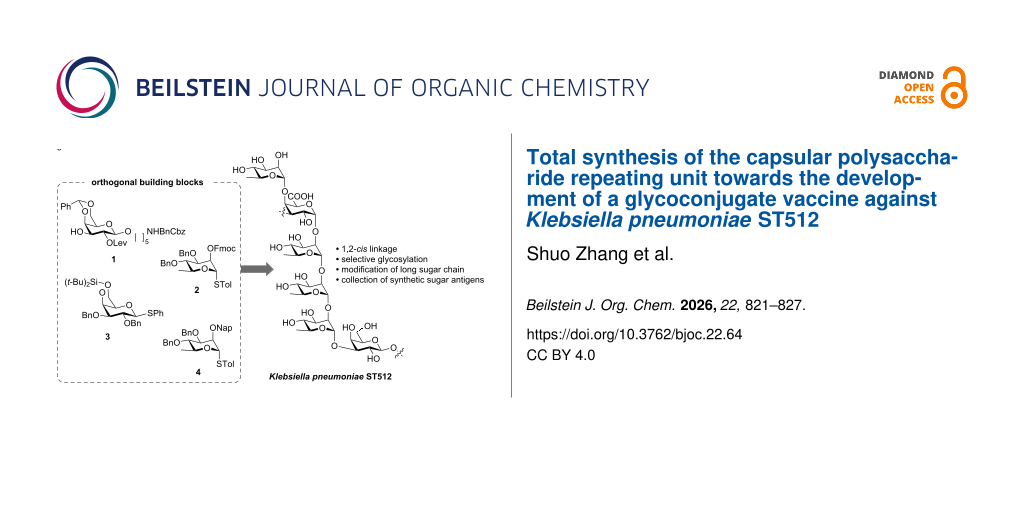
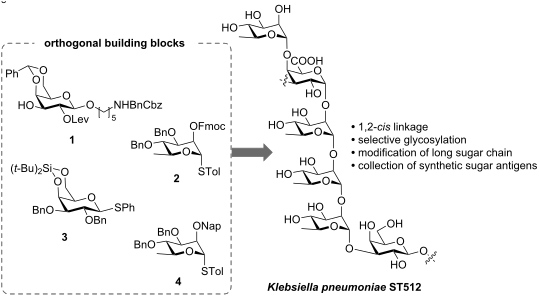
The CPS of K. pneumoniae ST512 consists of a branched hexasaccharide repeating unit {3)-[α-ʟ-Rhap-(1→4)]-α-ᴅ-GalpA-(1→2)-α-ʟ-Rhap-(1→2)-α-ʟ-Rhap-(1→2)-α-ʟ-Rhap-(1→3)-β-ᴅ-Galp-(1→}n (Figure 1) [13]. The chemical synthesis of this molecule is challenging due to the stereoselective formation of the 1,2-cis glycosidic linkage on the galacturonic acid core. In addition, the assembly and subsequent functionalization of long oligosaccharide chains are hampered by their intrinsically low reactivity [29]. Overcoming these challenges relying on a linear strategy employing four key building blocks 1–4, we describe the first chemical synthesis of the hexasaccharide repeating unit.
![[1860-5397-22-64-1]](/bjoc/content/figures/1860-5397-22-64-1.svg?scale=2.0&max-width=1024&background=FFFFFF)
Figure 1: Structure of the K. pneumoniae ST512 CPS repeating unit and retrosynthetic analysis.
Figure 1: Structure of the K. pneumoniae ST512 CPS repeating unit and retrosynthetic analysis.
The total synthesis commenced with the preparation of the orthogonally protected monosaccharide building blocks 1–4 (Scheme 1). Galactoside 1 was synthesized starting from the β-selective glycosylation of thioglycoside 5 [30] with aminopentyl linker 6. This reaction was promoted by N-iodosuccinimide (NIS) and trifluoromethanesulfonic acid (TfOH) to afford 7 in 86% yield, neighboring participation effect of the levulinoyl (Lev) group at C2 position provided only the β-product. The linker was introduced in anticipation of conjugation to a carrier protein or a glycan microarray surface [31]. Subsequent removal of the 2-naphthylmethyl (Nap) group using 2,3-dichloro-5,6-dicyano-1,4-benzoquinone (DDQ) furnished the desired alcohol 1 in 74% yield.
![[1860-5397-22-64-i1]](/bjoc/content/inline/1860-5397-22-64-i1.svg?scale=2.0&max-width=1024&background=FFFFFF)
Scheme 1: Preparation of building blocks 1–4.
Scheme 1: Preparation of building blocks 1–4.
For the synthesis of ʟ-rhamnoside building blocks 2 and 4, the C2-hydroxy group of known thioglycoside 8 [32,33] was regioselectively protected with a Nap group to yield 9 (87% yield). Protection of the remaining C3-hydroxy group with a benzyl (Bn) ether furnished building block 4. To obtain building block 2, the Nap group was replaced with a fluorenylmethyloxycarbonyl protecting group (Fmoc) via a two-step sequence: DDQ-mediated deprotection (69% yield) followed by treatment with 9-fluorenylmethyloxycarbonyl chloride to install the Fmoc group in 97% yield.
The galacturonic acid precursor 3 was prepared from thioglycoside 11. Global deacetylation followed by the introduction of a 4,6-O-silylidene group afforded diol 12 (88% over two steps). Finally, protection of the hydroxy groups with benzyl ethers furnished building block 3 in 83% yield.
With the building blocks in hand, the assembly of the hexasaccharide was pursued as outlined in Scheme 2. The synthesis commenced with the coupling of monosaccharides 1 and 2 promoted by NIS/TfOH followed by a one-pot Fmoc deprotection, afforded disaccharide 13 in 70% yield over two steps. Complete α-selectivity was observed, which can be attributed to the anomeric effect and the neighboring group participation of the C2-Fmoc group [34]. Two sequential cycles of glycosylation and Fmoc removal furnished tetrasaccharide 15. Subsequently, donor 3 was coupled with compound 15 under NIS/TfOH promotion to yield pentasaccharide 16 in 89% yield. The stereoselective construction of the 1,2-cis linkage was directed by the bulky 4,6-O-silylidene protecting group of 3. Treatment with HF·pyridine successfully cleaved the silylidene group, producing pentasaccharide diol 17 in 81% yield.
![[1860-5397-22-64-i2]](/bjoc/content/inline/1860-5397-22-64-i2.svg?scale=2.0&max-width=1024&background=FFFFFF)
Scheme 2: Synthesis of hexasaccharide repeating unit 20.
Scheme 2: Synthesis of hexasaccharide repeating unit 20.
The final stages involved the regioselective installation of an Fmoc group at the C6-hydroxy group, followed by glycosylation with building block 4 to provide hexasaccharide 19 with complete α-selectivity. Global deprotection was achieved by removing the Fmoc and Lev protecting groups with sodium methoxide, followed by 2,2,6,6-tetramethyl-1-piperidinyl-1-oxyl (TEMPO)/bis(acetoxy)iodobenzene (BAIB)-mediated oxidation of the C6-primary alcohol [35]. Final hydrogenolysis furnished the target hexasaccharide repeating unit 20 in 45% yield over three steps.
The identification of the minimal antigenic epitope is of paramount importance in the development of semi-synthetic glycoconjugate vaccines [36,37]. To expand the library of synthetic carbohydrate antigens and provide a chemical foundation for subsequent high-throughput screening, a series of analogues including di-, tri-, tetra-, and pentasaccharides were synthesized (Scheme 3). We utilized the intermediate products from the assembly of the hexasaccharide repeating unit 20. The protecting groups of disaccharide 13 were removed by treatment with sodium methoxide followed by catalytic hydrogenation over palladium on carbon, affording disaccharide 21 in 47% yield over two steps. Similarly, trisaccharide 22, tetrasaccharide 23, and pentasaccharide 24 were prepared from intermediates 14, 15, and 17, respectively. The analogues 21–24, together with the repeating unit 20, constitute a collection of well-defined synthetic oligosaccharide antigens resembling the surface of K. pneumoniae ST512. Glycan microarray analysis is currently underway to identify the lead antigens and key epitopes responsible for inducing specific immune responses against the native ST512 CPS.
![[1860-5397-22-64-i3]](/bjoc/content/inline/1860-5397-22-64-i3.svg?scale=2.0&max-width=1024&background=FFFFFF)
Scheme 3: Synthesis of the analogues 21–24.
Scheme 3: Synthesis of the analogues 21–24.
Conclusion
We accomplished the first total synthesis of the hexasaccharide repeating unit of the K. pneumoniae ST512 capsular polysaccharide, along with four structurally defined analogues. Major synthetic challenges, including the stereoselective formation of multiple 1,2-cis and 1,2-trans glycosidic linkages and the selective manipulation of long oligosaccharide chains, were successfully overcome using orthogonally protected building blocks. The resulting conjugation-ready oligosaccharides bearing aminopentyl linkers provide direct access to glycan microarray screening and in vivo immunological evaluation. This work represents a key step toward the development of semi-synthetic glycoconjugate vaccines against multidrug-resistant K. pneumoniae.
Supporting Information
| Supporting Information File 1: Experimental procedures and NMR spectra. | ||
| Format: PDF | Size: 6.8 MB | Download |
Data Availability Statement
All data that supports the findings of this study is available in the published article and/or the supporting information of this article.
References
-
Macesic, N.; Uhlemann, A.-C.; Peleg, A. Y. Lancet 2025, 405, 257–272. doi:10.1016/s0140-6736(24)02081-6
Return to citation in text: [1] -
Marino, A.; Maniaci, A.; Lentini, M.; Ronsivalle, S.; Nunnari, G.; Cocuzza, S.; Parisi, F. M.; Cacopardo, B.; Lavalle, S.; La Via, L. Epidemiologia (Basel, Switz.) 2025, 6, 21. doi:10.3390/epidemiologia6020021
Return to citation in text: [1] -
Bharadwaj, A.; Rastogi, A.; Pandey, S.; Gupta, S.; Sohal, J. S. BioMed Res. Int. 2022, 5419874. doi:10.1155/2022/5419874
Return to citation in text: [1] -
Li, P.; Liu, D.; Zhang, X.; Tuo, H.; Lei, C.; Xie, X.; Gu, J.; Zhang, A. Microb. Drug Resist. (New Rochelle, NY, U. S.) 2019, 25, 1050–1056. doi:10.1089/mdr.2018.0405
Return to citation in text: [1] -
Bengoechea, J. A.; Sa Pessoa, J. FEMS Microbiol. Rev. 2019, 43, 123–144. doi:10.1093/femsre/fuy043
Return to citation in text: [1] -
Navon-Venezia, S.; Kondratyeva, K.; Carattoli, A. FEMS Microbiol. Rev. 2017, 41, 252–275. doi:10.1093/femsre/fux013
Return to citation in text: [1] [2] -
Chang, D.; Sharma, L.; Dela Cruz, C. S.; Zhang, D. Front. Microbiol. 2021, 12, 750662. doi:10.3389/fmicb.2021.750662
Return to citation in text: [1] -
Abbas, R.; Chakkour, M.; Zein El Dine, H.; Obaseki, E. F.; Obeid, S. T.; Jezzini, A.; Ghssein, G.; Ezzeddine, Z. Biology (Basel, Switz.) 2024, 13, 78. doi:10.3390/biology13020078
Return to citation in text: [1] -
Feng, Y.; Lu, Y.; Yao, Z.; Zong, Z. Antimicrob. Agents Chemother. 2018, 62, e02644-17. doi:10.1128/aac.02644-17
Return to citation in text: [1] -
Li, S.; Lin, J.; Tao, S.; Guo, L.; Huang, W.; Li, J.; Du, C.; Wang, Z.; Liu, L.; Chen, Y.; Qiao, F. Antibiotics (Basel, Switz.) 2023, 12, 1199. doi:10.3390/antibiotics12071199
Return to citation in text: [1] -
Arcari, G.; Cecilia, F.; Oliva, A.; Polani, R.; Raponi, G.; Sacco, F.; De Francesco, A.; Pugliese, F.; Carattoli, A. Emerging Infect. Dis. 2023, 29, 2266–2274. doi:10.3201/eid2911.230921
Return to citation in text: [1] -
Villa, L.; Feudi, C.; Fortini, D.; García-Fernández, A.; Carattoli, A. Antimicrob. Agents Chemother. 2014, 58, 1707–1712. doi:10.1128/aac.01803-13
Return to citation in text: [1] -
Bellich, B.; Lagatolla, C.; Rizzo, R.; D'Andrea, M. M.; Rossolini, G. M.; Cescutti, P. Int. J. Biol. Macromol. 2020, 155, 315–323. doi:10.1016/j.ijbiomac.2020.03.196
Return to citation in text: [1] [2] -
Xu, L.; Li, J.; Wu, W.; Wu, X.; Ren, J. Virulence 2024, 15, 2439509. doi:10.1080/21505594.2024.2439509
Return to citation in text: [1] -
Rodrigues, C.; Sousa, C.; Lopes, J. A.; Novais, Â.; Peixe, L. mSystems 2020, 5, e00386-19. doi:10.1128/msystems.00386-19
Return to citation in text: [1] -
Opoku-Temeng, C.; Kobayashi, S. D.; DeLeo, F. R. Comput. Struct. Biotechnol. J. 2019, 17, 1360–1366. doi:10.1016/j.csbj.2019.09.011
Return to citation in text: [1] -
Henke, M. T.; Brown, E. M.; Cassilly, C. D.; Vlamakis, H.; Xavier, R. J.; Clardy, J. Proc. Natl. Acad. Sci. U. S. A. 2021, 118, e2007595118. doi:10.1073/pnas.2007595118
Return to citation in text: [1] -
Sun, X.; Stefanetti, G.; Berti, F.; Kasper, D. L. Proc. Natl. Acad. Sci. U. S. A. 2019, 116, 193–198. doi:10.1073/pnas.1816401115
Return to citation in text: [1] -
Seeberger, P. H. Chem. Rev. 2021, 121, 3598–3626. doi:10.1021/acs.chemrev.0c01210
Return to citation in text: [1] [2] -
Avci, F. Y.; Li, X.; Tsuji, M.; Kasper, D. L. Nat. Med. 2011, 17, 1602–1609. doi:10.1038/nm.2535
Return to citation in text: [1] -
Ma, X.; Zhao, J.; Wang, G.; Chen, J.; Li, J.; Huang, Z.; Gu, G. Org. Chem. Front. 2024, 11, 2539–2547. doi:10.1039/d4qo00092g
Return to citation in text: [1] -
Shen, D.; Seco, B. M. S.; Teixeira Alves, L. G.; Yao, L.; Bräutigam, M.; Opitz, B.; Witzenrath, M.; Fries, B. C.; Seeberger, P. H. J. Am. Chem. Soc. 2024, 146, 35356–35366. doi:10.1021/jacs.4c13972
Return to citation in text: [1] -
Tian, G.; Hu, J.; Qin, C.; Li, L.; Ning, Y.; Zhu, S.; Xie, S.; Zou, X.; Seeberger, P. H.; Yin, J. J. Am. Chem. Soc. 2024, 146, 18427–18439. doi:10.1021/jacs.4c03814
Return to citation in text: [1] -
Kay, E.; Cuccui, J.; Wren, B. W. npj Vaccines 2019, 4, 16. doi:10.1038/s41541-019-0110-z
Return to citation in text: [1] -
Sianturi, J.; Weber, F.; Singh, R. K.; Lingscheid, T.; Tober‐Lau, P.; Kurth, F.; Fries, B. C.; Seeberger, P. H. Angew. Chem., Int. Ed. 2025, 64, e202419516. doi:10.1002/anie.202419516
Return to citation in text: [1] -
Miller, J. C.; Cross, A. S.; Tennant, S. M.; Baliban, S. M. Vaccines (Basel, Switz.) 2024, 12, 1177. doi:10.3390/vaccines12101177
Return to citation in text: [1] -
Wantuch, P. L.; Robinson, L. S.; Knoot, C. J.; Darwech, I.; Matsuguma, A. M.; Vinogradov, E.; Scott, N. E.; Harding, C. M.; Rosen, D. A. npj Vaccines 2025, 10, 270. doi:10.1038/s41541-025-01314-7
Return to citation in text: [1] -
Schumann, B.; Reppe, K.; Kaplonek, P.; Wahlbrink, A.; Anish, C.; Witzenrath, M.; Pereira, C. L.; Seeberger, P. H. ACS Cent. Sci. 2018, 4, 357–361. doi:10.1021/acscentsci.7b00504
Return to citation in text: [1] -
Ishiwata, A.; Tanaka, K.; Ao, J.; Ding, F.; Ito, Y. Front. Chem. (Lausanne, Switz.) 2022, 10, 972429. doi:10.3389/fchem.2022.972429
Return to citation in text: [1] -
Zhang, S.; Sella, M.; Sianturi, J.; Priegue, P.; Shen, D.; Seeberger, P. H. Angew. Chem., Int. Ed. 2021, 60, 14679–14692. doi:10.1002/anie.202103990
Return to citation in text: [1] -
Micoli, F.; Adamo, R.; Costantino, P. Molecules 2018, 23, 1451. doi:10.3390/molecules23061451
Return to citation in text: [1] -
Castelli, R.; Overkleeft, H. S.; van der Marel, G. A.; Codée, J. D. C. Org. Lett. 2013, 15, 2270–2273. doi:10.1021/ol4008475
Return to citation in text: [1] -
Lin, S.; Lowary, T. L. Chem. – Eur. J. 2018, 24, 16992–16996. doi:10.1002/chem.201804795
Return to citation in text: [1] -
Nishizawa, M.; Kan, Y.; Shimomoto, W.; Yamada, H. Tetrahedron Lett. 1990, 31, 2431–2434. doi:10.1016/s0040-4039(00)97381-7
Return to citation in text: [1] -
Zhang, S.; Seeberger, P. H. Chem. – Eur. J. 2021, 27, 17444–17451. doi:10.1002/chem.202103234
Return to citation in text: [1] -
Mettu, R.; Chen, C.-Y.; Wu, C.-Y. J. Biomed. Sci. (London, U. K.) 2020, 27, 9. doi:10.1186/s12929-019-0591-0
Return to citation in text: [1] -
Naini, A.; Bartetzko, M. P.; Sanapala, S. R.; Broecker, F.; Wirtz, V.; Lisboa, M. P.; Parameswarappa, S. G.; Knopp, D.; Przygodda, J.; Hakelberg, M.; Pan, R.; Patel, A.; Chorro, L.; Illenberger, A.; Ponce, C.; Kodali, S.; Lypowy, J.; Anderson, A. S.; Donald, R. G. K.; von Bonin, A.; Pereira, C. L. JACS Au 2022, 2, 2135–2151. doi:10.1021/jacsau.2c00401
Return to citation in text: [1]
| 36. | Mettu, R.; Chen, C.-Y.; Wu, C.-Y. J. Biomed. Sci. (London, U. K.) 2020, 27, 9. doi:10.1186/s12929-019-0591-0 |
| 37. | Naini, A.; Bartetzko, M. P.; Sanapala, S. R.; Broecker, F.; Wirtz, V.; Lisboa, M. P.; Parameswarappa, S. G.; Knopp, D.; Przygodda, J.; Hakelberg, M.; Pan, R.; Patel, A.; Chorro, L.; Illenberger, A.; Ponce, C.; Kodali, S.; Lypowy, J.; Anderson, A. S.; Donald, R. G. K.; von Bonin, A.; Pereira, C. L. JACS Au 2022, 2, 2135–2151. doi:10.1021/jacsau.2c00401 |
| 1. | Macesic, N.; Uhlemann, A.-C.; Peleg, A. Y. Lancet 2025, 405, 257–272. doi:10.1016/s0140-6736(24)02081-6 |
| 2. | Marino, A.; Maniaci, A.; Lentini, M.; Ronsivalle, S.; Nunnari, G.; Cocuzza, S.; Parisi, F. M.; Cacopardo, B.; Lavalle, S.; La Via, L. Epidemiologia (Basel, Switz.) 2025, 6, 21. doi:10.3390/epidemiologia6020021 |
| 3. | Bharadwaj, A.; Rastogi, A.; Pandey, S.; Gupta, S.; Sohal, J. S. BioMed Res. Int. 2022, 5419874. doi:10.1155/2022/5419874 |
| 4. | Li, P.; Liu, D.; Zhang, X.; Tuo, H.; Lei, C.; Xie, X.; Gu, J.; Zhang, A. Microb. Drug Resist. (New Rochelle, NY, U. S.) 2019, 25, 1050–1056. doi:10.1089/mdr.2018.0405 |
| 14. | Xu, L.; Li, J.; Wu, W.; Wu, X.; Ren, J. Virulence 2024, 15, 2439509. doi:10.1080/21505594.2024.2439509 |
| 15. | Rodrigues, C.; Sousa, C.; Lopes, J. A.; Novais, Â.; Peixe, L. mSystems 2020, 5, e00386-19. doi:10.1128/msystems.00386-19 |
| 16. | Opoku-Temeng, C.; Kobayashi, S. D.; DeLeo, F. R. Comput. Struct. Biotechnol. J. 2019, 17, 1360–1366. doi:10.1016/j.csbj.2019.09.011 |
| 34. | Nishizawa, M.; Kan, Y.; Shimomoto, W.; Yamada, H. Tetrahedron Lett. 1990, 31, 2431–2434. doi:10.1016/s0040-4039(00)97381-7 |
| 6. | Navon-Venezia, S.; Kondratyeva, K.; Carattoli, A. FEMS Microbiol. Rev. 2017, 41, 252–275. doi:10.1093/femsre/fux013 |
| 11. | Arcari, G.; Cecilia, F.; Oliva, A.; Polani, R.; Raponi, G.; Sacco, F.; De Francesco, A.; Pugliese, F.; Carattoli, A. Emerging Infect. Dis. 2023, 29, 2266–2274. doi:10.3201/eid2911.230921 |
| 12. | Villa, L.; Feudi, C.; Fortini, D.; García-Fernández, A.; Carattoli, A. Antimicrob. Agents Chemother. 2014, 58, 1707–1712. doi:10.1128/aac.01803-13 |
| 13. | Bellich, B.; Lagatolla, C.; Rizzo, R.; D'Andrea, M. M.; Rossolini, G. M.; Cescutti, P. Int. J. Biol. Macromol. 2020, 155, 315–323. doi:10.1016/j.ijbiomac.2020.03.196 |
| 35. | Zhang, S.; Seeberger, P. H. Chem. – Eur. J. 2021, 27, 17444–17451. doi:10.1002/chem.202103234 |
| 9. | Feng, Y.; Lu, Y.; Yao, Z.; Zong, Z. Antimicrob. Agents Chemother. 2018, 62, e02644-17. doi:10.1128/aac.02644-17 |
| 10. | Li, S.; Lin, J.; Tao, S.; Guo, L.; Huang, W.; Li, J.; Du, C.; Wang, Z.; Liu, L.; Chen, Y.; Qiao, F. Antibiotics (Basel, Switz.) 2023, 12, 1199. doi:10.3390/antibiotics12071199 |
| 31. | Micoli, F.; Adamo, R.; Costantino, P. Molecules 2018, 23, 1451. doi:10.3390/molecules23061451 |
| 5. | Bengoechea, J. A.; Sa Pessoa, J. FEMS Microbiol. Rev. 2019, 43, 123–144. doi:10.1093/femsre/fuy043 |
| 6. | Navon-Venezia, S.; Kondratyeva, K.; Carattoli, A. FEMS Microbiol. Rev. 2017, 41, 252–275. doi:10.1093/femsre/fux013 |
| 7. | Chang, D.; Sharma, L.; Dela Cruz, C. S.; Zhang, D. Front. Microbiol. 2021, 12, 750662. doi:10.3389/fmicb.2021.750662 |
| 8. | Abbas, R.; Chakkour, M.; Zein El Dine, H.; Obaseki, E. F.; Obeid, S. T.; Jezzini, A.; Ghssein, G.; Ezzeddine, Z. Biology (Basel, Switz.) 2024, 13, 78. doi:10.3390/biology13020078 |
| 32. | Castelli, R.; Overkleeft, H. S.; van der Marel, G. A.; Codée, J. D. C. Org. Lett. 2013, 15, 2270–2273. doi:10.1021/ol4008475 |
| 33. | Lin, S.; Lowary, T. L. Chem. – Eur. J. 2018, 24, 16992–16996. doi:10.1002/chem.201804795 |
| 19. | Seeberger, P. H. Chem. Rev. 2021, 121, 3598–3626. doi:10.1021/acs.chemrev.0c01210 |
| 28. | Schumann, B.; Reppe, K.; Kaplonek, P.; Wahlbrink, A.; Anish, C.; Witzenrath, M.; Pereira, C. L.; Seeberger, P. H. ACS Cent. Sci. 2018, 4, 357–361. doi:10.1021/acscentsci.7b00504 |
| 29. | Ishiwata, A.; Tanaka, K.; Ao, J.; Ding, F.; Ito, Y. Front. Chem. (Lausanne, Switz.) 2022, 10, 972429. doi:10.3389/fchem.2022.972429 |
| 24. | Kay, E.; Cuccui, J.; Wren, B. W. npj Vaccines 2019, 4, 16. doi:10.1038/s41541-019-0110-z |
| 25. | Sianturi, J.; Weber, F.; Singh, R. K.; Lingscheid, T.; Tober‐Lau, P.; Kurth, F.; Fries, B. C.; Seeberger, P. H. Angew. Chem., Int. Ed. 2025, 64, e202419516. doi:10.1002/anie.202419516 |
| 26. | Miller, J. C.; Cross, A. S.; Tennant, S. M.; Baliban, S. M. Vaccines (Basel, Switz.) 2024, 12, 1177. doi:10.3390/vaccines12101177 |
| 27. | Wantuch, P. L.; Robinson, L. S.; Knoot, C. J.; Darwech, I.; Matsuguma, A. M.; Vinogradov, E.; Scott, N. E.; Harding, C. M.; Rosen, D. A. npj Vaccines 2025, 10, 270. doi:10.1038/s41541-025-01314-7 |
| 30. | Zhang, S.; Sella, M.; Sianturi, J.; Priegue, P.; Shen, D.; Seeberger, P. H. Angew. Chem., Int. Ed. 2021, 60, 14679–14692. doi:10.1002/anie.202103990 |
| 19. | Seeberger, P. H. Chem. Rev. 2021, 121, 3598–3626. doi:10.1021/acs.chemrev.0c01210 |
| 20. | Avci, F. Y.; Li, X.; Tsuji, M.; Kasper, D. L. Nat. Med. 2011, 17, 1602–1609. doi:10.1038/nm.2535 |
| 21. | Ma, X.; Zhao, J.; Wang, G.; Chen, J.; Li, J.; Huang, Z.; Gu, G. Org. Chem. Front. 2024, 11, 2539–2547. doi:10.1039/d4qo00092g |
| 22. | Shen, D.; Seco, B. M. S.; Teixeira Alves, L. G.; Yao, L.; Bräutigam, M.; Opitz, B.; Witzenrath, M.; Fries, B. C.; Seeberger, P. H. J. Am. Chem. Soc. 2024, 146, 35356–35366. doi:10.1021/jacs.4c13972 |
| 23. | Tian, G.; Hu, J.; Qin, C.; Li, L.; Ning, Y.; Zhu, S.; Xie, S.; Zou, X.; Seeberger, P. H.; Yin, J. J. Am. Chem. Soc. 2024, 146, 18427–18439. doi:10.1021/jacs.4c03814 |
| 17. | Henke, M. T.; Brown, E. M.; Cassilly, C. D.; Vlamakis, H.; Xavier, R. J.; Clardy, J. Proc. Natl. Acad. Sci. U. S. A. 2021, 118, e2007595118. doi:10.1073/pnas.2007595118 |
| 18. | Sun, X.; Stefanetti, G.; Berti, F.; Kasper, D. L. Proc. Natl. Acad. Sci. U. S. A. 2019, 116, 193–198. doi:10.1073/pnas.1816401115 |
| 13. | Bellich, B.; Lagatolla, C.; Rizzo, R.; D'Andrea, M. M.; Rossolini, G. M.; Cescutti, P. Int. J. Biol. Macromol. 2020, 155, 315–323. doi:10.1016/j.ijbiomac.2020.03.196 |
© 2026 Zhang et al.; licensee Beilstein-Institut.
This is an open access article licensed under the terms of the Beilstein-Institut Open Access License Agreement (https://www.beilstein-journals.org/bjoc/terms), which is identical to the Creative Commons Attribution 4.0 International License (https://creativecommons.org/licenses/by/4.0). The reuse of material under this license requires that the author(s), source and license are credited. Third-party material in this article could be subject to other licenses (typically indicated in the credit line), and in this case, users are required to obtain permission from the license holder to reuse the material.