




Abstract
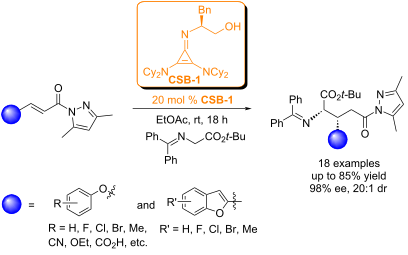
The enantioselective Michael reactions of benzophenone-imine of glycine esters with phenol- and benzofuran-derived α,β-unsaturated pyrazolamides have been realized by using a chiral cyclopropenimine (Lambert catalyst, CSB-1) as an organocatalyst. In the presence of 20 mol % CSB-1, the Michael adducts were obtained in up to 85% yield and 98% ee under mild conditions. The configurations of these Michael products were deduced by X-ray single crystal diffraction of a pyroglutamic acid ester containing two adjacent stereocenters, which was obtained from in-situ acidic hydrolysis and lactamization of the corresponding Michael product.
Graphical Abstract
Introduction
Phenols and benzofurans are feedstock chemicals in organic synthesis. Many medicines and intermediates contain these two motifs and show diverse functions and bioactivities [1,2]. The esterification and etherification of phenols are some of their common modifications. 2-Substituted benzofurans are backbones for many medicines such as amiodarone, dronedarone, saprisartan and so on [3]. Therefore, the introduction of benzofuran to organic molecules plays an important role in drug research and development. Compounds containing glutamic and pyroglutamic acid frameworks (Figure 1) indicate many pharmacologic properties including influence on protein synthesis, neurotransmitter function, and regulation of acid-base balance, metabolic intermediates, and promotion of nutrient absorption [4]. Therefore, the synthesis of substituted glutamic and pyroglutamic acid derivatives is vital to medicinal chemistry. In our previous reports, we have synthesized a series of 3-substitued glutamic acid esters in high yields and diastereoselectivities through DBU-catalyzed Michael additions of benzophenone-imine of glycine ester and α,β-unsaturated esters which derived from phenols and benzofurans under mild conditions [5,6]. The chiral 3-aryl-substituted glutamic and pyroglutamic acid esters were also produced by enantioselective Michael additions of β-aryl-substituted α,β-unsaturated pyrazolamides with benzophenone-imine of glycine ester in excellent ee and de values by using a chiral cyclopropenimine (Lambert catalyst, Figure 2b) as an organosuperbase catalyst [7,8]. Due to the importance of unnatural amino acids in the development of new medicines [9], we want to introduce phenol and benzofuran motifs to glutamic acids. For our continuous interest on the synthesis of chiral 3-substituted glutamic and pyroglutamic acids, herein, we present Michael reactions of phenol- and benzofuran-derived α,β-unsaturated pyrazolamides with benzophenone-imine of glycine esters by a chiral cyclopropenimine (CSB-1) to give 3-substituted glutamic and pyroglutamic acid esters in up to 98% ee and 20:1 diastereomeric ratio. In this reaction, a phenoxymethyl or benzofuryl group was introduced to the 3-position of glutamic and pyroglutamic acid esters, respectively (Figure 2c).
![[1860-5397-22-69-1]](/bjoc/content/figures/1860-5397-22-69-1.svg?scale=2.0&max-width=1024&background=FFFFFF)
Figure 1: Bioactive molecules with benzofuran and pyroglutamic acid motif.
Figure 1: Bioactive molecules with benzofuran and pyroglutamic acid motif.
![[1860-5397-22-69-2]](/bjoc/content/figures/1860-5397-22-69-2.svg?scale=2.0&max-width=1024&background=FFFFFF)
Figure 2: CSB-1-catalyzed Michael reactions of α,β-unsaturated compouds with glycine benzophenone-imine esters.
Figure 2: CSB-1-catalyzed Michael reactions of α,β-unsaturated compouds with glycine benzophenone-imine ester...
Results and Discussion
In fact, some simple α,β-unsaturated esters can be used as substrates to give Michael adducts in good yields and stereoselectivties [10,11]. Firstly, we tried to explore asymmetric Michael reactions between β-substituted α,β-unsaturated ester 1a and benzophenone-imine of glycine tert-butyl ester 2a in the presence of 20 mol % of CSB-1 and other chiral tertiary amine catalysts including quinine, levamisole, (+)-sparteine (Scheme 1). To our disappointment, the results showed that the chiral catalysts quinine and CSB-1 can give the corresponding product 3a in high yields but in its racemic form in the presence of 1 equiv LiBr.
![[1860-5397-22-69-i1]](/bjoc/content/inline/1860-5397-22-69-i1.svg?scale=2.0&max-width=1024&background=FFFFFF)
Scheme 1: Chiral base-catalyzed Michael reaction of 1a and 2a.
Scheme 1: Chiral base-catalyzed Michael reaction of 1a and 2a.
Based on our previous research [7,8], β-aryl-substituted α,β-unsaturated isoxazoles and pyrazolamide can be used as Michael acceptors to produce Michael adducts in high yields and enantioselectivities in the presence of Lambert catalyst CSB-1. Therefore, the phenol-derived pyrazolamides 5a–l were prepared from phenols, ethyl 4-bromocrotonate and 3,5-dimethyl-1H-pyrazole in three steps including alkylation, hydrolysis and amidation (Scheme 2a). The benzofuran-derived pyrazolamides 5m–q were synthesized through DBU-mediated cyclocondensation of 2-hydroxybenzaldehydes with 4-bromocrotonates to afford (E)-2-benzofuranyl-3-acrylates followed hydrolysis and coupling with 3,5-dimethyl-1H-pyrazole (Scheme 2b) [12].
![[1860-5397-22-69-i2]](/bjoc/content/inline/1860-5397-22-69-i2.svg?scale=2.0&max-width=1024&background=FFFFFF)
Scheme 2: The preparation of β-substituted α,β-unsaturated pyrazolamides 5.
Scheme 2: The preparation of β-substituted α,β-unsaturated pyrazolamides 5.
Initially, the Michael reaction between α,β-unsaturated pyrazolamide 5a and benzophenone-imine of glycine ester 2a was performed as a model reaction for reaction conditions screening with nine chiral organocatalysts (Figure 3) including five Lambert catalysts (CSB-1–CSB-5), quinine, levamisole, (+)-sparteine, and chiral imidazole (CID-OH). Among these nine catalysts, it was found that CSB-1 derived from ʟ-phenylalaninol demonstrates good chiral induction among five chiral cyclopropenimines to afford 6a in high yield (85%) and excellent stereoselectivities (98% ee, dr > 20:1, Table 1, entry 1). To our surprise, CSB-2 derived from ʟ-phenylglycinol only provided trace product 6a (Table 1, entry 2), although its structure is very similar to CSB-1. CSB-3 based on vicinal amino-alcohol backbone also afforded trace product. The other catalysts resulted in no reaction of 2a and 5a (Table 1, entries 3–9). These results show the unique catalytic and stereospecific ability of CSB-1. This may be due to a more flexible hydrogen-bonding donor group and a smaller steric hinderance in CSB-1 than in other cyclopropenimines to provide good hydrogen-bonding interaction in the transition state [13]. With decreasing amount of CSB-1 from 20 mol % to 10 mol %, the yield of 6a dropped to 76% but with an excellent ee value (Table 1, entry 10 vs entry 1). The yields and enantioselectivities of 6a are both decreased in dichloromethane (DCM), toluene, and acetone (Table 1, entries 11–13). When THF was used as a solvent, the yield of 6a was slightly lower than in ethyl acetate (EA) as a solvent (Table 1, entry 14 vs entry 1). The reaction carried out in acetonitrile provided racemic 6a (Table 1, entry 15). When MeOH was used as a solvent, it led to no reaction (Table 1, entry 16), this may due to the large amount of hydrogen-bonding interactions in MeOH to inactivate the catalytic effect of CSB-1. Based on these results, the optimal reaction conditions are listed in Table 1, entry 1. The reactions between 2 and 5 were carried out in EtOAc by using 20 mol % of CSB-1 as a catalyst at room temperature.
![[1860-5397-22-69-3]](/bjoc/content/figures/1860-5397-22-69-3.svg?scale=2.0&max-width=1024&background=FFFFFF)
Figure 3: The catalysts used in the screening of Michael reaction conditions.
Figure 3: The catalysts used in the screening of Michael reaction conditions.
Table 1: The screening of reaction conditionsa.
![[Graphic 1]](/bjoc/content/inline/1860-5397-22-69-i5.svg?max-width=637&scale=1.0)
|
||||
| Entrya | Catalyst | Solvent | Yield (%)b | ee (%)c |
| 1 | CSB-1 (0.2 equiv) | EA | 85 | 98 |
| 2 | CSB-2 (0.2 equiv) | EA | trace | – |
| 3 | CSB-3 (0.2 equiv) | EA | trace | – |
| 4 | CSB-4 (0.2 equiv) | EA | n.r. | – |
| 5 | CSB-5 (0.2 equiv) | EA | n.r. | – |
| 6 | quinine (0.2 equiv) | EA | n.r. | – |
| 7 | levamisole (0.2 equiv) | EA | n.r. | – |
| 8 | (+)-sparteine (0.2 equiv) | EA | n.r. | – |
| 9 | CID-OH (0.2 equiv) | EA | n.r. | – |
| 10d | CSB-1 (0.1 equiv) | EA | 76 | 97 |
| 11 | CSB-1 (0.2 equiv) | DCM | 37 | 47 |
| 12 | CSB-1 (0.2 equiv) | toluene | 52 | 89 |
| 13 | CSB-1 (0.2 equiv) | acetone | 76 | 45 |
| 14 | CSB-1 (0.2 equiv) | THF | 78 | 96 |
| 15 | CSB-1 (0.2 equiv) | CH3CN | 79 | racemic |
| 16 | CSB-1 (0.2 equiv) | CH3OH | n.r. | – |
a2a (0.1 mmol), 5a (0.1 mmol) and 0.5 mL solvent were used. bIsolated yield based on 5a. cEnantiomeric excess (ee) was measured by HPLC analysis using a chiralcel OD-H column. dReaction time was 36 h.
With the optimal conditions in hand, the asymmetric Michael reactions of α,β-unsaturated pyrazolamides 5a–q with benzophenone-imine of glycine esters 2 (Scheme 3) were performed to provide the corresponding products 6a–q in moderate to good yields (up to 85%) with excellent ee values (up to 98% ee). The substrates from phenols 5a–l containing electron-withdrawing or electron-donating groups have afforded chiral Michael adducts in good yields and enantioselectivities, however, substrates from benzofurans (5m–p) have produced the corresponding Michael adducts in moderate yields except 5q, which gave 6q in 27% yield but with 94% ee. Carvacrol-derived substrate 5j and paracetamol-derived substrate 5k provided 6j and 6k in good yields and enantioselectivities. These results demonstrated that some natural molecules and medicines containing a phenol group can be modified by this protocol to introduce a glutamic acid motif to their molecular structures.
![[1860-5397-22-69-i3]](/bjoc/content/inline/1860-5397-22-69-i3.svg?scale=2.0&max-width=1024&background=FFFFFF)
Scheme 3: CSB-1-catalyzed Michael additions between compounds compounds 2 and 5.
Scheme 3: CSB-1-catalyzed Michael additions between compounds compounds 2 and 5.
A possible explanation for the high diastereoselectivity for this Michael reaction is shown in Figure 4. By attack according to mode A, the anti-form of 6a should be obtained, however, the steric repulsion between benzophenone-imine 2a and the 3,5-dimethylpyrazolyl group in 5a may inhibit this attack pathway to afford the anti-form of 6a. With mode B, the π–π stacking between benzophenone-imine 2a and the phenoxylmethyl group in 5a may enhance the ratio of this attack to produce the syn-form of 6a as major product.
![[1860-5397-22-69-4]](/bjoc/content/figures/1860-5397-22-69-4.svg?scale=2.0&max-width=1024&background=FFFFFF)
Figure 4: The proposed attack modes of Michael addition of 2a and 5a.
Figure 4: The proposed attack modes of Michael addition of 2a and 5a.
A mechanism for this highly enantioselective Michael addition between 2a and 5a was proposed based on experimental facts and the studies of the Lambert group [13]. This proposed reaction mechanism is demonstrated in Figure 5. At the beginning of the reaction, the chiral organosuperbase catalyst CSB-1 can deprotonate benzophenone-imine of glycine ester 2a to form the (E)-enolate of 2a and a cyclopropenium as ion pair A, which attacks β-substituted α,β-unsaturated pyrazolamide 5a to provide transition state B. Transition state B may be stabilized through an H-bonding interaction network between the two substrates and CSB-1. Additionally, π–π stacking between the two phenyl groups of 2a and 5a may also enhance the formation of transition state B. The highly diastereomic ratio of 6a in syn-form may be generated from transition state B. The formation of intermediate C is the rate-limiting step. When intermediate C is formed, the protonation happened rapidly to afford 6a in high enantioselectivity. The catalyst CSB-1 was released and entered the next catalytic cycle.
![[1860-5397-22-69-5]](/bjoc/content/figures/1860-5397-22-69-5.svg?scale=2.0&max-width=1024&background=FFFFFF)
Figure 5: A proposed reaction mechanism of CSB-1 catalyzed Michael reaction between 2a and 5a.
Figure 5: A proposed reaction mechanism of CSB-1 catalyzed Michael reaction between 2a and 5a.
The pyroglutamic acid esters 7 were obtained through in-situ acidic hydrolysis and lactamization of 6 [14]. Three Michael products 6d, 6d’ and 6h were treated under 4 N HCl in DCM to give 3-substituted pyroglutamic acid esters 7d, 7d’ and 7h in high yields and excellent ee values (Scheme 4)
![[1860-5397-22-69-i4]](/bjoc/content/inline/1860-5397-22-69-i4.svg?scale=2.0&max-width=1024&background=FFFFFF)
Scheme 4: In situ acidic hydrolysis and lactamization of 6.
Scheme 4: In situ acidic hydrolysis and lactamization of 6.
To our delight, 3-substituted pyroglutamic acid ester 7d’ was obtained as single crystals for X-ray diffraction analysis [15]. The ester group and the bromophenoxymethyl group were arranged on the other side of the pyrrolidinone ring to be in trans-conformation and the absolute configurations of 7d’ was unambiguously assigned as 2S and 3S, this means that the benzophenone-imine group and bromophenoxymethyl group should be arranged on the same side of the longest carbon chain to be syn before lactamization, therefore, the absolute configuration of 6d’ was deduced to be 2S and 3S either (Figure 6).
![[1860-5397-22-69-6]](/bjoc/content/figures/1860-5397-22-69-6.svg?scale=2.0&max-width=1024&background=FFFFFF)
Figure 6: Configuration of 7d’ determined by X-ray diffraction analysis.
Figure 6: Configuration of 7d’ determined by X-ray diffraction analysis.
Conclusion
In conclusion, we have developed facile routes to chiral 3-substituted glutamic and pyroglutamic acid esters from phenols and benzofuran-derived α,β-unsaturated pyrazolamides in the presence of Lambert catalyst CSB-1 under mild conditions in good yields and enantioselectivities. The absolute configuration of chiral 3-substituted pyroglutamic acid ester were determined by X-ray single crystal diffraction. This protocol can be used for the late-stage modification of bioactive molecules containing a phenol group. The synthesis of chiral 3,4-disubstituted glutamic and pyroglutamic acid esters by this protocol are underway.
Experimental
General procedure for the CSB-1-catalyzed Michael addition of compounds 2 and 5
To 2a (1.0 mmol) and 5a (1.0 mmol) in EtOAc (10.0 mL) was added CSB-1 (0.2 mmol) and the mixture was stirred at rt for 18 h. After the reaction was completed (detected by TLC), the solvent was removed by a rotary evaporator under reduced pressure. The residue was purified by flash column chromatography (petroether/EtOAc/Et3N 40:1:0.01–20:1:0.01, v/v) to afford pure 6a as a colorless sticky oil.
Typical procedure for in situ acidic hydrolysis and lactamization to compound 7d
To 6d (1.0 mmol) in DCM (5.0 mL) was added 4 N HCl (5.0 mL) and the mixture was stirred at rt for 2–3 h. After the reaction was completed (detected by TLC), it was quenched by H2O (15.0 mL) and extracted with DCM (2 × 25.0 mL). The combined organic layers were dried over Na2SO4 and the solvent was evaporated under vacuum. The residue was purified by flash column chromatography to afford pure 7d as a white solid.
Supporting Information
| Supporting Information File 1: Detailed experimental procedures, characterization data of all new compounds with NMR, HRMS, HPLC charts, and X-ray single crystal diffraction data. | ||
| Format: PDF | Size: 13.1 MB | Download |
Data Availability Statement
All data that supports the findings of this study is available in the published article and/or the supporting information of this article.
References
-
Abbas, A. A.; Dawood, K. M. RSC Adv. 2023, 13, 11096–11120. doi:10.1039/d3ra01383a
Return to citation in text: [1] -
Shehda, M. S.; Almatary, A. M.; Salem, M. S. H.; Aboutaleb, M. H.; Takizawa, S.; Abdel Aziz, Y. M.; El-Sayed, M. A. A.; Elrayess, R. RSC Med. Chem. 2026, 17, 477–493. doi:10.1039/d5md00837a
Return to citation in text: [1] -
Heravi, M. M.; Zadsirjan, V.; Hamidi, H.; Tabar Amiri, P. H. RSC Adv. 2017, 7, 24470–24521. doi:10.1039/c7ra03551a
Return to citation in text: [1] -
Kubyshkin, V.; Mykhailiuk, P. K. J. Med. Chem. 2024, 67, 20022–20055. doi:10.1021/acs.jmedchem.4c01987
Return to citation in text: [1] -
Cheng, M.-L.; Wang, X.-Y.; Bai, Y.-J.; Zhu, S.-K.; Zhang, S.-Y.; Bao, G.-Q.; Wang, P.-A. Synth. Commun. 2023, 53, 1637–1646. doi:10.1080/00397911.2023.2240450
Return to citation in text: [1] -
Wang, X.-Y.; Zhu, S.-K.; Cheng, M.-L.; Jiang, R.; Zhang, S.-Y.; Wang, P.-A. Eur. J. Org. Chem. 2024, 27, e202400184. doi:10.1002/ejoc.202400184
Return to citation in text: [1] -
Bai, Y.-J.; Wang, X.-Y.; Zhu, S.-K.; Zheng, X.-H.; Zhang, S.-Y.; Wang, P.-A. New J. Chem. 2023, 47, 18811–18817. doi:10.1039/d3nj02537c
Return to citation in text: [1] [2] -
Bai, Y.-J.; Cheng, M.-L.; Zheng, X.-H.; Zhang, S.-Y.; Wang, P.-A. Chem. – Asian J. 2022, 17, e202200131. doi:10.1002/asia.202200131
Return to citation in text: [1] [2] -
Sharma, K. K.; Sharma, K.; Rao, K.; Sharma, A.; Rathod, G. K.; Aaghaz, S.; Sehra, N.; Parmar, R.; VanVeller, B.; Jain, R. J. Med. Chem. 2024, 67, 19932–19965. doi:10.1021/acs.jmedchem.4c00110
Return to citation in text: [1] -
Kisszékelyi, P.; Šebesta, R. Beilstein J. Org. Chem. 2023, 19, 593–634. doi:10.3762/bjoc.19.44
Return to citation in text: [1] -
Oh, D.; Lee, J.; Yang, S.; Jung, S. H.; Kim, M.; Lee, G.; Park, H.-g. ACS Omega 2024, 9, 15328–15338. doi:10.1021/acsomega.3c10080
Return to citation in text: [1] -
Reddy, S.; Thadkapally, S.; Mamidyala, M.; Nanubolu, J. B.; Menon, R. S. RSC Adv. 2015, 5, 8199–8204. doi:10.1039/c4ra14948c
Return to citation in text: [1] -
Bandar, J. S.; Sauer, G. S.; Wulff, W. D.; Lambert, T. H.; Vetticatt, M. J. J. Am. Chem. Soc. 2014, 136, 10700–10707. doi:10.1021/ja504532d
Return to citation in text: [1] [2] -
Kim, B.; Song, Y.; Lee, S. Y. Chem. Commun. 2021, 57, 11052–11055. doi:10.1039/d1cc04875a
Return to citation in text: [1] -
The crystallographic data (CCDC 2357563) for 7d’, can be obtained free of charge from the Cambridge crystallographic Data Centre via https://www.ccdc.cam.ac.uk/data_request/cif.
Return to citation in text: [1]
| 1. | Abbas, A. A.; Dawood, K. M. RSC Adv. 2023, 13, 11096–11120. doi:10.1039/d3ra01383a |
| 2. | Shehda, M. S.; Almatary, A. M.; Salem, M. S. H.; Aboutaleb, M. H.; Takizawa, S.; Abdel Aziz, Y. M.; El-Sayed, M. A. A.; Elrayess, R. RSC Med. Chem. 2026, 17, 477–493. doi:10.1039/d5md00837a |
| 7. | Bai, Y.-J.; Wang, X.-Y.; Zhu, S.-K.; Zheng, X.-H.; Zhang, S.-Y.; Wang, P.-A. New J. Chem. 2023, 47, 18811–18817. doi:10.1039/d3nj02537c |
| 8. | Bai, Y.-J.; Cheng, M.-L.; Zheng, X.-H.; Zhang, S.-Y.; Wang, P.-A. Chem. – Asian J. 2022, 17, e202200131. doi:10.1002/asia.202200131 |
| 5. | Cheng, M.-L.; Wang, X.-Y.; Bai, Y.-J.; Zhu, S.-K.; Zhang, S.-Y.; Bao, G.-Q.; Wang, P.-A. Synth. Commun. 2023, 53, 1637–1646. doi:10.1080/00397911.2023.2240450 |
| 6. | Wang, X.-Y.; Zhu, S.-K.; Cheng, M.-L.; Jiang, R.; Zhang, S.-Y.; Wang, P.-A. Eur. J. Org. Chem. 2024, 27, e202400184. doi:10.1002/ejoc.202400184 |
| 4. | Kubyshkin, V.; Mykhailiuk, P. K. J. Med. Chem. 2024, 67, 20022–20055. doi:10.1021/acs.jmedchem.4c01987 |
| 15. | The crystallographic data (CCDC 2357563) for 7d’, can be obtained free of charge from the Cambridge crystallographic Data Centre via https://www.ccdc.cam.ac.uk/data_request/cif. |
| 3. | Heravi, M. M.; Zadsirjan, V.; Hamidi, H.; Tabar Amiri, P. H. RSC Adv. 2017, 7, 24470–24521. doi:10.1039/c7ra03551a |
| 12. | Reddy, S.; Thadkapally, S.; Mamidyala, M.; Nanubolu, J. B.; Menon, R. S. RSC Adv. 2015, 5, 8199–8204. doi:10.1039/c4ra14948c |
| 13. | Bandar, J. S.; Sauer, G. S.; Wulff, W. D.; Lambert, T. H.; Vetticatt, M. J. J. Am. Chem. Soc. 2014, 136, 10700–10707. doi:10.1021/ja504532d |
| 7. | Bai, Y.-J.; Wang, X.-Y.; Zhu, S.-K.; Zheng, X.-H.; Zhang, S.-Y.; Wang, P.-A. New J. Chem. 2023, 47, 18811–18817. doi:10.1039/d3nj02537c |
| 8. | Bai, Y.-J.; Cheng, M.-L.; Zheng, X.-H.; Zhang, S.-Y.; Wang, P.-A. Chem. – Asian J. 2022, 17, e202200131. doi:10.1002/asia.202200131 |
| 14. | Kim, B.; Song, Y.; Lee, S. Y. Chem. Commun. 2021, 57, 11052–11055. doi:10.1039/d1cc04875a |
| 10. | Kisszékelyi, P.; Šebesta, R. Beilstein J. Org. Chem. 2023, 19, 593–634. doi:10.3762/bjoc.19.44 |
| 11. | Oh, D.; Lee, J.; Yang, S.; Jung, S. H.; Kim, M.; Lee, G.; Park, H.-g. ACS Omega 2024, 9, 15328–15338. doi:10.1021/acsomega.3c10080 |
| 9. | Sharma, K. K.; Sharma, K.; Rao, K.; Sharma, A.; Rathod, G. K.; Aaghaz, S.; Sehra, N.; Parmar, R.; VanVeller, B.; Jain, R. J. Med. Chem. 2024, 67, 19932–19965. doi:10.1021/acs.jmedchem.4c00110 |
| 13. | Bandar, J. S.; Sauer, G. S.; Wulff, W. D.; Lambert, T. H.; Vetticatt, M. J. J. Am. Chem. Soc. 2014, 136, 10700–10707. doi:10.1021/ja504532d |
© 2026 Bai et al.; licensee Beilstein-Institut.
This is an open access article licensed under the terms of the Beilstein-Institut Open Access License Agreement (https://www.beilstein-journals.org/bjoc/terms), which is identical to the Creative Commons Attribution 4.0 International License (https://creativecommons.org/licenses/by/4.0). The reuse of material under this license requires that the author(s), source and license are credited. Third-party material in this article could be subject to other licenses (typically indicated in the credit line), and in this case, users are required to obtain permission from the license holder to reuse the material.




