Abstract
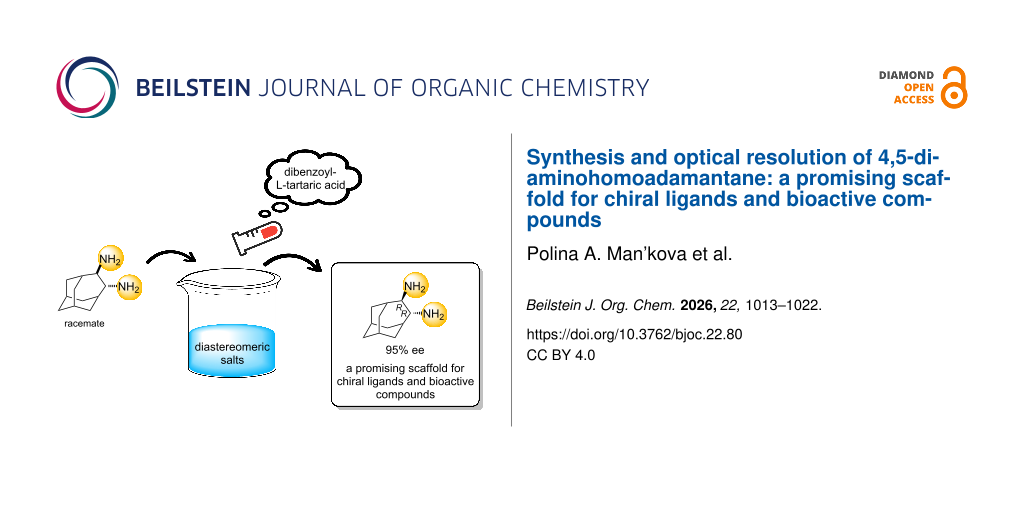
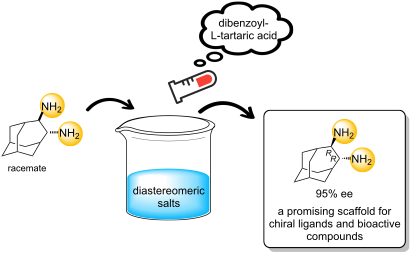
Vicinal diamines based on a rigid polycyclic framework such as homoadamantane remain underexplored. We anticipated that the unique steric and lipophilic properties of chiral trans-4,5-diaminohomoadamantane could provide the necessary stereoinduction in metal-catalyzed asymmetric reactions. In addition, such structures may serve as a novel scaffold for bioactive compounds. Herein, we report a synthetic approach to this previously inaccessible chiral scaffold. 4,5-Diaminohomoadamantane was prepared as a mixture of cis- and trans-isomers by reduction of the corresponding vicinal azidoxime with LiAlH4. In contrast, the trans-isomer was selectively obtained via ring-opening of an N-Tf-protected aziridine. The racemic trans-4,5-diaminohomoadamantane was resolved with dibenzoyl-ʟ-tartaric acid. The absolute (4R,5R)-configuration was proposed on the basis of TDDFT calculations of the specific optical rotation using the CAM-B3LYP functional and the 6-311G++(2d,2p) basis set with solvation by CH2Cl2 in the SMD model on the base of conformational analysis. Catalytic systems based on (4R,5R)-4,5-diaminohomoadamantane derivatives exhibited low to moderate asymmetric induction in Henry and Michael reactions. These results suggest that further molecular design of homoadamantane-based chiral N,N-ligands is promising.
Graphical Abstract
Introduction
The chemistry of organic polycyclic cage compounds has been of interest to organic chemists for many years. Such a simple and symmetric structure as adamantane is widely used in pharmaceutics to obtain drugs with a wide spectrum of action, as well as to improve the properties of drugs currently in use [1-7]. The chemistry of adamantane has been extensively studied [8-16], while the properties of homoadamantane, its closest homologue, have not been studied so thoroughly. Chemical transformations of homoadamantane both at the bridgehead [17-23] and at the C-4 positions [24-28] are described in the literature. However, compounds of the homoadamantane family with substituents at the C-3 and C-4 [29-38] or at the C-4 and C-5 [39-53] positions have recently attracted more attention. At present, a few examples of homoadamantane derivatives showing pronounced biological activity are known. More than 40 homoadamantane polyprenylated acylphloroglucinols have been isolated from Hypericum plants [54-56]. Among them, hyperacmosins A and B showed a protective effect in paracetamol-induced cell damage [57], and activity against Staphylococcus aureus was noted for peroxysampsone A С [58]. Basarić and co-workers showed that the replacement of 2-substituted adamantane by a homoadamantane skeleton led to enhanced antiproliferative activity (compound D) [59]. Compound E showed efficacy against Staphylococcus aureus [60]. Fluorobenzohomoadamantanamine F proved to be a potent NMDA receptor antagonist with efficacy very close to memantine [61] and compound G is approximately two times more potent as an NMDA antagonist than compound F [62]. The benzohomoadamantane-based derivative H showed high analgesic activity in a mouse model of cystitis (Figure 1) [63].
![[1860-5397-22-80-1]](/bjoc/content/figures/1860-5397-22-80-1.svg?scale=2.0&max-width=1024&background=FFFFFF)
Figure 1: Examples of bioactive homoadamantanes.
Figure 1: Examples of bioactive homoadamantanes.
Vicinal diamines are of interest to chemists not only as precursors for the synthesis of heterocyclic compounds, but also because of their wide range of practical applications. Structures with a 1,2-diamine fragment are widely used in clinical practice [64-66], as well as auxiliaries and ligands in important asymmetric transformations [67-70]. Bi- and polycyclic vicinal diamines can also be considered as potential ligands for asymmetric catalysis [71-74], but little attention has been paid to methods for obtaining compounds of this type. Vicinal diamines with an adamantyl substituent I–K have already been obtained [75-78] and 1,2-diaminoadamantane L has been synthesized by different methods [79-81]. For 1,2-diaminonoradamantane M there are even fewer data [82]. Polycyclic vicinal diamines N and O have been prepared recently (Figure 2) [69,83,84].
![[1860-5397-22-80-2]](/bjoc/content/figures/1860-5397-22-80-2.svg?scale=2.0&max-width=1024&background=FFFFFF)
Figure 2: Examples of cage vicinal diamines.
Figure 2: Examples of cage vicinal diamines.
Results and Discussion
Synthetic approaches to cage vicinal diamines are actively studied, as their rigid cage framework makes them promising ligands for asymmetric catalysis. In continuation of the theme of our studies [75,77,81], we decided to focus on new approaches to the synthesis of 4,5-diaminohomoadamantane, its chiral resolution, and to test its applicability as chirality-inducing ligand in selected model reactions. We commenced the study using a route for the synthesis of 4,5-diaminohomoadamantane from azidoxime 4. Initially, homoadamantan-4-ene (2) was obtained from homoadamantan-4-ol (1). In 1969, a method for the preparation of alkene 2 from homoadamant-4-yl tosylate was proposed [85]. However, the formation of methyl tosylate and the need for purification of the product reduces its usefulness. We herein report an improved method for the synthesis of compound 2 from alcohol 1 using phosphoric acid, affording the target compound in high yield and purity. In the next step, chloronitrosation of alkene 2 led to α-chloroxime 3 in moderate yield. Substitution of chlorine in 3 with azido and benzylamino groups was then carried out to give azidoxime 4 and aminoxime 5 (Scheme 1).
![[1860-5397-22-80-i1]](/bjoc/content/inline/1860-5397-22-80-i1.svg?scale=2.0&max-width=1024&background=FFFFFF)
Scheme 1: Synthetic route to homoadamantane oximes 3–5.
Scheme 1: Synthetic route to homoadamantane oximes 3–5.
The reduction of azidoxime 4 was carried out using various systems in order to obtain trans-4,5-diaminohomoadamantane. Thus, treatment of compound 4 with NaBH4 in the presence of nickel(II) chloride [86] resulted in the formation of 4-aminohomoadamantane (6). The NaBH4/MoO3 system [81] led to the selective reduction of only the hydroxyimino group, affording azidoamine 7. The reduction of azidoxime 4 using LiAlH4 [75,87] allowed total reduction of both the oxyimino and azido groups, resulting in the formation of isomeric diamines 8a,b (Scheme 2).
![[1860-5397-22-80-i2]](/bjoc/content/inline/1860-5397-22-80-i2.svg?scale=2.0&max-width=1024&background=FFFFFF)
Since 4,5-diaminohomoadamantane was isolated as a mixture of trans- and cis-isomers 8a,b, we decided to synthesize trans-4,5-diaminohomoadamantane through ring opening of aziridine 9. This compound was obtained from homoadamantanone oxime by reduction with LiAlH4 [41]. Since the aziridine ring-opening reaction usually proceeds easily when the aziridine bears an electron-withdrawing group at the N-atom, we synthesized N-substituted aziridines 10–12 by reactions of 9 with Boc2O, TsCl, and Tf2O, respectively (Scheme 3).
![[1860-5397-22-80-i3]](/bjoc/content/inline/1860-5397-22-80-i3.svg?scale=2.0&max-width=1024&background=FFFFFF)
Scheme 3: Synthesis of N-substituted aziridines 10–12.
Scheme 3: Synthesis of N-substituted aziridines 10–12.
Compounds 10–12 were studied in the aziridine ring-opening reaction with sodium azide. Typically, N-Boc-substituted aziridines easily give the corresponding ring-opened products [77,88,89], however in our case only the starting compound 10 was isolated. In the reaction of tosylated compound 11 with sodium azide in the presence of ammonium chloride, trans- and cis-diastereomers of 13a,b were obtained (Scheme 4).
![[1860-5397-22-80-i4]](/bjoc/content/inline/1860-5397-22-80-i4.svg?scale=2.0&max-width=1024&background=FFFFFF)
Scheme 4: Aziridine 11 ring-opening reaction with NaN3.
Scheme 4: Aziridine 11 ring-opening reaction with NaN3.
In order to find a more selective method for the synthesis of trans-4,5-diaminohomoadamantane (8a), aziridine 12 was studied. When the tosyl group was replaced with a triflic group (12), only the trans-diastereomer 14 was formed in the reaction with NaN3 and NH4Cl. Upon reduction of the azido group with LiAlH4, the trans-isomer 15 was isolated. However, the removal of the protecting group in 15 by the known method [90] (sequential action of chloroacetonitrile and Cs2CO3) was unsuccessful. Therefore, we decided to use Red-Al [91,92] for simultaneous reduction and deprotection of 14 yielding only the trans-diastereomer 8a (Scheme 5).
![[1860-5397-22-80-i5]](/bjoc/content/inline/1860-5397-22-80-i5.svg?scale=2.0&max-width=1024&background=FFFFFF)
Scheme 5: Aziridine 12 ring-opening and reduction.
Scheme 5: Aziridine 12 ring-opening and reduction.
At the next stage of the research, we attempted to resolve racemic trans-4,5-diaminohomoadamantane (8a′) with the use of ʟ-tartaric, ʟ-malic, (R)-mandelic and dibenzoyl-ʟ-tartaric acids. The diastereomeric salts derived from the corresponding acids and 4,5-diaminohomoadamantane (8a′) in both 2:1 and 1:1 ratios were studied. Successful resolution was achieved by triple crystallization of the bis(dibenzoyl)-ʟ-tartrate from a MeOH/CHCl3 mixture (Scheme 6).
![[1860-5397-22-80-i6]](/bjoc/content/inline/1860-5397-22-80-i6.svg?scale=2.0&max-width=1024&background=FFFFFF)
Scheme 6: Resolution of racemic diamine 8a′.
Scheme 6: Resolution of racemic diamine 8a′.
The attempted determination of the enantiomeric ratio by chiral HPLC of the free amine failed because no optimal analysis conditions could be identified. Therefore, a preliminary derivatization of diamine 8a′ was required, which was carried out by reactions with carbon disulfide [75] or benzil [77].
However, HPLC analysis was only successful for racemic 2,3-dihydropyrazine 17 (Scheme 6). For (4R,5R)-2,3-dihydropyrazine (4R,5R)-17 derived from diamine (4R,5R)-8a', the enantiomeric excess was determined to be 95%. Multiple attempts to grow a crystal suitable for X-ray analysis were unsuccessful; therefore, the absolute configuration of (4R,5R)-8a' was proposed on the basis of quantum mechanical calculations. To date, a number of successful determinations of the absolute configuration for both conformationally flexible and rigid molecules have been performed by comparison of experimental and calculated specific rotation values [93-101]. The main difficulty of such a procedure is taking into account all possible conformers of a molecule, especially a flexible one, since specific rotation depends fundamentally on dihedral angles along bonds adjacent to the asymmetric atom. Therefore, the calculation of the specific rotation of rigid molecules is significantly easier since fewer conformers must be taken into account. Recently, it was shown, that calculated optical rotation values may be significantly affected not only by conformers but also by conformations that are close to them in energy [102,103]. Therefore, to calculate the specific rotation of (4R,5R)-8a′ we applied a methodology that considers optical rotation of conformations that differ from the stable ones by no more than 10 kJ/mol [103]. All calculations were performed with the Gaussian 09 software [104]. Optimization of the molecule’s geometry by DFT was performed using the CAM-B3LYP functional and the 6-311G++(2d,2p) basis set with solvation by CH2Cl2 in the SMD model. The dihedral scan for the C4–NH2 and C5–NH2 bonds was performed using the HF method in the 6-31G+(d) basis set. The dihedral angle for C5–C4–N–H was set to 50.66, −61.16, and 178.95 degrees that corresponds to staggered conformations and for each of them the dihedral angle for C4–C5–N–H was scanned in 15 degrees increments, starting from 171.48 degree. The results of scans are represented in Figure 3.
![[1860-5397-22-80-3]](/bjoc/content/figures/1860-5397-22-80-3.png?scale=2.0&max-width=1024&background=FFFFFF)
Figure 3: The results of C4–C5–N–H dihedrals scan for staggered conformations with C5–C4–N–H dihedrals 50.66, −61.16, and 178.95 degrees. Red lines in the graphics represent the energy of 10 kJ/mol. The scans were performed using HF/6-31G(d) method.
Figure 3: The results of C4–C5–N–H dihedrals scan for staggered conformations with C5–C4–N–H dihedrals 50.66,...
All in all, 18 conformations, that have energies within 10 kJ/mol from the most stable conformer, were chosen for further computation. The geometry optimization and optical rotation calculations of the chosen conformations were performed using DFT method with the CAM-B3LYP functional and the 6-311G++(2d,2p) basis set with solvation by CH2Cl2 in SMD model. The distribution of conformations was calculated on the basis of their relative energy with respect to the minimum energy using the Boltzmann law. The overall specific rotation was calculated through weight averaging of all chosen conformations. The results of the specific rotation calculation for six wavelengths, reported in Table 1, agree well with the experimental values of specific rotation, what allows to assign the (4R,5R)-configuration to compound 8a′.
![[Graphic 1]](/bjoc/content/inline/1860-5397-22-80-i10.svg?max-width=637&scale=1.18182)
![[Graphic 2]](/bjoc/content/inline/1860-5397-22-80-i11.svg?max-width=637&scale=1.18182)
Since the chiral resolution of trans-4,5-diaminohomoadamantane was successful, we decided to study metal complexes of ligands based on (4R,5R)-8a′ in model reactions. Ligand 18 was obtained by the reaction of diamine (4R,5R)-8a' with benzaldehyde and the N,N’-dibenzyl-substituted ligand (4R,5R)-19’ was synthesized by reduction of diimine 18 (Scheme 7).
![[1860-5397-22-80-i7]](/bjoc/content/inline/1860-5397-22-80-i7.svg?scale=2.0&max-width=1024&background=FFFFFF)
Scheme 7: Synthesis of ligands 18 and 19′.
Scheme 7: Synthesis of ligands 18 and 19′.
Ligands (4R,5R)-8a′ and 18 were studied as chiral inducers in a Henry reaction. The reaction of benzaldehyde with nitromethane was carried out in iPrOH in the presence of copper(II) acetate hydrate, ligand 8a′ or 18, and diisopropylethylamine (5 mol % each) (Scheme 8).
![[1860-5397-22-80-i8]](/bjoc/content/inline/1860-5397-22-80-i8.svg?scale=2.0&max-width=1024&background=FFFFFF)
Scheme 8: Enantiodivergent Henry reaction when using ligands 8a′ and 18.
Scheme 8: Enantiodivergent Henry reaction when using ligands 8a′ and 18.
When diamine (4R,5R)-8a′ was used, the reaction mixture was enriched in the (S)-isomer (36% ee), while diimine ligand 18 promoted the formation of mainly the (R)-isomer (60% ee). The formation of products with different configurations when using ligands of similar structure indicates an enantiodivergent effect [105].
The ligand 19′ was studied in a model Michael reaction. The reaction of nitrostyrene with diethyl malonate was conducted in chloroform in the presence of ligand 19′, NiBr2, and NEt3 (2 mol % each). This reaction does not proceed in the absence of triethylamine, as evidenced by the quantitative recovery of the starting materials (Scheme 9).
![[1860-5397-22-80-i9]](/bjoc/content/inline/1860-5397-22-80-i9.svg?scale=2.0&max-width=1024&background=FFFFFF)
Scheme 9: Catalysis of the Michael reaction using the complex (4R,5R)-19′−NiBr2.
Scheme 9: Catalysis of the Michael reaction using the complex (4R,5R)-19′−NiBr2.
A slight enantiomeric enrichment in the (S)-enantiomer (10% ee) was observed with the N,N′-dibenzyl-substituted diamine 19′ based complex.
Conclusion
In conclusion, a new route for the synthesis of trans-4,5-diaminohomoadamantane and its subsequent optical resolution has been proposed. This compound is a valuable chiral scaffold for the construction of bioactive molecules and chiral ligands. In this work, chiral imine and amine ligands based on trans-4,5-diaminohomoadamantane were obtained. Catalytic systems based on them have been studied in the asymmetric Michael and Henry reactions. Low enantioselectivity (up to 60% ee) was observed, but an enantiodivergent effect was noted in the Henry reaction.
Supporting Information
| Supporting Information File 1: Experimental section. | ||
| Format: PDF | Size: 9.5 MB | Download |
Data Availability Statement
All data that supports the findings of this study is available in the published article and/or the supporting information of this article.
References
-
Lamoureux, G.; Artavia, G. Curr. Med. Chem. 2010, 17, 2967–2978. doi:10.2174/092986710792065027
Return to citation in text: [1] -
Wanka, L.; Iqbal, K.; Schreiner, P. R. Chem. Rev. 2013, 113, 3516–3604. doi:10.1021/cr100264t
Return to citation in text: [1] -
Spilovska, K.; Zemek, F.; Korabecny, J.; Nepovimova, E.; Soukup, O.; Windisch, M.; Kuca, K. Curr. Med. Chem. 2016, 23, 3245–3266. doi:10.2174/0929867323666160525114026
Return to citation in text: [1] -
Dembitsky, V. M.; Gloriozova, T. A.; Poroikov, V. V. Biochem. Biophys. Res. Commun. 2020, 529, 1225–1241. doi:10.1016/j.bbrc.2020.06.123
Return to citation in text: [1] -
Ragshaniya, A.; Kumar, V.; Tittal, R. K.; Lal, K. Arch. Pharm. (Weinheim, Ger.) 2024, 357, 2300595. doi:10.1002/ardp.202300595
Return to citation in text: [1] -
Klimochkin, Y. N.; Shiryaev, V. A.; Leonova, M. V. Russ. Chem. Bull. 2015, 64, 1473–1496. doi:10.1007/s11172-015-1035-y
Return to citation in text: [1] -
Shiryaev, V. A.; Klimochkin, Y. N. Russ. Chem. Bull. 2025, 74, 1203–1220. doi:10.1007/s11172-025-4616-4
Return to citation in text: [1] -
Moiseev, I. K.; Makarova, N. V.; Zemtsova, M. N. Russ. Chem. Rev. 1999, 68, 1001–1020. doi:10.1070/rc1999v068n12abeh000495
Return to citation in text: [1] -
Hrdina, R. Synthesis 2019, 51, 629–642. doi:10.1055/s-0037-1610321
Return to citation in text: [1] -
Todd, M.; Hrdina, R. Molecules 2023, 28, 7636. doi:10.3390/molecules28227636
Return to citation in text: [1] -
Grover, N.; Senge, M. O. Synthesis 2020, 52, 3295–3325. doi:10.1055/s-0040-1707884
Return to citation in text: [1] -
Baranov, N. I.; Bagrii, E. I.; Safir, R. E.; Cherednichenko, A. G.; Bozhenko, K. V.; Maximov, A. L. Pet. Chem. 2022, 62, 352–375. doi:10.1134/s0965544122020153
Return to citation in text: [1] -
Weigel, W. K.; Dang, H. T.; Feceu, A.; Martin, D. B. C. Org. Biomol. Chem. 2022, 20, 10–36. doi:10.1039/d1ob01916c
Return to citation in text: [1] -
Schreiner, P. R.; Sekutor, M.; Fokin, A. A. The Chemistry of Diamondoids: Building Blocks for Ligands, Catalysts, Pharmaceuticals, and Materials; Wiley VCH: Weinheim, Germany, 2024; pp 73–121. doi:10.1002/9783527812950
Return to citation in text: [1] -
Stoikov, I. I.; Antipin, I. S.; Burilov, V. A.; Kurbangalieva, A. R.; Rostovskii, N. V.; Pankova, A. S.; Balova, I. A.; Remizov, Y. O.; Pevzner, L. M.; Petrov, M. L.; Vasilyev, A. V.; Averin, A. D.; Beletskaya, I. P.; Nenajdenko, V. G.; Beloglazkina, E. K.; Gromov, S. P.; Karlov, S. S.; Magdesieva, T. V.; Prishchenko, A. A.; Popkov, S. V.; Terent’ev, A. O.; Tsaplin, G. V.; Kustova, T. P.; Kochetova, L. B.; Magdalinova, N. A.; Krasnokutskaya, E. A.; Nyuchev, A. V.; Kuznetsova, Y. L.; Fedorov, A. Y.; Egorova, A. Y.; Grinev, V. S.; Sorokin, V. V.; Ovchinnikov, K. L.; Kofanov, E. R.; Kolobov, A. V.; Rusinov, V. L.; Zyryanov, G. V.; Nosov, E. V.; Bakulev, V. A.; Belskaya, N. P.; Berezkina, T. V.; Obydennov, D. L.; Sosnovskikh, V. Y.; Bakhtin, S. G.; Baranova, O. V.; Doroshkevich, V. S.; Raskildina, G. Z.; Sultanova, R. M.; Zlotskii, S. S.; Dyachenko, V. D.; Dyachenko, I. V.; Fisyuk, A. S.; Konshin, V. V.; Dotsenko, V. V.; Ivleva, E. A.; Reznikov, A. N.; Klimochkin, Y. N.; Aksenov, D. A.; Aksenov, N. A.; Aksenov, A. V.; Burmistrov, V. V.; Butov, G. M.; Novakov, I. A.; Shikhaliev, K. S.; Stolpovskaya, N. V.; Medvedev, S. M.; Kandalintseva, N. V.; Prosenko, O. I.; Menshchikova, E. B.; Golovanov, A. A.; Khashirova, S. Y. Russ. J. Org. Chem. 2024, 60, 1361–1584. doi:10.1134/s1070428024080013
Return to citation in text: [1] -
Shokova, E. A.; Kim, J. K.; Kovalev, V. V. Russ. J. Org. Chem. 2024, 60, 1831–1891. doi:10.1134/s1070428024100014
Return to citation in text: [1] -
Sasaki, T.; Eguchi, S.; Katada, T.; Hiroaki, O. J. Org. Chem. 1977, 42, 3741–3743. doi:10.1021/jo00443a024
Return to citation in text: [1] -
Margosian, D.; Speier, J.; Kovacic, P. J. Org. Chem. 1981, 46, 1346–1350. doi:10.1021/jo00320a023
Return to citation in text: [1] -
Takaishi, N.; Fujikura, Y.; Inamoto, Y. Synthesis 1983, 293–294. doi:10.1055/s-1983-30308
Return to citation in text: [1] -
Sasaki, T.; Nakanishi, A.; Ohno, M. J. Org. Chem. 1982, 47, 3219–3224. doi:10.1021/jo00138a004
Return to citation in text: [1] -
Klimochkin, Y. N.; Zhilkina, E. O.; Abramov, O. V.; Moiseev, I. K. Russ. J. Org. Chem. 1993, 29, 1358–1364.
Return to citation in text: [1] -
Klimochkin, Y. N.; Leonova, M. V.; Ivleva, E. A. Russ. J. Org. Chem. 2020, 56, 1702–1710. doi:10.1134/s107042802010005x
Return to citation in text: [1] -
Ivleva, E. A.; Zaborskaya, M. S.; Shiryaev, V. A.; Klimochkin, Y. N. Synth. Commun. 2023, 53, 476–491. doi:10.1080/00397911.2023.2177173
Return to citation in text: [1] -
Majerski, Z.; Liggero, S. H.; Schleyer, P. v. R. J. Chem. Soc. D 1970, 949–950. doi:10.1039/c29700000949
Return to citation in text: [1] -
Sasaki, T.; Eguchi, S.; Mizutani, M. Tetrahedron Lett. 1975, 16, 2685–2688. doi:10.1016/s0040-4039(00)75214-2
Return to citation in text: [1] -
Nelsen, S. F.; Teasley, M. F.; Kapp, D. L. J. Am. Chem. Soc. 1986, 108, 5503–5509. doi:10.1021/ja00278a022
Return to citation in text: [1] -
Taeschler, C.; Parvez, M.; Sorensen, T. S. J. Phys. Org. Chem. 2002, 15, 36–47. doi:10.1002/poc.453
Return to citation in text: [1] -
Reznikov, A. N.; Ashatkina, M. A.; Vostruhina, S. Yu.; Klimochkin, Y. N. Tetrahedron Lett. 2023, 116, 154322. doi:10.1016/j.tetlet.2022.154322
Return to citation in text: [1] -
Takeuchi, K.; Miyazaki, T.; Kitagawa, I.; Okamoto, K. Tetrahedron Lett. 1985, 26, 661–664. doi:10.1016/s0040-4039(00)89173-x
Return to citation in text: [1] -
Takeuchi, K.; Akiyama, F.; Miyazaki, T.; Kitagawa, I.; Okamoto, K. Tetrahedron 1987, 43, 701–709. doi:10.1016/s0040-4020(01)90004-3
Return to citation in text: [1] -
Takeuchi, K.; Kitagawa, I.; Akiyama, F.; Shibata, T.; Kato, M.; Okamoto, K. Synthesis 1987, 612–615. doi:10.1055/s-1987-28022
Return to citation in text: [1] -
Takeuchi, K.; Yoshida, M.; Nishida, M.; Kohama, A.; Kitagawa, T. Synthesis 1991, 37–40. doi:10.1055/s-1991-26374
Return to citation in text: [1] -
Krasutskii, P. A.; Semenova, I. S.; Safronova, E. E.; Novikova, M. I.; Yurchenko, A. G. J. Org. Chem. USSR 1989, 25, 2106–2111.
Return to citation in text: [1] -
Okazaki, T.; Kitagawa, T.; Takeuchi, K. J. Phys. Org. Chem. 1994, 7, 485–494. doi:10.1002/poc.610070904
Return to citation in text: [1] -
Leonova, M. V.; Baimuratov, M. R.; Klimochkin, Y. N. Russ. J. Org. Chem. 2017, 53, 326–334. doi:10.1134/s1070428017030034
Return to citation in text: [1] -
Baimuratov, M. R.; Leonova, M. V.; Shiryaev, V. A.; Klimochkin, Y. N. Tetrahedron 2017, 73, 6101–6108. doi:10.1016/j.tet.2017.08.025
Return to citation in text: [1] -
Leonova, M. V.; Belaya, N. V.; Baimuratov, M. R.; Rybakov, V. B.; Klimochkin, Y. N. Chem. Heterocycl. Compd. 2020, 56, 537–541. doi:10.1007/s10593-020-02696-3
Return to citation in text: [1] -
Ohno, M.; Itoh, M.; Umeda, M.; Furuta, R.; Kondo, K.; Eguchi, S. J. Am. Chem. Soc. 1996, 118, 7075–7082. doi:10.1021/ja953977q
Return to citation in text: [1] -
Sasaki, T.; Eguchi, S.; Hattori, S. Synthesis 1975, 718–719. doi:10.1055/s-1975-23903
Return to citation in text: [1] -
Tkachenko, I. M.; Mankova, P. A.; Rybakov, V. B.; Golovin, E. V.; Klimochkin, Y. N. Org. Biomol. Chem. 2020, 18, 465–478. doi:10.1039/c9ob02060h
Return to citation in text: [1] -
Schlatmann, J. L. M. A.; Korsloot, J. G.; Schut, J. Tetrahedron 1970, 26, 949–954. doi:10.1016/s0040-4020(01)97892-5
Return to citation in text: [1] [2] -
Umada, A.; Okano, T.; Eguchi, S. Synthesis 1994, 1457–1462. doi:10.1055/s-1994-25713
Return to citation in text: [1] -
Shiryaev, V. A.; Radchenko, E. V.; Palyulin, V. A.; Zefirov, N. S.; Bormotov, N. I.; Serova, O. A.; Shishkina, L. N.; Baimuratov, M. R.; Bormasheva, K. M.; Gruzd, Y. A.; Ivleva, E. A.; Leonova, M. V.; Lukashenko, A. V.; Osipov, D. V.; Osyanin, V. A.; Reznikov, A. N.; Shadrikova, V. A.; Sibiryakova, A. E.; Tkachenko, I. M.; Klimochkin, Y. N. Eur. J. Med. Chem. 2018, 158, 214–235. doi:10.1016/j.ejmech.2018.08.009
Return to citation in text: [1] -
Tkachenko, I. M.; Rybakov, V. B.; Klimochkin, Y. N. Synthesis 2019, 51, 1482–1490. doi:10.1055/s-0037-1610312
Return to citation in text: [1] -
Tkachenko, I. M.; Shiryaev, V. A.; Klimochkin, Y. N. Org. Biomol. Chem. 2023, 21, 5629–5642. doi:10.1039/d3ob00777d
Return to citation in text: [1] -
Gyarmati, Z. C.; Liljeblad, A.; Argay, G.; Kálmán, A.; Bernáth, G.; Kanerva, L. T. Adv. Synth. Catal. 2004, 346, 566–572. doi:10.1002/adsc.200303205
Return to citation in text: [1] -
Gyarmati, Z. C.; Csomós, P.; Bernáth, G.; Valtamo, P.; Kivelä, H.; Klika, K. D.; Pihlaja, K.; Argay, G.; Kálmán, A. J. Heterocycl. Chem. 2004, 41, 187–199. doi:10.1002/jhet.5570410208
Return to citation in text: [1] -
Bovonsombat, P.; Nelis, E. M. Synth. Commun. 1995, 25, 1223–1229. doi:10.1080/00397919508012685
Return to citation in text: [1] -
Eguchi, S.; Umada, A.; Okano, T. Heterocycles 1996, 42, 333–340. doi:10.3987/com-95-s41
Return to citation in text: [1] -
Nelsen, S. F.; Teasley, M. F. J. Org. Chem. 1986, 51, 3221–3223. doi:10.1021/jo00366a034
Return to citation in text: [1] -
Saalfrank, R. W.; Paul, W.; Schierling, P. Chem. Ber. 1985, 118, 2150–2155. doi:10.1002/cber.19851180538
Return to citation in text: [1] -
Shiryaev, V. A.; Sokolova, I. V.; Gorbachova, A. M.; Rybakov, V. B.; Shiryaev, A. K.; Klimochkin, Y. N. Tetrahedron 2022, 117-118, 132828. doi:10.1016/j.tet.2022.132828
Return to citation in text: [1] -
Majerski, Z.; Marinic, Z.; Sarac-Arneri, R. J. Org. Chem. 1983, 48, 5109–5111. doi:10.1021/jo00173a061
Return to citation in text: [1] -
Cheng, Y.; Qin, D. Novel Plant Natural Product Skeletons; Springer Nature: Singapore, 2024; p 83. doi:10.1007/978-981-99-7329-3_7
Return to citation in text: [1] -
Li, Y.; Zhang, L.; Wang, W.; Liu, Y.; Sun, D.; Li, H.; Chen, L. Bioorg. Chem. 2022, 128, 106106. doi:10.1016/j.bioorg.2022.106106
Return to citation in text: [1] -
Sun, Z.; Li, Y.; Zhong, R.; Li, R. Front. Pharmacol. 2023, 14, 1247675. doi:10.3389/fphar.2023.1247675
Return to citation in text: [1] -
Wang, X.; Shi, M.; Wang, J.; Suo, X.; Sun, H.; Zhen, B.; Sun, H.; Li, J.; Ji, T. Fitoterapia 2020, 142, 104535. doi:10.1016/j.fitote.2020.104535
Return to citation in text: [1] -
Xiao, Z. Y.; Zeng, Y. H.; Mu, Q.; Shiu, W. K. P.; Gibbons, S. Chem. Biodiversity 2010, 7, 953–958. doi:10.1002/cbdv.200900247
Return to citation in text: [1] -
Basarić, N.; Sohora, M.; Cindro, N.; Mlinarić‐Majerski, K.; De Clercq, E.; Balzarini, J. Arch. Pharm. (Weinheim, Ger.) 2014, 347, 334–340. doi:10.1002/ardp.201300345
Return to citation in text: [1] -
Barniol-Xicota, M.; Escandell, A.; Valverde, E.; Julián, E.; Torrents, E.; Vázquez, S. Bioorg. Med. Chem. 2015, 23, 290–296. doi:10.1016/j.bmc.2014.11.041
Return to citation in text: [1] -
Valverde, E.; Sureda, F. X.; Vázquez, S. Bioorg. Med. Chem. 2014, 22, 2678–2683. doi:10.1016/j.bmc.2014.03.025
Return to citation in text: [1] -
Pérez-Areales, F. J.; Turcu, A. L.; Barniol-Xicota, M.; Pont, C.; Pivetta, D.; Espargaró, A.; Bartolini, M.; De Simone, A.; Andrisano, V.; Pérez, B.; Sabate, R.; Sureda, F. X.; Vázquez, S.; Muñoz-Torrero, D. Eur. J. Med. Chem. 2019, 180, 613–626. doi:10.1016/j.ejmech.2019.07.051
Return to citation in text: [1] -
Codony, S.; Entrena, J. M.; Calvó-Tusell, C.; Jora, B.; González-Cano, R.; Osuna, S.; Corpas, R.; Morisseau, C.; Pérez, B.; Barniol-Xicota, M.; Griñán-Ferré, C.; Pérez, C.; Rodríguez-Franco, M. I.; Martínez, A. L.; Loza, M. I.; Pallàs, M.; Verhelst, S. H. L.; Sanfeliu, C.; Feixas, F.; Hammock, B. D.; Brea, J.; Cobos, E. J.; Vázquez, S. J. Med. Chem. 2022, 65, 13660–13680. doi:10.1021/acs.jmedchem.2c00515
Return to citation in text: [1] -
Michalson, E. T.; Szmuszkovicz, J. Medicinal agents incorporating the 1,2-diamine functionality. In Progress in Drug Research; Jucker, E., Ed.; Birkhäuser Verlag: Basel, 1989; Vol. 33, pp 135–149. doi:10.1007/978-3-0348-9146-2_6
Return to citation in text: [1] -
Misirlic-Dencic, S.; Poljarevic, J.; Isakovic, A. M.; Sabo, T.; Markovic, I.; Trajkovic, V. Curr. Med. Chem. 2020, 27, 380–410. doi:10.2174/0929867325666181031114306
Return to citation in text: [1] -
Du, S.; Huo, X.; Wang, X. Org. Lett. 2024, 26, 2945–2948. doi:10.1021/acs.orglett.4c00491
Return to citation in text: [1] -
Kizirian, J.-C. Chem. Rev. 2008, 108, 140–205. doi:10.1021/cr040107v
Return to citation in text: [1] -
Lucet, D.; Le Gall, T.; Mioskowski, C. Angew. Chem., Int. Ed. 1998, 37, 2580–2627. doi:10.1002/(sici)1521-3773(19981016)37:19<2580::aid-anie2580>3.0.co;2-l
Return to citation in text: [1] -
Bennani, Y. L.; Hanessian, S. Chem. Rev. 1997, 97, 3161–3196. doi:10.1021/cr9407577
Return to citation in text: [1] [2] -
Reznikov, A. N.; Golovin, E. V.; Klimochkin, Y. N. Russ. J. Org. Chem. 2013, 49, 663–668. doi:10.1134/s1070428013050047
Return to citation in text: [1] -
Khlebnikova, T. B.; Konev, V. N.; Pai, Z. P. Tetrahedron 2018, 74, 260–267. doi:10.1016/j.tet.2017.11.059
Return to citation in text: [1] -
Milbeo, P.; Moulat, L.; Didierjean, C.; Aubert, E.; Martinez, J.; Calmès, M. Eur. J. Org. Chem. 2018, 178–187. doi:10.1002/ejoc.201701452
Return to citation in text: [1] -
Reznikov, A. N.; Kapranov, L. E.; Ivankina, V. V.; Sibiryakova, A. E.; Rybakov, V. B.; Klimochkin, Y. N. Helv. Chim. Acta 2018, 101, e1800170. doi:10.1002/hlca.201800170
Return to citation in text: [1] -
Sibiryakova, A. E.; Shiryaev, V. A.; Reznikov, A. N.; Kabanova, A. A.; Klimochkin, Y. N. Synthesis 2019, 51, 463–469. doi:10.1055/s-0037-1610824
Return to citation in text: [1] -
Man’kova, P. A.; Reznikov, A. N.; Shiryaev, V. A.; Baimuratov, M. R.; Rybakov, V. B.; Klimochkin, Y. N. Russ. J. Org. Chem. 2021, 57, 226–236. doi:10.1134/s1070428021020135
Return to citation in text: [1] [2] [3] [4] -
Tataridis, D.; Fytas, G.; Kolocouris, A.; Fytas, C.; Kolocouris, N.; Foscolos, G. B.; Padalko, E.; Neyts, J.; De Clercq, E. Bioorg. Med. Chem. Lett. 2007, 17, 692–696. doi:10.1016/j.bmcl.2006.10.092
Return to citation in text: [1] -
Mankova, P. A.; Reznikov, A. N.; Shiryaev, V. A.; Tkachenko, I. M.; Klimochkin, Y. N. Russ. J. Org. Chem. 2023, 59, 383–394. doi:10.1134/s1070428023030053
Return to citation in text: [1] [2] [3] [4] -
Abdel-Aziz, A. A.-M.; El Bialy, S. A. A.; Goda, F. E.; Kunieda, T. Tetrahedron Lett. 2004, 45, 8073–8077. doi:10.1016/j.tetlet.2004.08.164
Return to citation in text: [1] -
Schleyer, P. V. R.; Lenoir, D.; Glaser, R.; Mison, P. J. Org. Chem. 1971, 36, 1821–1826. doi:10.1021/jo00812a022
Return to citation in text: [1] -
Stetter, H.; Löhr, V.; Simos, A. Justus Liebigs Ann. Chem. 1977, 999–1004. doi:10.1002/jlac.197719770613
Return to citation in text: [1] -
Man’kova, P. A.; Shiryaev, V. A.; Shmel’kova, Y. D.; Moiseev, A. V.; Reznikov, A. N.; Klimochkin, Y. N. Russ. Chem. Bull. 2023, 72, 1791–1801. doi:10.1007/s11172-023-3961-4
Return to citation in text: [1] [2] [3] -
Camps, P.; Muñoz-Torrero, D. Tetrahedron Lett. 1994, 35, 3187–3190. doi:10.1016/s0040-4039(00)76863-8
Return to citation in text: [1] -
Fokin, A. A.; Pashenko, A. E.; Bakhonsky, V. V.; Zhuk, T. S.; Chernish, L. V.; Gunchenko, P. A.; Kushko, A. O.; Becker, J.; Wende, R. C.; Schreiner, P. R. Synthesis 2017, 49, 2003–2008. doi:10.1055/s-0036-1588694
Return to citation in text: [1] -
Bakhonsky, V. V.; Pashenko, A. A.; Becker, J.; Hausmann, H.; De Groot, H. J. M.; Overkleeft, H. S.; Fokin, A. A.; Schreiner, P. R. Dalton Trans. 2020, 49, 14009–14016. doi:10.1039/d0dt02391d
Return to citation in text: [1] -
Nordlander, J. E.; Wu, F. Y.-H.; Jindal, S. P.; Hamilton, J. B. J. Am. Chem. Soc. 1969, 91, 3962–3964. doi:10.1021/ja01042a057
Return to citation in text: [1] -
Proietti, G.; Prathap, K. J.; Ye, X.; Olsson, R. T.; Dinér, P. Synthesis 2022, 54, 133–146. doi:10.1055/a-1579-2190
Return to citation in text: [1] -
Shatzmiller, S.; Bercovici, S. Liebigs Ann. Chem. 1992, 10, 1005–1009. doi:10.1002/jlac.1992199201166
Return to citation in text: [1] -
Gardiner, J. M.; Loyns, C. R.; Burke, A.; Khan, A.; Mahmood, N. Bioorg. Med. Chem. Lett. 1995, 5, 1251–1254. doi:10.1016/0960-894x(95)00203-6
Return to citation in text: [1] -
Fitremann, J.; Duréault, A.; Depezay, J.-C. Tetrahedron Lett. 1994, 35, 1201–1204. doi:10.1016/0040-4039(94)88023-9
Return to citation in text: [1] -
Chan, K. S. L.; Fu, H.-Y.; Yu, J.-Q. J. Am. Chem. Soc. 2015, 137, 2042–2046. doi:10.1021/ja512529e
Return to citation in text: [1] -
Gold, E. H.; Babad, E. J. Org. Chem. 1972, 37, 2208–2210. doi:10.1021/jo00978a034
Return to citation in text: [1] -
Wang, Y.; Wu, Y.; Li, Y.; Tang, Y. Chem. Sci. 2017, 8, 3852–3857. doi:10.1039/c7sc00367f
Return to citation in text: [1] -
Polavarapu, P. L. Chirality 2002, 14, 768–781. doi:10.1002/chir.10145
Return to citation in text: [1] -
Polavarapu, P. L.; Zhao, C. Chem. Phys. Lett. 1998, 296, 105–110. doi:10.1016/s0009-2614(98)01009-4
Return to citation in text: [1] -
Stephens, P. J.; Devlin, F. J.; Cheeseman, J. R.; Frisch, M. J. J. Phys. Chem. A 2001, 105, 5356–5371. doi:10.1021/jp0105138
Return to citation in text: [1] -
Stephens, P. J.; McCann, D. M.; Cheeseman, J. R.; Frisch, M. J. Chirality 2005, 17 (Suppl. 1), S52–S64. doi:10.1002/chir.20109
Return to citation in text: [1] -
McCann, D. M.; Stephens, P. J. J. Org. Chem. 2006, 71, 6074–6098. doi:10.1021/jo060755+
Return to citation in text: [1] -
Crawford, T. D. Theor. Chem. Acc. 2006, 115, 227–245. doi:10.1007/s00214-005-0001-4
Return to citation in text: [1] -
Srebro-Hooper, M.; Autschbach, J. Annu. Rev. Phys. Chem. 2017, 68, 399–420. doi:10.1146/annurev-physchem-052516-044827
Return to citation in text: [1] -
Lu, J.-M.; Yang, B.-B.; Li, L. Eur. J. Org. Chem. 2020, 4768–4774. doi:10.1002/ejoc.202000736
Return to citation in text: [1] -
Nikerov, D. S.; Ashatkina, M. A.; Shiryaev, V. A.; Tkachenko, I. M.; Rybakov, V. B.; Reznikov, A. N.; Klimochkin, Y. N. Tetrahedron 2021, 84, 132029. doi:10.1016/j.tet.2021.132029
Return to citation in text: [1] -
Nag, P. K.; Mukhopadhyay, T. K.; Kumar, L. S. J. Indian Chem. Soc. 2025, 102, 101584. doi:10.1016/j.jics.2025.101584
Return to citation in text: [1] -
Zhu, H.; Wang, Y.; Nafie, L. A. Front. Nat. Prod. 2023, 1, 1086897. doi:10.3389/fntpr.2022.1086897
Return to citation in text: [1] [2] -
Gaussian 09, Revision A.02; Gaussian, Inc: Wallingford CT, 2016.
Return to citation in text: [1] -
Beletskaya, I. P.; Nájera, C.; Yus, M. Chem. Rev. 2018, 118, 5080–5200. doi:10.1021/acs.chemrev.7b00561
Return to citation in text: [1]
| 77. | Mankova, P. A.; Reznikov, A. N.; Shiryaev, V. A.; Tkachenko, I. M.; Klimochkin, Y. N. Russ. J. Org. Chem. 2023, 59, 383–394. doi:10.1134/s1070428023030053 |
| 88. | Gardiner, J. M.; Loyns, C. R.; Burke, A.; Khan, A.; Mahmood, N. Bioorg. Med. Chem. Lett. 1995, 5, 1251–1254. doi:10.1016/0960-894x(95)00203-6 |
| 89. | Fitremann, J.; Duréault, A.; Depezay, J.-C. Tetrahedron Lett. 1994, 35, 1201–1204. doi:10.1016/0040-4039(94)88023-9 |
| 90. | Chan, K. S. L.; Fu, H.-Y.; Yu, J.-Q. J. Am. Chem. Soc. 2015, 137, 2042–2046. doi:10.1021/ja512529e |
| 91. | Gold, E. H.; Babad, E. J. Org. Chem. 1972, 37, 2208–2210. doi:10.1021/jo00978a034 |
| 92. | Wang, Y.; Wu, Y.; Li, Y.; Tang, Y. Chem. Sci. 2017, 8, 3852–3857. doi:10.1039/c7sc00367f |
| 1. | Lamoureux, G.; Artavia, G. Curr. Med. Chem. 2010, 17, 2967–2978. doi:10.2174/092986710792065027 |
| 2. | Wanka, L.; Iqbal, K.; Schreiner, P. R. Chem. Rev. 2013, 113, 3516–3604. doi:10.1021/cr100264t |
| 3. | Spilovska, K.; Zemek, F.; Korabecny, J.; Nepovimova, E.; Soukup, O.; Windisch, M.; Kuca, K. Curr. Med. Chem. 2016, 23, 3245–3266. doi:10.2174/0929867323666160525114026 |
| 4. | Dembitsky, V. M.; Gloriozova, T. A.; Poroikov, V. V. Biochem. Biophys. Res. Commun. 2020, 529, 1225–1241. doi:10.1016/j.bbrc.2020.06.123 |
| 5. | Ragshaniya, A.; Kumar, V.; Tittal, R. K.; Lal, K. Arch. Pharm. (Weinheim, Ger.) 2024, 357, 2300595. doi:10.1002/ardp.202300595 |
| 6. | Klimochkin, Y. N.; Shiryaev, V. A.; Leonova, M. V. Russ. Chem. Bull. 2015, 64, 1473–1496. doi:10.1007/s11172-015-1035-y |
| 7. | Shiryaev, V. A.; Klimochkin, Y. N. Russ. Chem. Bull. 2025, 74, 1203–1220. doi:10.1007/s11172-025-4616-4 |
| 29. | Takeuchi, K.; Miyazaki, T.; Kitagawa, I.; Okamoto, K. Tetrahedron Lett. 1985, 26, 661–664. doi:10.1016/s0040-4039(00)89173-x |
| 30. | Takeuchi, K.; Akiyama, F.; Miyazaki, T.; Kitagawa, I.; Okamoto, K. Tetrahedron 1987, 43, 701–709. doi:10.1016/s0040-4020(01)90004-3 |
| 31. | Takeuchi, K.; Kitagawa, I.; Akiyama, F.; Shibata, T.; Kato, M.; Okamoto, K. Synthesis 1987, 612–615. doi:10.1055/s-1987-28022 |
| 32. | Takeuchi, K.; Yoshida, M.; Nishida, M.; Kohama, A.; Kitagawa, T. Synthesis 1991, 37–40. doi:10.1055/s-1991-26374 |
| 33. | Krasutskii, P. A.; Semenova, I. S.; Safronova, E. E.; Novikova, M. I.; Yurchenko, A. G. J. Org. Chem. USSR 1989, 25, 2106–2111. |
| 34. | Okazaki, T.; Kitagawa, T.; Takeuchi, K. J. Phys. Org. Chem. 1994, 7, 485–494. doi:10.1002/poc.610070904 |
| 35. | Leonova, M. V.; Baimuratov, M. R.; Klimochkin, Y. N. Russ. J. Org. Chem. 2017, 53, 326–334. doi:10.1134/s1070428017030034 |
| 36. | Baimuratov, M. R.; Leonova, M. V.; Shiryaev, V. A.; Klimochkin, Y. N. Tetrahedron 2017, 73, 6101–6108. doi:10.1016/j.tet.2017.08.025 |
| 37. | Leonova, M. V.; Belaya, N. V.; Baimuratov, M. R.; Rybakov, V. B.; Klimochkin, Y. N. Chem. Heterocycl. Compd. 2020, 56, 537–541. doi:10.1007/s10593-020-02696-3 |
| 38. | Ohno, M.; Itoh, M.; Umeda, M.; Furuta, R.; Kondo, K.; Eguchi, S. J. Am. Chem. Soc. 1996, 118, 7075–7082. doi:10.1021/ja953977q |
| 64. | Michalson, E. T.; Szmuszkovicz, J. Medicinal agents incorporating the 1,2-diamine functionality. In Progress in Drug Research; Jucker, E., Ed.; Birkhäuser Verlag: Basel, 1989; Vol. 33, pp 135–149. doi:10.1007/978-3-0348-9146-2_6 |
| 65. | Misirlic-Dencic, S.; Poljarevic, J.; Isakovic, A. M.; Sabo, T.; Markovic, I.; Trajkovic, V. Curr. Med. Chem. 2020, 27, 380–410. doi:10.2174/0929867325666181031114306 |
| 66. | Du, S.; Huo, X.; Wang, X. Org. Lett. 2024, 26, 2945–2948. doi:10.1021/acs.orglett.4c00491 |
| 105. | Beletskaya, I. P.; Nájera, C.; Yus, M. Chem. Rev. 2018, 118, 5080–5200. doi:10.1021/acs.chemrev.7b00561 |
| 24. | Majerski, Z.; Liggero, S. H.; Schleyer, P. v. R. J. Chem. Soc. D 1970, 949–950. doi:10.1039/c29700000949 |
| 25. | Sasaki, T.; Eguchi, S.; Mizutani, M. Tetrahedron Lett. 1975, 16, 2685–2688. doi:10.1016/s0040-4039(00)75214-2 |
| 26. | Nelsen, S. F.; Teasley, M. F.; Kapp, D. L. J. Am. Chem. Soc. 1986, 108, 5503–5509. doi:10.1021/ja00278a022 |
| 27. | Taeschler, C.; Parvez, M.; Sorensen, T. S. J. Phys. Org. Chem. 2002, 15, 36–47. doi:10.1002/poc.453 |
| 28. | Reznikov, A. N.; Ashatkina, M. A.; Vostruhina, S. Yu.; Klimochkin, Y. N. Tetrahedron Lett. 2023, 116, 154322. doi:10.1016/j.tetlet.2022.154322 |
| 67. | Kizirian, J.-C. Chem. Rev. 2008, 108, 140–205. doi:10.1021/cr040107v |
| 68. | Lucet, D.; Le Gall, T.; Mioskowski, C. Angew. Chem., Int. Ed. 1998, 37, 2580–2627. doi:10.1002/(sici)1521-3773(19981016)37:19<2580::aid-anie2580>3.0.co;2-l |
| 69. | Bennani, Y. L.; Hanessian, S. Chem. Rev. 1997, 97, 3161–3196. doi:10.1021/cr9407577 |
| 70. | Reznikov, A. N.; Golovin, E. V.; Klimochkin, Y. N. Russ. J. Org. Chem. 2013, 49, 663–668. doi:10.1134/s1070428013050047 |
| 17. | Sasaki, T.; Eguchi, S.; Katada, T.; Hiroaki, O. J. Org. Chem. 1977, 42, 3741–3743. doi:10.1021/jo00443a024 |
| 18. | Margosian, D.; Speier, J.; Kovacic, P. J. Org. Chem. 1981, 46, 1346–1350. doi:10.1021/jo00320a023 |
| 19. | Takaishi, N.; Fujikura, Y.; Inamoto, Y. Synthesis 1983, 293–294. doi:10.1055/s-1983-30308 |
| 20. | Sasaki, T.; Nakanishi, A.; Ohno, M. J. Org. Chem. 1982, 47, 3219–3224. doi:10.1021/jo00138a004 |
| 21. | Klimochkin, Y. N.; Zhilkina, E. O.; Abramov, O. V.; Moiseev, I. K. Russ. J. Org. Chem. 1993, 29, 1358–1364. |
| 22. | Klimochkin, Y. N.; Leonova, M. V.; Ivleva, E. A. Russ. J. Org. Chem. 2020, 56, 1702–1710. doi:10.1134/s107042802010005x |
| 23. | Ivleva, E. A.; Zaborskaya, M. S.; Shiryaev, V. A.; Klimochkin, Y. N. Synth. Commun. 2023, 53, 476–491. doi:10.1080/00397911.2023.2177173 |
| 62. | Pérez-Areales, F. J.; Turcu, A. L.; Barniol-Xicota, M.; Pont, C.; Pivetta, D.; Espargaró, A.; Bartolini, M.; De Simone, A.; Andrisano, V.; Pérez, B.; Sabate, R.; Sureda, F. X.; Vázquez, S.; Muñoz-Torrero, D. Eur. J. Med. Chem. 2019, 180, 613–626. doi:10.1016/j.ejmech.2019.07.051 |
| 103. | Zhu, H.; Wang, Y.; Nafie, L. A. Front. Nat. Prod. 2023, 1, 1086897. doi:10.3389/fntpr.2022.1086897 |
| 8. | Moiseev, I. K.; Makarova, N. V.; Zemtsova, M. N. Russ. Chem. Rev. 1999, 68, 1001–1020. doi:10.1070/rc1999v068n12abeh000495 |
| 9. | Hrdina, R. Synthesis 2019, 51, 629–642. doi:10.1055/s-0037-1610321 |
| 10. | Todd, M.; Hrdina, R. Molecules 2023, 28, 7636. doi:10.3390/molecules28227636 |
| 11. | Grover, N.; Senge, M. O. Synthesis 2020, 52, 3295–3325. doi:10.1055/s-0040-1707884 |
| 12. | Baranov, N. I.; Bagrii, E. I.; Safir, R. E.; Cherednichenko, A. G.; Bozhenko, K. V.; Maximov, A. L. Pet. Chem. 2022, 62, 352–375. doi:10.1134/s0965544122020153 |
| 13. | Weigel, W. K.; Dang, H. T.; Feceu, A.; Martin, D. B. C. Org. Biomol. Chem. 2022, 20, 10–36. doi:10.1039/d1ob01916c |
| 14. | Schreiner, P. R.; Sekutor, M.; Fokin, A. A. The Chemistry of Diamondoids: Building Blocks for Ligands, Catalysts, Pharmaceuticals, and Materials; Wiley VCH: Weinheim, Germany, 2024; pp 73–121. doi:10.1002/9783527812950 |
| 15. | Stoikov, I. I.; Antipin, I. S.; Burilov, V. A.; Kurbangalieva, A. R.; Rostovskii, N. V.; Pankova, A. S.; Balova, I. A.; Remizov, Y. O.; Pevzner, L. M.; Petrov, M. L.; Vasilyev, A. V.; Averin, A. D.; Beletskaya, I. P.; Nenajdenko, V. G.; Beloglazkina, E. K.; Gromov, S. P.; Karlov, S. S.; Magdesieva, T. V.; Prishchenko, A. A.; Popkov, S. V.; Terent’ev, A. O.; Tsaplin, G. V.; Kustova, T. P.; Kochetova, L. B.; Magdalinova, N. A.; Krasnokutskaya, E. A.; Nyuchev, A. V.; Kuznetsova, Y. L.; Fedorov, A. Y.; Egorova, A. Y.; Grinev, V. S.; Sorokin, V. V.; Ovchinnikov, K. L.; Kofanov, E. R.; Kolobov, A. V.; Rusinov, V. L.; Zyryanov, G. V.; Nosov, E. V.; Bakulev, V. A.; Belskaya, N. P.; Berezkina, T. V.; Obydennov, D. L.; Sosnovskikh, V. Y.; Bakhtin, S. G.; Baranova, O. V.; Doroshkevich, V. S.; Raskildina, G. Z.; Sultanova, R. M.; Zlotskii, S. S.; Dyachenko, V. D.; Dyachenko, I. V.; Fisyuk, A. S.; Konshin, V. V.; Dotsenko, V. V.; Ivleva, E. A.; Reznikov, A. N.; Klimochkin, Y. N.; Aksenov, D. A.; Aksenov, N. A.; Aksenov, A. V.; Burmistrov, V. V.; Butov, G. M.; Novakov, I. A.; Shikhaliev, K. S.; Stolpovskaya, N. V.; Medvedev, S. M.; Kandalintseva, N. V.; Prosenko, O. I.; Menshchikova, E. B.; Golovanov, A. A.; Khashirova, S. Y. Russ. J. Org. Chem. 2024, 60, 1361–1584. doi:10.1134/s1070428024080013 |
| 16. | Shokova, E. A.; Kim, J. K.; Kovalev, V. V. Russ. J. Org. Chem. 2024, 60, 1831–1891. doi:10.1134/s1070428024100014 |
| 63. | Codony, S.; Entrena, J. M.; Calvó-Tusell, C.; Jora, B.; González-Cano, R.; Osuna, S.; Corpas, R.; Morisseau, C.; Pérez, B.; Barniol-Xicota, M.; Griñán-Ferré, C.; Pérez, C.; Rodríguez-Franco, M. I.; Martínez, A. L.; Loza, M. I.; Pallàs, M.; Verhelst, S. H. L.; Sanfeliu, C.; Feixas, F.; Hammock, B. D.; Brea, J.; Cobos, E. J.; Vázquez, S. J. Med. Chem. 2022, 65, 13660–13680. doi:10.1021/acs.jmedchem.2c00515 |
| 58. | Xiao, Z. Y.; Zeng, Y. H.; Mu, Q.; Shiu, W. K. P.; Gibbons, S. Chem. Biodiversity 2010, 7, 953–958. doi:10.1002/cbdv.200900247 |
| 60. | Barniol-Xicota, M.; Escandell, A.; Valverde, E.; Julián, E.; Torrents, E.; Vázquez, S. Bioorg. Med. Chem. 2015, 23, 290–296. doi:10.1016/j.bmc.2014.11.041 |
| 93. | Polavarapu, P. L. Chirality 2002, 14, 768–781. doi:10.1002/chir.10145 |
| 94. | Polavarapu, P. L.; Zhao, C. Chem. Phys. Lett. 1998, 296, 105–110. doi:10.1016/s0009-2614(98)01009-4 |
| 95. | Stephens, P. J.; Devlin, F. J.; Cheeseman, J. R.; Frisch, M. J. J. Phys. Chem. A 2001, 105, 5356–5371. doi:10.1021/jp0105138 |
| 96. | Stephens, P. J.; McCann, D. M.; Cheeseman, J. R.; Frisch, M. J. Chirality 2005, 17 (Suppl. 1), S52–S64. doi:10.1002/chir.20109 |
| 97. | McCann, D. M.; Stephens, P. J. J. Org. Chem. 2006, 71, 6074–6098. doi:10.1021/jo060755+ |
| 98. | Crawford, T. D. Theor. Chem. Acc. 2006, 115, 227–245. doi:10.1007/s00214-005-0001-4 |
| 99. | Srebro-Hooper, M.; Autschbach, J. Annu. Rev. Phys. Chem. 2017, 68, 399–420. doi:10.1146/annurev-physchem-052516-044827 |
| 100. | Lu, J.-M.; Yang, B.-B.; Li, L. Eur. J. Org. Chem. 2020, 4768–4774. doi:10.1002/ejoc.202000736 |
| 101. | Nikerov, D. S.; Ashatkina, M. A.; Shiryaev, V. A.; Tkachenko, I. M.; Rybakov, V. B.; Reznikov, A. N.; Klimochkin, Y. N. Tetrahedron 2021, 84, 132029. doi:10.1016/j.tet.2021.132029 |
| 57. | Wang, X.; Shi, M.; Wang, J.; Suo, X.; Sun, H.; Zhen, B.; Sun, H.; Li, J.; Ji, T. Fitoterapia 2020, 142, 104535. doi:10.1016/j.fitote.2020.104535 |
| 61. | Valverde, E.; Sureda, F. X.; Vázquez, S. Bioorg. Med. Chem. 2014, 22, 2678–2683. doi:10.1016/j.bmc.2014.03.025 |
| 102. | Nag, P. K.; Mukhopadhyay, T. K.; Kumar, L. S. J. Indian Chem. Soc. 2025, 102, 101584. doi:10.1016/j.jics.2025.101584 |
| 103. | Zhu, H.; Wang, Y.; Nafie, L. A. Front. Nat. Prod. 2023, 1, 1086897. doi:10.3389/fntpr.2022.1086897 |
| 54. | Cheng, Y.; Qin, D. Novel Plant Natural Product Skeletons; Springer Nature: Singapore, 2024; p 83. doi:10.1007/978-981-99-7329-3_7 |
| 55. | Li, Y.; Zhang, L.; Wang, W.; Liu, Y.; Sun, D.; Li, H.; Chen, L. Bioorg. Chem. 2022, 128, 106106. doi:10.1016/j.bioorg.2022.106106 |
| 56. | Sun, Z.; Li, Y.; Zhong, R.; Li, R. Front. Pharmacol. 2023, 14, 1247675. doi:10.3389/fphar.2023.1247675 |
| 75. | Man’kova, P. A.; Reznikov, A. N.; Shiryaev, V. A.; Baimuratov, M. R.; Rybakov, V. B.; Klimochkin, Y. N. Russ. J. Org. Chem. 2021, 57, 226–236. doi:10.1134/s1070428021020135 |
| 39. | Sasaki, T.; Eguchi, S.; Hattori, S. Synthesis 1975, 718–719. doi:10.1055/s-1975-23903 |
| 40. | Tkachenko, I. M.; Mankova, P. A.; Rybakov, V. B.; Golovin, E. V.; Klimochkin, Y. N. Org. Biomol. Chem. 2020, 18, 465–478. doi:10.1039/c9ob02060h |
| 41. | Schlatmann, J. L. M. A.; Korsloot, J. G.; Schut, J. Tetrahedron 1970, 26, 949–954. doi:10.1016/s0040-4020(01)97892-5 |
| 42. | Umada, A.; Okano, T.; Eguchi, S. Synthesis 1994, 1457–1462. doi:10.1055/s-1994-25713 |
| 43. | Shiryaev, V. A.; Radchenko, E. V.; Palyulin, V. A.; Zefirov, N. S.; Bormotov, N. I.; Serova, O. A.; Shishkina, L. N.; Baimuratov, M. R.; Bormasheva, K. M.; Gruzd, Y. A.; Ivleva, E. A.; Leonova, M. V.; Lukashenko, A. V.; Osipov, D. V.; Osyanin, V. A.; Reznikov, A. N.; Shadrikova, V. A.; Sibiryakova, A. E.; Tkachenko, I. M.; Klimochkin, Y. N. Eur. J. Med. Chem. 2018, 158, 214–235. doi:10.1016/j.ejmech.2018.08.009 |
| 44. | Tkachenko, I. M.; Rybakov, V. B.; Klimochkin, Y. N. Synthesis 2019, 51, 1482–1490. doi:10.1055/s-0037-1610312 |
| 45. | Tkachenko, I. M.; Shiryaev, V. A.; Klimochkin, Y. N. Org. Biomol. Chem. 2023, 21, 5629–5642. doi:10.1039/d3ob00777d |
| 46. | Gyarmati, Z. C.; Liljeblad, A.; Argay, G.; Kálmán, A.; Bernáth, G.; Kanerva, L. T. Adv. Synth. Catal. 2004, 346, 566–572. doi:10.1002/adsc.200303205 |
| 47. | Gyarmati, Z. C.; Csomós, P.; Bernáth, G.; Valtamo, P.; Kivelä, H.; Klika, K. D.; Pihlaja, K.; Argay, G.; Kálmán, A. J. Heterocycl. Chem. 2004, 41, 187–199. doi:10.1002/jhet.5570410208 |
| 48. | Bovonsombat, P.; Nelis, E. M. Synth. Commun. 1995, 25, 1223–1229. doi:10.1080/00397919508012685 |
| 49. | Eguchi, S.; Umada, A.; Okano, T. Heterocycles 1996, 42, 333–340. doi:10.3987/com-95-s41 |
| 50. | Nelsen, S. F.; Teasley, M. F. J. Org. Chem. 1986, 51, 3221–3223. doi:10.1021/jo00366a034 |
| 51. | Saalfrank, R. W.; Paul, W.; Schierling, P. Chem. Ber. 1985, 118, 2150–2155. doi:10.1002/cber.19851180538 |
| 52. | Shiryaev, V. A.; Sokolova, I. V.; Gorbachova, A. M.; Rybakov, V. B.; Shiryaev, A. K.; Klimochkin, Y. N. Tetrahedron 2022, 117-118, 132828. doi:10.1016/j.tet.2022.132828 |
| 53. | Majerski, Z.; Marinic, Z.; Sarac-Arneri, R. J. Org. Chem. 1983, 48, 5109–5111. doi:10.1021/jo00173a061 |
| 59. | Basarić, N.; Sohora, M.; Cindro, N.; Mlinarić‐Majerski, K.; De Clercq, E.; Balzarini, J. Arch. Pharm. (Weinheim, Ger.) 2014, 347, 334–340. doi:10.1002/ardp.201300345 |
| 77. | Mankova, P. A.; Reznikov, A. N.; Shiryaev, V. A.; Tkachenko, I. M.; Klimochkin, Y. N. Russ. J. Org. Chem. 2023, 59, 383–394. doi:10.1134/s1070428023030053 |
| 79. | Schleyer, P. V. R.; Lenoir, D.; Glaser, R.; Mison, P. J. Org. Chem. 1971, 36, 1821–1826. doi:10.1021/jo00812a022 |
| 80. | Stetter, H.; Löhr, V.; Simos, A. Justus Liebigs Ann. Chem. 1977, 999–1004. doi:10.1002/jlac.197719770613 |
| 81. | Man’kova, P. A.; Shiryaev, V. A.; Shmel’kova, Y. D.; Moiseev, A. V.; Reznikov, A. N.; Klimochkin, Y. N. Russ. Chem. Bull. 2023, 72, 1791–1801. doi:10.1007/s11172-023-3961-4 |
| 71. | Khlebnikova, T. B.; Konev, V. N.; Pai, Z. P. Tetrahedron 2018, 74, 260–267. doi:10.1016/j.tet.2017.11.059 |
| 72. | Milbeo, P.; Moulat, L.; Didierjean, C.; Aubert, E.; Martinez, J.; Calmès, M. Eur. J. Org. Chem. 2018, 178–187. doi:10.1002/ejoc.201701452 |
| 73. | Reznikov, A. N.; Kapranov, L. E.; Ivankina, V. V.; Sibiryakova, A. E.; Rybakov, V. B.; Klimochkin, Y. N. Helv. Chim. Acta 2018, 101, e1800170. doi:10.1002/hlca.201800170 |
| 74. | Sibiryakova, A. E.; Shiryaev, V. A.; Reznikov, A. N.; Kabanova, A. A.; Klimochkin, Y. N. Synthesis 2019, 51, 463–469. doi:10.1055/s-0037-1610824 |
| 75. | Man’kova, P. A.; Reznikov, A. N.; Shiryaev, V. A.; Baimuratov, M. R.; Rybakov, V. B.; Klimochkin, Y. N. Russ. J. Org. Chem. 2021, 57, 226–236. doi:10.1134/s1070428021020135 |
| 76. | Tataridis, D.; Fytas, G.; Kolocouris, A.; Fytas, C.; Kolocouris, N.; Foscolos, G. B.; Padalko, E.; Neyts, J.; De Clercq, E. Bioorg. Med. Chem. Lett. 2007, 17, 692–696. doi:10.1016/j.bmcl.2006.10.092 |
| 77. | Mankova, P. A.; Reznikov, A. N.; Shiryaev, V. A.; Tkachenko, I. M.; Klimochkin, Y. N. Russ. J. Org. Chem. 2023, 59, 383–394. doi:10.1134/s1070428023030053 |
| 78. | Abdel-Aziz, A. A.-M.; El Bialy, S. A. A.; Goda, F. E.; Kunieda, T. Tetrahedron Lett. 2004, 45, 8073–8077. doi:10.1016/j.tetlet.2004.08.164 |
| 75. | Man’kova, P. A.; Reznikov, A. N.; Shiryaev, V. A.; Baimuratov, M. R.; Rybakov, V. B.; Klimochkin, Y. N. Russ. J. Org. Chem. 2021, 57, 226–236. doi:10.1134/s1070428021020135 |
| 87. | Shatzmiller, S.; Bercovici, S. Liebigs Ann. Chem. 1992, 10, 1005–1009. doi:10.1002/jlac.1992199201166 |
| 41. | Schlatmann, J. L. M. A.; Korsloot, J. G.; Schut, J. Tetrahedron 1970, 26, 949–954. doi:10.1016/s0040-4020(01)97892-5 |
| 86. | Proietti, G.; Prathap, K. J.; Ye, X.; Olsson, R. T.; Dinér, P. Synthesis 2022, 54, 133–146. doi:10.1055/a-1579-2190 |
| 81. | Man’kova, P. A.; Shiryaev, V. A.; Shmel’kova, Y. D.; Moiseev, A. V.; Reznikov, A. N.; Klimochkin, Y. N. Russ. Chem. Bull. 2023, 72, 1791–1801. doi:10.1007/s11172-023-3961-4 |
| 75. | Man’kova, P. A.; Reznikov, A. N.; Shiryaev, V. A.; Baimuratov, M. R.; Rybakov, V. B.; Klimochkin, Y. N. Russ. J. Org. Chem. 2021, 57, 226–236. doi:10.1134/s1070428021020135 |
| 77. | Mankova, P. A.; Reznikov, A. N.; Shiryaev, V. A.; Tkachenko, I. M.; Klimochkin, Y. N. Russ. J. Org. Chem. 2023, 59, 383–394. doi:10.1134/s1070428023030053 |
| 81. | Man’kova, P. A.; Shiryaev, V. A.; Shmel’kova, Y. D.; Moiseev, A. V.; Reznikov, A. N.; Klimochkin, Y. N. Russ. Chem. Bull. 2023, 72, 1791–1801. doi:10.1007/s11172-023-3961-4 |
| 85. | Nordlander, J. E.; Wu, F. Y.-H.; Jindal, S. P.; Hamilton, J. B. J. Am. Chem. Soc. 1969, 91, 3962–3964. doi:10.1021/ja01042a057 |
| 82. | Camps, P.; Muñoz-Torrero, D. Tetrahedron Lett. 1994, 35, 3187–3190. doi:10.1016/s0040-4039(00)76863-8 |
| 69. | Bennani, Y. L.; Hanessian, S. Chem. Rev. 1997, 97, 3161–3196. doi:10.1021/cr9407577 |
| 83. | Fokin, A. A.; Pashenko, A. E.; Bakhonsky, V. V.; Zhuk, T. S.; Chernish, L. V.; Gunchenko, P. A.; Kushko, A. O.; Becker, J.; Wende, R. C.; Schreiner, P. R. Synthesis 2017, 49, 2003–2008. doi:10.1055/s-0036-1588694 |
| 84. | Bakhonsky, V. V.; Pashenko, A. A.; Becker, J.; Hausmann, H.; De Groot, H. J. M.; Overkleeft, H. S.; Fokin, A. A.; Schreiner, P. R. Dalton Trans. 2020, 49, 14009–14016. doi:10.1039/d0dt02391d |
© 2026 Man’kova et al.; licensee Beilstein-Institut.
This is an open access article licensed under the terms of the Beilstein-Institut Open Access License Agreement (https://www.beilstein-journals.org/bjoc/terms), which is identical to the Creative Commons Attribution 4.0 International License (https://creativecommons.org/licenses/by/4.0). The reuse of material under this license requires that the author(s), source and license are credited. Third-party material in this article could be subject to other licenses (typically indicated in the credit line), and in this case, users are required to obtain permission from the license holder to reuse the material.