


Search results
Search for "Curtius rearrangement" in Full Text gives 30 result(s) in Beilstein Journal of Organic Chemistry.
A novel high-yield synthesis of aminoacyl p-nitroanilines and aminoacyl 7-amino-4-methylcoumarins: Important synthons for the synthesis of chromogenic/fluorogenic protease substrates
Beilstein J. Org. Chem. 2011, 7, 1030–1035, doi:10.3762/bjoc.7.117

- was found in the reaction mixture. Although the addition of DMAP improved the amidation yields, the formation of hydantoin by-product also increased [15]. A modified procedure using Curtius rearrangement with diphenyl phosphorazidate (DPPA) was reported to minimize the side reaction, affording

An overview of the key routes to the best selling 5-membered ring heterocyclic pharmaceuticals
Beilstein J. Org. Chem. 2011, 7, 442–495, doi:10.3762/bjoc.7.57
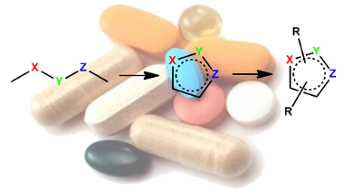
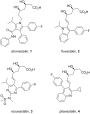
- , making candesartan a pro-drug in the same way as olmesartan [62]. This synthesis of the benzimidazole precursor makes use of a 1,2,3-trisubstituted nitrophthalic acid 205, which had to be selectively monoesterified and subjected to a Curtius rearrangement, which is cumbersome when the reaction is scaled







A short synthesis of (±)-cherylline dimethyl ether
Beilstein J. Org. Chem. 2009, 5, No. 80, doi:10.3762/bjoc.5.80

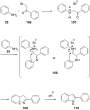
- Sciences and Humanities Department, SVNIT, Surat – 395 007, India 10.3762/bjoc.5.80 Abstract A synthesis of (±)-cherylline dimethyl ether is reported. The key steps involved are Michael-type addition, radical azidonation of an aldehyde, Curtius rearrangement, and reduction of an isocyanate intermediate
- followed by Pictet–Spengler cyclization. Keywords: Curtius rearrangement; Michael reaction; Pictet–Spengler cyclization; radical azidonation; Introduction Aryl-1,2,3,4-tetrahydroisoquinolines have attracted much attention from the synthetic community owing to the potential biological activities of this
- are Michael addition, radical azidonation of aldehydes [18], Curtius rearrangement, and reduction of an isocyanate intermediate followed by Pictet–Spengler cyclization. Results and Discussion Our retrosynthetic analysis of (±)-cherylline dimethyl ether (5) is depicted in Scheme 1. It can be


Controlling hazardous chemicals in microreactors: Synthesis with iodine azide
Beilstein J. Org. Chem. 2009, 5, No. 30, doi:10.3762/bjoc.5.30
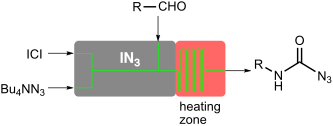
- Discussion The radical addition of azide to aldehydes 1 initially forms acyl azides 2 which directly rearrange in a Curtius rearrangement to the corresponding isocyanates 3. Isocyanates are very reactive themselves and offer a wide range of possible conversions. An excess of azide leads to the formation of
- 1 was added to the reagent in the microreactor as shown in Figure 1. All reagents and the aldehyde 1 were used as solutions in acetonitrile. After mixing the aldehyde with the iodine azide reagent the solution is passed through a capillary (volume: 196 µL) in a heating zone to allow the Curtius
- rearrangement to occur. Flow rates of 20 µL/min or higher led to very low or no conversion. At slower flow rates the yields were enhanced but seemed to stop growing at one point. Optimal yields were constant within a range of 15 to 1.5 µl/min corresponding to residence times in the heating zone of 13–130


Synthesis and enzymatic evaluation of 2- and 4-aminothiazole- based inhibitors of neuronal nitric oxide synthase
Beilstein J. Org. Chem. 2009, 5, No. 28, doi:10.3762/bjoc.5.28

- completion of the reaction and reprotecting the amine. The resulting esters (26a, R = H; 26b, R= Me; 26c, R = i-Pr) were hydrolyzed, and a Curtius rearrangement performed in tert-butanol gave the protected 4-aminothiazoles (7a-c) [18]. Unlike the case of the aminopyridine analogues [19], the aminothiazole


Other Beilstein-Institut Open Science Activities



