


Search results
Search for "GC/MS" in Full Text gives 265 result(s) in Beilstein Journal of Organic Chemistry. Showing first 200.
Friedel–Crafts acylation of benzene derivatives in tunable aryl alkyl ionic liquids (TAAILs)
Beilstein J. Org. Chem. 2023, 19, 212–216, doi:10.3762/bjoc.19.20
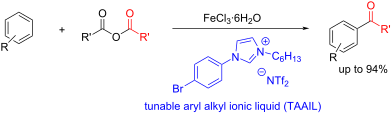
- amounts of acetic anhydride were used and a time-dependent investigation of the catalytic system was performed. Samples of the reaction mixture were taken after 10, 20, 30, 60 and 120 minutes and analyzed via GC–MS. The results are shown in Figure 1. The results show that full conversion of the starting
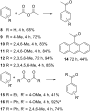
- via GC–MS). The products were isolated via flash column chromatography to determine the yield. Anthracene was selectively acylated at the 9-position (14) using acetic anhydride. The use of other anhydrides was also tested: propionic anhydride and benzoic anhydride lead to yields between 41% and 92


Germacrene B – a central intermediate in sesquiterpene biosynthesis
Beilstein J. Org. Chem. 2023, 19, 186–203, doi:10.3762/bjoc.19.18

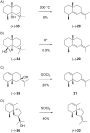
- , but this study did not report on the isolation and structure elucidation [117]. Rather the identification was only based on GC–MS data, without a reference to a previous identification through rigorous structure elucidation. Conclusively, this compound has not been described thoroughly and its
- based on tentative GC–MS assignments, often even without comparison to authentic standards, which results in a lot of information of questionable relevance. The large number of such papers published today makes it more and more difficult to find the relevant information in the literature. With this work








Sequential hydrozirconation/Pd-catalyzed cross coupling of acyl chlorides towards conjugated (2E,4E)-dienones
Beilstein J. Org. Chem. 2023, 19, 176–185, doi:10.3762/bjoc.19.17
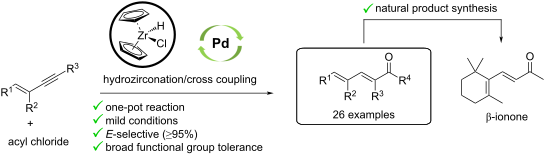
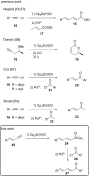
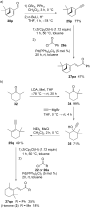
- and HPLC purification steps. However, GC–MS analysis of the crude product of one exemplary dienone 27ac (with only 17% yield) indicated only decomposition in the reaction sequence. Further, phenylenyne 25a was treated with different conjugated and aliphatic acyl chlorides 26m–p (Table 4, entries 13–16



Identification and determination of the absolute configuration of amorph-4-en-10β-ol, a cadinol-type sesquiterpene from the scent glands of the African reed frog Hyperolius cinnamomeoventris
Beilstein J. Org. Chem. 2023, 19, 167–175, doi:10.3762/bjoc.19.16
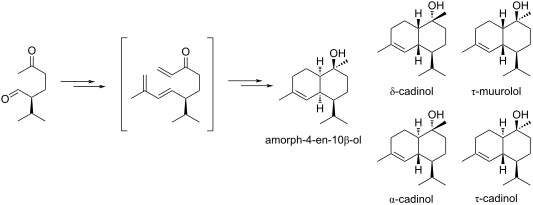
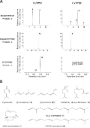
- chromatography; enantioselective synthesis; GC/MS; semiochemicals; Introduction Hyperolius cinnamomeoventris (Figure 1) is one of the largest species of reed frogs (Hyperoliidae), which are commonly found in Africa, south of the Sahara. Males of the Hyperoliidae possess a characteristic yellow gular patch on
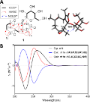
- A and C (Figure 3). As biological material is scarce and the amount of analytes is low, GC–MS trace analytical methods are performed to investigate extracts from the glands of individual frogs to identify their constituents. The analysis of MS and GC–IR data as well as gas chromatographic retention


Characterization of a new fusicoccane-type diterpene synthase and an associated P450 enzyme
Beilstein J. Org. Chem. 2022, 18, 1396–1402, doi:10.3762/bjoc.18.144
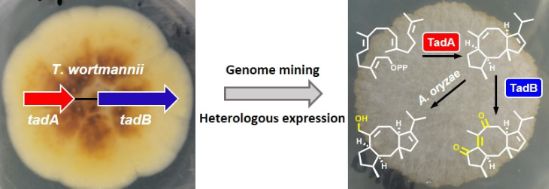
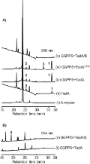
- ]. The resulted transformant was cultivated in the modified Czapek–Dox medium for four days, and then mycelia were harvested and extracted for analysis. Upon gas chromatography-mass spectrometry (GC–MS) analysis, we observed an additional peak at m/z = 272 [M]+ from the tadA harboring transformant
- with or without addition of deuterated water (D2O). GC–MS analysis showed that when the reaction mixture was supplemented with D2O, the ion peak at m/z 273 was observed, indicating that exogenous deuterium was incorporated into 1 (Supporting Information File 1, Figure S19). This suggests that TadA
- , through careful examination of the GC–MS profile of the transformant expressing tadA, we also observed the appearance of 3, the content of which is rather lower than that in the tadAY91H-containing transformant (Supporting Information File 1, Figure S25). Based on these, we propose that though both MgMS


Ionic multiresonant thermally activated delayed fluorescence emitters for light emitting electrochemical cells
Beilstein J. Org. Chem. 2022, 18, 1311–1321, doi:10.3762/bjoc.18.136
- File 250: 1H NMR and 13C NMR spectra, GC–MS, and HRMS; supplementary computational data and coordinates; additional photophysical. Acknowledgements We thank Dr. David Hall for providing help with the calculations and initial samples of some of the intermediates. Funding M. K. would like to thank 2214



From amines to (form)amides: a simple and successful mechanochemical approach
Beilstein J. Org. Chem. 2022, 18, 1210–1216, doi:10.3762/bjoc.18.126
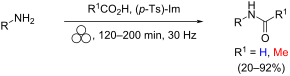
- intermediate was not detected by NMR or GC–MS analysis, possibly due to its instability [64]. Several studies carried out on our reaction crude at different times did not show the presence of compounds traceable to formylimidazole. The imidazole plays a dual role as promoting reagent and solid grinding
- assistance with the generation of the 1H, 13C NMR, and GC–MS spectroscopic data. Funding This research was funded by MIUR Italy, PRIN 2017 project (grant number: 2017B7MMJ5_001) “MultIFunctional poLymer cOmposites based on groWn matERials (MIFLOWER) and Fondazione di Sardegna (FdS, F72F20000230007).
The stereochemical course of 2-methylisoborneol biosynthesis
Beilstein J. Org. Chem. 2022, 18, 818–824, doi:10.3762/bjoc.18.82
- by GC/MS analysis and synthesis of reference compounds [29], several of which also occur in Escherichia coli or yeast strains that were engineered for the biosynthesis of methylated monoterpenes derived from 2-Me-GPP [30][31]. About one decade ago, the crystal structures of GPPMT and 2MIBS have been
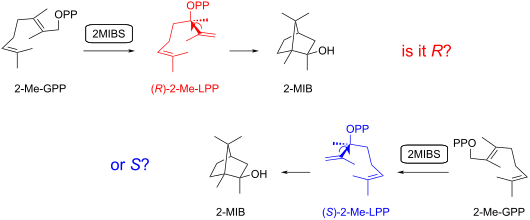
- enriched 2-Me-LPP with 2-MIBS The enantiomerically enriched substrates (R)- and (S)-2-Me-LPP were incubated with purified 2MIBS (Figure S2 in Supporting Information File 1), followed by extraction of the enzyme reactions with hexane and GC/MS analysis of the obtained products (Figure S3, Table S1 in
- enantiomerically pure 2-Me-LPP with 2-MIBS Both pure enantiomers of 2-Me-LPP were incubated with 2-MIBS. GC/MS analysis of the products (Figure 3A and 3B, and Table S1 in Supporting Information File 1) showed with the substrate (R)-2-Me-LPP an efficient conversion into 2-methylisoborneol (1, 75%). Minor compounds




Synthesis of α-(perfluoroalkylsulfonyl)propiophenones: a new set of reagents for the light-mediated perfluoroalkylation of aromatics
Beilstein J. Org. Chem. 2022, 18, 788–795, doi:10.3762/bjoc.18.79
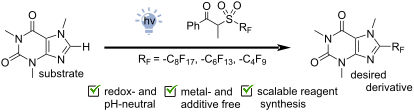
- 2-(perfluorohexyl)-1,1-diphenylethylene (8), and propiophenone through GC–MS analysis. Additionally, the presence of free SO2 gas was confirmed by the reaction of acidic potassium dichromate solution on paper (green coloration of the exposed surface). See Supporting Information File 1 for details
- as N-phenylpyrrole and 2-phenylindole were found to produce large quantities of the desired perfluorohexyl and perfluorooctyl analogues as observed by both 1H NMR and GC–MS analysis. However, these molecules generated large concentrations of fluorinated byproducts which rendered separation of the


Synthesis of odorants in flow and their applications in perfumery
Beilstein J. Org. Chem. 2022, 18, 754–768, doi:10.3762/bjoc.18.76
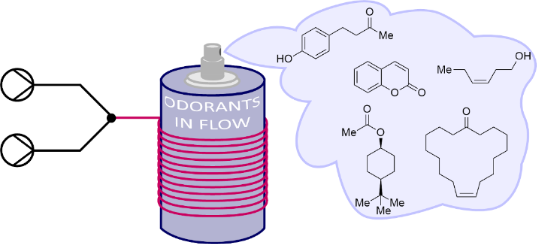
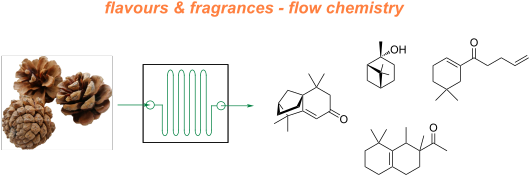
- overview of selected flow protocols for the synthesis of various odorants and highlight their role for perfumery. All quotations of percentages of these raw materials in perfumes are in the concentrate formula, before dilution, and are taken from GC/MS analyses. Review Classification of odorants As there
- heated tube reactor made from stainless steel 316L. In this reactor, the second step, i.e. pyrolysis of triperoxide 55 is achieved at 270 °C with a residence time of 12 min. The reaction mixture is collected and analyzed by GC/MS indicating formation of juniper lactone (56) in a yield of 10% along with
- temperature of 70 °C and a residence time of 30 min, macrocycles 65 and 66 are obtained in excellent yields with a preference for the E-isomers as determined by GC/MS analysis. Although, macrocycles 65 and 66 are, to the best of our knowledge, not used as musks in perfumery, this work demonstrates the value


A trustworthy mechanochemical route to isocyanides
Beilstein J. Org. Chem. 2022, 18, 732–737, doi:10.3762/bjoc.18.73
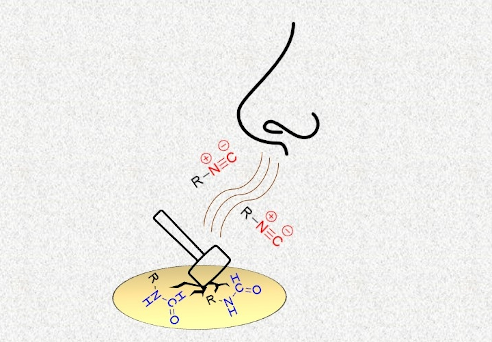
- (GC–MS analysis). Unexpectedly, the addition of Lewis acids, namely LiCl and BF3·Et2O, did not improve the enolate generation. The next step was searching the optimal conditions for a better conversion of 1f in 2f. These were found in the 1:2:7 ratios of the three components with the addition of 400
- after 1h (70%, GC–MS analysis). Reducing the amount of sodium carbonate did not provide any advantage. Interestingly, using anhydrous sodium carbonate instead of its hydrated form improved reaction yields, likely due to the hydrolysis of tosyl chloride. With these data in hand, we then opted for


Terpenoids from Glechoma hederacea var. longituba and their biological activities
Beilstein J. Org. Chem. 2022, 18, 555–566, doi:10.3762/bjoc.18.58
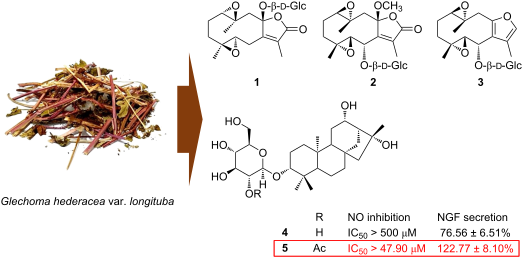
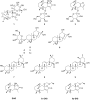
- spectrum of 1S,4S,5R,8S,10R-(1a). Finally, the ᴅ-glucopyranosyl moiety was identified by GC–MS analysis of a chiral derivatization product of the sugar obtained by enzyme hydrolysis of 1 [9][10]. The retention time of glucopyranose (11.3 min) corresponded to that of the standard ᴅ-glucopyranose (11.3 min
- as 3α,12α,16α [15]. Finally, the ᴅ-glucopyranose unit in 4 was confirmed by GC–MS analysis as described above (Supporting Information File 1, Figure S35) [10], and the coupling constant of anomeric protons at δH 4.33 (J = 7.8 Hz) implied β-ᴅ-glucopyranose [16]. Thus, the structure of compound 4 was
- using GC–MS. Monosaccharides (1, 0.4 mg; 2, 0.3 mg; 3, 0.4 mg; 4, 0.4 mg), obtained by hydrolysis, were dissolved in pyridine (0.5 mL), then ʟ-cysteine methyl ester hydrochloride (2 mg) was added. The reaction mixtures were then stirred at 60 °C for 2 h. After adding 1-trimethylsilylimidazole (0.1 mL



Synthesis of piperidine and pyrrolidine derivatives by electroreductive cyclization of imine with terminal dihaloalkanes in a flow microreactor
Beilstein J. Org. Chem. 2022, 18, 350–359, doi:10.3762/bjoc.18.39
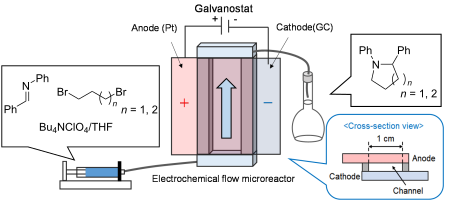
- column (Mightysil RP-18 GP II 250-4.6 (5 µm), Cica) using a mixture of H2O/MeCN/H3PO4 (60/40/0.1%) as a mobile phase. All chromatograms were recorded using an LC workstation (LabSolutions DB, Shimadzu). Helium gas was used as a carrier gas for the gas chromatography/mass spectrometry (GC–MS) analyses. 1H


A resorcin[4]arene hexameric capsule as a supramolecular catalyst in elimination and isomerization reactions
Beilstein J. Org. Chem. 2022, 18, 337–349, doi:10.3762/bjoc.18.38
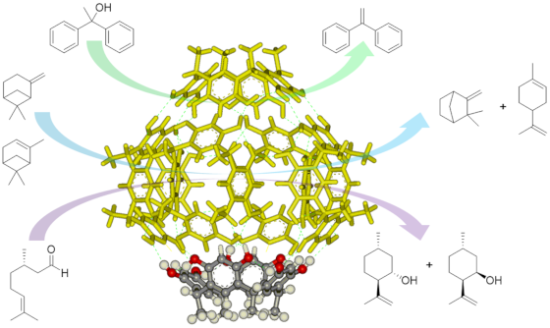
- subsequent water elimination leading to a stable tertiary, bis-benzyl carbocation that evolves forming the corresponding alkene by proton elimination (Scheme 3). The reaction was carried out at 60 °C with 10 mol % of 16 (Table 2, entry 1), monitoring the formation of the products by 1H NMR and GC–MS (see
- spectra were acquired at 298 K with a Bruker AVANCE 300 spectrometer operating at 300.15 MHz and with a Bruker 400 spectrometer operating at 400.15 MHz. The chemical shift values (δ) in ppm refer to SiMe4 (TMS) as standard. For GC–MS analysis a GC Trace GC 2000 apparatus was used equipped with an HP5-MS
- . Subsequently, the substrate (75 mM) was introduced, and the tube was maintained at 60 °C. The progress of the reaction was monitored by 1H NMR and GC–MS by periodic sampling of the solution. Product assignments in the 1H NMR spectra were carried out in accordance with literature data: for citronellal


The enzyme mechanism of patchoulol synthase
Beilstein J. Org. Chem. 2022, 18, 13–24, doi:10.3762/bjoc.18.2
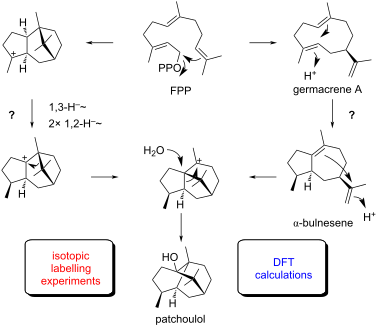
- the target compound (2-2H)FPP with some (2,15-2H2)FPP, seems to be the more likely explanation for the deuteration of 3 at C15 observed by Faraldos et al. [14]. This can also much better explain the deuterium content observed by GC–MS in the PTS products that were proposed to transfer deuterium to 3






Efficient N-arylation of 4-chloroquinazolines en route to novel 4-anilinoquinazolines as potential anticancer agents
Beilstein J. Org. Chem. 2021, 17, 2968–2975, doi:10.3762/bjoc.17.206

- , copies of 1H and 13C spectra and additional information of antiproliferative assay. Acknowledgements The authors acknowledge the assistance of Mrs. Izabel C. C. Turatti, Mr. José C. Tomaz and Mr. Vinicius Palaretti in the GC–MS, HRMS and NMR analysis, respectively. Funding The authors gratefully thank


Synthesis of highly substituted fluorenones via metal-free TBHP-promoted oxidative cyclization of 2-(aminomethyl)biphenyls. Application to the total synthesis of nobilone
Beilstein J. Org. Chem. 2021, 17, 2668–2679, doi:10.3762/bjoc.17.181
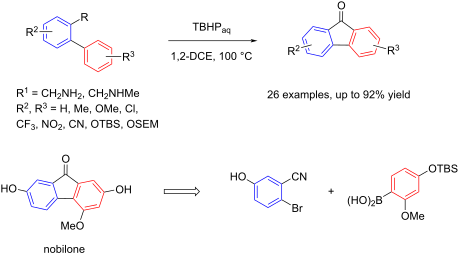
- secondary and tertiary amines, amides/lactams/carbamates, and nitrile. The test reactions were monitored by thin-layer chromatography (TLC) and, where deemed necessary, results were further verified by GC–MS. The reagents employed encompassed tritylium tetrafluoroborate [50], H2O2/HBr [42], ceric ammonium
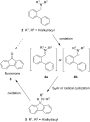
- /reagent combinations employed. The reaction of the secondary N-methylamine 2b with CBr4 [22] gave fluorenone (3) in 6% yield (determined by GC–MS), while tertiary amines, amides, and the γ-lactam 2e did not yield any. Formation of fluorenone (3) was also confirmed after applying a modified version of one
- fluorenone (3) in 30% yield (determined by GC–MS). TLC analysis further revealed that fluorenone formation does not occur when treating tertiary amides 2h and 2i, γ-lactam derivative 2e, and carbamate 2j with this reagent (Table 1, entries 5, 8, 9, and 10). The reaction does, however, also work with tertiary





Recent advances in the tandem annulation of 1,3-enynes to functionalized pyridine and pyrrole derivatives
Beilstein J. Org. Chem. 2021, 17, 2462–2476, doi:10.3762/bjoc.17.163
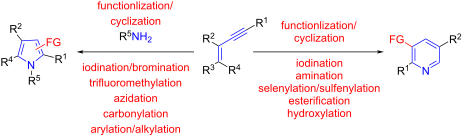
- standard conditions could inhibit the formation of target product. In contrast, the compound TEMPO–N3 was detected by GC–MS analysis. Based on the radical trapping experiment and previous reports, the reaction may undergo a radical process. 2-Carbonylpyrrole is a key subunit of many bioactive natural




Targeting active site residues and structural anchoring positions in terpene synthases
Beilstein J. Org. Chem. 2021, 17, 2441–2449, doi:10.3762/bjoc.17.161
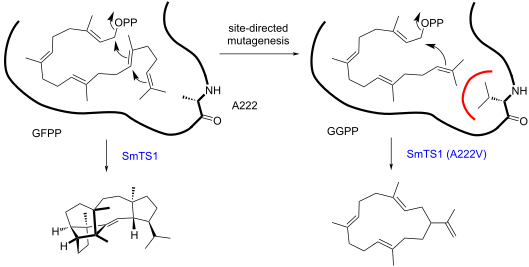
- (Supporting Information File 1, Figure S2). Enzyme reactions with GFPP as substrate were performed in triplicates and the relative activities were determined based on the sum of peak integrals for all sesterterpene products monitored by GC–MS (for representative chromatograms cf. Supporting Information File 1
- diterpenes cembrene A (8) and nephthenol (9) that were identified by GC–MS (Figure 5 and Supporting Information File 1, Figure S5). While it is easy to understand that GFPP cannot enter the active site of the A222V variant, these findings raise the question why GGPP is not converted by the wildtype? A


Phenolic constituents from twigs of Aleurites fordii and their biological activities
Beilstein J. Org. Chem. 2021, 17, 2329–2339, doi:10.3762/bjoc.17.151

- demethyldihydrodehydrodiconiferyl alcohol based on the comparison of 1H NMR and MS data [13]. The relatively large coupling constant of the anomeric proton (7.8 Hz) confirmed that the glucose is combined as β-form [14]. ᴅ-Glucose was identified by co-TLC with a standard sample [CHCl3/MeOH/H2O 2:1:0.1, Rf = 0.3)] and GC–MS analysis
- analyzed by GC–MS. The identification of ᴅ-glucose and ʟ-rhamnose was carried out by coinjection of the hydrolysate with standard silylated samples, giving a single peak at 9.730 and 9.712 min, respectively. Authentic samples (Sigma-Aldrich, St. Louis, MO, USA) that were treated in the same way showed a


Transition-metal-free intramolecular Friedel–Crafts reaction by alkene activation: A method for the synthesis of some novel xanthene derivatives
Beilstein J. Org. Chem. 2021, 17, 2203–2208, doi:10.3762/bjoc.17.142
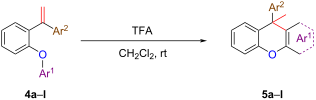
- and were characterized by IR and GC–MS. All novel pruducts were characterized by IR, 1H NMR, 13C NMR, elemental analysis and GC–MS. The reactions were monitored by TLC using silica gel plates and the products were purified by flash column chromatography on silica gel (Merck; 230–400 mesh), eluting
- with hexane/ethyl acetate (v/v 9:1). NMR spectra were recorded at 500 MHz for 1H and 125 MHz for 13C using Me4Si as the internal standard in CDCl3. GC–MS were recorded on a Shimadzu/ QP2010 Plus spectrometer. IR spectra were recorded on a Mattson 1000 spectrometer. Melting points were determined with a


Volatile emission and biosynthesis in endophytic fungi colonizing black poplar leaves
Beilstein J. Org. Chem. 2021, 17, 1698–1711, doi:10.3762/bjoc.17.118
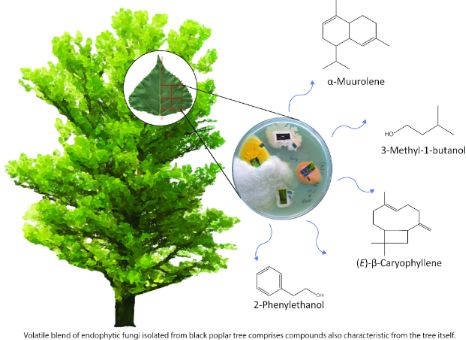
- collection PDMS tubes were immediately removed from the wire and stored in glass vials at −20 °C until further analysis. Volatiles trapped on PDMS tubes were analyzed by GC–MS (GCMS-QP2010 Ultra, Shimadzu, Duisburg, Germany) coupled to a thermal desorption unit (TD-20, Shimadzu, Duisburg, Germany). A single
- )-GGPP) and 20 mM MgCl2. Assays were overlaid with 100 µL hexane and incubated for 60 minutes at 30 °C. One microliter of the hexane phase was injected into the GC–MS machine and the analysis was conducted using an Agilent 6890 Series gas chromatograph coupled to an Agilent 5973 quadrupole mass selective



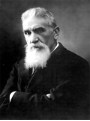
Icilio Guareschi and his amazing “1897 reaction”
Beilstein J. Org. Chem. 2021, 17, 1335–1351, doi:10.3762/bjoc.17.93
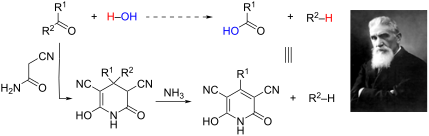
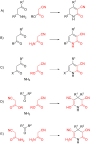
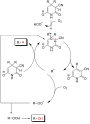
- before the introduction of GC–MS, and the elemental analysis of gases required special attention [55]. Guareschi also made the observation that air was necessary for the development of the gas, proposing a general scheme for the transformation that provides, however, no clue for a possible mechanism. In









A comprehensive review of flow chemistry techniques tailored to the flavours and fragrances industries
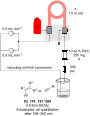
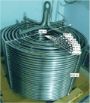
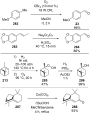
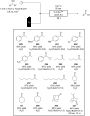
Beilstein J. Org. Chem. 2021, 17, 1181–1312, doi:10.3762/bjoc.17.90










Synthesis of bis(aryloxy)fluoromethanes using a heterodihalocarbene strategy
Beilstein J. Org. Chem. 2021, 17, 813–818, doi:10.3762/bjoc.17.70

- the corresponding mass was observed by GC–MS, we were unable to isolate 13 in pure form. The base-mediated method we have reported herein is complementary to that of Scheeren, since it is apparently more practical for electron-poor arenes, while the bis(aryloxy)chloromethanes required as intermediates





