Search results
Search for "azomethine ylide" in Full Text gives 39 result(s) in Beilstein Journal of Organic Chemistry.
Multicomponent reactions in nucleoside chemistry
Beilstein J. Org. Chem. 2014, 10, 1706–1732, doi:10.3762/bjoc.10.179
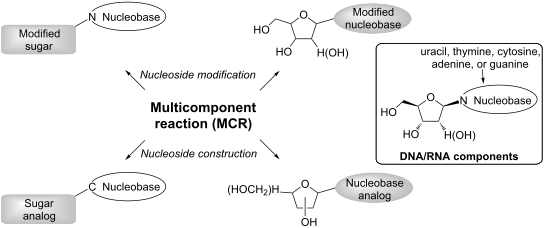
- polyoxin C hydrochloride 105*HCl (Scheme 44) [121]. The reaction cascade involved thermal formation of the corresponding azomethine ylide from substrate 105*HCl and benzaldehyde, followed by 1,3-dipolar cycloaddition of the ylide to N-methylmaleimide. The formation of compound 107 as the only product was


Site-selective covalent functionalization at interior carbon atoms and on the rim of circumtrindene, a C36H12 open geodesic polyarene
Beilstein J. Org. Chem. 2014, 10, 956–968, doi:10.3762/bjoc.10.94
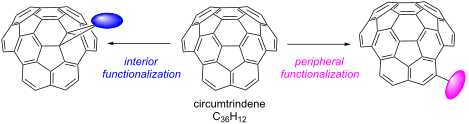
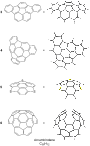
- the great electrophilicity of circumtrindene in the Bingel–Hirsch reaction, it came as no surprise that circumtrindene can act as a good dipolarophile in a [3 + 2] cycloaddition reaction as well. Accordingly, the azomethine ylide 23 generated in situ from N-methylglycine and formaldehyde adds to
- selectivity. The molecule behaves as an electrophile toward the bromoenolate (deprotonated bromomalonate) in the Bingel–Hirsch reaction and as an electrophile toward the 1,3-dipole (azomethine ylide) in the Prato reaction. Consequently, the LUMO of circumtrindene is the frontier molecular orbital that should




Domino reactions of 2H-azirines with acylketenes from furan-2,3-diones: Competition between the formation of ortho-fused and bridged heterocyclic systems
Beilstein J. Org. Chem. 2014, 10, 784–793, doi:10.3762/bjoc.10.74

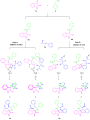
- electron withdrawing effect of the nitro group. As for possible routes for the formation of adducts 4 and 5, the first (Scheme 2, (a)) involves cleavage of the aziridine ring of intermediate 8 to generate azomethine ylide 10, and further “dimerization” of the latter. Examples of compounds that can be
- , benzene (PCM)), respectively, that far exceed the barriers to reactions leading to compound 3. These do not allow the possibility that azomethine ylide 10 can be a probable intermediate in the formation of adducts 4 and 5. It has been known that imines react with acylketenes, generated from furandiones


Silver and gold-catalyzed multicomponent reactions
Beilstein J. Org. Chem. 2014, 10, 481–513, doi:10.3762/bjoc.10.46
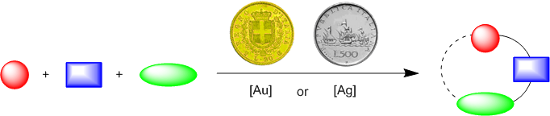
- , aldehydes and alkenes in a three-component reaction based on the cascade imine formation, azomethine ylide generation and [3 + 2] cycloaddition reaction for the synthesis of pyrrolidines. However, the adopted method to induce chirality in the final products is rather dissimilar. Thus, in 2006 Garner’s group
- one hand, as an electron withdrawing group, it decreases the nucleophilicity of the amine, thus avoiding the formation of detrimental Michael-type adducts with the alkene. On the other hand, it increases the α-acidity of the imine intermediate, thus favoring the azomethine ylide formation. Moreover


Additive-assisted regioselective 1,3-dipolar cycloaddition of azomethine ylides with benzylideneacetone
Beilstein J. Org. Chem. 2014, 10, 352–360, doi:10.3762/bjoc.10.33

- 4-nitrobenzoic acid, respectively. The substituent effects on the regioselectivity were also investigated. Keywords: 1,3-dipolar cycloaddition; azomethine ylide; regioselectivity; spirooxindole; Introduction Spirooxindoles are important synthetic targets due to their significant biological
- -unsaturated enones. Moreover, we envisioned that the additive might effectively tune the regioselectivity of a 1,3-dipolar cycloaddition of azomethine ylide. Herein, we report a three-component 1,3-dipolar cycloaddition of azomethine ylides, generated in situ from isatin derivatives and benzylamine, with
- benzylideneacetone derivatives in the presence of various additives. It was found that the addition of water can significantly improve the regioselectivity and yield of this reaction [45][46][47][48]. More importantly, the regioselectivity of the 1,3-dipolar cycloaddition of azomethine ylide was reversed by the




The regioselective synthesis of spirooxindolo pyrrolidines and pyrrolizidines via three-component reactions of acrylamides and aroylacrylic acids with isatins and α-amino acids
Beilstein J. Org. Chem. 2014, 10, 117–126, doi:10.3762/bjoc.10.8
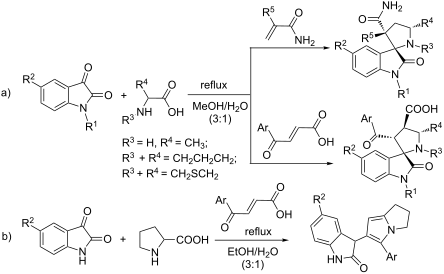
- indolones. Keywords: acrylamides; aroylacrylic acids; azomethine ylide; cyclative rearrangement; cycloaddition; multicomponent; spirooxindoles; Introduction The design of new spirocyclic compounds is intriguing due to their unique non-planar structure and great potential for binding to biomolecules due to
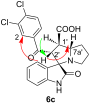
- 22.9° and the shortest distance between carbon atoms (C6…C15) is 3.04 Å). The mechanism of the azomethine ylide formation by a decarboxylative route has been repeatedly described by a number of authors and is depicted in Scheme 1 [35][36]. The reaction between isatin and the α-amino acid affords the
- azomethine ylide, which regioselectively adds to the C=C bond of acrylamide or aroylacrylic acid. Since the stereochemistry of the cycloadducts 4a and 6a was clarified by a single-crystal X-ray analysis, the structures of the reacting systems – the azomethine ylide and dipolarophiles (acrylamide and




Synthetic scope and DFT analysis of the chiral binap–gold(I) complex-catalyzed 1,3-dipolar cycloaddition of azlactones with alkenes
Beilstein J. Org. Chem. 2013, 9, 2422–2433, doi:10.3762/bjoc.9.280
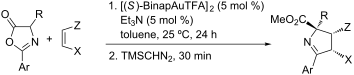
- unexpected regioselectivity of the 1,3-DC depicted in Scheme 6, calculations within the DFT framework were performed. In the accepted mechanism of the metal catalyzed 1,3-DC of azomethine ylides and acrylates, the α-carbon atom of the azomethine ylide (C2 in Figure 5) reacts with the β-carbon of the acrylate
- higher in the carbon in α-position to the carboxy group (C2). Initially, a model azomethine ylide derived from oxazolone 10 was considered (Figure 5). Moreover, an acyclic w-shaped ylide analogue (Ylide-II) was also studied as a reference. We chose this latter 1,3-dipole because it is known that with
- needed using other synthetic strategies [43]. Pyrrolines also possess a typical 1,3-dipole precursor structure (azomethine ylide), so a second cycloaddition was attempted with a new equivalent of N-methylmaleimide. The reaction took place under microwave assisted heating (1 h, 75 W) using triethylamine





The chemistry of amine radical cations produced by visible light photoredox catalysis
Beilstein J. Org. Chem. 2013, 9, 1977–2001, doi:10.3762/bjoc.9.234
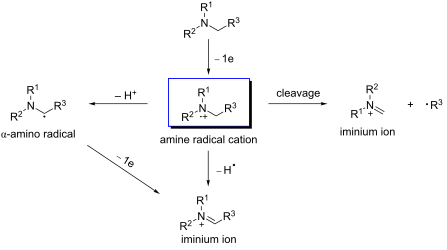
- cycloaddition is shown in Scheme 13. The reaction commences with oxidation of tetrahydroisoquinoline 41 to amine radical cation 48 by the photoexcited state of Ru2+. Subsequently, abstraction of a hydrogen atom α to the nitrogen atom of 48 yields iminium ion 49, which is then converted to azomethine ylide 50 by




Dipolar addition to cyclic vinyl sulfones leading to dual conformation tricycles
Beilstein J. Org. Chem. 2013, 9, 1419–1425, doi:10.3762/bjoc.9.159

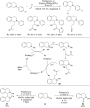
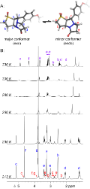
- species [13][14][15][16][17][18][19][20][21]) have been less-frequently employed as acceptors in 1,3-dipolar cycloadditions [22][23][24][25]. Indeed, we are only aware of a single prior example of a cyclic alkyl vinyl sulfone participating in a dipolar addition with an azomethine ylide [26]. In part, this


Organocatalytic C–H activation reactions
Beilstein J. Org. Chem. 2012, 8, 1374–1384, doi:10.3762/bjoc.8.159
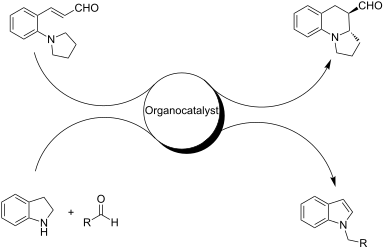
- explanation is the formation of azomethine ylide intermediate 11 (Scheme 8) [19][20]. The carbanion of ylide 11 is then protonated by benzoic acid, and the resulting benzoate anion supports the aromatization process. In fact, Seidel and co-workers provided the experimental evidence for the existence of
- azomethine ylide intermediates in the Tunge pyrrole formation and in the formation of N-alkylindoles from indoline [19]. These reactions are considered C–H activation reactions, as during the azomethine ylide formation, the C–H bond that is cleaved is not activated by electron-withdrawing (such as ester
- indicated that the formation of acetic acid assisted azomethine ylide 13 is the most plausible pathway for the rearrangement process [21]. The first step is the nucleophilic addition of an amine to the carbonyl group to generate a carbinolamine intermediate (Scheme 8). It then becomes O-acetylated by acetic





Synthesis of fused tricyclic amines unsubstituted at the ring-junction positions by a cascade condensation, cyclization, cycloaddition then decarbonylation strategy
Beilstein J. Org. Chem. 2012, 8, 107–111, doi:10.3762/bjoc.8.11
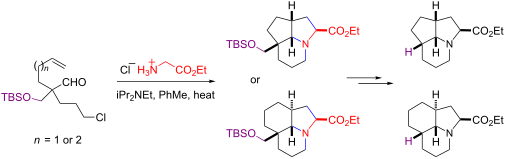
- sequence involving condensation to an intermediate imine, then cyclization and formation of an intermediate azomethine ylide and then intramolecular dipolar cycloaddition. The fused tricyclic products are formed with complete or very high stereochemical control. The hydroxymethyl group was converted into
- an aldehyde – which could be removed to give the tricyclic amine products that are unsubstituted at the ring junction positions – or was converted into an alkene, which allowed the formation of the core ring system of the alkaloids scandine and meloscine. Keywords: alkaloid; azomethine ylide
- transformation [2][3][4][5][6][7][8]. We have been studying the intramolecular dipolar cycloaddition of azomethine ylides in synthesis [9][10][11][12][13][14][15][16] and were able to show that the azomethine ylide could be prepared in situ by a cyclization step [17][18]; for example, by heating the aldehyde 1


Recent developments in gold-catalyzed cycloaddition reactions
Beilstein J. Org. Chem. 2011, 7, 1075–1094, doi:10.3762/bjoc.7.124
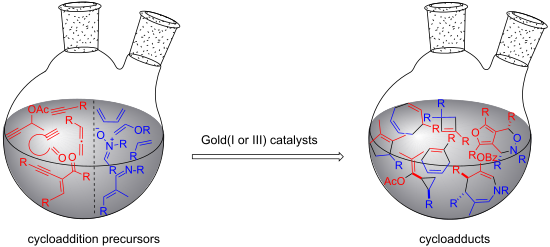
- cycloadditions is the initial nucleophilic addition of a carbonyl oxygen to the alkyne. As expected, an imine can also be used as a nucleophile, such as 15, which leads to the generation of an azomethine ylide capable of participating in dipolar (3 + 2) cycloadditions to unsaturated systems such as electron-rich
- alternative procedure for the generation and subsequent cycloaddition of azomethine ylide intermediates under gold catalysis. Importantly, they demonstrated that the intramolecular attack of a nitrone oxygen to a tethered gold-activated alkyne leads, by means of an internal redox reaction, to an α-carbonyl
- carbenoid tethered to an imine group (Scheme 10). A subsequent attack of this imine to the carbenoid generates the reactive azomethine ylide intermediate XIV, which undergoes a (3 + 2) dipolar cycloaddition with an intramolecularly tethered alkene or alkyne. Thus, interesting azabicyclo[3.2.1]octane


Chiral gold(I) vs chiral silver complexes as catalysts for the enantioselective synthesis of the second generation GSK-hepatitis C virus inhibitor
Beilstein J. Org. Chem. 2011, 7, 988–996, doi:10.3762/bjoc.7.111
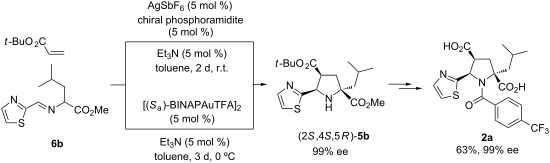
- synthesis of the endo-pyrrolidine core of 5 is the key step for the preparation of these antiviral agents, and can be efficiently achieved by a 1,3-dipolar cycloaddition (1,3-DC) between the corresponding azomethine ylide and an alkyl acrylate [14][15][16][17][18] (Scheme 1). The first synthesis of racemic




Mitomycins syntheses: a recent update
Beilstein J. Org. Chem. 2009, 5, No. 33, doi:10.3762/bjoc.5.33