


Search results
Search for "chiral auxiliaries" in Full Text gives 56 result(s) in Beilstein Journal of Organic Chemistry.
Synthesis of spirocyclic scaffolds using hypervalent iodine reagents
Beilstein J. Org. Chem. 2018, 14, 1778–1805, doi:10.3762/bjoc.14.152
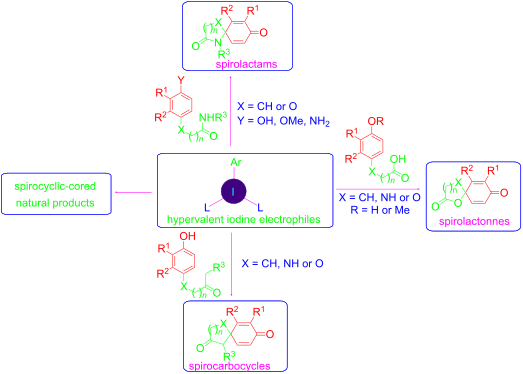
- chiral auxiliaries 129a or 129b under similar reaction conditions mentioned in Scheme 48. Furthermore, the synthesized spiroketal 159 (R2 = iPr; R4 = SiMe3) was used as synthetic intermediate for enantioselective synthesis of natural product (−)-biscarvacrol [8] (Scheme 59). Additionally, Parra and


Diastereoselective auxiliary- and catalyst-controlled intramolecular aza-Michael reaction for the elaboration of enantioenriched 3-substituted isoindolinones. Application to the synthesis of a new pazinaclone analogue
Beilstein J. Org. Chem. 2018, 14, 593–602, doi:10.3762/bjoc.14.46

- incorporate α-methylbenzylamine-type chiral auxiliaries, which have been extensively used by Davies et al. to gain access to a wide range of chiral N-heterocycles via intermolecular aza-Michael reactions [34][47][48][49][50][51]. The starting unsaturated benzoic acids 14a–e and 15 were readily prepared via a
- previously observed in other Michael-additions involving chiral auxiliaries on the nucleophile and on the Michael acceptor [62]. As for (S)-6a, catalyst 18c bearing a bulky tert-butyl group at the benzyl para-position gave the best results in term of stereoselectivity (80% de, Table 2, entry 7). However, the


Investigations towards the stereoselective organocatalyzed Michael addition of dimethyl malonate to a racemic nitroalkene: possible route to the 4-methylpregabalin core structure
Beilstein J. Org. Chem. 2018, 14, 553–559, doi:10.3762/bjoc.14.42
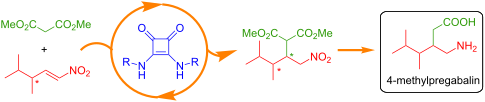
- amino acids have also been investigated as treatments for ocular disorders [7]. However, the syntheses of this type of compounds were long and relied on the use of Evans chiral auxiliaries or chiral starting materials. Various GABA derivatives were synthesized using asymmetric organocatalysis


A mechanochemical approach to access the proline–proline diketopiperazine framework
Beilstein J. Org. Chem. 2017, 13, 2169–2178, doi:10.3762/bjoc.13.217
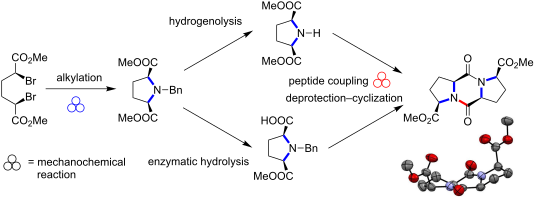
- chemists have used DKPs extensively as a synthetic platform, easily synthesized and stereochemically controlled, for the preparation of small bioactive molecules [4][5]. DKPs have also been considered as chiral auxiliaries in asymmetric synthesis [6]. Furthermore, the rigidity of the DKPs is a unique


Sulfamide chemistry applied to the functionalization of self-assembled monolayers on gold surfaces
Beilstein J. Org. Chem. 2017, 13, 648–658, doi:10.3762/bjoc.13.64

- applications in medicinal chemistry, sulfamide groups have been incorporated in self-assembling molecules [22][23][24][25][26][27], peptides [28], polymers [29], ligands [30], chiral auxiliaries [31][32][33] and in organocatalysts [34][35][36][37]. In light of the importance of the sulfamide functionality, our




Diastereoselective anodic hetero- and homo-coupling of menthol-, 8-methylmenthol- and 8-phenylmenthol-2-alkylmalonates
Beilstein J. Org. Chem. 2017, 13, 33–42, doi:10.3762/bjoc.13.5
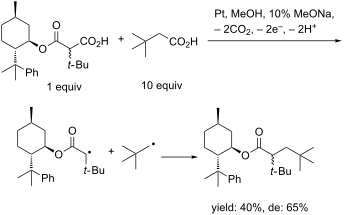
- Matthias C. Letzel Hans J. Schafer Roland Frohlich Organisch-Chemisches Institut der Westfälischen Wilhelms- Universität, Corrensstraße 40, D-48149 Münster, Germany 10.3762/bjoc.13.5 Abstract Diastereoselective radical coupling was achieved with chiral auxiliaries. The radicals were generated by
- reason, we were interested in exploring the structural influence of chiral auxiliaries (Figure 1) and the carboxylic acid on the diastereoselectivity in the anodic coupling of carboxylic acids. We report here on the diastereoselectivity found in the anodic hetero- and homo-coupling of menthol- (1)-, 8
- so far successful reagents LiAlH4 and DIBAL. Therefore, in the future bulky chiral auxiliaries must be developed that can be partially disassembled before their cleavage and slim cleavage reagents have to be found and explored. Conclusion We developed an efficient procedure for the synthesis of




Stereo- and regioselectivity of the hetero-Diels–Alder reaction of nitroso derivatives with conjugated dienes
Beilstein J. Org. Chem. 2016, 12, 1949–1980, doi:10.3762/bjoc.12.184
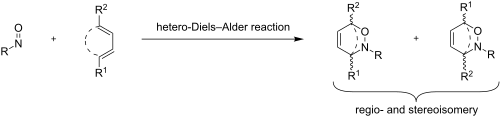
- substrates: a) reaction with chiral nitroso dienophiles; b) reaction with a chiral diene; and c) reaction via double asymmetric induction, with both the diene and nitroso dienophile being chiral entities. Chiral dienophiles: The use of acylnitroso dienophiles with chiral auxiliaries has ample precedent in
- used by Orena in reactions with cyclopentadiene and cyclohexadiene, giving the products with de values of 74 and 86%, respectively [118]. A series of chiral auxiliaries based on mandelic acid showed similar stereoselectivity benefits and have been proposed by Procter for stereoselective synthesis [109


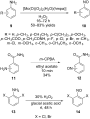




Experimental and theoretical insights in the alkene–arene intramolecular π-stacking interaction
Beilstein J. Org. Chem. 2016, 12, 1616–1623, doi:10.3762/bjoc.12.158
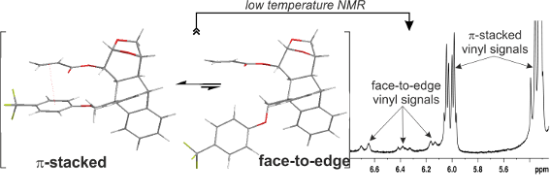
- 1). Saponification of adducts 11 and 12 provided the free 5-norbornenecarboxylic acid and the chiral auxiliaries 5a and 5b in excellent yields, which can be reused. Conclusion We have reported the synthesis of chiral acrylates derived from renewable feedstock as models to study arene–alkene π




Diastereoselective Ugi reaction of chiral 1,3-aminoalcohols derived from an organocatalytic Mannich reaction
Beilstein J. Org. Chem. 2016, 12, 139–143, doi:10.3762/bjoc.12.15

- /epimerization can again be an issue in special cases [24]. However, the use of amines as chiral auxiliaries has been seldom exploited in peptidomimetic synthesis [16][25][26] because the need to remove the auxiliary reduces the number of diversity inputs and increases the number of synthetic steps. From the
- point of view of atom- and step-economy, the use of chiral amines that are retained in the final products will be more valuable [27]. In this case they are not "chiral auxiliaries" and are not removed after the multicomponent reaction, and they contribute to the diversity of the final products. However


Diastereoselective and enantioselective conjugate addition reactions utilizing α,β-unsaturated amides and lactams
Beilstein J. Org. Chem. 2015, 11, 530–562, doi:10.3762/bjoc.11.60

- development of asymmetric variants of the Michael reaction. In early studies, chemists relied on chiral auxiliaries [5], heterocuprates [15][16], or natural product-based [17] ligands to induce high to modest stereoselectivity. In 1991, Alexandre Alexakis and co-workers reported the first asymmetric conjugate
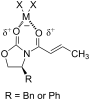
- lactams. 1.1 DCA using chiral auxiliaries Chiral auxiliaries have been useful tools to induce stereoselectivity in C–C bond forming reactions [5][32][33][34]. Ideally, these compounds are stable, easily attached, removed and recoverable. One of the first examples of a DCA reaction using a chiral auxiliary
- the oxygen of the resulting enolate of the CA reaction. This chelation to the magnesium would retard the 1,2-addition reaction from occurring. Since the Mukaiyama publication, there have been many chiral auxiliaries studied in DCA reactions of α,β-unsaturated amides [35]. Figure 2 highlights a few of




Metal-free one-pot synthesis of 2-substituted and 2,3-disubstituted morpholines from aziridines
Beilstein J. Org. Chem. 2015, 11, 524–529, doi:10.3762/bjoc.11.59

- cis-2,3-disubstituted morpholine, aprepitant, is approved for the use in the prevention of chemotherapy-induced nausea and vomiting [6]. In addition to pharmacological properties, morpholines are also used in organic synthesis as bases, catalysts, and chiral auxiliaries [7][8][9][10][11][12][13]. Thus


(2R,1'S,2'R)- and (2S,1'S,2'R)-3-[2-Mono(di,tri)fluoromethylcyclopropyl]alanines and their incorporation into hormaomycin analogues
Beilstein J. Org. Chem. 2014, 10, 2844–2857, doi:10.3762/bjoc.10.302

- -threonine (4) and (2S,3R)-β-methylphenylalanine (3), using the Belokon' approach with (S)- and (R)-2-[(N-benzylprolyl)amino]benzophenone [(S)- and (R)-10] as reusable chiral auxiliaries have been developed. Three new fluoromethyl analogues of the naturally occurring octadepsipeptide hormaomycin (1) with
- from (S)- and (R)-2-[(N-benzylprolyl)amino]benzophenone [(S)- and (R)-10] as reusable chiral auxiliaries with the racemic iodides 11a–c, employing the protocol of Larionov and de Meijere [7], in each case led to a mixture of diastereomeric products, which were separated by column chromatography




One-pot stereoselective synthesis of α,β-differentiated diamino esters via the sequence of aminochlorination, aziridination and intermolecular SN2 reaction
Beilstein J. Org. Chem. 2014, 10, 1802–1807, doi:10.3762/bjoc.10.189

- corresponding β,γ-amino alcohols and vicinal diamines. α,β-Diamino acid derivatives have been served as organocatalysts, chiral ligands, chiral auxiliaries for asymmertric synthesis [10][11][12], as well as synthetic fragments for peptides and natural products [13]. Mannich-type addition reactions of α-amino


Asymmetric Ugi 3CR on isatin-derived ketimine: synthesis of chiral 3,3-disubstituted 3-aminooxindole derivatives
Beilstein J. Org. Chem. 2014, 10, 1383–1389, doi:10.3762/bjoc.10.141

- created, the stereoselectivity remains a difficult task. Waiting for enantioselective versions of the Ugi reaction [29][30][31], the diastereoselective approach by using chiral material is a possible solution. In particular, amines have shown to be promising as chiral auxiliaries, even though only a few


Preparation of phosphines through C–P bond formation
Beilstein J. Org. Chem. 2014, 10, 1064–1096, doi:10.3762/bjoc.10.106
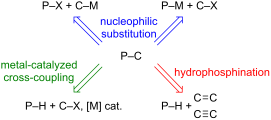
- halophosphines and their weak configurational stability. P-stereogenic chlorophosphines racemize easily even at room temperature [30]. Enantiopure P-stereogenic compounds can be synthesized via a diastereoselective nucleophilic substitution at phosphorus utilizing chiral auxiliaries. Diastereomeric intermediates
- are formed that are separable by chromatography or recrystallization. The protocol has proven to be effective and has become the preferred approach for the synthesis of chiral phosphines. Commonly used chiral auxiliaries are chiral secondary alcohols (for example (−)-menthol (3), endo-borneol, etc


Group-assisted purification (GAP) chemistry for the synthesis of Velcade via asymmetric borylation of N-phosphinylimines
Beilstein J. Org. Chem. 2014, 10, 746–751, doi:10.3762/bjoc.10.69
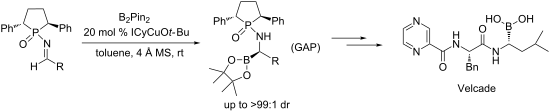
- -catalyzed borylation of the imine anchored with chiral auxiliaries [16][17]; (3) to conduct asymmetric catalytic hydrogenation as the key step to control the chiral center of boronic aicd [18]. As anticipated, the above known syntheses required traditional purification methods using column chromatography or


Synthesis of complex intermediates for the study of a dehydratase from borrelidin biosynthesis
Beilstein J. Org. Chem. 2014, 10, 634–640, doi:10.3762/bjoc.10.55
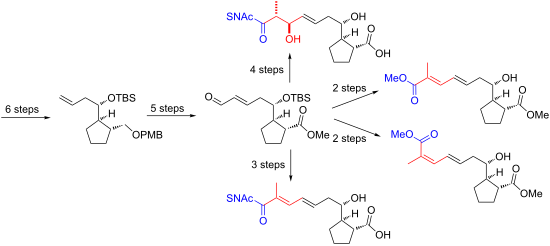
- as on aldehyde 11 [18][19][20][21]. However, in all these cases either the aldol reaction itself proved to be low yielding (<20%) or removal conditions of chiral auxiliaries were destructive to the molecule. The best results were obtained for an anti-selective variant, in which aldehyde 11 was


Concise, stereodivergent and highly stereoselective synthesis of cis- and trans-2-substituted 3-hydroxypiperidines – development of a phosphite-driven cyclodehydration
Beilstein J. Org. Chem. 2014, 10, 369–383, doi:10.3762/bjoc.10.35
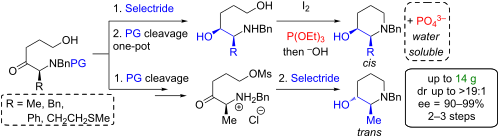
- active natural products [1][2][3][4][5][6][7][8][9], chiral auxiliaries [10][11] and catalysts for asymmetric synthesis [12][13][14]. Especially the 2-substituted 3-hydroxypiperidine scaffold of the general structure B (as one type of an 1,2-amino alcohol) can be found in numerous natural products and


Stereodivergent synthesis of jaspine B and its isomers using a carbohydrate-derived alkoxyallene as C3-building block
Beilstein J. Org. Chem. 2013, 9, 2564–2569, doi:10.3762/bjoc.9.291
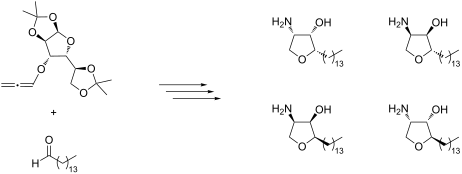
- . Keywords: chiral auxiliaries; gold catalysis; jaspine B; lithiated alkoxyallenes; natural product synthesis; pachastrissamine; tetrahydrofurans; Introduction Jaspine B, also known as pachastrissamine (1, Scheme 1), is an anhydrophytosphingosine derivative, isolated 2002 from the marine sponge Pachastrissa
- Having established suitable conditions for the construction of the functionalized tetrahydrofuran core we focused our attention on the synthesis of enantiopure jaspine B (1). Earlier investigations by Goré [38] and our group already showed the feasibility of alkoxyallenes with carbohydrate-derived chiral
- auxiliaries for the synthesis of enantiopure natural products such as preussin [39] and anisomycin [40] or in hetero Diels–Alder reactions [41][42]. For the stereodivergent synthesis of both enantiomers of jaspine B (1), we chose diacetoneglucose-derived alkoxyallene 11, which is easily accessible on gram


Non-cross-linked polystyrene-supported 2-imidazolidinone chiral auxiliary: synthesis and application in asymmetric alkylation reactions
Beilstein J. Org. Chem. 2013, 9, 2113–2119, doi:10.3762/bjoc.9.248

- -imidazolidinone chiral auxiliaries were successfully investigated with excellent diastereocontrol (>99% de). The recovery and the recycling of this soluble polymer-supported chiral auxiliary were achieved in order to produce highly optical pure carboxylic acids. Keywords: asymmetric alkylation; chiral
- auxiliaries; chiral carboxylic acids; 2-imidazolidinone; non-cross-linked polystyrene; Introduction Chiral auxiliaries have been proven as a powerful tool for the asymmetric synthesis of highly optical pure compounds used in pharmaceuticals or agrochemicals [1][2]. The recycling and reuse of expensive chiral
- auxiliaries is a challenge in organic synthesis and remains under-developed [3]. In this field, polymer-supported synthesis has emerged as a versatile technique, which involves the attachment of chiral auxiliaries to the polymer carriers for convenient purification, recovery and reuse. Most recently, cross


Enantioselective synthesis of planar chiral ferrocenes via palladium-catalyzed annulation with diarylethynes
Beilstein J. Org. Chem. 2013, 9, 1891–1896, doi:10.3762/bjoc.9.222

- planar chirality are applied as efficient ligands or catalysts in asymmetric catalysis [5][6][7][8][9][10][11][12][13][14][15]. However, the typical method for introduction of planar chirality in the ferrrocene backbone is still utilizing the chiral auxiliaries strategy [16][17][18][19][20][21]. Snieckus


A versatile and efficient approach for the synthesis of chiral 1,3-nitroamines and 1,3-diamines via conjugate addition to new (S,E)-γ-aminated nitroalkenes derived from L-α-amino acids
Beilstein J. Org. Chem. 2013, 9, 832–837, doi:10.3762/bjoc.9.95

- enantioselective synthesis as chiral auxiliaries, chiral catalysts, chiral reagents and chiral ligands [59][60]. In our continuing interest in synthesizing new chiral nonracemic nitro compounds [61][62][63][64][65][66][67][68] by a "chiron" approach [45], we intended to develop a route for obtaining γ-nitrogenated


Chemoenzymatic synthesis and biological evaluation of enantiomerically enriched 1-(β-hydroxypropyl)imidazolium- and triazolium-based ionic liquids
Beilstein J. Org. Chem. 2013, 9, 516–525, doi:10.3762/bjoc.9.56

- to the stereogenic center of the alcohol in the same plane. The differences in the chemical shifts (ΔδRS) observed in the spectra of the esters prepared from the chiral auxiliaries [(R)- and (S)-MPA acids, respectively], were calculated separately for the protons attached to the carbon atoms situated


Asymmetric Diels–Alder reaction with >C=P– functionality of the 2-phosphaindolizine-η1-P-aluminium(O-menthoxy) dichloride complex: experimental and theoretical results
Beilstein J. Org. Chem. 2013, 9, 392–400, doi:10.3762/bjoc.9.40

- ; DFT calculations Diels–Alder reaction; Introduction There is an increasing emphasis on the synthesis of optically pure compounds, as far as possible, for environmental, economic and social reasons. Using chiral auxiliaries for changing enantiotopic faces into diastereotopic faces is a common approach
- developed [2]. The chiral pool continues to be an attractive and economic source of enantiomerically pure chiral auxiliaries (ligands or modifiers) for enantioselective synthesis [3]. Two naturally occurring enantiomers of menthol and synthetically prepared (1R)-(+)-8-phenylmenthol have often been used as
- chiral auxiliaries [3][4]. Chiral phosphines constitute a very important group of ligands as their coordination compounds with transition metals have been extensively employed in asymmetric catalysis to convert achiral compounds into enantio-enriched products with high efficiency and enantioselectivity


trans-2-(2,5-Dimethoxy-4-iodophenyl)cyclopropylamine and trans-2-(2,5-dimethoxy-4-bromophenyl)cyclopropylamine as potent agonists for the 5-HT2 receptor family
Beilstein J. Org. Chem. 2012, 8, 1705–1709, doi:10.3762/bjoc.8.194
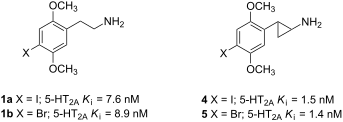
- chiral auxiliaries in the cyclopropanation step could directly afford the chiral cyclopropane acids [8], but time and resources did not allow us to pursue that approach. Conclusion In conclusion, our strategy to replace the ethylamine side chain of 1a (or 1b) with a cyclopropylamine moiety was successful





