


Search results
Search for "chirality transfer" in Full Text gives 37 result(s) in Beilstein Journal of Organic Chemistry.
Some aspects of radical chemistry in the assembly of complex molecular architectures
Beilstein J. Org. Chem. 2013, 9, 557–576, doi:10.3762/bjoc.9.61

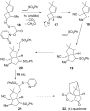
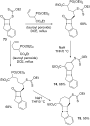
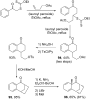
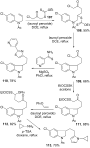
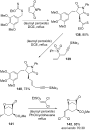
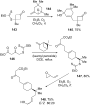
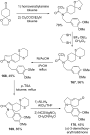
- exceedingly potent Claisen rearrangement [37], with the attending advantages of stereocontrol and chirality transfer. Another powerful approach to polycyclic structures is through association with Robinson-type annelations [38]. The synthesis of the precursors also exploits the Claisen rearrangement, as shown













Cyclodextrin nanosponge-sensitized enantiodifferentiating photoisomerization of cyclooctene and 1,3-cyclooctadiene
Beilstein J. Org. Chem. 2012, 8, 1305–1311, doi:10.3762/bjoc.8.149
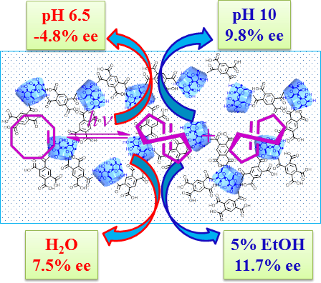
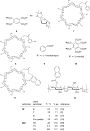
- chirality transfer from chiral host to prochiral substrate through the long-lasting intimate supramolecular contacts of guest substrate(s) with the chiral host in both the ground and excited states [4][5][6][7][8][9][10]. Various types of chiral supramolecular hosts, including modified zeolites [11




The interplay of configuration and conformation in helical perylenequinones: Insights from chirality induction in liquid crystals and calculations
Beilstein J. Org. Chem. 2012, 8, 155–163, doi:10.3762/bjoc.8.16
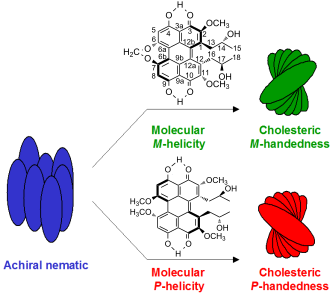
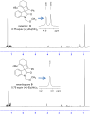
- Bologna, Italy Dipartimento di Scienze Molecolari Agroalimentari, Università degli Studi di Milano, via Celoria 2, 20133 Milano, Italy 10.3762/bjoc.8.16 Abstract The chirality transfer in liquid crystals induced by two helical perylenequinones (namely, the natural compounds cercosporin and phleichrome
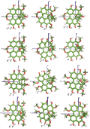
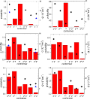
- introduced as dopants in nematic solvents. We evaluated the role of the different conformations of the chiral hydroxyalkyl side chains in determining the helical twisting power: They were found to affect the strength of the chirality transfer, although the handedness of the induced cholesteric phase is
- material science [3][4]. In this context, one of the major research lines focuses on the investigation of the chirality transfer between “shape persistent” dopants and nematic solvents [2][5][6][7][8][9][10][11]. Thus, the chirality amplification from the molecular to mesophase level can be exploited for


Progress in liquid crystal chemistry II
Beilstein J. Org. Chem. 2012, 8, 118–119, doi:10.3762/bjoc.8.13
- mesogens, amphiphiles, and liquid-crystalline nanoparticles. It is our goal to give the reader insight into both synthetic aspects of liquid crystal chemistry as well as application-oriented properties, such as photoconductivity or chirality transfer, to name just a few selected examples. Finally, we would
Recent advances in the gold-catalyzed additions to C–C multiple bonds
Beilstein J. Org. Chem. 2011, 7, 897–936, doi:10.3762/bjoc.7.103
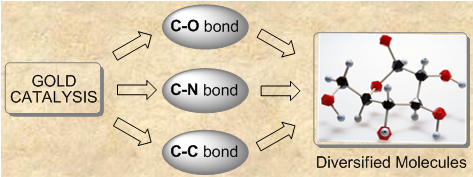
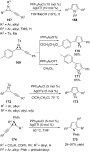
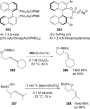
- chirality transfer. Rüttinger et al. reported a gold-catalyzed synthetic route for the preparation of enynes (Scheme 4) [26]. The gold-catalyzed cyclization provided the corresponding exo-enol ethers 19 in moderate to high yield with complete regioselectivity. By contrast, Wilckens et al. reported the gold












Complete transfer of chirality in an intramolecular, thermal [2 + 2] cycloaddition of allene-ynes to form non-racemic spirooxindoles
Beilstein J. Org. Chem. 2011, 7, 601–605, doi:10.3762/bjoc.7.70
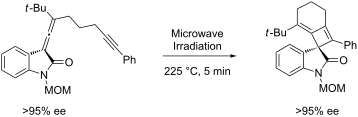
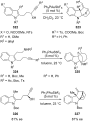
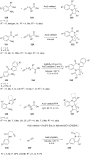
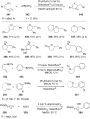
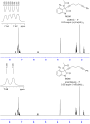
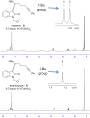
- expand the scope of this chirality transfer to other allenyl systems possessing less bulky and/or traceless groups. Chiral NMR shift analysis of propargyl acetate 7. Chiral NMR shift analysis of allenyloxindole 8. Chiral NMR shift analysis of spirooxindole 9. Thermally generated biradical intermediate 10




Ring-alkyl connecting group effect on mesogenic properties of p-carborane derivatives and their hydrocarbon analogues
Beilstein J. Org. Chem. 2009, 5, No. 83, doi:10.3762/bjoc.5.83
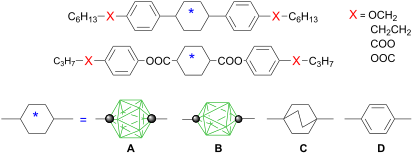
- fluorination [18][19] on mesophase stability, and also the effectiveness of shielding of a lateral substituent [8][16][20] and chirality transfer phenomena [17]. Results of these studies are important for the design of new materials and optimizing of their properties for applications. During our investigation


Chiral amplification in a cyanobiphenyl nematic liquid crystal doped with helicene-like derivatives
Beilstein J. Org. Chem. 2009, 5, No. 50, doi:10.3762/bjoc.5.50
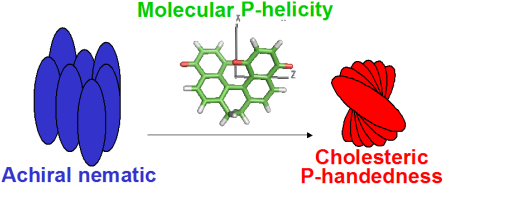
- good solubility in the nematic host and high helical twisting power. Understanding of the mechanism behind chirality transfer from solute molecules to host nematic phases is essential for designing LC-based chiral devices; our and other research groups have investigated this issue (for a selection of
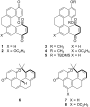
- lowest measured HTP. This is a confirmation of the fact that bulky substituents, though lacking centres of chirality (or other stereogenic elements), can strongly affect the molecule-to-phase chirality transfer. The data in Table 1 also show that, unlike derivatives 1–4, the [4]helicene quinones 6–8 have




Progress in liquid crystal chemistry
Beilstein J. Org. Chem. 2009, 5, No. 48, doi:10.3762/bjoc.5.48
- smectic phases, nematic phase engineering by using V-shaped molecules, saddle-shaped columnar systems displaying anomalous odd-even effects, theoretical studies on the origin of chirality transfer in liquid crystalline host-guest systems, liquid crystalline carboranes and dyes and discotic phenanthrene
The role of an aromatic group in remote chiral induction during conjugate addition of α-sulfonylallylic carbanions to ethyl crotonate
Beilstein J. Org. Chem. 2008, 4, No. 32, doi:10.3762/bjoc.4.32

- increase in diastereoselectivity for the more electron deficient nitro derivative 1c. The most remarkable case of remote chirality transfer (over 99% dr), was observed for the 9-anthryl case 1h, which showed a rate enhancement as well [15][16]. In order to determine whether an unusual steric effect may


Conformational rigidity of silicon- stereogenic silanes in asymmetric catalysis: A comparative study
Beilstein J. Org. Chem. 2007, 3, No. 9, doi:10.1186/1860-5397-3-9
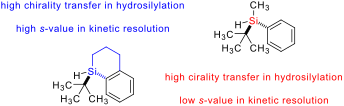
- metal-catalyzed asymmetric transformations as exemplified by (1) the hydrosilylation of alkenes constituting a chirality transfer from silicon to carbon and (2) the kinetic resolution of racemic mixtures of alcohols by dehydrogenative silicon-oxygen coupling. In this investigation, a cyclic and a
- inducing excellent chirality transfer (ct) in a palladium-catalyzed intermolecular carbon-silicon bond formation yet silicon incorporated into a cyclic framework is required in the copper-catalyzed silicon-oxygen bond forming reaction. Findings Within the last decade, several asymmetric transformations
- investigations directed towards the mechanistic elucidation of the origin of the chirality transfer in a palladium-catalyzed hydrosilylation, [10] we had to perform an extensive screening of silicon-stereogenic tertiary silanes. On that occasion, we became aware that a similar level of stereoselection was


Asymmetric aza-Diels- Alder reaction of Danishefsky's diene with imines in a chiral reaction medium
Beilstein J. Org. Chem. 2006, 2, No. 18, doi:10.1186/1860-5397-2-18
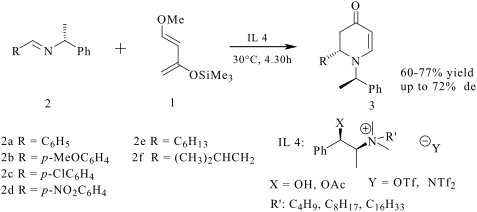
- , chirality transfer was carried out using chiral Lewis acid catalysts. However, these are often expensive, toxic, and not easily recycled. Up until this point, no chiral solvent is reported to have been used in this transformation. Therefore, when researching chiral ionic liquids (ILs), we had two objectives
- in mind: to promote 'green reaction media' and most importantly to provide a highly efficient chirality transfer due to the high degree of organization of the chiral ionic liquids. Chiral solvents are reported to have been already used as a sole inducer of enantiomeric excess in organic reactions
- a 'green method' for the chirality transfer in the aza-Diels-Alder reaction, we proceeded to elaborate the IL structure effect. To that end, a series of different alkyl chain lengths were tested on this model reaction (Table 2). Surprisingly, contrary to results obtained in the asymmetric Baylis





