


Search results
Search for "core-shell" in Full Text gives 27 result(s) in Beilstein Journal of Organic Chemistry.
Hybrid biofunctional nanostructures as stimuli-responsive catalytic systems
Beilstein J. Org. Chem. 2010, 6, 922–931, doi:10.3762/bjoc.6.98
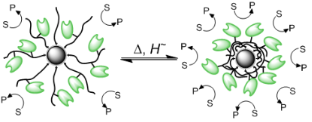
- , biocompatibility, and a tunable lower critical solution temperature (LCST) in water. The phase separation can alternatively be initiated by magnetic heating caused by magnetic losses in ac magnetic fields. The immobilization of porcine pancreas trypsin to the core–shell nanoparticles results in highly active
- , nanoparticulate biocatalysts that can easily be separated magnetically. The enzymatic activity of the obtained biocatalyst system can be influenced by outer stimuli, such as temperature and external magnetic fields, by utilizing the LCST of the copolymer shell. Keywords: biocatalysis; biolabelling; core–shell
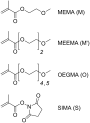
- -type shell. Synthesis of functional core–shell nanostructures In the first step, Fe3O4 nanoparticles are prepared by alkaline precipitation based on a method of Cabuil and Massart [43] and surface-functionalized with (p-chloromethyl)phenyltrimethoxysilane (CTS) [44] in order to introduce benzylic




![[Graphic 1]](/bjoc/content/inline/1860-5397-6-98-i6.png?max-width=637&scale=0.1536366) ).
).


Poly(glycolide) multi-arm star polymers: Improved solubility via limited arm length
Beilstein J. Org. Chem. 2010, 6, No. 67, doi:10.3762/bjoc.6.67
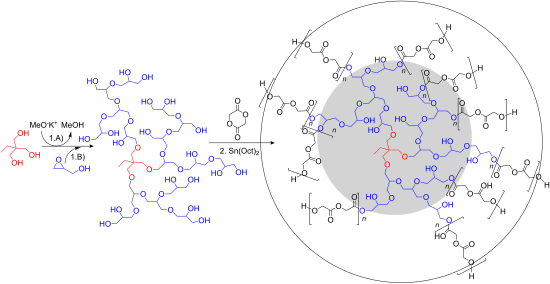
- architectures exhibit significantly altered physical properties [14][15]. This is often considered the primary motivation for the choice of this interesting polymer architecture [16]. A suitable multifunctional core molecule is required to prepare multi-arm star polymers with core–shell characteristics. Apart
- environment when core–shell topologies for encapsulation are desired. Here we present a solvent-free synthetic strategy for multi-arm star block copolymers with a hyperbranched polyether core and PGA arms, systematically varying arm length. The combination of glycolide with a multifunctional initiator studied


Other Beilstein-Institut Open Science Activities



