


Search results
Search for "desulfurization" in Full Text gives 31 result(s) in Beilstein Journal of Organic Chemistry.
Alternaric acid: formal synthesis and related studies
Beilstein J. Org. Chem. 2013, 9, 166–172, doi:10.3762/bjoc.9.19
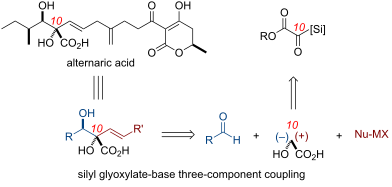
- and the wealth of precedents for single-step desulfurization to alkanes [36][37][38][39][40]. The racemic synthesis of the requisite aldehyde proved straightforward (see Supporting Information File 1). Most importantly, in initial three-component coupling reactions with vinyl nucleophile 4 and silyl
- was enabled. Most importantly, this provides the first example of such a highly functionalized nucleophile being used in a silyl glyoxylate based three-component coupling reaction. Remaining tasks for the complete formation of the natural product include desulfurization [49], deprotection [50], and


Imidazolinium and amidinium salts as Lewis acid organocatalysts
Beilstein J. Org. Chem. 2012, 8, 1798–1803, doi:10.3762/bjoc.8.205
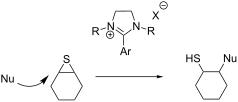
- desulfurization of the products containing a thiol or thiocarbonyl group. Keywords: Diels–Alder; ionic liquids; organocatalysis; soft Lewis acids; thiiranes; thioesters; Introduction Salts with melting points below 100 °C are known as ionic liquids and are often used as novel solvents for reactions and
- hydrogen-bond activation catalysts [18]. The utilization of the soft Lewis basic sulfur groups in this reaction is rare. Often mercury Lewis acids are applied [19][20][21][22] to activate the sulfur group and there is also the risk of desulfurization [23]. The only known asymmetric Diels–Alder reaction





A simple and efficient dual optical signaling chemodosimeter for toxic Hg(II)
Beilstein J. Org. Chem. 2012, 8, 1352–1357, doi:10.3762/bjoc.8.155

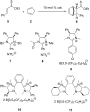
- optical targeting of toxic Hg2+ in buffered aqueous DMSO. The Hg2+-mediated desulfurization of the probe is translated into selective dual signaling of Hg2+ by means of color bleaching and fluorescence amplification while several other metal ions, including potentially competing Ag+, Cu2+ and Pb2+, afford
- ratiometric or switch-on responses even for the paramagnetic metal ions [17][18][19]. The first luminescence chemodosimeter for Hg2+ was developed by Czarnik et al. and was based on the Hg2+-mediated desulfurization of anthracene-thioamide chromophore [20][21]. Following this pioneering report, several other
- Hg2+ with the thione group of acrithion 2, forming an intermediate thioacridinium–Hg+ complex. This phenomena would polarize the C=S bond and therefore facilitate nucleophilic attack by water at the electrophilic C9 position. Subsequently, the hydrolytic desulfurization is expected to form compound 1


Synthetic glycopeptides and glycoproteins with applications in biological research
Beilstein J. Org. Chem. 2012, 8, 804–818, doi:10.3762/bjoc.8.90
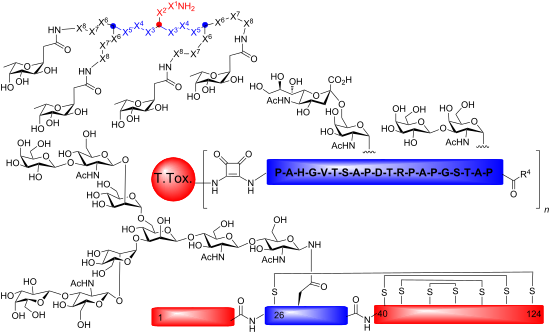
- ., auxiliary based protocols, desulfurization methods or sugar-assisted chemical ligation (SAL) are all examples of expanded NCL techniques [70][71][72][73][74][75][76][77]. According to the auxiliary-based ligation strategy, a thiol-containing mimic replaces the N-terminal cysteine; the mimic group is then
- functional groups. After ligation the side-chain thiol could be removed by Raney nickel treatment. Employing the desulfurization methodology, thiol amino acids could be converted to alanine, valine, phenylalanine and threonine residues [71][72][73][74][75][76]. As an alternative to Raney nickel reduction, a
- radical-induced desulfurization method was recently reported [76]. An example of the desulfurization method is illustrated in Scheme 6. After the NCL-reaction, the γ-thiol valine at the ligation site could be converted to a valine by treatment with tris(2-carboxyethyl)phosphine (TCEP), t-BuSH, and the


Convergent syntheses of LeX analogues
Beilstein J. Org. Chem. 2010, 6, No. 17, doi:10.3762/bjoc.6.17
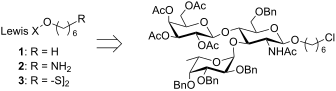
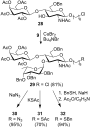
- respectively to the n-hexyl and 6-aminohexyl trisaccharide targets. Unexpectedly, the 6-acetylthiohexyl analogue underwent desulfurization and gave the n-hexyl glycoside product, whereas the 6-benzylthiohexyl analogue gave the desired disulfide trisaccharide dimer. This study constitutes a particularly
- efficient and convergent preparation of these three Lex analogues. Keywords: Birch reduction; convergent synthesis; desulfurization; Lewis X; Introduction Our group is involved in the design of new anti-cancer vaccines based on the Tumor Associated Carbohydrate Antigen (TACA) dimeric Lex (dimLex) [1][2][3
- conditions did not lead to the desired corresponding thiol or disulfide product but produced the hexyl glycoside 1. The mechanism proposed to explain this reductive desulfurization is shown in Scheme 4. It involves first a single electron transfer to the thioacetyl group that is followed by the cleavage of



Trifluoromethyl ethers – synthesis and properties of an unusual substituent
Beilstein J. Org. Chem. 2008, 4, No. 13, doi:10.3762/bjoc.4.13

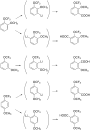
- desulfurization-fluorination has been disclosed by Hiyama [24][25][26][27]. When dithiocarbonates (2, xanthogenates) are exposed to a huge excess of hydrogen fluoride-pyridine and 1,3-dibromo-5,5-dimethylhydantoin, trifluoromethyl ethers form in moderate to excellent yields (Scheme 5 and Table 5). What makes this
- a chlorination/fluorination sequence. Preparation of trifluoromethyl ethers via an in situ chlorination/fluorination sequence. Preparation of trifluoromethyl ethers via chlorothionoformates. Preparation of trifluoromethyl ethers via fluoroformates. Oxidative desulfurization-fluorination toward
- trifluoromethyl ethers. Mechanism of the oxidative desulfurization-fluorination. Umemoto's O-(trifluoromethyl)dibenzofuranium salts 4 as CF3-transfer agents. Togni's approach using hypervalent iodine compounds as CF3-transfer agents. TAS OCF3 as a nucleophilic OCF3-transfer agent. Nitration of trifluoromethoxy




Other Beilstein-Institut Open Science Activities



