


Search results
Search for "dimedone" in Full Text gives 28 result(s) in Beilstein Journal of Organic Chemistry.
Regioselectivity in the multicomponent reaction of 5-aminopyrazoles, cyclic 1,3-diketones and dimethylformamide dimethylacetal under controlled microwave heating
Beilstein J. Org. Chem. 2012, 8, 18–24, doi:10.3762/bjoc.8.3
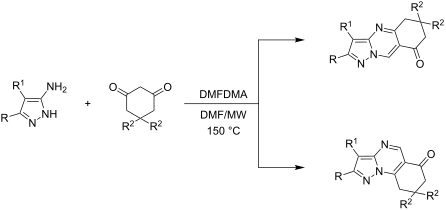
- (DMFDMA) in DMF at 150 °C under controlled microwave heating afforded regioselectively 8,9-dihydropyrazolo[1,5-a]quinazolin-6(7H)-ones 6 rather than the corresponding dihydropyrazolo[5,1-b]quinazolin-8(5H)-ones 4. Keywords: aminopyrazoles; dimedone; DMFDMA; regioselectivity; Introduction Several
- ., either kinetic or thermodynamic [11][12][13]. It has been reported that the use of microwave or ultrasound irradiation provides an additional parameter for synthetic selectivity [14][15][16][17]. Results and Discussion The multicomponent reaction of 5-aminopyrazoles, dimedone and aromatic aldehydes was
- triethylamine as base produces the more thermodynamically stable dihydropyridine (Hantzsch-type product). In addition, the nature of the catalyst plays an important role [20]. A one-pot three component reaction of 5-amino-1H-pyrazole-4-carbonitrile, dimedone and triethylorthoesters in toluene under reflux was



Surfactant catalyzed convenient and greener synthesis of tetrahydrobenzo[a]xanthene-11-ones at ambient temperature
Beilstein J. Org. Chem. 2011, 7, 53–58, doi:10.3762/bjoc.7.9
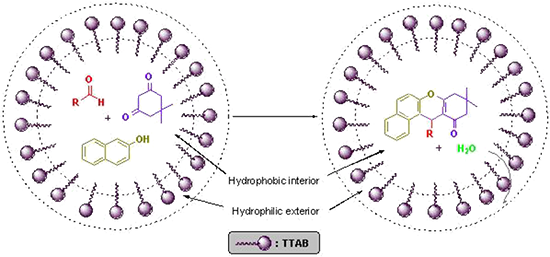
- our initial study, reaction of 4-chlorobenzaldehyde, β-naphthol and dimedone in water was considered as a standard model reaction (Scheme 1). During this investigation, efforts were mainly focused on a variety of surfactants. In this regard, different cationic surfactants such as
- methide (o-QM), subsequent Michael addition of dimedone to the o-QM followed by attack of the phenolic –OH group of the o-QM at the carbonyl carbon of dimedone to yield a cyclic hemiketal that on dehydration affords the final product. To generalize the synthetic procedure, various electronically divergent
- aryl aldehydes were treated with β-naphthol and dimedone under the optimized reaction conditions and all these substrates were found to be equally amenable to these conditions. Interestingly, some heteroaryl aldehydes also underwent the reaction smoothly. Representative results are summarized in Table


Microwave assisted synthesis of triazoloquinazolinones and benzimidazoquinazolinones
Beilstein J. Org. Chem. 2007, 3, No. 11, doi:10.1186/1860-5397-3-11
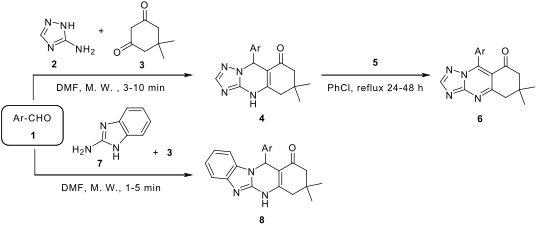
- nearly quantitative yields within few minutes during the reaction of aromatic aldehydes with 5-amino-1(H)-1,2,4-triazole (or 2-aminobenzimidazole) and dimedone in DMF. Conclusion Microwave irradiation can be used as a facile and general method for the construction of a wide variety of
- ) and dimedone (3) in DMF or methanol has been reported previously. [29][30] Fortunately, the microwave irradiation for the reaction containing the starting materials 1a-d, 2 and 3, afforded within a few minutes compounds 4a-d in nearly quantitative yields (Scheme 1). The products 4a,d are the same as
- from the reaction of 7 with the aromatic aldehydes 1a-e and dimedone (3) in DMF. We used the normal method of refluxing (method A) and compared it with the microwave irradiation (method B). The results in Scheme 3 indicated the isolation of products 8a-e by the two methods, however, in different yields


Other Beilstein-Institut Open Science Activities



