


Search results
Search for "earth-abundant" in Full Text gives 35 result(s) in Beilstein Journal of Organic Chemistry.
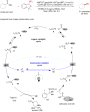
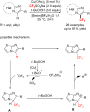
Recent advances in transition-metal-catalyzed incorporation of fluorine-containing groups
Beilstein J. Org. Chem. 2019, 15, 2213–2270, doi:10.3762/bjoc.15.218
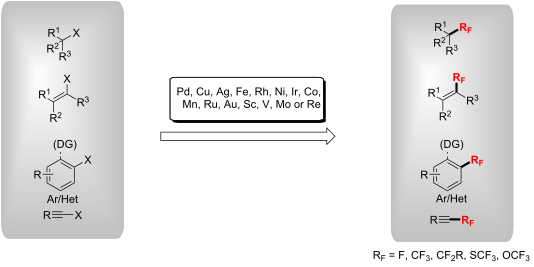
- of these technologies has been partially hampered by the high cost and toxicity associated with Pd, in addition to the difficulty encountered when attempting to remove this metal from product mixtures. Therefore, cupper as low-cost, earth-abundant and readily available transition metal has emerged as











Organometallic vs organic photoredox catalysts for photocuring reactions in the visible region
Beilstein J. Org. Chem. 2018, 14, 3025–3046, doi:10.3762/bjoc.14.282
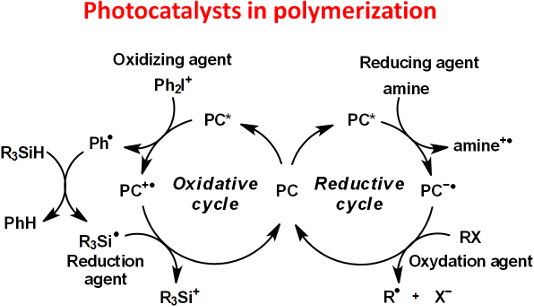
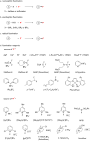
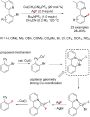
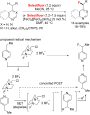
- -cost metals such as copper complexes or iron complexes which will be described in detail in the paragraph below. 2.1.2 The second generation of metal-based PCs: copper and iron complexes: Due to their earth-abundant property, iron and copper have received increasing attention and development of Fe and



Bioinspired cobalt cubanes with tunable redox potentials for photocatalytic water oxidation and CO2 reduction
Beilstein J. Org. Chem. 2018, 14, 2331–2339, doi:10.3762/bjoc.14.208
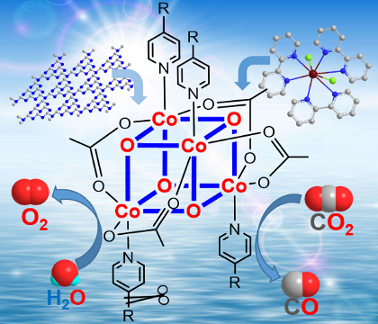
- Zhishan Luo Yidong Hou Jinshui Zhang Sibo Wang Xinchen Wang State Key Laboratory of Photocatalysis on Energy and Environment, College of Chemistry, Fuzhou University, Fuzhou 350002, China 10.3762/bjoc.14.208 Abstract The development of efficient, robust and earth-abundant catalysts for
- characteristics for a molecular catalyst by selective ligand modification. This work demonstrates a modulation method for fabricating effective, stable and earth-abundant molecular catalysts, which might facilitate further innovation in the function-led design and synthesis of cubane clusters for photoredox
- are typically based on noble metals (e.g., Ru, Ir) [37][38][39][40], which seriously restricts their practical applications. Therefore, the development of effective, stable and sustainable molecular catalysts based on earth-abundant elements is highly desirable [41][42][43]. Inspired by the molecular


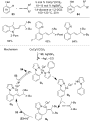
Hydroarylations by cobalt-catalyzed C–H activation
Beilstein J. Org. Chem. 2018, 14, 2266–2288, doi:10.3762/bjoc.14.202
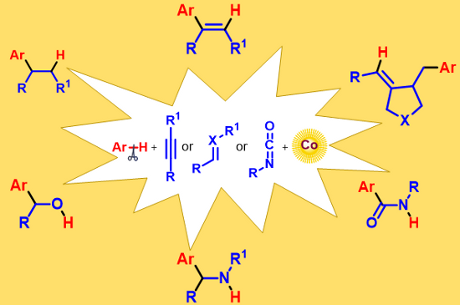
- Rajagopal Santhoshkumar Chien-Hong Cheng Department of Chemistry, National Tsing Hua University, Taiwan 10.3762/bjoc.14.202 Abstract As an earth-abundant first-row transition metal, cobalt catalysts offer a broad range of economical methods for organic transformations via C–H activation. One of
- or a C–H activation with high-valent cobalt to give A2 via deprotonation, followed by migratory insertion and reductive elimination or protonation (Scheme 3). We believe that this review will be helpful to the researchers for their future research on hydroarylation using earth-abundant metal








Graphitic carbon nitride prepared from urea as a photocatalyst for visible-light carbon dioxide reduction with the aid of a mononuclear ruthenium(II) complex
Beilstein J. Org. Chem. 2018, 14, 1806–1812, doi:10.3762/bjoc.14.153
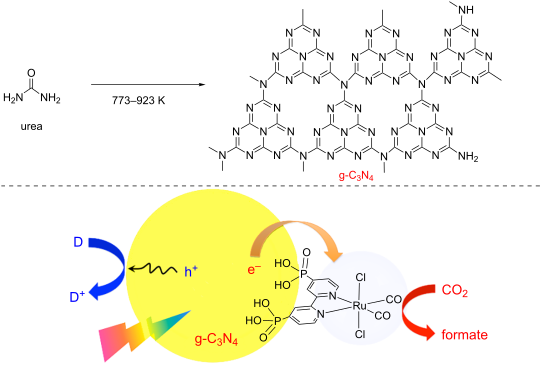
- emerging material as an organic semiconductor photocatalyst active for various kinds of reactions such as water splitting, CO2 reduction, and degradation of harmful organic compounds, because of its non-toxic, stable, and earth-abundant nature [2][3][4][5][6][7]. Our group has developed photocatalytic CO2


Thiocarbonyl-enabled ferrocene C–H nitrogenation by cobalt(III) catalysis: thermal and mechanochemical
Beilstein J. Org. Chem. 2018, 14, 1546–1553, doi:10.3762/bjoc.14.131

- towards more sustainable base metals [10][11][12][13][14][15][16][17], with considerable progress by earth-abundant cobalt catalysts [18][19][20][21][22]. In this context, well-defined cyclopentadienyl-derived cobalt(III) complexes have proven instrumental for enabling a wealth of C–H transformations [23




Recent advances in C(sp3)–H bond functionalization via metal–carbene insertions
Beilstein J. Org. Chem. 2016, 12, 796–804, doi:10.3762/bjoc.12.78

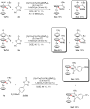
- computational study of the likely intermediate suggests that it is best described as a zinc-bound carbocation rather than a zinc carbene (Scheme 12). Notably, Zn is a cheap, earth-abundant 3d metal, thus making it attractive as catalyst for C–H bond functionalization. Conclusion The intermolecular metal–carbene


Copper-catalyzed arylation of alkyl halides with arylaluminum reagents
Beilstein J. Org. Chem. 2015, 11, 2400–2407, doi:10.3762/bjoc.11.261
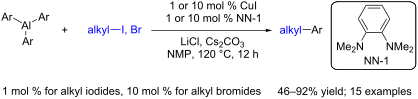
- inexpensive and earth-abundant metal. Organoaluminum reagents can be prepared directly from metallic aluminum [13][14][15], which further highlights the potential scope of these reagents in organic synthesis. However, despite extensive investigations and applications of organometallic reagents of Si, B, Mg


Copper catalysis in organic synthesis
Beilstein J. Org. Chem. 2015, 11, 2252–2253, doi:10.3762/bjoc.11.244
- -coupling reactions were discovered over a century ago and their development has really blossomed over the past twenty years. Second, copper is an earth-abundant metal, making its use more cost effective and more sustainable than precious transition metal catalysts. Over 25 contributions from leaders in the
Comparing kinetic profiles between bifunctional and binary type of Zn(salen)-based catalysts for organic carbonate formation
Beilstein J. Org. Chem. 2014, 10, 1817–1825, doi:10.3762/bjoc.10.191
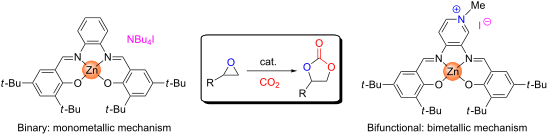
- , nontoxic and earth-abundant metal-based complexes based on aluminum [24] and iron [25] amino-triphenolate complexes. Additionally, salen-based Zn complexes were also found to be rather efficient catalyst for this transformation. More specifically, these systems relate to the Zn(salphen) family of complexes





