


Search results
Search for "epimerisation" in Full Text gives 30 result(s) in Beilstein Journal of Organic Chemistry.
Bis(oxazolines) based on glycopyranosides – steric, configurational and conformational influences on stereoselectivity
Beilstein J. Org. Chem. 2010, 6, No. 23, doi:10.3762/bjoc.6.23
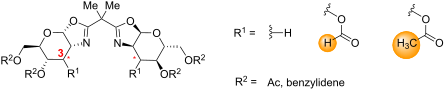
- . Because of the strong impact of the pyranose position 3 in ligands 3a–f on the stereoselectivity, we became interested in elucidating the influence of the stereochemistry at this position by both 3-epimerisation and 3-defunctionalisation. Inversion of the configuration at position 3 to give an allo
- yield. To prepare an allo-configured precursor for ligand synthesis, we decided first to use a previously described epimerisation sequence for 7 featuring Swern oxidation and subsequent reduction with sodium borohydride [25]. In our hands this method led to an inseparable product mixture in the second
- derivatives of gluco-configured bis(oxazoline) ligands 2 and 3 with 3-epimerisation or 3-defunctionalisation in the pyranose scaffold. Application in stereoselective cyclopropanation as a model reaction highlighted the strong impact of modifications at the pyranose position 3 on the asymmetric induction



Diastereoselective functionalisation of benzo-annulated bicyclic sultams: Application for the synthesis of cis-2,4-diarylpyrrolidines
Beilstein J. Org. Chem. 2009, 5, No. 69, doi:10.3762/bjoc.5.69

- explanation for this mixture of products, based on the high levels of diastereoselectivity observed in the similar examples discussed herein, is that the initially formed product begins to undergo epimerisation in order to place the larger (CO2Me) substituent on the least hindered face. Consequently, the
- complete epimerisation of this material was investigated using NaOMe (1 M) based on a literature report [26]. Pleasingly, the hoped for process did indeed lead to the formation of one diastereomer of carboxylic acid 26, which was formed from the methyl ester on hydrolysis following work-up (see Figure 4
- and crystallographic data). Although the yields described during this sequence are low at this stage, the successful epimerisation observed demonstrates that this approach represents a stereo-complementary method to those described in Scheme 1 and Scheme 8. With the lithiation chemistry described


Analogues of amphibian alkaloids: total synthesis of (5R,8S,8aS)-(−)-8-methyl- 5-pentyloctahydroindolizine (8-epi-indolizidine 209B) and [(1S,4R,9aS)-(−)-4-pentyloctahydro- 2H-quinolizin- 1-yl]methanol
Beilstein J. Org. Chem. 2008, 4, No. 5, doi:10.1186/1860-5397-4-5
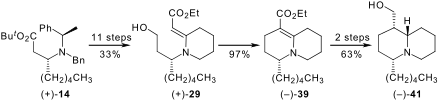
- set up the desired stereochemistry at C-8 and C-8a. Epimerisation of the ester in the reduced compound (−)-20 produced (−)-21, reduction of which gave the alcohol (−)-22. Reduction of the corresponding methanesulfonate with lithium triethylborohydride, as described by Holmes et al. [24], completed the
- ]. Finally, since the pendent substituents in the indolizidine series can be induced to adopt a trans-orientation by base-catalysed epimerisation of a carbonyl substituent adjacent to the bridgehead position (cf Scheme 1), it should in principle be possible to effect a similar epimerisation in the


Pd-catalysed [3 + 3] annelations in the stereoselective synthesis of indolizidines
Beilstein J. Org. Chem. 2007, 3, No. 8, doi:10.1186/1860-5397-3-8
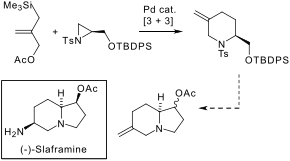
- corresponding Mosher's ester showed a single resonance in the 19F NMR spectrum (235 MHz, CDCl3: δ-72.0) suggesting that minimal epimerisation had taken place during the oxidation process. We next decided to investigate the formation of the azabicycle via the deprotection of the Ts-amine moiety followed by


Tether- directed synthesis of highly substituted oxasilacycles via an intramolecular allylation employing allylsilanes
Beilstein J. Org. Chem. 2007, 3, No. 6, doi:10.1186/1860-5397-3-6
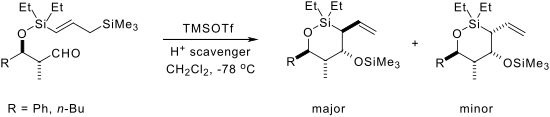
- temperature, allowing further reduction to the corresponding primary alcohols. Fortunately, the two alcohol products could be oxidised to the desired aldehydes syn-4a and anti-4a, using Dess-Martin periodinane[22][23] without epimerisation of the α-stereogenic centre (Scheme 7). With all four cyclisation


Other Beilstein-Institut Open Science Activities



