


Search results
Search for "halogen bonds" in Full Text gives 26 result(s) in Beilstein Journal of Organic Chemistry.
The subtle balance of weak supramolecular interactions: The hierarchy of halogen and hydrogen bonds in haloanilinium and halopyridinium salts
Beilstein J. Org. Chem. 2010, 6, No. 4, doi:10.3762/bjoc.6.4
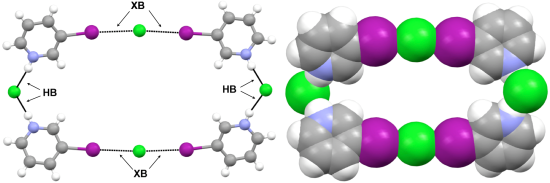
- chemistry [2]. Halogen bonding (XB) is the non-covalent interaction involving halogen atoms as electrophilic species [3]. The first reports of these interactions, only later classified as halogen bonds, date back to the late 1960’s [4]. In the following years, several X-ray studies demonstrated the
- halogen bond donors. Iodonitrobenzene derivatives represent a less explored type of haloarenes [29][30]. In these XB systems, secondary C–I···O2NAr halogen bonds (distances 13% shorter than the sum of standard VDW radii [17]) have been observed for iodonitrobenzenes themselves [31][32] or in co-crystals
- of iodo- and nitrobenzenes [29][30]. In our recent studies [33], we have shown that 1-iodo-3,5-dinitrobenzene forms surprisingly strong C–I···N halogen bonds (23% shorter than the sum of standard VDW radii [17]) with 1,4-diazabicyclo[2.2.2]octane (DABCO). One of the main challenges in supramolecular


Other Beilstein-Institut Open Science Activities



