


Search results
Search for "helical conformation" in Full Text gives 27 result(s) in Beilstein Journal of Organic Chemistry.
Supramolecular FRET photocyclodimerization of anthracenecarboxylate with naphthalene-capped γ-cyclodextrin
Beilstein J. Org. Chem. 2011, 7, 290–297, doi:10.3762/bjoc.7.38
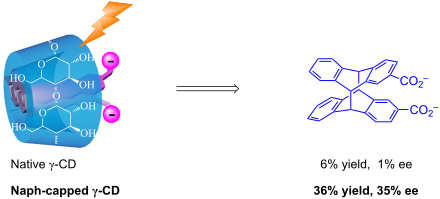
- -dependent. The addition of AC (0–0.26 mM) to the above solutions of 7 or 6 (0.2 mM) produced a strong positive exciton couplet at the 1Bb transition of AC (Figure 2 and Figure 3) which overwhelmed the inherent signals. The positive couplet observed indicates the right-handed helical conformation of the two



The C–F bond as a conformational tool in organic and biological chemistry
Beilstein J. Org. Chem. 2010, 6, No. 38, doi:10.3762/bjoc.6.38
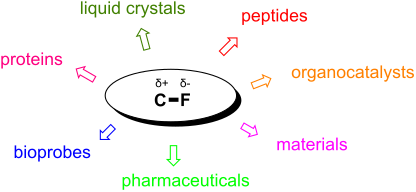
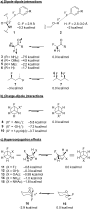
- . This concept is elegantly illustrated by the diastereoisomeric β-peptides 66 and 67 (Figure 18) [56]. The β-amino acid sequence of 66 and 67 is known to promote the formation of a left-handed helix and this helical conformation can be either reinforced or destabilised by a fluorine substituent. In the
- case of β-peptide 66, the fluorine atom aligns antiparallel to the adjacent C=O bond and gauche to the adjacent amide nitrogen, and this reinforces the helical conformation of the β-peptide. In contrast, the helical conformation of β-peptide 67 cannot accommodate these favourable alignments, so in this
- 65. The electron-withdrawing trifluoromethyl group of 65 disrupts a key hydrogen bond, leading to a different conformation as determined by NOESY experiments. The C–F bond influences the conformation of β-peptides. β-Heptapeptide 66 adopts a helical conformation, reinforced by the α-fluoroamide









Other Beilstein-Institut Open Science Activities



