


Search results
Search for "nitrone" in Full Text gives 36 result(s) in Beilstein Journal of Organic Chemistry.
Gold(I)-catalyzed enantioselective cycloaddition reactions
Beilstein J. Org. Chem. 2013, 9, 2250–2264, doi:10.3762/bjoc.9.264
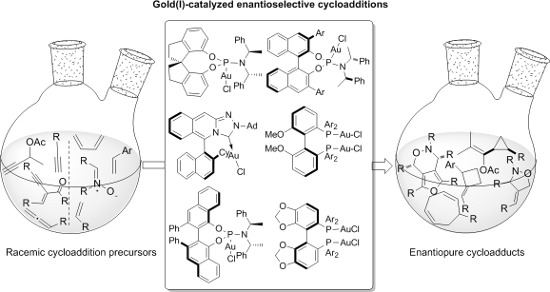
- the species that participates in the cycloaddition to the nitrone, probably in a concerted pathway, and thus providing the corresponding products with high levels of stereoselectivity [82][83]. Previously, in 2009, J. Zhang had reported a gold(I)-catalyzed 1,3-dipolar [3 + 3] cycloaddition between 2
- . This key intermediate is then trapped by the nitrone to afford XIV, which eventually evolves to the product by an intramolecular cyclization (Scheme 17). Finally, the same group recently reported a related reaction of 1-(1-alkynyl)cyclopropyl ketones such as 28, by means of a gold(I)-catalyzed
- asymmetric [4 + 3] cycloaddition. In this article, the authors demonstrated that a chiral gold catalyst generated from MeO-DTBM-Biphep was able to promote the [4 + 3] cycloaddition between ketone 28 and the nitrone 29, to afford the corresponding 5,7-fused bicyclic furo[3,4-d][1,2]oxazepine 30 in good yield


The chemistry of amine radical cations produced by visible light photoredox catalysis
Beilstein J. Org. Chem. 2013, 9, 1977–2001, doi:10.3762/bjoc.9.234
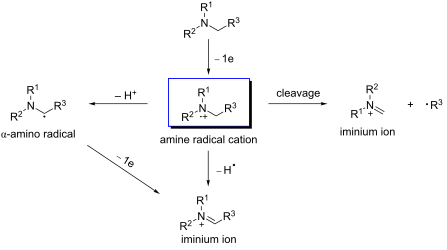
- oxidized to nitrone 64. Finally, an intramolecular 1,3-dipolar cycloaddition of 64 furnishes isoxazolidine 55. Tetrahydroisoquinolines are arguably the most exploited amines in visible light photoredox catalysis. However, efforts towards expanding the scope of amines have been recently reported. Li [82




Gold-catalyzed cyclization of allenyl acetal derivatives
Beilstein J. Org. Chem. 2013, 9, 1751–1756, doi:10.3762/bjoc.9.202
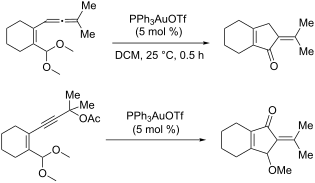
- ]. We postulate that compounds 2 arise from the attack of 1,3-diones at initially generated allyl cation intermediates I. In the case of electrophilic nitrones, allyl cations I release a proton to form reactive 1-methoxyfulvenes II to achieve a [3 + 2]-nitrone cycloaddition. The versatility of cationic
- alternative route involving the protonation of the fulvene intermediate D because this route would water as a proton source. The formation of the fulvene intermediate D from allyl cation B is assisted by a weak base like nitrone [18]. We envisage that a 1,2-hydrogen shift for the allyl cation B fails to


Some aspects of radical chemistry in the assembly of complex molecular architectures
Beilstein J. Org. Chem. 2013, 9, 557–576, doi:10.3762/bjoc.9.61

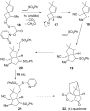
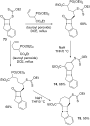
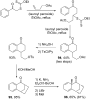
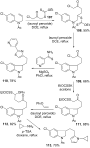
- hydroxylamine and hydrazine substituents in order to construct unusual heterocycles [33][34]. One typical illustration is presented in Scheme 14, where unmasking of the hydroxylamine in adduct 70 gives rise to cyclic nitrone 71, which can then be intercepted by a dipolarophile placed in the medium, as shown by
- synthesis of (±)-matrine (43). Synthesis of complex tetralones. Synthesis of functionalised azaindoline and indole derivatives. Synthesis of thiochromanones. Synthesis of complex benzothiepinones. Conditions: 1) CF3COOH; 2) RCHO / AcOH (PMB = p-methoxybenzyl). Formation and capture of a cyclic nitrone













Carbohydrate-auxiliary assisted preparation of enantiopure 1,2-oxazine derivatives and aminopolyols
Beilstein J. Org. Chem. 2012, 8, 662–674, doi:10.3762/bjoc.8.74
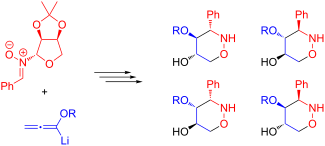
- hydroxylated 2H-1,2-oxazine derivatives is presented utilizing the [3 + 3] cyclisation of lithiated alkoxyallenes and an L-erythrose-derived N-glycosyl nitrone as precursors. This key step proceeded only with moderate diastereoselectivity, but allowed entry into both enantiomeric series of the resulting 3,6
- ][12]. Although the reactions of lithiated alkoxyallenes, with nitrones bearing substituents with stereogenic centres at the carbon atom, were studied in our group in great detail [13], N-glycosyl-substituted nitrones have so far not been used as electrophiles for this purpose. This type of nitrone has
- reagents [33]. Here we report on the application of a nitrone with an L-erythronolactone-derived auxiliary for the synthesis of 3,6-dihydro-2H-1,2-oxazine derivatives of type D. Their selected transformations, including hydroboration of the enol ether moiety, oxidative work-up, glycosyl cleavage, and




Synthesis and biological evaluation of nojirimycin- and pyrrolidine-based trehalase inhibitors
Beilstein J. Org. Chem. 2012, 8, 514–521, doi:10.3762/bjoc.8.58
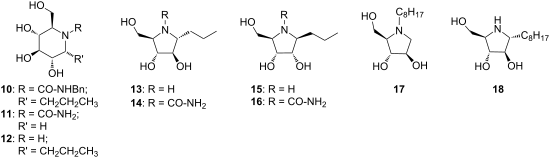
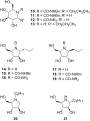
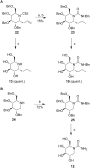
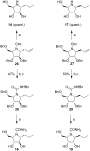
- , deprotection of intermediate 28 afforded monosubstituted urea 16 in only 58% purity. In addition, pyrrolidines 20 and 21 were synthesized in a few steps from nitrone 30 [23]. Catalytic hydrogenation over Pd/C followed by reductive amination in the presence of octanal and NaBH3CN afforded compound 20 in 33
- % yield over two steps (Scheme 3). Grignard addition of octylmagnesium bromide to nitrone 30 proceeded cleanly and gave stereoselectively the “all trans” hydroxypyrrolidine 31 as a single adduct in 84% yield, with a stereoselectivity that was in accordance with previously reported Grignard additions on
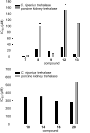
- the same nitrone [24]. Final catalytic hydrogenation over Pd/C gave pyrrolidine 21, which was recently synthesized by an enantioselective strategy [25], in 73% yield. Enzyme assays Synthesized compounds 10, 12–14, 16, 17 and 19–21 were tested for their inhibitory activity against insect (C. riparius



Recent developments in gold-catalyzed cycloaddition reactions
Beilstein J. Org. Chem. 2011, 7, 1075–1094, doi:10.3762/bjoc.7.124
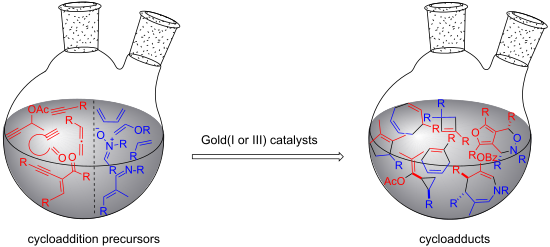
- activation of the alkyne group of 10 by the carbophilic gold catalyst (Ph3PAuCl/AgOTf), followed by an intramolecular cyclization that generates the furanyl–gold complex IX. This intermediate is then trapped by the nucleophilic oxygen atom of the nitrone to afford X, which eventually evolves to the final
- [L1(AuCl)2] or (R)-MeO-dtbm-biphep [L2(AuCl)2], with the former being slightly more efficient in certain cases (Scheme 6) [48]. If instead of a nitrone, a nucleophilic α,β-unsaturated imine is used as the second cycloaddition component, furo[3,4-c]azepines such as 12 can be obtained [49]. An example
- nitrone, delivers intermediate XIII, which evolves to the final cycloadduct by ring closure through a favored chair-like conformation. An attack of the nitrone on intermediate XII, to directly generate species XIII, has also been proposed as an alternative pathway. Common to all these reported


Rh-Catalyzed rearrangement of vinylcyclopropane to 1,3-diene units attached to N-heterocycles
Beilstein J. Org. Chem. 2011, 7, 298–303, doi:10.3762/bjoc.7.39

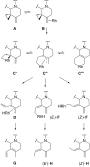
- heating, rearrange [10] to yield a large variety of spirocyclopropanated heterocyclic ketones 4 depending on the nature of the starting nitrone (Scheme 1) [11][12][13][14][15][16][17]. This rather general and convenient access to spirocyclopropane-annelated heterocyclic ketones 4 makes it attractive for
- Discussion The tetrahydropyridones employed in this study were prepared according to published procedures with slight modifications. In particular, oxidation of the tetrahydroquinoline 5 with oxone [38] afforded the nitrone 6 [39][40][41] in 66% yield (Scheme 2, see Supporting Information File 1 for full
- the enantiopure nitrone 10 [42] derived from L-tartaric acid was complete within only 1.5 h at 120–125 °C under microwave (MW) heating and afforded the oxospirocyclopropanes anti-12 and syn-12 in 55% overall yield along with the 1,5-hydrogen shift product 13 (13%) (Scheme 3, see Supporting Information


Addition of lithiated enol ethers to nitrones and subsequent Lewis acid induced cyclizations to enantiopure 3,6-dihydro-2H-pyrans – an approach to carbohydrate mimetics
Beilstein J. Org. Chem. 2010, 6, No. 75, doi:10.3762/bjoc.6.75

- is in line with the addition of other nucleophiles to nitrone 2a [9][10][11]. The configurations of compounds 4 could be unambiguously assigned by X-ray crystallographic analysis of an aminopyran derivative derived from anti-4b (compound 29, Scheme 12) [8]. The enol ethers used, i.e., ethyl vinyl
- good yields and stereoselectivities, 5 equivalents of the nucleophile were necessary to achieve reasonable yields in the addition to the nitrone/chlorodiethylaluminium complexes. Despite this, diastereomeric ratios in favour of the anti-products were generally excellent. Lithiated ethyl vinyl ether was
- also added to pre-complexed D-arabinose-derived nitrone 2c (Scheme 2). After a subsequent TBS-protection step, the desired hydroxylamine derivative anti-4e was obtained in low yield, but with excellent diastereoselectivity. Next, the protected hydroxylamine derivatives syn-4 and anti-4 were treated


Bioorthogonal metabolic glycoengineering of human larynx carcinoma (HEp-2) cells targeting sialic acid
Beilstein J. Org. Chem. 2010, 6, No. 24, doi:10.3762/bjoc.6.24
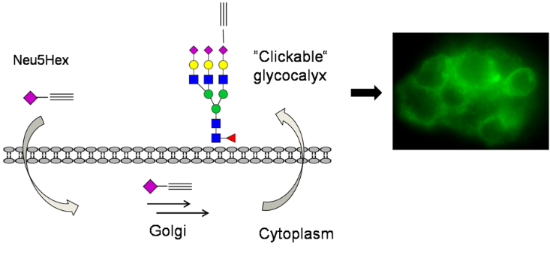
- ), followed by N-acylation with the activated ester 7 led to the alkyne 8 in a yield of 75% based on D-arabinose. A [3+2] cycloaddition reaction between N-tert-butyl nitrone 9 and 8 and subsequent base-catalyzed ring-opening and hydrolysis afforded N-(1-oxohex-5-ynyl)neuraminic acid (Neu5Hex, 3) in 38% yield
- -butyl-5-(1”-(hex-5’-ynoyl)amino-2’’,3’’,4’’,5’’-tetrahydroxy-pentyl)-isoxazolidine-3-carboxylic acid ethyl ester Polyhydroxy olefin (1.50 g, 5.53 mmol, 8) and nitrone (2.01 g, 11.6 mmol, 9) in dioxane (100 mL) were stirred at 30 °C for 14 d. After complete conversion of the starting material as




The use of silicon- based tethers for the Pauson- Khand reaction
Beilstein J. Org. Chem. 2007, 3, No. 21, doi:10.1186/1860-5397-3-21
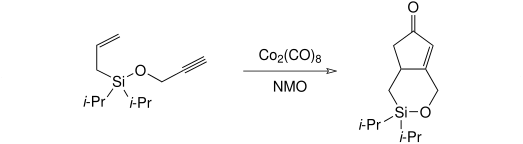
- explanation for the failure of all these reactions was that the 'arms' of the silyl ethers were too far apart for cyclisation to occur. We had already attempted to overcome this potential hurdle by the introduction of functionality within the side chains. Work by Denmark[25] on tethered nitrone cycloadditions





