


Search results
Search for "proton coupled electron transfer" in Full Text gives 32 result(s) in Beilstein Journal of Organic Chemistry.
Small anion-assisted electrochemical potential splitting in a new series of bistriarylamine derivatives: organic mixed valency across a urea bridge and zwitterionization
Beilstein J. Org. Chem. 2019, 15, 2277–2286, doi:10.3762/bjoc.15.220

- used for anion recognition [27][28][29]. In the oxidized state, the enhanced acidity of NH protons can increase the strength of H-bonds and give them more dynamic properties, which can be useful for refined designs of supramolecular systems [30] and proton-coupled electron-transfer systems [31][32][33


Complexation of a guanidinium-modified calixarene with diverse dyes and investigation of the corresponding photophysical response
Beilstein J. Org. Chem. 2019, 15, 1394–1406, doi:10.3762/bjoc.15.139
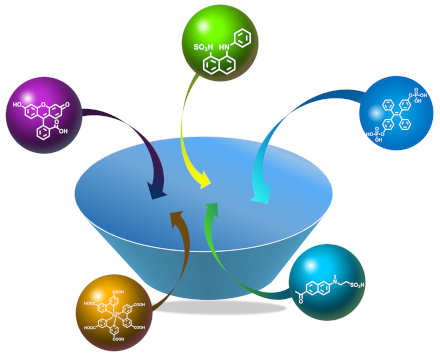
- covalent linked calixarene via proton-coupled electron transfer [62]. Kitamura and co-workers reported that the complexation of SC4A could quench the luminescence of tris(2,2'-bipyridine)Ru(II) dichloride (Ru(bpy)3), where SC4A serves as a PET quencher [63]. Shinkai and co-workers reported that the



Selective benzylic C–H monooxygenation mediated by iodine oxides
Beilstein J. Org. Chem. 2019, 15, 602–609, doi:10.3762/bjoc.15.55

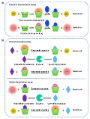
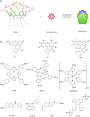
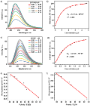
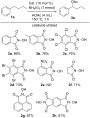
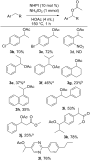
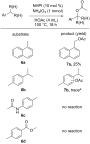
- proton coupled electron transfer (PCET) type mechanism. Additionally, as shown in Figure 2, 1,2,3,4-tetrahydronaphthalene was functionalized in poor yield (23%) to its acetate 3g if exposed to reaction conditions at lower temperatures (60 °C) than were used for other substrates. At 100 or 150 °C, only




Organometallic vs organic photoredox catalysts for photocuring reactions in the visible region
Beilstein J. Org. Chem. 2018, 14, 3025–3046, doi:10.3762/bjoc.14.282
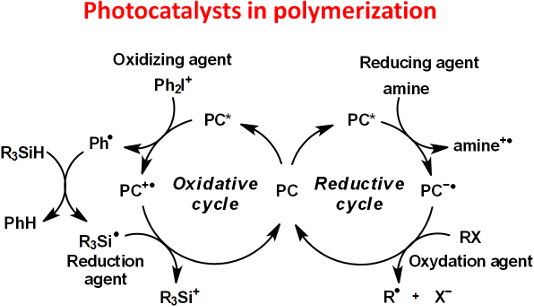
- already found wide applications such as in water splitting, solar energy storage, proton-coupled electron transfer or photovoltaic for example [18]. 1.3 Electronic transitions involved into photoredox processes For selected photoredox catalysts, light irradiation has enough energy for the excitation of



Photocatalyic Appel reaction enabled by copper-based complexes in continuous flow
Beilstein J. Org. Chem. 2018, 14, 2730–2736, doi:10.3762/bjoc.14.251
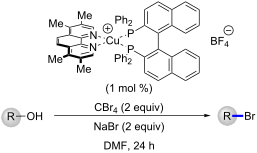
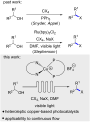
- ]. Specifically, our group has demonstrated that heteroleptic Cu(I) complexes [19][20][21] have significant potential as photocatalysts that can promote a variety of mechanistically distinct photochemical transformations including single electron transfer (SET), energy transfer (ET), and proton-coupled electron
- transfer (PCET) reactions [22][23][24][25][26]. Herein, the evaluation of Cu(I)-complexes for photocatalytic Appel reactions and demonstration in continuous flow is described. Results and Discussion The first step in identifying a heteroleptic diamine/bisphosphine Cu(I)-based photocatalyst for the




Photocatalytic nucleophilic addition of alcohols to styrenes in Markovnikov and anti-Markovnikov orientation
Beilstein J. Org. Chem. 2015, 11, 568–575, doi:10.3762/bjoc.11.62
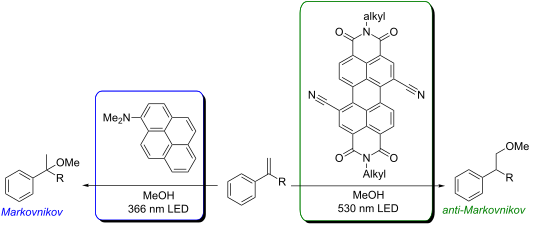
- protonated rapidly to the neutral radical that is the key intermediate to explain the Markovnikov selectivity of this route. Both steps, electron transfer and protonation, could also occur in one proton-coupled electron transfer step. Back electron transfer to the photocatalyst finishes the photocatalytic


3-Pyridinols and 5-pyrimidinols: Tailor-made for use in synergistic radical-trapping co-antioxidant systems
Beilstein J. Org. Chem. 2013, 9, 2781–2792, doi:10.3762/bjoc.9.313
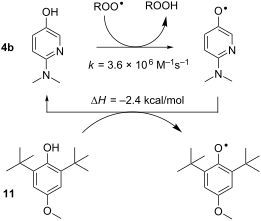
- radical is believed to be a proton-coupled electron transfer reaction, occurring via an approximately planar transition state wherein the unpaired electron is delocalized across both phenyl rings [36]. As such, it is difficult to envision how the conformation of the dimethylamino substituent in 4c may




Other Beilstein-Institut Open Science Activities



