


Search results
Search for "quantum mechanical calculations" in Full Text gives 34 result(s) in Beilstein Journal of Organic Chemistry.
Topochemical control of the photodimerization of aromatic compounds by γ-cyclodextrin thioethers in aqueous solution
Beilstein J. Org. Chem. 2013, 9, 1858–1866, doi:10.3762/bjoc.9.217
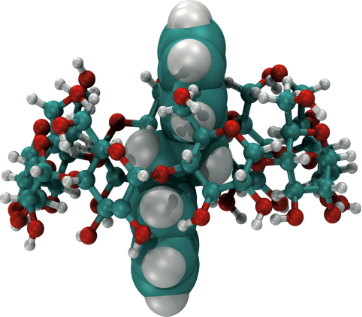
- with heavy atoms attached, e.g., 6-deoxy-iodo-CDs, are known to even enable room temperature phosphorescence of an excited guest [36]. (b) Moreover, according to the results of the quantum mechanical calculations [25][34] the preferential anti-parallel alignment of the ACE dimer within the CD cavity
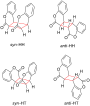
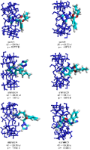
- mechanical calculations of the structures and interaction energies ΔE of the four COU dimers were performed using the Gaussian 03 software package to investigate the favored packing [47]. The aromatic dimers were fully optimized at the MP2/6-31G* level without any symmetry restriction during the computation
- the dominant factor, but rather the pre-organization of the guest molecules in the CD cavity prior to excitation has the greatest effect. The distribution of the stereoisomers appears to be mainly topochemically [5] controlled because of the short lifetime of the excited state of COU. Quantum



Electron self-exchange activation parameters of diethyl sulfide and tetrahydrothiophene
Beilstein J. Org. Chem. 2013, 9, 1448–1454, doi:10.3762/bjoc.9.164
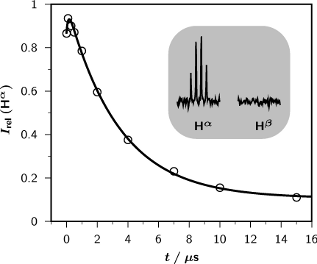
- was done with a Lambda Physik EMG 101 excimer laser (medium, XeCl; wavelength, 308 nm; pulse width, 15 ns) triggered by the computer of the spectrometer. The probe was thermostated to ±0.3 K. Quantum mechanical calculations were carried out with the Gaussian 09 package [53] using the AM1 Hamiltonian


Synthesis and spectroscopic properties of 4-amino-1,8-naphthalimide derivatives involving the carboxylic group: a new molecular probe for ZnO nanoparticles with unusual fluorescence features
Beilstein J. Org. Chem. 2013, 9, 1311–1318, doi:10.3762/bjoc.9.147

- square of the laser power shown in the inset (Figure 5) clearly demonstrates the two-photon excitation nature. Quantum mechanical calculations Quantum mechanical calculations were performed for derivative 4 to gain deeper insight into the nature of the longest wavelength transition and to estimate the


The β-cyclodextrin/benzene complex and its hydrogen bonds – a theoretical study using molecular dynamics, quantum mechanics and COSMO-RS
Beilstein J. Org. Chem. 2013, 9, 118–134, doi:10.3762/bjoc.9.15
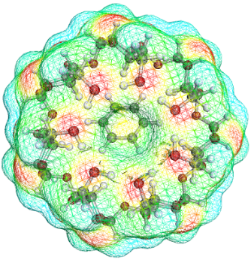
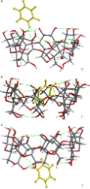
- . Since quantum-mechanical calculations lead to these highly ordered optimised structures, they represent the lowest energy conformers in vacuo at 0 K. Nevertheless, they will be the basis for the assumptions of the COSMO-RS method and its thermodynamic formulas and calculations/extrapolations based on




A new family of four-ring bent-core nematic liquid crystals with highly polar transverse and end groups
Beilstein J. Org. Chem. 2013, 9, 26–35, doi:10.3762/bjoc.9.4
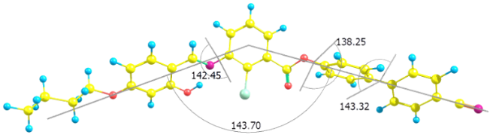
- to possibly weakened lateral interactions and increased intermolecular spacing between molecules. Density functional theory calculations The quantum mechanical calculations of molecular properties in the gas phase were performed by using density functional theory (DFT) [58] employing the combination


Theoretical study on β-cyclodextrin inclusion complexes with propiconazole and protonated propiconazole
Beilstein J. Org. Chem. 2012, 8, 2191–2201, doi:10.3762/bjoc.8.247
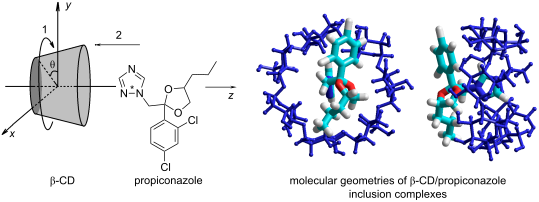
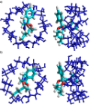
- theoretically investigates the interaction between PP, PPH+ and β-CD molecules by means of AM1 and PM3 semi-empirical quantum-mechanical calculations, to examine in detail the insertion pathways and to determine the intimate configurations of the β-CD/propiconazole (β-CD/PP and β-CD/PPH+) inclusion complexes
- parameter and the complex stability by means of quantum-mechanical calculations has been previously reported [19][20]. The PP molecule has a permanent electric dipole, and the dipole–dipole interaction can make the difference between the A and B configurations. The decrease of the global dipole moment






The crystal structure of the Dess–Martin periodinane
Beilstein J. Org. Chem. 2012, 8, 1523–1527, doi:10.3762/bjoc.8.172

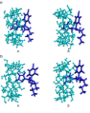
- respect to the mechanism of the Dess–Martin oxidation. Our X-ray structure will serve as a starting point for detailed quantum mechanical calculations to address this topic. Experimental Crystallographic data for 1: Data collected by means of an Oxford Diffraction Xcalibur 3 diffractometer, Mo Kα


NMR studies of anion-induced conformational changes in diindolylureas and diindolylthioureas
Beilstein J. Org. Chem. 2011, 7, 1205–1214, doi:10.3762/bjoc.7.140
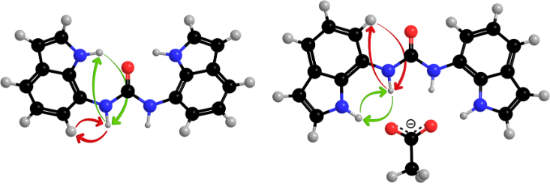
- complexes by quantum mechanics calculations The observations on the conformational equilibria in the absence and in the presence of anions were corroborated by quantum mechanical calculations at the B3LYP/6-311+G(d,p) level of theory by means of the Gaussian 03 [40] and Gaussian 09 [41] programs. Indole
- H1 and H7α NMR resonances prevented conformational analysis of 2 upon addition of other anions used in the study. The conformational preferences of 2 were evaluated by quantum mechanical calculations at the B3LYP/6-311+G(d,p) level of theory. The freely optimized anti–anti conformer of 2 exhibited






Synthesis of some novel hydrazono acyclic nucleoside analogues
Beilstein J. Org. Chem. 2010, 6, No. 49, doi:10.3762/bjoc.6.49
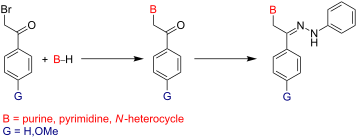
- quantum mechanical calculations were carried out using MOPAC in CS Chem 3D Ultra 8 (Cambridge Soft, 2004) or Hyperchem (Hypercube Inc., Version 7). The results are summarized in Table 2; ΔE refers to the energy difference between the (Z)- and (E)-isomer (ΔE = EZ − EE (kcal/mol)). As can be seen in Table 2
- the (E)-hydrazone derivatives rather than the (Z)-isomers, PM3 semiempirical quantum mechanical calculations were carried out which showed that the heats of formation of the (E)-isomers were lower. The biological studies of compounds 2a–2o are currently under investigation and will be reported in due


Other Beilstein-Institut Open Science Activities



