


Search results
Search for "vinyl ethers" in Full Text gives 38 result(s) in Beilstein Journal of Organic Chemistry.
Reaction of 2,2,4,4-tetrakis(trifluoromethyl)-1,3-dithiethane with N-vinyl compounds
Beilstein J. Org. Chem. 2013, 9, 2615–2619, doi:10.3762/bjoc.9.295

- hexafluorothioacetone dimer (2,2,4,4-tetrakis(trifluoromethyl)-1,3-dithiethane (1) were shown to react with a wide variety of electron-rich olefins and dienes, producing the corresponding cycloadducts. Reported examples include the corresponding thietanes, derived from the reaction of HFTA with vinyl ethers, vinyl
- sulfides, cyclic dienes and styrenes [1][2], fluoride anion-catalyzed reactions of compound 1 with vinyl ethers [1][3][4], vinyl sulfides [3], ketene dimethylacetal [5], styrenes [6][7], cyclic dienes [8] and quadricyclane [9]. At this point, no data for the reaction of HFTA or HFTA dimer with vinylamines
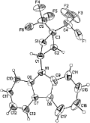
- compounds 3a and 3b are connected to the isolation protocol (see Experimental). In contrast to the corresponding cycloadducts of vinyl ethers and HFTA (2,2-bis(trifluoromethyl)-4-alkoxythietanes), which are high-boiling liquids [3], thietanes 3a and 3b are solids at room temperature. The structure of




Ambient gold-catalyzed O-vinylation of cyclic 1,3-diketone: A vinyl ether synthesis
Beilstein J. Org. Chem. 2013, 9, 2537–2543, doi:10.3762/bjoc.9.288
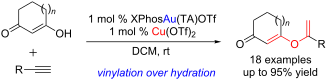
- access to various vinyl ethers. A catalytic amount of copper triflate was identified as the significant additive in promoting this transformation. Both aromatic and aliphatic alkynes are suitable substrates with good to excellent yields. Keywords: alkyne; copper salt; diketone; gold catalysis; vinyl


Sequential Diels–Alder/[3,3]-sigmatropic rearrangement reactions of β-nitrostyrene with 3-methyl-1,3-pentadiene
Beilstein J. Org. Chem. 2013, 9, 2137–2146, doi:10.3762/bjoc.9.251

- ) to γ,δ-unsaturated nitro compounds. In the reported examples, 6-membered cyclic O-allyl nitronates were converted to 4-nitrocyclohexenes [1][2]. This rearrangement strongly resembles the classic Claisen rearrangement of allyl vinyl ethers [3][4][5][6]. The O-allyl nitronic ester rearrangement has


Acid, silver, and solvent-free gold-catalyzed hydrophenoxylation of internal alkynes
Beilstein J. Org. Chem. 2013, 9, 2002–2008, doi:10.3762/bjoc.9.235
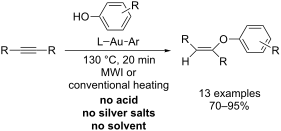
- either electron-withdrawing or electron-donating groups were efficiently added using these catalysts. No silver salts, acids, or solvents were needed for the catalysis, and either microwave or conventional heating afforded moderate to excellent yields of the vinyl ethers. Keywords: acid-free; catalysis
- various silver/potassium salts as promoters [1]. He found that moderate to excellent yields of the vinyl ethers could be obtained upon heating the reaction mixtures (dichloromethane or THF solutions) to 100 °C for 24–146 hours. Given the current interest in the synthetic community regarding the
- catalyst in the absence of solvent to 130 °C for 20 minutes generated excellent yields of the vinyl ethers. Control reactions revealed that the arylgold compound was essential to the success of the reaction as its removal lead to quantitative recovery of starting materials. The generation of the active


A Wittig-olefination–Claisen-rearrangement approach to the 3-methylquinoline-4-carbaldehyde synthesis
Beilstein J. Org. Chem. 2012, 8, 1725–1729, doi:10.3762/bjoc.8.197

- important 3-methylquinoline-4-carbaldehydes 6a–h from o-nitrobenzaldehydes 1a–h employing a Wittig-olefination–Claisen-rearrangement protocol. The Wittig reaction of o-nitrobenzaldehydes with crotyloxymethylene triphenylphosphorane afforded crotyl vinyl ethers 2a–h, which on heating under reflux in xylene
- developed in our group [28][29]. Results and Discussion Reaction of the o-nitrobenzaldehydes 1a–h with crotyloxymethylene triphenylphosphorane under optimized reaction conditions (Scheme 1) gave crotyl vinyl ethers in good yields (Table 1). The geometrical isomers of the crotyl vinyl ethers 2a–d were well
- separated on TLC, and it was possible to separate them by column chromatography. In the case of other crotyl vinyl ethers 2e–h, all attempts to separate these (E)- or (Z)-isomers were unsuccessful. Claisen rearrangement on either (E)- or (Z)-isomers 2a–d also led to a diastereomeric mixture of 4-pentenals


Combined bead polymerization and Cinchona organocatalyst immobilization by thiol–ene addition
Beilstein J. Org. Chem. 2012, 8, 1126–1133, doi:10.3762/bjoc.8.125
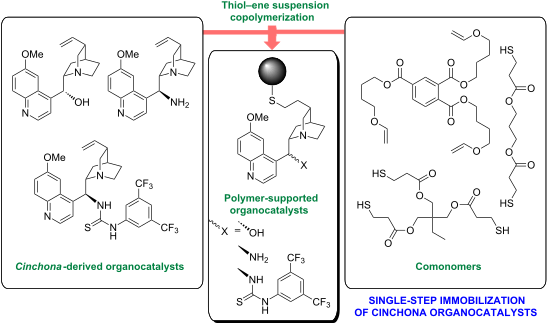
- combined in a single step. Vinyl ethers, allyl ethers, acrylates and methacrylates can all be effectively incorporated as part of such thiol–ene networks. The supported organocatalysts have been tried out successfully in several asymmetric transformations, but catalyst recycling so far is relatively poor


Recent developments in gold-catalyzed cycloaddition reactions
Beilstein J. Org. Chem. 2011, 7, 1075–1094, doi:10.3762/bjoc.7.124
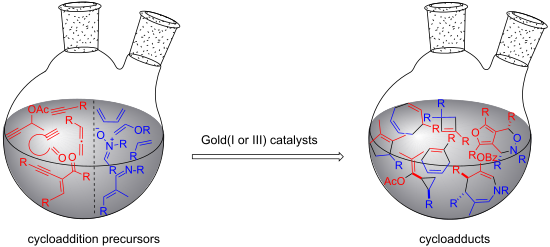
- highly stereoselective (4 + 2) cycloaddition with the vinyl ether to yield, after the elimination of the gold catalyst, highly substituted oxacyclic systems 7 in good yields and with notable diastereoselectivities. Importantly, this reaction tolerates a wide range of vinyl ethers, and different


Synthetic applications of gold-catalyzed ring expansions
Beilstein J. Org. Chem. 2011, 7, 767–780, doi:10.3762/bjoc.7.87
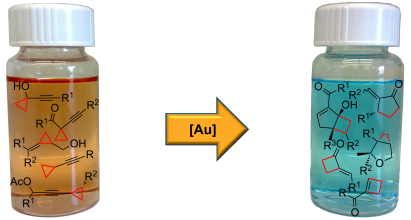
- ). Nitrones also reacted as dipolarophiles in the presence of AuCl3, even if in some cases copper catalysts were found to be more effective at triggering the corresponding annulations [52]. By contrast, when alkoxy vinyl ethers were employed as dipolarophiles, the cycloaddition takes place prior to the


Ene–yne cross-metathesis with ruthenium carbene catalysts
Beilstein J. Org. Chem. 2011, 7, 156–166, doi:10.3762/bjoc.7.22
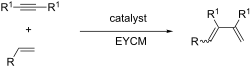
- obtained for EYCM with styrenes. EYCM of terminal olefins with internal borylated alkynes. Synthesis of propenylidene cyclobutane via EYCM. Efficient EYCM with vinyl ethers. From cyclopentene to cyclohepta-1,3-dienes via cyclic olefin-alkyne cross-metathesis. Ring expansion via EYCM from bicyclic olefins


Cross-metathesis of allylcarboranes with O-allylcyclodextrins
Beilstein J. Org. Chem. 2010, 6, 1099–1105, doi:10.3762/bjoc.6.126

- analytically pure compounds. It has been reported that low yields and conversions could be explained by isomerization of terminal to internal double bonds in both reactants (e.g., isomerization of allyl ethers to vinyl ethers [29][30][31] and allylcarboranes to propenylcarboranes [25]) and thus decreasing the


Total synthesis of (±)-coerulescine and (±)-horsfiline
Beilstein J. Org. Chem. 2010, 6, 876–879, doi:10.3762/bjoc.6.103

- allyl vinyl ethers was heated in refluxing xylene to effect the Claisen rearrangement to obtain 4-pentenal 6 in 85% yield. Aldehyde 6 was transformed into acid 7 by Jones oxidation, which was immediately converted to the ethyl ester 8. Subsequently, reduction of the compound 8 with Zn and NH4Cl resulted


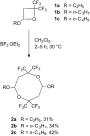
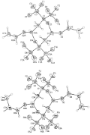
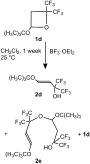
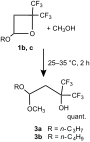
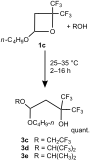
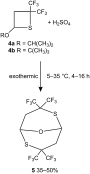
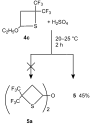
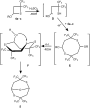
Acid catalyzed cyclodimerization of 2,2-bis(trifluoromethyl)-4-alkoxy-oxetanes and -thietanes. Synthesis of 2,2,6,6-tetrakis(trifluoromethyl)-4,8-dialkoxy-1,5-dioxocanes and 3,3,7,7-tetrakis(trifluoromethyl)-9-oxa-2,6-dithia-bicyclo[3.3.1]nonane
Beilstein J. Org. Chem. 2010, 6, No. 46, doi:10.3762/bjoc.6.46
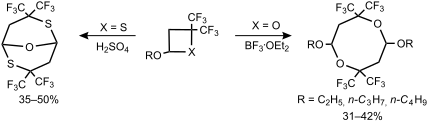
- are readily available materials, prepared by [2 + 2] cycloaddition of vinyl ethers with hexafluoroacetone [1][2][3] or hexafluorothioacetone [4][5], respectively. Although both groups of compounds have been known for over 40 years, reports on their chemical transformations are limited. Among the



Synthesis of spiropyrans: H-abstractions in 3-cycloalkenyloxybenzopyrans
Beilstein J. Org. Chem. 2007, 3, No. 14, doi:10.1186/1860-5397-3-14
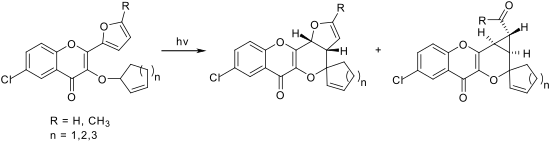
- cyclisations and [4+2] cycloadditions. [11][12][13][14][15][16] These methods being specific in nature for a particular spirocyclic compound, offer limited synthetic utility. In the past, we have investigated the use of photochemical methods for the synthesis of organic molecules like vinyl ethers, [17





