


Search results
Search for "xanthate" in Full Text gives 29 result(s) in Beilstein Journal of Organic Chemistry.
Radical cascades using enantioenriched 7-azabenzonorbornenes and their applications in synthesis
Beilstein J. Org. Chem. 2008, 4, No. 38, doi:10.3762/bjoc.4.38
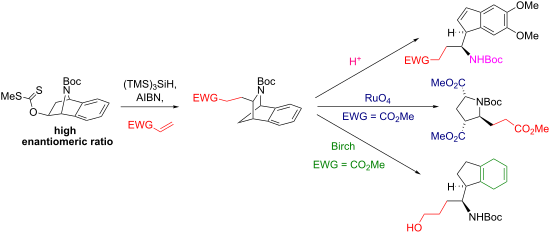
- and Discussion Chatgilialoglu and co-workers have previously shown that (TMS)3SiH-mediated xanthate deoxygenations can be performed in tandem with electrophile trapping [22][23]. We were encouraged that the best yields of deoxygenated, trapped product relative to directly reduced product were achieved
- achieve a slow rate of addition of the radical initiator and reductant [21][24]. Pleasingly, combining these procedures, i.e. performing a slow addition of AIBN, (TMS)3SiH (1.5 equiv) and acrylonitrile (1.5 equiv) to a 0.03 M solution of xanthate 5 [24][25] in refluxing toluene, resulted in the formation
- alcohols 17 and 19 in similar ers. With highly enantioenriched alcohols 17 and 19 in hand, the possibility of extending the tandem deoxygenation–rearrangement–electrophile trapping to these substrates was examined. Simple deoxygenation–rearrangement–reduction of the methyl xanthate derivatives 20 and 23


Part 3. Triethylborane- air: a suitable initiator for intermolecular radical additions of S-2-oxoalkyl- thionocarbonates (S-xanthates) to olefins
Beilstein J. Org. Chem. 2007, 3, No. 47, doi:10.1186/1860-5397-3-47

- triethylborane-air combination proves to be an efficient radical initiator that allows intermolecular radical additions of S-2-oxoalkyl-thionocarbonates (S-xanthates) to olefins. Depending on both the structures of the xanthate and the olefin, the addition process can be achieved at room temperature or slightly
- additions of various S-alkylxanthates to vinyl epoxides and related derivatives using an excess of triethylborane (2 equiv vs xanthate) at room temperature. The mechanism is different from that reported in this note as the radical chain is maintained by the ring opening of the oxirane that produces an
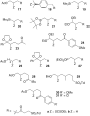
- alkoxy radical. The latter reacts rapidly with Et3B to afford a borinate and ethyl radical.[8] Results and discussion The pivotal experiments at the origin of this paper are depicted in Scheme 1. In the first experiment, 2.5 equiv of Et3B were added to a mixture of xanthate 1a and 1-decene in



Part 2. Mechanistic aspects of the reduction of S-alkyl- thionocarbonates in the presence of triethylborane and air
Beilstein J. Org. Chem. 2007, 3, No. 46, doi:10.1186/1860-5397-3-46

- from cyclododecanol afforded cyclododecane in a remarkable 62% yield. No hypothesis about the origin of the hydrogen atom that replaced the original xanthate function was proposed. Recently, as the work reported here was largely completed as already mentioned in the first part of this series,[3][4
- cleanly transfer a hydrogen atom to a specific type of carbon radical.[8][9] Disproportionation between the ethyl radical and the carbon-centred radical derived from the xanthate would have probably given the corresponding olefins, especially in the case of a tertiary radical. Such olefins were never
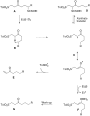
- an attempt to gain information about the mechanism, we performed deuteration experiments (Figure 1 and Table 1). Most of the results reported herein concern the reduction of xanthate 1a [see Supporting Information File 2, Supporting Information File 3, and Supporting Information File 4]. This


Part 1. Reduction of S-alkyl- thionocarbonates and related compounds in the presence of trialkylboranes/air
Beilstein J. Org. Chem. 2007, 3, No. 45, doi:10.1186/1860-5397-3-45

- of the xanthate moiety.[4][5] To date, the most widely used reductive method to remove these functional groups that become superfluous at the end of the reaction process, is based on the Bu3SnH/AIBN combination that operates at 80°C or above. The main virtue of this method relies on its versatility
- present in the commercial Et3B solution (entries 3 and 6). Experimentally, in method A, a solution of xanthate, Et3B (5 equiv., 1M solution in hexanes), in the given solvent (if needed) was simply stirred for 2 h in the presence of air under anhydrous conditions [see Supporting Information File 1
- . Thus, compounds 10a, 12a–14a gave the corresponding alkanes in fair to good yields (entries 8–11). The reduction of a tertiary xanthate, without risk of any pseudo-Tchugaev thermal elimination, was also feasible in good yield as shown by reaction of compound 15a (entry 12). Attempts to reduce a primary


Other Beilstein-Institut Open Science Activities



