


Search results
Search for "α,β-unsaturated ketone" in Full Text gives 53 result(s) in Beilstein Journal of Organic Chemistry.
An expedient and new synthesis of pyrrolo[1,2-b]pyridazine derivatives
Beilstein J. Org. Chem. 2009, 5, No. 66, doi:10.3762/bjoc.5.66

- ; tertiary butyl carbamate; tertiary butyl carbazate; α,β-unsaturated ketone; Introduction Pyrrolopyridazine derivatives have various biological applications [1][2][3][4][5][6][7][8], and their fluorescent properties have been investigated for potential use in sensors, lasers, and semiconductor devices [9


Sordarin, an antifungal agent with a unique mode of action
Beilstein J. Org. Chem. 2008, 4, No. 31, doi:10.3762/bjoc.4.31

- synthesis of compound 22 began with double alkylation of (+)-21 through a cuprate conjugate addition followed by treatment of the resulting enolate with methyl iodide (Scheme 5). Retro-Diels-Alder reaction of 22 in refluxing 1,2-dichlorobenzene gave α,β-unsaturated ketone 23. Trisubstituted cyclopentanone
- NaBH4) of the nitrile, MOM protection of the newly formed primary alcohol, and hydrolysis of the dioxolane gave ketone 30 and occurred as a prelude to retro-Diels-Alder reaction of the latter, leading to the α,β-unsaturated ketone 31. Compound 32 was obtained by treatment with LDA and Mander’s reagent


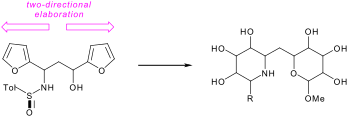
Methods for the synthesis of polyhydroxylated piperidines by diastereoselective dihydroxylation: Exploitation in the two-directional synthesis of aza-C-linked disaccharide derivatives
Beilstein J. Org. Chem. 2005, 1, No. 2, doi:10.1186/1860-5397-1-2
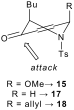
- from oxidation to the corresponding α,β-unsaturated ketone,[47] followed by conjugate addition. The dihydroxyation of the anti allylic alcohol 19 under Upjohn conditions was not synthetically useful (entry 8a, Table 1). Although dihydroxyation of the remote allyl group was rapid, the dihydroxylation of





Other Beilstein-Institut Open Science Activities



