


Search results
Search for "1,3-dienes" in Full Text gives 55 result(s) in Beilstein Journal of Organic Chemistry.
Chemistry of polyhalogenated nitrobutadienes, 10: Synthesis of highly functionalized heterocycles with a rigid 6-amino-3-azabicyclo[3.1.0]hexane moiety
Beilstein J. Org. Chem. 2012, 8, 621–628, doi:10.3762/bjoc.8.69

- reactions, namely the conversion of the 1-amino-2,2-dichlorovinyl group to a dichloromethyl ketone and, in addition, the reductive bisdechlorination of a dichloromethyl group were recently published by our group [5][43]. Conclusion Regioselective reactions of the nitrotrichlorobuta-1,3-dienes 3 and 4, some


Efficient synthesis of 1,3-diaryl-4-halo-1H-pyrazoles from 3-arylsydnones and 2-aryl-1,1-dihalo-1-alkenes
Beilstein J. Org. Chem. 2011, 7, 1656–1662, doi:10.3762/bjoc.7.195
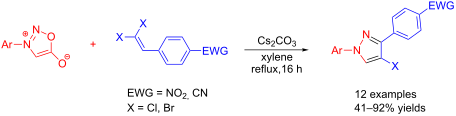
- ], alkenyl arenes [19], 1,3-dienes [20][21], α,β-unsaturated esters [19][22] and nitriles [23], phosphane oxides [24] or with alkynyl silanes [18], stannanes [18][25][26], arenes [27][28], esters [29][30][31][32][33], boronic esters [34][35]. However, the cycloaddition of sydnones with 1,1-dihaloalkenes is


Recent developments in gold-catalyzed cycloaddition reactions
Beilstein J. Org. Chem. 2011, 7, 1075–1094, doi:10.3762/bjoc.7.124
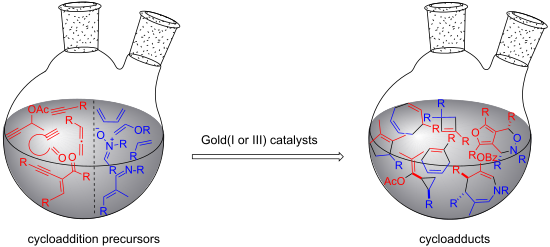
- cations and dienes [95][96]. Initially, we found that PtCl2 was an excellent catalyst for promoting these intramolecular [4C + 3C] cycloadditions between 1,3-dienes and allenes (Scheme 26) [97]. DFT calculations as well as experimental data agreed with a mechanistic pathway based on the metal activation
- , cobalt, nickel or palladium catalysts [4]. In recent years, however, platinum and particularly gold complexes have also emerged as excellent catalysts for the promotion of novel types of cycloaddition reactions, usually involving non-activated unsaturated systems (e.g., alkynes, allenes, alkenes or 1,3
- -dienes) [5][6][7][8][9][10][11][12]. Today it is well known that the excellent reactivity of these group-11 catalysts can in part be explained in terms of relativistic effects, particularly marked in the case of gold [13][14], that induce the contraction of 6s and the expansion of 5d orbitals. As a


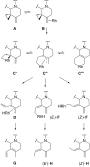
Rh-Catalyzed rearrangement of vinylcyclopropane to 1,3-diene units attached to N-heterocycles
Beilstein J. Org. Chem. 2011, 7, 298–303, doi:10.3762/bjoc.7.39

- domino 1,3-dipolar cycloaddition/thermal rearrangement sequence, were converted by Wittig methylenation to the corresponding vinylcyclopropanes (VCPs), which underwent rearrangement to 1,3-dienes in the presence of the Wilkinson Rh(I) complex under microwave heating. The previously unexplored Rh(I
- )-catalyzed opening of the VCP moiety embedded in an azapolycyclic system occurs at high temperature (110–130 °C) to afford the corresponding 1,3-dienes in moderate yield (34–53%). Keywords: nitrogen heterocycles; rearrangement; rhodium; small ring systems; spiro compounds; Introduction The cyclopropyl
- influence of the N-heterocyclic system on the rearrangement, some model VCPs were generated by Wittig olefination of the α-oxocyclopropane group of functionalized oligocyclic spirocyclopropane-tetrahydropyridones and converted into the corresponding 1,3-dienes by treatment with Rh(PPh3)3Cl. Results and


Ene–yne cross-metathesis with ruthenium carbene catalysts
Beilstein J. Org. Chem. 2011, 7, 156–166, doi:10.3762/bjoc.7.22
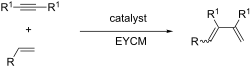
- Cedric Fischmeister Christian Bruneau UMR 6226-CNRS-Université de Rennes 1, Sciences Chimiques de Rennes, Catalyse et Organométalliques, Campus de Beaulieu, 263 avenue du général Leclerc, 35042 Rennes cedex, France 10.3762/bjoc.7.22 Abstract Conjugated 1,3-dienes are important building blocks in
- synthesis of Anolignans [48] and another closely related example is shown in the preparation of Amphidinolide E [50][51] where the diene system is extended by further cross-metathesis with 2-methylpenta-1,4-diene (Figure 2). The Diels–Alder reaction is one of the most popular transformations of 1,3-dienes
- in the presence of Grubbs second generation catalyst. It was found that depending on the nature of the alkyne (terminal or internal), the regioselectivity of the cross-coupling changed. Terminal alkynes gave 1,3-dienes with a 1,3-relationship between the alkenyl substituent and the silyl group


Other Beilstein-Institut Open Science Activities



