


Search results
Search for "Diels–Alder cycloaddition" in Full Text gives 57 result(s) in Beilstein Journal of Organic Chemistry.
Recent developments in gold-catalyzed cycloaddition reactions
- Fernando López and
- José L. Mascareñas
Beilstein J. Org. Chem. 2011, 7, 1075–1094, doi:10.3762/bjoc.7.124
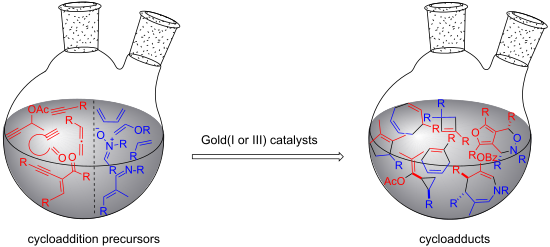
- with alkenes [70]. Gold-catalyzed intermolecular hetero-dehydro Diels–Alder cycloaddition [72]. Gold(I)-catalyzed stereoselective olefin cyclopropanation [74]. Reaction of propargylic benzoates with α,β-unsaturated imines to give azepine cycloadducts [77]. Gold-catalyzed (3 + 3) annulation of

Graphical Abstract

Scheme 1: AuCl3-catalyzed benzannulations reported by Yamamoto.

Scheme 2: Synthesis of 9-oxabicyclo[3.3.1]nona-4,7-dienes from 1-oxo-4-oxy-5-ynes [40].

Scheme 3: Stereocontrolled oxacyclization/(4 + 2)-cycloaddition cascade of ketone–allene substrates [43].

Scheme 4: Gold-catalyzed synthesis of polycyclic, fully substituted furans from 1-(1-alkynyl)cyclopropyl keto...

Scheme 5: Gold-catalyzed 1,3-dipolar cycloaddition of 2-(1-alkynyl)-2-alken-1-ones with nitrones [47].

Scheme 6: Enantioselective 1,3-dipolar cycloaddition of 2-(1-alkynyl)-2-alken-1-ones with nitrones [48].

Scheme 7: Gold-catalyzed 1,3-dipolar cycloaddition of 2-(1-alkynyl)-2-alken-1-ones with α,β-unsaturated imine...

Scheme 8: Gold-catalyzed (4 + 3) cycloadditions of 1-(1-alkynyl)oxiranyl ketones [50].

Scheme 9: (3 + 2) Cycloaddition of gold-containing azomethine ylides [52].

Scheme 10: Gold-catalyzed generation and reaction of azomethine ylides [53].

Scheme 11: Gold-catalyzed intramolecular (4 + 2) cycloadditions of unactivated alkynes and dienes [55].

Scheme 12: Gold-catalyzed preparation of bicyclo[4.3.0]nonane derivatives from dienol silyl ethers [59].

Scheme 13: Gold(I)-catalyzed intramolecular (4 + 2) cycloadditions of arylalkynes or 1,3-enynes with alkenes [60].

Scheme 14: Gold(I)-catalyzed intermolecular (2 + 2) cycloaddition of alkynes with alkenes [62].

Scheme 15: Metal-catalyzed cycloaddition of alkynes tethered to cycloheptatriene [65].

Scheme 16: Gold-catalyzed cycloaddition of functionalized ketoenynes: Synthesis of (+)-orientalol F [68].

Scheme 17: Gold-catalyzed intermolecular cyclopropanation of enynes with alkenes [70].

Scheme 18: Gold-catalyzed intermolecular hetero-dehydro Diels–Alder cycloaddition [72].

Figure 1: Gold-catalyzed 1,2- or 1,3-acyloxy migrations of propargyl esters.

Scheme 19: Gold(I)-catalyzed stereoselective olefin cyclopropanation [74].

Scheme 20: Reaction of propargylic benzoates with α,β-unsaturated imines to give azepine cycloadducts [77].

Scheme 21: Gold-catalyzed (3 + 3) annulation of azomethine imines with propargyl esters [81].

Scheme 22: Gold(I)-catalyzed isomerization of 5-en-2-yn-1-yl acetates [83].

Scheme 23: (3 + 2) and (2 + 2) cycloadditions of indole-3-acetates 41 [85,86].

Scheme 24: Gold(I)-catalyzed (2 + 2) cycloaddition of allenenes [87].

Scheme 25: Formal (3 + 2) cycloaddition of allenyl MOM ethers and alkenes [90].

Scheme 26: (4 + 3) Cycloadditions of allenedienes [97,98].

Scheme 27: Gold-catalyzed transannular (4 + 3) cycloaddition reactions [101].

Scheme 28: Gold(I)-catalyzed (4 + 2) cycloadditions of allenedienes [102].

Scheme 29: Enantioselective gold(I)-catalyzed (4 + 2) cycloadditions of allenedienes [88,102,104].

Scheme 30: (3 + 2) versus (2 + 2) Cycloadditions of allenenes [87,99].

Figure 2: NHC ligands with different π-acceptor properties [106].

Scheme 31: (3 + 2) versus (2 + 2) Cycloadditions of allenenes [106].

Scheme 32: Gold(I)-catalyzed intermolecular (4 + 2) cycloaddition of allenamides and acyclic dienes [109].
One-pot Diels–Alder cycloaddition/gold(I)-catalyzed 6-endo-dig cyclization for the synthesis of the complex bicyclo[3.3.1]alkenone framework
- Boubacar Sow,
- Gabriel Bellavance,
- Francis Barabé and
- Louis Barriault
Beilstein J. Org. Chem. 2011, 7, 1007–1013, doi:10.3762/bjoc.7.114
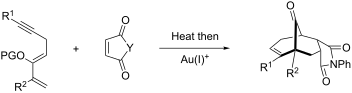
- ) are underway and will be reported in due course. Structures of naturally occurring PPAPs. Gold(I)-catalyzed 6-endo-dig cyclization. Synthesis of papuaforin A core 4. Proposed domino Diels–Alder reaction/gold(I)-catalyzed cyclization. One-pot Diels–Alder cycloaddition/gold(I) catalyzed carbocyclization
- . Results of the one-pot Diels–Alder reaction/Au(I)-catalyzed cyclization. One-pot Diels–Alder cycloaddition/Au(I)-catalyzed carbocyclization of internal alkynes. Supporting Information Supporting Information File 179: Experimental procedures, characterization data, 1H NMR and 13C NMR spectra. Supporting

Graphical Abstract

Figure 1: Structures of naturally occurring PPAPs.

Scheme 1: Gold(I)-catalyzed 6-endo-dig cyclization.

Scheme 2: Synthesis of papuaforin A core 4.

Scheme 3: Proposed domino Diels–Alder reaction/gold(I)-catalyzed cyclization.

Scheme 4: One-pot Diels–Alder cycloaddition/gold(I) catalyzed carbocyclization.
Palladium- catalyzed cross coupling reactions of 4-bromo- 6H-1,2-oxazines
- Reinhold Zimmer,
- Elmar Schmidt,
- Michal Andrä,
- Marcel-Antoine Duhs,
- Igor Linder and
- Hans-Ulrich Reissig
Beilstein J. Org. Chem. 2009, 5, No. 44, doi:10.3762/bjoc.5.44

- literature describes just one related 4-chloro-substituted 6H-1,2-oxazine which was prepared by a hetero-Diels–Alder cycloaddition–elimination sequence of 2-chloro-1-nitroso-1-phenyl-ethene and 1-bromo-2-ethoxyethene in low yield (22%) [32]. As demonstrated in Scheme 2, a more efficient approach consists in

Graphical Abstract

Scheme 1: Brominations of 6H-1,2-oxazines. a) Br2, Et2O, −30 °C, 2 h. b) Et3N, −30 °C to r.t., overnight.

Scheme 2: Chlorinations of 6H-1,2-oxazines. a) Cl2, Et2O, −30 °C. b) Et3N, −30 °C to r.t.

Scheme 3: Suzuki-couplings of 4-bromo-6H-1,2-oxazines. a) ArB(OH)2, Pd(PPh3)4, Na2CO3, toluene, 80 °C, 3 h.

Scheme 4: Sonogashira-couplings of 4-bromo-6H-1,2-oxazines. a) PdCl2(PPh3)2, CuI, Et3N, toluene, r.t., 6–20 h....

Scheme 5: Sonogashira-couplings of 4,5-dibromo-6H-1,2-oxazines. a) PdCl2(PPh3)2, CuI, Et3N, toluene, r.t., 4 ...

Scheme 6: Preparation of trisubstituted pyridine derivatives: a) BF3·OEt2, CH2Cl2, −78 °C to r.t., overnight.
Synthesis and Diels–Alder cycloaddition reaction of norbornadiene and benzonorbornadiene dimers
- Bilal Nişancı,
- Erdin Dalkılıç,
- Murat Güney and
- Arif Daştan
Beilstein J. Org. Chem. 2009, 5, No. 39, doi:10.3762/bjoc.5.39
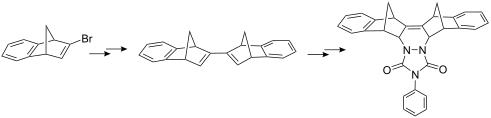
- rearrangement [12][13][14][15], as well as in other instances [16][17][18][19][20][21][22]. Therefore, functionalizations of these compounds are important. In this study, we investigated the synthesis and Diels–Alder cycloaddition reaction of norbornadiene and benzonorbornadiene dimers. Results and Discussion
- between unsaturated halides and stannanes [28][29]. Treatment of 6 with Cu(NO3)2·3H2O in dry THF at r.t. afforded the first synthesis of the expected dimers 7 and 8 in 25% yield in a 3:4 ratio, respectively, besides benzonorbornadiene 2 after column chromatography. The Diels–Alder cycloaddition of dimers
- ). Numbering of carbon atoms and description of possible structures for dimers 11–14 and 18–21. Synthesis of starting materials 4 and 5. Synthesis and Diels–Alder cycloaddition reactions of dimers 7 and 8. Synthesis and Diels–Alder cycloaddition reactions of dimers 16 and 17. Acknowledgments This work has

Graphical Abstract

Scheme 1: Synthesis of starting materials 4 and 5.

Scheme 2: Synthesis and Diels–Alder cycloaddition reactions of dimers 7 and 8.

Scheme 3: Synthesis and Diels–Alder cycloaddition reactions of dimers 16 and 17.

Figure 1: Numbering of carbon atoms and description of possible structures for dimers 11–14 and 18–21.
Mitomycins syntheses: a recent update
- Jean-Christophe Andrez
Beilstein J. Org. Chem. 2009, 5, No. 33, doi:10.3762/bjoc.5.33


Graphical Abstract

Scheme 1: Aziridine containing natural products.

Scheme 2: Mitomycin structures and nomenclature.

Scheme 3: Base catalysed epimerization of mitomycin B.

Scheme 4: Biosynthesis of mitomycin C (MMC) 7.

Scheme 5: Mode of action of mitomycin C.

Scheme 6: The N–C3–C9a disconnection.

Scheme 7: Danishefsky’s Retrosynthesis of mitomycin K.

Scheme 8: Hetero Diels–Alder reaction en route to mitomycins.

Scheme 9: Nitroso Diels–Alder cycloaddition.

Scheme 10: Frank azide cycloadddition.

Scheme 11: Final steps of mitomycin K synthesis. aPDC, DCM; bPhSCH2N3, PhH, 80 °C; cL-selectride, THF, −78 °C; ...

Scheme 12: Naruta–Maruyama retrosynthesis.

Scheme 13: Synthesis of a leucoaziridinomitosane by nitrene cycloaddition. aAlCl3-Et2O; bNaH, ClCH2OMe; cn-BuL...

Scheme 14: Thermal decomposition of azidoquinone 51.

Scheme 15: Diastereoselectivity during the cycloaddition.

Scheme 16: Oxidation with iodo-azide.

Scheme 17: Williams’ approach towards mitomycins.aDEIPSCl, Imidazole, DCM; bPd/C, HCO2NH4, MeOH; cAllocCl, NaH...

Scheme 18: Synthesis of pyrrolidones by homoconjugate addition.
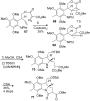
Scheme 19: Homoconjugate addition on the fully functionalized substrate.

Scheme 20: Introduction of the olefin.

Scheme 21: Retrosynthesis of N–C9a, N–C3 bond formation.

Scheme 22: Synthesis of the pyrrolo[1,2]indole 82 using N-PSP activation.aAc2O, Py; bAc2O, Hg(OAc)2, AcOH, 90%...

Scheme 23: Synthesis of an aziridinomitosane. am-CPBA, DCM then iPr2NH, CCl4 reflux; bK2CO3, MeOH; cBnBr, KH; d...

Scheme 24: Oxidation products of a leucoaziridinomitosane obtained from a Polonovski oxidation.

Scheme 25: Polonovski oxidation of an aziridinomitosane. am-CPBA; bPd/C, H2; cDimethoxypropane, PPTS.

Scheme 26: The C1–C9a disconnection.

Scheme 27: Ziegler synthesis of desmethoxymitomycin A.aIm2C=O, THF; bNH3; cTMSOTf, 2,6-di-tert-butylpyridine, ...

Scheme 28: Transformation of sodium erythorbate.aTBDMSCl; bNaN3; cPPh3; d(Boc)2O, DMAP; eTBAF; fTf2O, Pyr.

Scheme 29: Formation of C9,C10-unsaturation in the mitomycins. am-CPBA, DCM; bO3, MeOH; cMe2S; dKHMDS, (EtO)3P...

Scheme 30: Fragmentation mechanism.

Scheme 31: Michael addition-cyclisation.

Scheme 32: SmI2 8-endo-dig cyclisation.

Scheme 33: Synthesis of pyrrolo[1,2-a]indole by 5-exo-dig radical cyclization.

Scheme 34: The C9–C9a disconnection.

Scheme 35: Intramolecular nitrile oxide cycloaddition.

Scheme 36: Regioselectivity of the INOC.

Scheme 37: Fukuyama’s INOC strategy.

Scheme 38: Synthesis of a mitosane core by rearrangement of a 1-(1-pyrrolidinyl)-1,3-butadiene.

Scheme 39: Sulikowski synthesis of an aziridinomitosene. aPd(Tol3P)2Cl2, Bu3SnF, 140; bH2, Pd/C; cTFAA, Et3N; d...

Scheme 40: Enantioselective carbene insertion.

Scheme 41: Parson’s radical cyclization.

Scheme 42: Cha’s mitomycin B core synthesis.

Scheme 43: The N-aromatic disconnection.

Scheme 44: Kishi retrosynthesis.

Scheme 45: Kishi synthesis of a starting material. aallyl bromide, K2CO3, acetone, reflux; bN,N-Dimethylanilin...
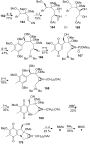
Scheme 46: Kishi synthesis of MMC 7. aLDA, THF, −78 °C then PhSeBr, THF, −78 °C; bH2O2, THF-EtOAc; cDIBAL, DCM...

Scheme 47: Acid catalyzed degradation of MMC 7.

Scheme 48: In vivo formation of apomitomycin B.

Scheme 49: Advanced intermediate for apomitomycin B synthesis.

Scheme 50: Remers synthesis of a functionalized mitosene. aTMSCl, Et3N, ZnCl2 then NBS; bAcOK; cNH2OH; dPd/C, H...

Scheme 51: Coleman synthesis of desmethoxymitomycin A. aSnCl2, PhSH, Et3N, CH3CN; bClCO2Bn, Et3N; cPPh3, DIAD,...

Scheme 52: Transition state and pyrrolidine synthesis.

Scheme 53: Air oxidation of mitosanes and aziridinomitosanes.

Scheme 54: The C9-aromatic disconnection.

Scheme 55: Synthesis of the aziridine precursor. aLHMDS, THF; bNaOH; c(s)-α-Me-BnNH2, DCC, HOBT; dDIBAL; eK2CO3...

Scheme 56: Synthesis of 206 via enamine conjugate addition.

Scheme 57: Rapoport synthesis of an aziridinomitosene.

Scheme 58: One pot synthesis of a mitomycin analog.

Scheme 59: Synthesis of compound 218 via intramolecular Heck coupling. aEtMgCl, THF, then 220; bMsCl, Et3N; cN...

Scheme 60: Elaboration of indole 223. aEt3N, Ac2O; bAcOH; cSOCl2, Et3N; dNaN3, DMF; eH2SO4, THF; fK2CO3, MeOH; ...

Scheme 61: C9-C9a functionalization from indole.

Scheme 62: Synthesis of mitomycin K. a2 equiv. MoO5.HMPA, MeOH; bPPh3, Et3N, THF-H2O; cMeOTf, Py, DCM; dMe3SiCH...

Scheme 63: Configurational stability of mitomycin K derivatives.

Scheme 64: Epimerization of carbon C9a in compound 227b.

Scheme 65: Corey–Chaykovsky synthesis of indol 235.

Scheme 66: Cory intramolecular aza-Darzens reaction for the formation of aziridinomitosene 239.

Scheme 67: Jimenez synthesis of aziridinomitosene 242.

Scheme 68: Von Braun opening of indoline 244.

Scheme 69: C9a oxidation of an aziridinomitosane with DDQ/OsO4.

Scheme 70: Synthesis of epi-mitomycin K. aNaH, Me2SO4; bH2, Pd/C; cMitscher reagent [165]; d[(trimethylsilyl)methyl...

Scheme 71: Mitomycins rearrangement.

Scheme 72: Fukuyama’s retrosynthesis.

Scheme 73: [2+3] Cycloaddition en route to isomitomycin A. aToluene, 110 °C; bDIBAL, THF, −78 °C; cAc2O, Py.; d...

Scheme 74: Final steps of Fukuyama’s synthesis.

Scheme 75: “Crisscross annulation”.

Scheme 76: Synthesis of 274; the 8-membered ring 274 was made using a crisscross annulation. a20% Pd(OH)2/C, H2...

Scheme 77: Conformational analysis of compound 273 and 275.

Scheme 78: Synthesis of a mitomycin analog. aNa2S2O4, H2O, DCM; bBnBr (10 equiv), K2CO3, 18-crown-6 (cat.), TH...

Scheme 79: Vedejs retrosynthesis.

Scheme 80: Formation of the azomethine ylide.

Scheme 81: Vedejs second synthesis of an aziridinomitosene. aDIBAL; bTPAP, NMO; c287; dTBSCl, imidazole.

Scheme 82: Trityl deprotection and new aziridine protecting group 300.

Scheme 83: Ene reaction towards benzazocinones.

Scheme 84: Benzazocenols via homo-Brook rearrangement.

Scheme 85: Pt-catalyzed [3+2] cycloaddition.

Scheme 86: Carbonylative lactamization entry to benzazocenols. aZn(OTf)2, (+)-N-methylephedrine, Et3N, TMS-ace...

Scheme 87: 8 membered ring formation by RCM. aBOC2O, NaHCO3; bTBSCl, Imidazole, DMF; callyl bromide, NaH, DMF; ...

Scheme 88: Aziridinomitosene synthesis. aTMSN3; bTFA; cPOCl3, DMF; dNaClO2, NaH2PO4, 2-methyl-2-butene; eMeI, ...

Scheme 89: Metathesis from an indole.

Scheme 90: Synthesis of early biosynthetic intermediates of mitomycins.
Asymmetric reactions in continuous flow
- Xiao Yin Mak,
- Paola Laurino and
- Peter H. Seeberger
Beilstein J. Org. Chem. 2009, 5, No. 19, doi:10.3762/bjoc.5.19
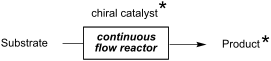
- on the use of Ti-TADDOL-functionalized monolithic columns for Diels-Alder cycloaddition of cyclopentadiene and 3-crotonyl-1,3-oxazolidin-2-one [39]. In this case, a complete reversal of topicity was observed, switching from a monolithic catalyst to the one grafted on a polymer matrix. Kirschning and

Graphical Abstract

Scheme 1: Enantioselective addition of trimethylsilyl cyanide to benzaldehyde.

Scheme 2: Asymmetric catalytic hydrogenation in a falling-film microreactor.

Scheme 3: Aldol reaction catalyzed by 5-(pyrrolidine-2-yl)tetrazole.

Scheme 4: Enantioselective addition of diethylzinc to aryl aldehydes.

Scheme 5: Glyoxylate-ene reaction in flow.

Scheme 6: Asymmetric synthesis of ß-lactams.

Scheme 7: α-Chlorination of acid chlorides in flow.

Scheme 8: Asymmetric Michael reaction in continuous flow.

Scheme 9: Enantioselective addition of Et2Zn to benzaldehyde using monolithic chiral amino alcohol.

Scheme 10: Continuous-flow hydrolytic dynamic kinetic resolution of epibromohydrin (32).

Scheme 11: Continuous-flow asymmetric cyclopropanation.

Scheme 12: Continuous asymmetric hydrogenation of dimethyl itaconate in scCO2.

Scheme 13: Continuous asymmetric transfer hydrogenation of acetophenone.

Scheme 14: Asymmetric epoxidation using a continuous flow membrane reactor.

Scheme 15: Enzymatic cyanohydrin formation in a microreactor.

Scheme 16: Resolution of (R/S)- 54 with immobilized lipase in a continuous scCO2- flow reactor.

Scheme 17: Enantioselective separation of Acetyl-D-Phe in a continuous flow reactor.
Trifluoromethyl ethers – synthesis and properties of an unusual substituent
- Frédéric R. Leroux,
- Baptiste Manteau,
- Jean-Pierre Vors and
- Sergiy Pazenok
Beilstein J. Org. Chem. 2008, 4, No. 13, doi:10.3762/bjoc.4.13

- - and -OCF3 in Metalation reactions. Metalation of trifluoromethoxyanisoles. Metalation of Bromo(trifluoromethoxy)benzenes. Aryne formation from bromo(trifluoromethoxy)phenyllithiums and subsequent Diels-Alder cycloaddition with furan. Metalation of (trifluoromethoxy)anilines. α-Fluorinated ethers used

Graphical Abstract

Figure 1: OCF3-bearing pesticides.

Scheme 1: Preparation of trifluoromethyl ethers via a chlorination/fluorination sequence.

Scheme 2: Preparation of trifluoromethyl ethers via an in situ chlorination/fluorination sequence.

Scheme 3: Preparation of trifluoromethyl ethers via chlorothionoformates.

Scheme 4: Preparation of trifluoromethyl ethers via fluoroformates.

Scheme 5: Oxidative desulfurization-fluorination toward trifluoromethyl ethers.

Scheme 6: Mechanism of the oxidative desulfurization-fluorination.

Scheme 7: Umemoto's O-(trifluoromethyl)dibenzofuranium salts 4 as CF3-transfer agents.

Scheme 8: Togni's approach using hypervalent iodine compounds as CF3-transfer agents.

Scheme 9: TAS OCF3 as a nucleophilic OCF3-transfer agent.

Figure 2: Mesomeric structures of the OCF3-group.

Figure 3: Structures of 6 and 7.

Figure 4: Conformational preference of the trifluoromethoxy group on aryl rings.

Scheme 10: Nitration of trifluoromethoxy benzene.

Scheme 11: Synthesis and Nitration of N-Acetyl-(trifluoromethoxy)anilines.

Scheme 12: Bromine/lithium exchange of bromo(trifluoromethoxy)benzenes.

Scheme 13: Metalation of (trifluoromethoxy)benzene.

Scheme 14: Metalation of (trifluoromethoxy)naphthalenes.

Scheme 15: Competition between -CF3- and -OCF3 in Metalation reactions.

Scheme 16: Competition between -F- and -OCF3 in Metalation reactions.
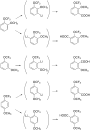
Scheme 17: Metalation of trifluoromethoxyanisoles.

Figure 5: Direction of π-polarization depending on the substituent as described by Schlosser et al. [57].

Scheme 18: Metalation of Bromo(trifluoromethoxy)benzenes.

Scheme 19: Aryne formation from bromo(trifluoromethoxy)phenyllithiums and subsequent Diels-Alder cycloaddition...

Scheme 20: Metalation of (trifluoromethoxy)anilines.



