


Search results
Search for "Friedel–Crafts alkylation" in Full Text gives 55 result(s) in Beilstein Journal of Organic Chemistry.
Catalytic asymmetric tandem Friedel–Crafts alkylation/Michael addition reaction for the synthesis of highly functionalized chromans
Beilstein J. Org. Chem. 2013, 9, 1210–1216, doi:10.3762/bjoc.9.137

- Jiahuan Peng Da-Ming Du School of Chemical Engineering and Environment, Beijing Institute of Technology, Beijing 100081, China 10.3762/bjoc.9.137 Abstract The enantioselective tandem Friedel–Crafts alkylation/Michael addition reaction of indoles with nitroolefin enoates catalyzed by a
- diphenylamine-linked bis(oxazoline)-Zn(OTf)2 complex was investigated. This tandem reaction afforded functionalized chiral chromans in good yields with moderate to high stereoselectivities (up to 95:5 dr, up to 99% ee). Keywords: asymmetric catalysis; bis(oxazoline); chroman; Friedel–Crafts alkylation; tandem
- [21][22][23][24][25][26][27][28][29][30][31][32]. Chiral indolyl(nitro)chromans have been successfully synthesized in our previous study [33]. Good results were obtained in the diastereo- and enantioselective Friedel–Crafts alkylation of indoles with 3-nitro-2H-chromenes catalyzed by diphenylamine


Camera-enabled techniques for organic synthesis
Beilstein J. Org. Chem. 2013, 9, 1051–1072, doi:10.3762/bjoc.9.118
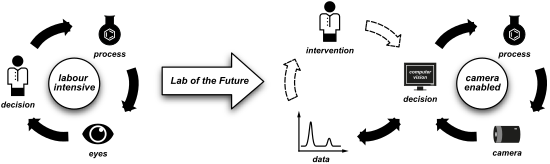
- product within the microdroplets to be visualised accurately (Figure 6). Another beneficial way to use a camera to assist in a reaction optimisation is simply to see what is happening in an otherwise inaccessible reaction vessel or closed cavity. During studies on the Friedel–Crafts alkylation of anisole


Ion-exchange-resin-catalyzed adamantylation of phenol derivatives with adamantanols: Developing a clean process for synthesis of 2-(1-adamantyl)-4-bromophenol, a key intermediate of adapalene
Beilstein J. Org. Chem. 2012, 8, 227–233, doi:10.3762/bjoc.8.23
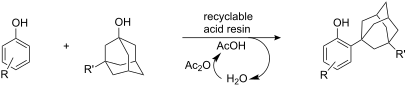
- derivatives are the key skeletons of synthetic retinoid analogues [1][2][3][4][5][6][7][8][9] and supporting ligands of many homogeneous transition-metal catalysts [10][11][12][13][14]. Introduction of an adamantyl group to the phenol ring has largely relied on acid-catalyzed Friedel–Crafts alkylation with
- catalyze adamantylation of aromatics with 1-bromoadamantane similarly to organic sulfonic acids or their fluorinated analogues. However, due to the detrimental effects of water on the catalytic activity of the cation-exchange resin in Friedel–Crafts alkylation, there is, to the best of our knowledge, no


A review of new developments in the Friedel–Crafts alkylation – From green chemistry to asymmetric catalysis
Beilstein J. Org. Chem. 2010, 6, No. 6, doi:10.3762/bjoc.6.6
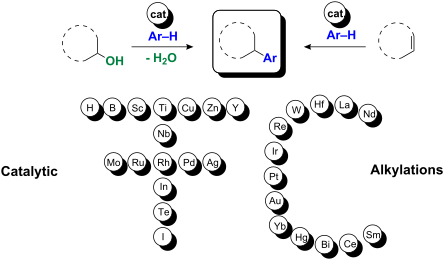
- descriptions of a Lewis acid used in organic synthesis but also the first example of what was later to be called Friedel–Crafts alkylation (FC alkylation) after its inventors. Today Friedel–Crafts alkylations remain the method of choice for the alkylation of arenes and heteroarenes. Over the intervening years
- . Despite the great importance of the Friedel–Crafts alkylation for organic synthesis it has major drawbacks since stoichiometric or super stoichiometric amounts of a Lewis acid or Brønsted acid and toxic alkyl halides have to be utilized leading to vast amounts of salt side products. With the need for more
- intermediate which subsequently undergoes an intramolecular [1,3]- or [1,5]-hydride shift resulting in the desired diarylmethanes 9 in good yields. Electron donating and electron withdrawing functional groups of aldehyde moiety are tolerated in this reductive Friedel–Crafts alkylation procedure. However, there


A stable enol from a 6-substituted benzanthrone and its unexpected behaviour under acidic conditions
Beilstein J. Org. Chem. 2009, 5, No. 31, doi:10.3762/bjoc.5.31
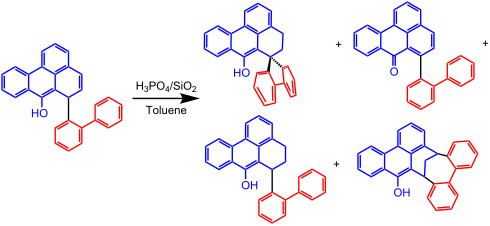
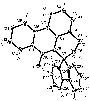
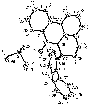
- internal Friedel-Crafts alkylation provides the spiro compound 11. Alternatively, protonation of 4 at C-5 generates the benzylic cation 17, which by intramolecular electrophilic attack leads to the bicyclo[4.3.1]decane derivative 12. Finally, the formation of 13 is a formal hydrogenation of the starting




Other Beilstein-Institut Open Science Activities



