


Search results
Search for "PTSA" in Full Text gives 54 result(s) in Beilstein Journal of Organic Chemistry.
An efficient and practical entry to 2-amido-dienes and 3-amido-trienes from allenamides through stereoselective 1,3-hydrogen shifts
Beilstein J. Org. Chem. 2011, 7, 410–420, doi:10.3762/bjoc.7.53
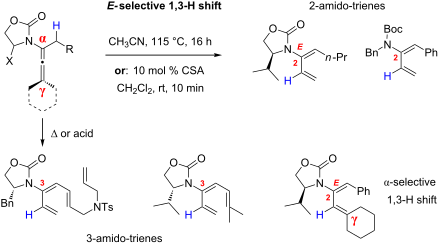
- ). There appears to be some solvent effect on the E/Z selectivity with more polar solvents providing the best ratio (Table 1, entries 2–4). In addition to thermal conditions, we screened several Brønsted acids at room temperature in order to investigate a milder condition. While PTSA resulted in poor E/Z


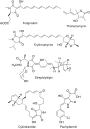
A short stereoselective synthesis of (+)-(6R,2′S)-cryptocaryalactone via ring- closing metathesis
Beilstein J. Org. Chem. 2009, 5, No. 14, doi:10.3762/bjoc.5.14
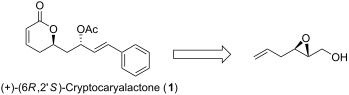
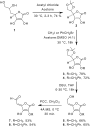
- presence of PTSA to afford compound 10 in 95% yield, which was regioselectively opened with DIBAL-H to afford the primary alcohol 11 in 92% yield (Scheme 1). The primary alcohol 11 was oxidized under Swern conditions and the crude aldehyde was exposed to the alkynylation reaction directly. Several base
- assigned from the chemical shift of acetonide carbon atoms in 13C NMR spectrum. So, upon deprotection of 7, diol 12 was obtained in good chemical yield (84%) and was further protected with 2,2-DMP, in presence of catalytic amount of PTSA, to furnish compound 13. The analytical data of acetonide 13


Facile synthesis of two diastereomeric indolizidines corresponding to the postulated structure of alkaloid 5,9E- 259B from a Bufonid toad (Melanophryniscus)
Beilstein J. Org. Chem. 2008, 4, No. 6, doi:10.1186/1860-5397-4-6
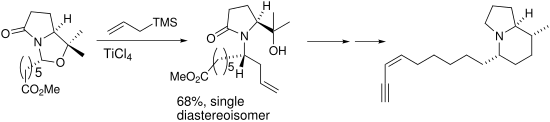
- 5,9E-259B, and b) synthetic 7. Structure shown with relative configuration. Reagents: (i) MeMgI. 96% (ii) PTSA 71%. (iii) TiCl4 CH2Cl2 25 oC 3d 68%. (iv) MsCl, Et3N, THF -40 oC, 74%. (v) Grubbs' catalyst, 25 oC CH2Cl2, 90%. (vi) H2 MeOH Pt/C 79%. (vii) LiAlH4, AlCl3, 73%. (viii) (a) Dess Martin


An efficient synthesis of tetramic acid derivatives with extended conjugation from L-Ascorbic Acid
Beilstein J. Org. Chem. 2006, 2, No. 24, doi:10.1186/1860-5397-2-24

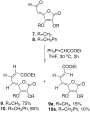
- of the hydroxy lactam derivatives 19–22 with pTSA in CH2Cl2 led to the formation of dienyl lactam derivatives 31–34 in good yields (see Table 2). The structures of all the compounds were determined on the basis of spectroscopic data and microanalysis (Supporting Information File 1). Detailed



Other Beilstein-Institut Open Science Activities



