


Search results
Search for "aza-Michael" in Full Text gives 59 result(s) in Beilstein Journal of Organic Chemistry.
The chemistry of amine radical cations produced by visible light photoredox catalysis
Beilstein J. Org. Chem. 2013, 9, 1977–2001, doi:10.3762/bjoc.9.234
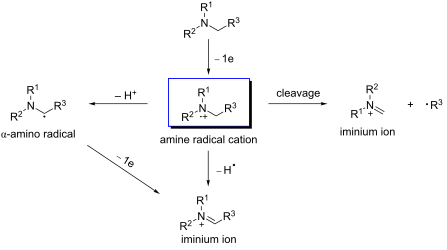
- 15 by abstraction of a hydrogen atom directly. The addition of the enol form of α-ketoester 59 to 15 furnishes the Mannich adduct 60. A retro-aza-Michael reaction via enol 61 allows cleavage of the C–N bond to yield secondary aniline 62. Aniline 62 is first oxidized to imine 63, which is further




Efficient synthesis of β’-amino-α,β-unsaturated ketones
Beilstein J. Org. Chem. 2013, 9, 486–495, doi:10.3762/bjoc.9.52

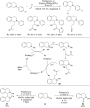
- reaction of chiral imines with enolates derived from Weinreb amides [13][14]. In previous work on the asymmetric synthesis of 2,6-disubstituted piperidines by C–N bond formation, we demonstrated that intramolecular aza-Michael ”type” cyclisation [15] using a β'-carbamate-α,β-unsaturated ketone
- devised for the asymmetric synthesis of β’-amino-protected-α,β enones, a valuable intermediate for the synthesis of trans 2,6-disubstituted piperidines. The scope and limitation of the aza-Michael reaction were studied with a range of substrates. We are currently working on the application of this


Organocatalytic cascade aza-Michael/hemiacetal reaction between disubstituted hydrazines and α,β-unsaturated aldehydes: Highly diastereo- and enantioselective synthesis of pyrazolidine derivatives
Beilstein J. Org. Chem. 2012, 8, 1710–1720, doi:10.3762/bjoc.8.195
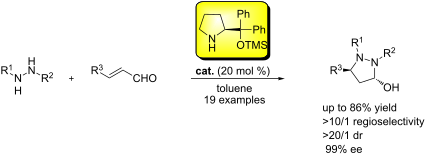
- 65880378 10.3762/bjoc.8.195 Abstract The catalytic synthesis of nitrogen-containing heterocycles is of great importance to medicinal and synthetic chemists, and also a challenge for modern chemical methodology. In this paper, we report the synthesis of pyrazolidine derivatives through a domino aza-Michael
- good results (up to 86% yield, >10/1 regioselectivity, >20:1 dr, 99% ee) in the presence of (S)-diphenylprolinol trimethylsilyl ether catalyst. Keywords: aza-Michael; domino; hydrazine; organocatalysis; pyrazolidine; Introduction Pyrazolidines are privileged and valuable heterocyclic compounds, which
- explored by several groups [72][73]. In 2007, Jørgensen et al. reported that the organocatalyzed asymmetric aza-Michael addition of hydrazones to cyclic enones had been achieved in good yield and stereoselectivity [74]. In 2011, the Deng group developed a highly enantioselective organocatalytic synthesis


Organocatalytic tandem Michael addition reactions: A powerful access to the enantioselective synthesis of functionalized chromenes, thiochromenes and 1,2-dihydroquinolines
Beilstein J. Org. Chem. 2012, 8, 1668–1694, doi:10.3762/bjoc.8.191

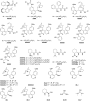
- thiochromenes; and (3) Organocatalytic aza-Michael reactions to access functionalized 1,2-dihydroquinolines, using chiral proline and its derivatives (Figure 2), chiral bifunctional thioureas, cinchona alkaloids and other organocatalysts (Figure 3). For each reaction, the initial screening result of various
- -unsaturated nitro compounds 27 in toluene afforded chiral thiochromans 51 bearing three continuous stereogenic centers with high diastereo- and enantioselectivities by this novel cascade process (Scheme 26). 3. Organocatalytic aza-Michael reactions to access functionalized 1,2-dihydroquinolines 3.1. Reaction
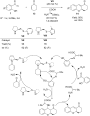
- alcohol. Córdova and co-workers [73] in 2007 first reported an asymmetric organocatalytic tandem aza-Michael–aldol reaction for the synthesis of 1,2-dihydroquinolines through the iminium activation strategy. Thus, the aza-Michael–aldol reaction between 2-aminobenzaldehydes 52 and enals 2 in the presence






A quantitative approach to nucleophilic organocatalysis
Beilstein J. Org. Chem. 2012, 8, 1458–1478, doi:10.3762/bjoc.8.166
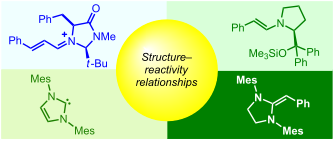
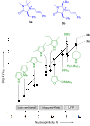
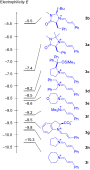
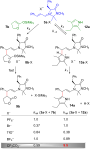
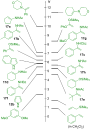
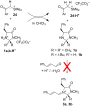
- °C, silyl ketene acetal 7b in dichloromethane with c(3a-CF3CO2) = (1.7–2.5) × 10−5 M, kryptopyrrole 12a in acetonitrile with c(3a-CF3CO2) = 5.0 × 10⁻⁵ M). Comparison of calculated and experimental rate constants of electrophilic aromatic substitutions with iminium ions [56]. Aza-Michael additions of









Coupled chemo(enzymatic) reactions in continuous flow
Beilstein J. Org. Chem. 2011, 7, 1449–1467, doi:10.3762/bjoc.7.169
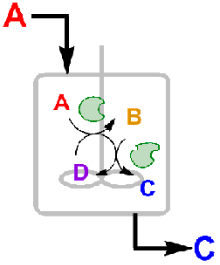
- and solvent-free environment [38]. In the first noncatalyzed thermal aza-Michael addition performed at 80 °C, the racemic ester rac-46 is formed from cheap starting materials benzylamine (44) and trans-ethylcrotonate (45) (Scheme 14). Subsequently, Novozym 435 is applied for the kinetic resolution of


Amines as key building blocks in Pd-assisted multicomponent processes
Beilstein J. Org. Chem. 2011, 7, 1387–1406, doi:10.3762/bjoc.7.163
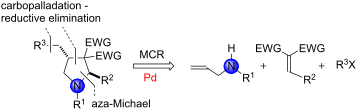
- used. A proper choice of catalyst and reaction conditions is also needed to improve the efficiency of each reaction (Scheme 18) [18]. Consecutive one-pot transformations initiated by Heck reaction and terminated by intramolecular aza–Michael addition were developed by Hanson and coworkers to access a
- , and catalytic Pd2(dba)3·CHCl3 led to the production of the desired sultams 42 upon heating at 110 °C. A series of sultam derivatives of bioactive, related isoindol-1-one amides 43 were also prepared by entering acrylic acid into the Heck–aza–Michael process and coupling a second amine derivative
- sulfur dioxide. However, this Pd-catalyzed aminosulfonylation process proved inefficient with primary amines (Scheme 20) [20]. Multicomponent synthesis of nitrogen-containing heterocycles may also be initiated by an aza-Michael addition and terminated by a palladium-catalyzed ring-closure process [21


Single enantiomer synthesis of α-(trifluoromethyl)-β-lactam
Beilstein J. Org. Chem. 2011, 7, 759–766, doi:10.3762/bjoc.7.86
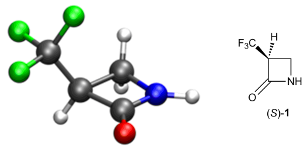
- explored as the enantiomerically pure amine. In the event 4a was generated after aza-Michael addition as a mixture of two stereoisomers, without any obvious diastereoisomeric bias (1:1, 0% de) as judged by both 1H and 19F NMR. β-Lactam ring closure, using thionyl chloride and triethylamine gave the N
- explored for the hydrogenolysis of 5a, however cleavage of the C–N bond proved very difficult and a satisfactory method could not be found. Therefore, (S)-α-(p-methoxyphenyl)ethylamine (3b) was explored as an alternative amine for the aza-Michael reaction, as removal of this amine using ceric ammonium
- nitrate (CAN) oxidation offered a milder deprotection method [15]. The aza-Michael reaction proved straightforward to generate 4b and then cyclisation again using thionyl chloride and triethylamine gave β-lactams 5b in a 40% de, presumably again a thermodynamically biased isomer ratio. The


Michael-type addition of azoles of broad-scale acidity to methyl acrylate
Beilstein J. Org. Chem. 2011, 7, 173–178, doi:10.3762/bjoc.7.24
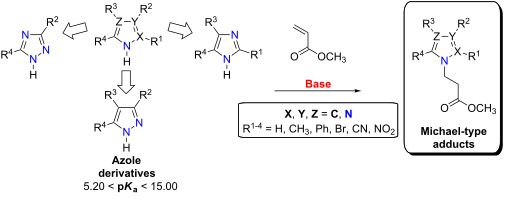
- reports on the synthesis of Michael-type adducts of azoles by the use of microwave irradiation [7][24]. The optimisation of aza-Michael reactions with N-methylimidazole as the base catalyst was published in 2007 by Liu et al [25]. However, when this catalyst was used with azoles of narrower-scale acidity
- important drugs, have seldomly been considered as aza-Michael donors due to their poor nucleophilicity and the possible tendency of adducts to undergo retro-Michael reactions [26]. Here, we present Michael-type addition of azoles, inter alia imidazole and 1,2,4-triazole derivatives of high acidity (pKa


Other Beilstein-Institut Open Science Activities



