


Search results
Search for "aziridines" in Full Text gives 57 result(s) in Beilstein Journal of Organic Chemistry.
Isotopic labelling studies for a gold-catalysed skeletal rearrangement of alkynyl aziridines
Beilstein J. Org. Chem. 2011, 7, 839–846, doi:10.3762/bjoc.7.96
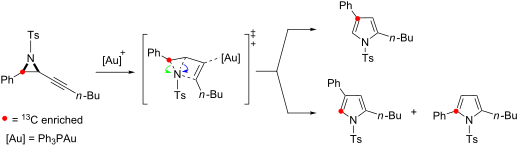
- aziridines into 2,4-disubstituted pyrroles. Two isotopomers of the expected skeletal rearrangement product were identified using 13C-labelling and led to a revised mechanism featuring two distinct skeletal rearrangements. The mechanistic proposal has been rationalised against the reaction of a range of 13C
- 1,2-alkyl migrations are well-established in gold-catalysed heterocyclic synthesis [12][13], 1,2-aryl shifts are much less common [14][15][16][17]. In relation to these processes, we recently reported the gold-catalysed reactions of aryl substituted alkynyl aziridines, such as 1. Careful choice of
- afford the desired cycloisomerisation precursor 4 [28]. The aziridines were formed as a mixture of diastereomers, with the cis diastereomer predominating, and were employed as such in the cycloisomerisation reactions. Deuterated aziridine 4 was reacted under the standard conditions for skeletal


Synthesis of novel 5-alkyl/aryl/heteroaryl substituted diethyl 3,4-dihydro-2H-pyrrole-4,4-dicarboxylates by aziridine ring expansion of 2-[(aziridin-1-yl)-1-alkyl/aryl/heteroaryl-methylene]malonic acid diethyl esters
Beilstein J. Org. Chem. 2011, 7, 831–838, doi:10.3762/bjoc.7.95
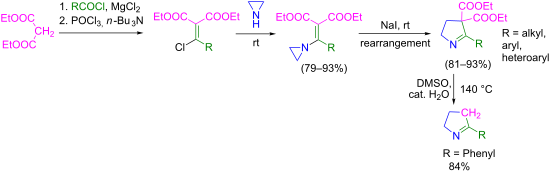
- -[(aziridin-1-yl)-1-alkyl/aryl/heteroaryl-methylene]malonic acid diethyl esters in very good to excellent yields under mild reaction conditions. The electronic and steric impact of the substituents on the kinetics of ring expansion of N-vinyl aziridines to pyrrolines has been studied. Various diversely
- -vinyl substituted aziridines; ring expansion; sodium iodide; Introduction Vinylaziridines are a particularly interesting class of aziridine derivatives that lend themselves to a host of highly useful synthetic transformations [1]. They are versatile electrophiles and notably undergo regioselective ring
- chemistry and new applications of these compounds are being continuously explored [10][11][12][13][14][15][16][17][18][19][20][21][22]. However, not much attention has been paid to N-vinyl substituted aziridines. Thus, N-vinyl substituted aziridines provide an opportunity for researchers to explore their


Synthetic applications of gold-catalyzed ring expansions
Beilstein J. Org. Chem. 2011, 7, 767–780, doi:10.3762/bjoc.7.87
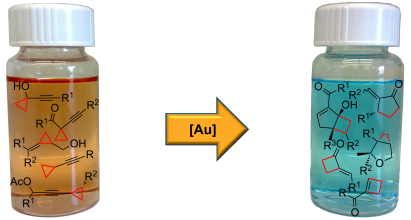
- gold-catalyzed ring expansion of 1-oxiranyl-1-alkynylcyclopropanes [43][44]. An alternative method for obtaining disubstituted pyrroles via gold-catalyzed ring expansion was reported by Davies and co-workers who employed alkynyl aziridines 51 as intramolecular nucleophiles [45]. Ring expansion from the
- aziridines onto the adjacent alkyne afforded the 2,5-disubstituted pyrroles 52 in high yields (Scheme 16). In 2011, Barluenga et al. developed a new methodology for the preparation of 1,6-disubstituted regioisomeric cyclohexadienes 54 and 54' (Scheme 17) [46]. The process resulted in a five-to-six-membered
- aziridines. Gold-catalyzed synthesis of disubstituted cyclohexadienes. Gold-catalyzed synthesis of indenes. Gold-catalyzed [n + m] annulation processes. Gold-catalyzed generation of 1,4-dipoles. Gold-catalyzed synthesis of repraesentin F. Gold-catalyzed ring expansion of cyclopropyl 1,6-enynes. Gold


α,β-Aziridinylphosphonates by lithium amide-induced phosphonyl migration from nitrogen to carbon in terminal aziridines
Beilstein J. Org. Chem. 2010, 6, 978–983, doi:10.3762/bjoc.6.110

- David. M. Hodgson Zhaoqing Xu Department of Chemistry, Chemistry Research Laboratory, University of Oxford, Mansfield Road, Oxford, OX1 3TA, UK, Fax: +44(1865) 285002 10.3762/bjoc.6.110 Abstract N-Phosphonate terminal aziridines undergo lithium 2,2,6,6-tetramethylpiperidide-induced N- to C-[1,2
- acids; aziridines; lithiation; migration; synthetic methods; Introduction The synthesis of aminophosphonic acids and their derivatives has attracted considerable attention, since the presence of such functionality, typically as amino acid surrogates, leads to interesting bioactivity in, for example
- our investigations [9][10][11][12][13] on the generation and subsequent chemistry of α-lithiated terminal aziridines [14], we considered whether α,β-aziridinylphosphonates 3 could be accessed by α-lithiation of N-phosphonate terminal aziridines 1, followed by N- to C-[1,2]-anionic phosphonyl group


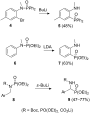


Palladium- catalyzed cross coupling reactions of 4-bromo- 6H-1,2-oxazines
Beilstein J. Org. Chem. 2009, 5, No. 44, doi:10.3762/bjoc.5.44

- alcohols [20], aziridines [21], pyrrolizidines [22], and pyrrolidine derivatives [15][23][24]. In the context of our ongoing exploration of the synthetic potential of these heterocycles we were interested to modify the substitution pattern of the C-4,C-5 double bond of 6H-1,2-oxazines [25][26][27]. Herein


The enantiospecific synthesis of (+)-monomorine I using a 5-endo- trig cyclisation strategy
Beilstein J. Org. Chem. 2007, 3, No. 39, doi:10.1186/1860-5397-3-39
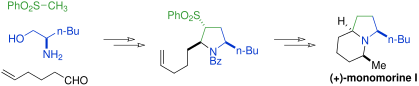
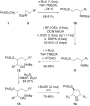
- mode of cyclisation. [1][2][3][4][5][6] The methodology allows the conversion of epoxides (X = O) or aziridines (X = N-PG) (2) into the desired trisubstituted tetrahydrofurans or pyrrolidines (5) via a series of sulfone-mediated transformations (Scheme 1). Ring-opening 2 with the sulfone-stabilised




Pd-catalysed [3 + 3] annelations in the stereoselective synthesis of indolizidines
Beilstein J. Org. Chem. 2007, 3, No. 8, doi:10.1186/1860-5397-3-8
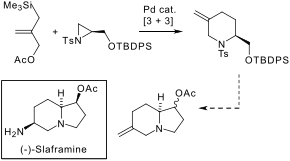
- + 3] annelation of aziridines and Trost's conjunctive allylsilane reagent. We have also found that reduction of the lactam unit of 11 and acetylation of the hydroxyl group takes place smoothly to provide 13, demonstrating the potential of these intermediates for the synthesis of slaframine and related


Other Beilstein-Institut Open Science Activities



