


Search results
Search for "cellular uptake" in Full Text gives 56 result(s) in Beilstein Journal of Organic Chemistry.
A peptidic hydrogel that may behave as a “Trojan Horse”
Beilstein J. Org. Chem. 2013, 9, 417–424, doi:10.3762/bjoc.9.44

- carry drug molecules into the cell. For this purpose, we used the gelator A (Figure 1), derived from natural proteinogenic amino acids (Thr, Phe) and a fatty acid (azelaic acid). Compound A was prepared from Boc-L-Phe-D-Oxd-OBn and azelaic acid, as previously reported [23]. To check the cellular uptake
- as gelator, doped by a small amount of the dansyl-containing compounds B, C and D. These all readily form fluorescent hydrogels, which may be used to evaluate the cellular uptake of A. Before evaluating the cellular uptake of the hydrogels, the structure of 1 (hydrogel), and its corresponding xerogel
- with small amounts of dansyl-containing compounds, needed to show the cellular uptake into IGROV-1 cells by confocal laser scanning microscopy. These gels are readily internalized by cells and are biologically inactive. In contrast, the hydrogel 6 formed only by B and a water/ethanol mixture is


Peptoids and polyamines going sweet: Modular synthesis of glycosylated peptoids and polyamines using click chemistry
Beilstein J. Org. Chem. 2013, 9, 56–63, doi:10.3762/bjoc.9.7
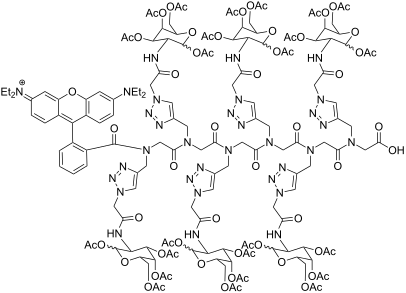
- derivatives of biomacromolecules that have to be soluble in hydrophilic environments to be taken up in vivo or in cell culture. Common solubilizers that enhance the cellular uptake are polyamines and other polycationic moieties such as particular peptoids. Recently, polycationic polyamines have been shown to
- coupling sequence resulted in the peptoids, which were further modified with rhodamine B (Rho-CO2H) as an easily accessible and versatile fluorescent tag. Rhodamine B was coupled to the N-terminus in order to provide a label for future biological applications, such as the study of the cellular uptake. For


Chemical modification allows phallotoxins and amatoxins to be used as tools in cell biology
Beilstein J. Org. Chem. 2012, 8, 2072–2084, doi:10.3762/bjoc.8.233
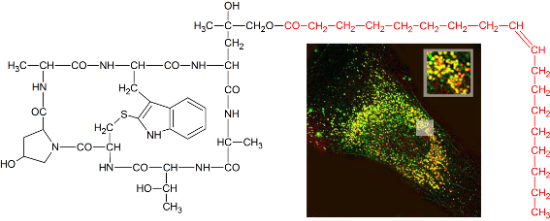
- .8.233 Abstract Phallotoxins inhibit the dynamics of microfilaments in cells and lead to apoptosis. Due to poor cellular uptake these effects cannot be studied in live cells, even at millimolar toxin concentrations, nor can phalloidin be used for the elimination of tumor cells. Uptake is greatly enhanced
- , into live cells. Keywords: amatoxins; cellular uptake; endocytosis; peptides; phalloidin; phallotoxins; Introduction Phallotoxins and amatoxins, the two families of toxic cyclopeptides produced by the green death cap Amanita phalloides, have been the subject of intense biochemical research for
- cells Tetramethylrhodaminyl-phalloidin (Figure 6a) has been used to visualize actin fibers in fixed cells for 30 years. Here we show that the rhodamine residue also strongly enhanced cellular uptake, making this phalloidin derivative a tool for cell biology. With an IC50 value of 11 µM its toxicity is




Dimerization of a cell-penetrating peptide leads to enhanced cellular uptake and drug delivery
Beilstein J. Org. Chem. 2012, 8, 1788–1797, doi:10.3762/bjoc.8.204
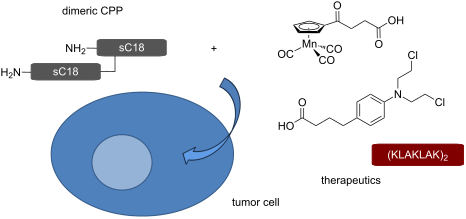
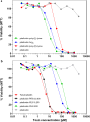
- (cymantrene) complexes to tumor cell lines, inducing high cellular toxicity. In order to increase the potential of the organometallic complexes to kill tumor cells, we were looking for a way to enhance cellular uptake. Therefore, we designed a branched dimeric variant of sC18, (sC18)2, which was shown to have
- potential due to limited bioavailability and cellular uptake. In recent years, cell-penetrating peptides (CPPs) emerged as an encouraging tool to overcome this obstacle owing to their ability to autonomously cross the cellular membrane in a receptor-independent manner. This enables them to deliver a large
- the peptides, which is considered to be crucial for initial membrane interaction through binding to negatively charged phospholipids and glycosaminoglycans [6]. Endocytic and non-endocytic processes have been proposed to be involved in cellular uptake; however, the exact mechanism triggering


Unprecedented deoxygenation at C-7 of the ansamitocin core during mutasynthetic biotransformations
Beilstein J. Org. Chem. 2012, 8, 861–869, doi:10.3762/bjoc.8.96
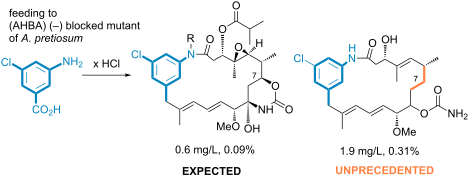
- ]. Producer strains genetically blocked in the biosynthesis of important and complex natural products can serve as such new tools. The synthetic concept based on these blocked mutants is termed “mutational biosynthesis”, or in short mutasynthesis, and it relies on the cellular uptake of modified biosynthetic




An easily accessible sulfated saccharide mimetic inhibits in vitro human tumor cell adhesion and angiogenesis of vascular endothelial cells
Beilstein J. Org. Chem. 2012, 8, 787–803, doi:10.3762/bjoc.8.89
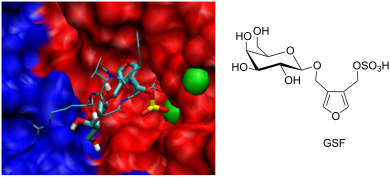
- gelatinase MMP-2 and its proforms could also be caused by lower pro-MMP-2 expression upon GSF binding or its cellular uptake. Effects of saccharide mimetics on adhesion, migration and tubule formation of vascular endothelial cells Endothelial cells play a central role in the process of angiogenesis, which is


Other Beilstein-Institut Open Science Activities



