


Search results
Search for "chalcone" in Full Text gives 59 result(s) in Beilstein Journal of Organic Chemistry.
Total synthesis of ochnaflavone
Beilstein J. Org. Chem. 2013, 9, 1346–1351, doi:10.3762/bjoc.9.152
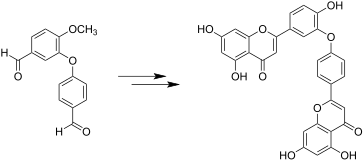
- moieties, and the permethyl ether of 2,3,2'',3''-tetrahydroochnaflavone have been achieved. The key steps in the synthesis of ochnaflavone were the formation of a diaryl ether and ring cyclization of an ether-linked dimeric chalcone to assemble the two flavone nuclei. Optimal experimental conditions for
- nucleophilic substitution and chalcone formation as the key steps. Results and Discussion Our synthesis of 1 is summarized in Scheme 1. The two most important steps in the synthesis of 1 are the formation of the diaryl ether linkage and the assembly of the flavone nuclei. The most logical approach to the
- formation of the chalcone by an aldol condensation reaction with a suitably substituted acetophenone. Selective methylation of 2,4,6-trihydroxyacetophenone with methyl iodide yielded 2'-hydroxy-4',6'-dimethoxyacetophenone (5) in moderate yield. The Claisen–Schmidt condensation of 5 with diaryl ether 4 under


Amyloid-β probes: Review of structure–activity and brain-kinetics relationships
Beilstein J. Org. Chem. 2013, 9, 1012–1044, doi:10.3762/bjoc.9.116
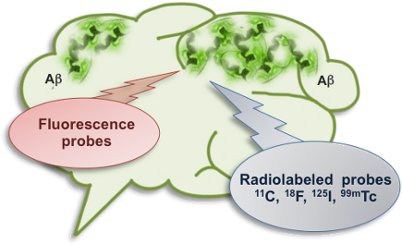
- resulted in a variety of radiolabeled molecular probes for in vivo PET/SPECT imaging. The scaffolds from which these newer radiolabeled probes are derived include chalcone (5) and its conformationally restricted analogues flavone (6) and aurone (7); stilbene (8) and its analogues diphenyl-1,2,4-oxadiazole
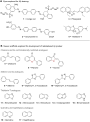
- introduce radiolabels into PET probes are outlined in Scheme 1. These general strategies will be abbreviated as Gs A–D in all subsequent schemes in this review. Chalcone and its conformationally restricted analogues Chalcone derivatives Chalcones and indolochalcones, such as 18a–l, 19a,b, 20a,b, and 21
- pegylation (n = 0–3) all showed similar affinity. In biodistribution experiments using normal mice, the [18F]-labeled chalcone 19a showed high brain uptake rate and good clearance, whereas the [11C]-labeled chalcone 19b revealed reasonable brain uptake rate, but very fast clearance [14]. The [18F]-labeled










Reactions of salicylaldehyde and enolates or their equivalents: versatile synthetic routes to chromane derivatives
Beilstein J. Org. Chem. 2012, 8, 2166–2175, doi:10.3762/bjoc.8.244

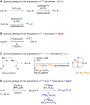
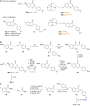
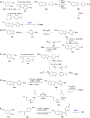
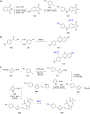
- a C-2 phenyl substituent. The synthesis of flavans and flavones generally involves treatment of acetophenone (7) with a base to give enolate 8, which undergoes a Knoevenagel condensation with salicylaldehyde (5) to yield a chalcone 9. These chalcone derivatives are then cyclized by using various
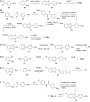
- temperature to give chalcone 14. To set the stage for the cyclisation reaction, the trans carbon–carbon double bond must either be isomerized to the cis form or completely reduced. In this case, chalcone 14 was treated with H2 in the presence of a catalytic amount of Pd to give intermediate 15 in 99% yield
- acetophenone derivatives 7 to give the corresponding chalcones of type 9 in 66–85% yields. Contrary to Xue’s reduction method where H2/Pd was used, we used NaBH4 in the reduction of both the carbon–carbon and carbon–oxygen double bonds of chalcone derivatives 9 to give the corresponding alcohols 17. It is


Syntheses and applications of furanyl-functionalised 2,2’:6’,2’’-terpyridines
Beilstein J. Org. Chem. 2012, 8, 379–389, doi:10.3762/bjoc.8.41

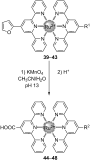
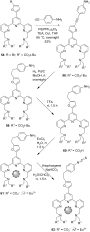
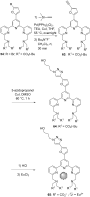
- synthesis starts with 6-carboxy-2-acetylpyridine (20), which is reacted with furfural (1), thus providing chalcone 21. This is then reacted with di-pyridinium salt 22 in the presence of ammonium acetate to afford quinquepyridine 23 (Scheme 4). Another possibility to access the key intermediate “1,5-diketone
- . Nevertheless, it was demonstrated that also asymmetric tpys are accessible via the 1,5-diketone pathway [31]. Michael addition of ethyl picolinoylacetate 29 to chalcone 30 affords diketone 31 in 60% yield. Reaction with ammonium acetate to effect ring closure did not yield a terpyridine, but instead





Continuous-flow hydration–condensation reaction: Synthesis of α,β-unsaturated ketones from alkynes and aldehydes by using a heterogeneous solid acid catalyst
Beilstein J. Org. Chem. 2011, 7, 1680–1687, doi:10.3762/bjoc.7.198
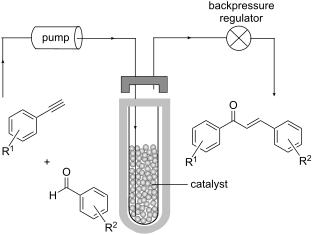
- was purified by column chromatography (n-hexane/DCM [2:1 to 1:1]). The schematic arrangement of the continuous-flow system. Preparation of chalcone 3b on larger scale. Optimization of hydration–condensation reactions.a Flow hydration–condensation of alkynes 1 and aldehydes 2.a Supporting Information


Continuous flow hydrogenation using polysilane-supported palladium/alumina hybrid catalysts
Beilstein J. Org. Chem. 2011, 7, 735–739, doi:10.3762/bjoc.7.83
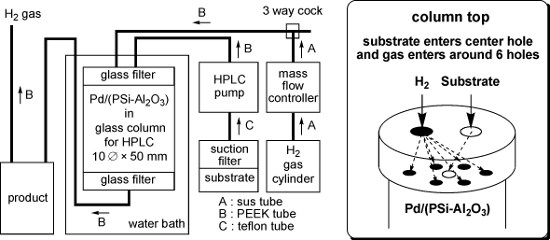
- double and triple bonds in various substrates are shown in Table 1; these proceeded quantitatively at room temperature under neat conditions. The products were obtained at approximately 10 g/h through the 4 cm3 column. The hydrogenation reactions of trans-stilbene and trans-chalcone, as representative
- solid substrates (Scheme 2), were also examined. The substrates were dissolved in toluene or ethyl acetate. The reduction of trans-stilbene proceeded quantitatively, but an overreaction product was obtained (7% yield) in the reduction of trans-chalcone. We then investigated the hydrogenation of a nitro
- , CDCl3) δ 7.46–7.50 (m, 2H), 7.60–7.63 (m, 1H), 8.12–8.14 (m, 2H). Schematic diagram of the continuous flow reactor (left) and the column top (right). Hydrogenation of ethyl cinnamate. Hydrogenation of trans-stilbene and trans-chalcone. Hydrogenation of nitrobenzene and deprotection of the Cbz group


An expedient and new synthesis of pyrrolo[1,2-b]pyridazine derivatives
Beilstein J. Org. Chem. 2009, 5, No. 66, doi:10.3762/bjoc.5.66

- -methyl-3-oxo-pentanoic acid phenylamide with tertiary butyl carbazate and subsequent condensation of the resulting carbamate derivative with a chalcone provided a facile new approach to pyrrolo[1,2-b]pyridazine derivatives. Keywords: 1,4-diketone; migration and cyclization; pyrrolo[1,2-b]pyridazine
- [1,2-b]pyridazine-5-carboxylic acid phenylamide 5a. A plausible mechanistic pathway for the formation of compounds 6a–j involves hydrolysis and decarboxylation of carbamate 3, subsequent condensation with chalcone 4a–j to provide alkenyl imine 9, its sequential hydrolysis and decarboxylation, followed


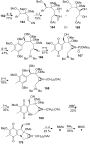
Mitomycins syntheses: a recent update
Beilstein J. Org. Chem. 2009, 5, No. 33, doi:10.3762/bjoc.5.33






An improved synthesis of 1,3,5-triaryl- 2-pyrazolines in acetic acid aqueous solution under ultrasound irradiation
Beilstein J. Org. Chem. 2007, 3, No. 13, doi:10.1186/1860-5397-3-13

- ratio to 1:2, and 1:3 the yields of 3a increased to 82% and 89% respectively (Table 1, Entry b, c). The results showed that changing the molar ratio of 1:2 had a significant effect on the yield, and the optimum molar ratio of chalcone: phenylhydrazine was 1:3. The important discovery was that in the
- decreased from 96% to 95% and 92% respectively (Table 1, Entry d, e, f). So the reaction conditions we chose were: the molar ratio of chalcone: phenylhydrazine: sodium acetate was 1:3:0.15. In order to verify the effect of ultrasound irradiation, in the absence of ultrasound, we have performed the reaction
- of chalcone with phenylhydrazine hydrochloride by refluxing at 108°C for 4 h. The yield of pyrazoline was 76% (Table 1, Entry i). While under ultrasound irradiation, the reaction can be completed within 2 h in 96% yield at room temperature (Table 1, Entry d). It was clear that the ultrasound could


Other Beilstein-Institut Open Science Activities



