


Search results
Search for "diethyl malonate" in Full Text gives 53 result(s) in Beilstein Journal of Organic Chemistry.
Synthesis and characterization of new diiodocoumarin derivatives with promising antimicrobial activities
Beilstein J. Org. Chem. 2011, 7, 1688–1696, doi:10.3762/bjoc.7.199
- -diiodosalicylaldehyde; diethyl malonate; ethyl cyanoacetate; coumarins; Michael reaction; Introduction Coumarins and their derivatives are biologically and pharmaceutically interesting compounds known for their use as additives in food, perfumes, cosmetics, pharmaceuticals, platelet aggregation and agrochemicals [1][2
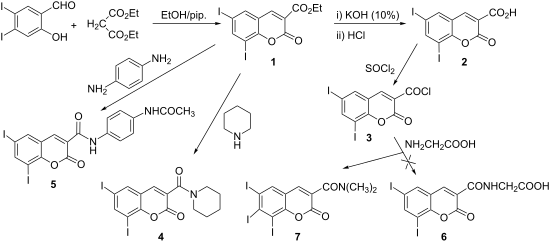
- diiodocoumarin derivatives bearing side chains with different structures, as such derivatives could possess interesting and useful biological properties. Results and Discussion Interaction of 3,5-diiodosalicylaldehyde with diethyl malonate according to the literature procedure [14][15] afforded ethyl 6,8
- diethyl malonate according to the literature procedures [19][20][21]. 6,8-Diiodocoumarin-3-carboxylic acid (2). A solution of compound 1 (0.47 g, 10 mmol) in absolute ethanol (20 mL) was mixed with ethanolic solution of KOH (10%), which was then refluxed for 10 min. The reaction mixture was poured onto


Synthesis of novel 5-alkyl/aryl/heteroaryl substituted diethyl 3,4-dihydro-2H-pyrrole-4,4-dicarboxylates by aziridine ring expansion of 2-[(aziridin-1-yl)-1-alkyl/aryl/heteroaryl-methylene]malonic acid diethyl esters
Beilstein J. Org. Chem. 2011, 7, 831–838, doi:10.3762/bjoc.7.95
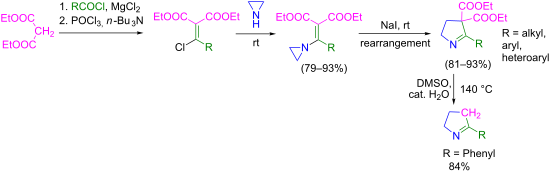
- -chloromethylene)malonates 19. The chloro alkenyl malonates 19 were synthesized in two steps from diethyl malonate and acid chlorides. The acylation of diethyl malonate was carried out with various acyl chlorides in the presence of anhydrous magnesium chloride and triethylamine, as per the reaction conditions
- the aryl substituents with the electron donating group. The presence of the electron withdrawing group on the aryl ring at the α-carbon of vinylaziridines reduces the electron density on the methylene carbon of diethyl malonate and thus reduces the rate of iodo group displacement (Table 2, entries 5
- conditions: i) THF, rt, 3 h; ii) NaI, acetone, rt, overnight. Reaction conditions: i) THF, TEA, rt; ii) NaI, acetone, rt, overnight. Synthesis of N-vinylaziridines from diethyl malonate and acyl chlorides. Iodide ion mediated ring expansion of N-vinylaziridines. Supporting Information Supporting Information


C-Arylation reactions catalyzed by CuO-nanoparticles under ligand free conditions
Beilstein J. Org. Chem. 2010, 6, No. 35, doi:10.3762/bjoc.6.35
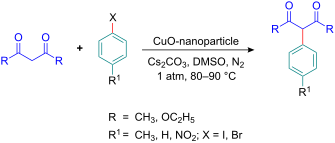
- . The above results encouraged us to investigate further reactions. Under similar reaction conditions, diethyl malonate was treated with iodobenzene to give the desired product in 78% yield (Scheme 3). The reaction was then repeated with a variety of aryl halides. The results are summarized in Table 4
- acetylacetone using different aryl halidesa C-arylation of diethyl malonate using different aryl halidesa. Recycle studies of nano-CuO for C-arylation reactiona. Supporting Information Supporting Information File 74: Typical procedure and characterization data of prepared compounds Acknowledgements Saurav


Other Beilstein-Institut Open Science Activities



