


Search results
Search for "difunctionalization" in Full Text gives 58 result(s) in Beilstein Journal of Organic Chemistry.
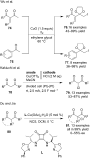
Copper-catalyzed intermolecular oxyamination of olefins using carboxylic acids and O-benzoylhydroxylamines
Beilstein J. Org. Chem. 2016, 12, 22–28, doi:10.3762/bjoc.12.4
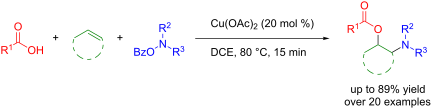
- -benzoylhydroxylamines as an electrophilic amine source and carboxylic acids as a nucleophilic oxygen source to achieve a modular difunctionalization of olefins. The reaction proceeded in a regioselective manner with moderate to good yields, exhibiting a broad scope of carboxylic acid, amine, and olefin substrates
- Liu reported a palladium-catalyzed introduction of phthalimide (HNPhth) and acetate functionalities to terminal allylic and homoallylic ethers in the presence of an iodine oxidant (Scheme 1B) [13]. The Yoon lab also developed copper- and iron-catalyzed olefin difunctionalization reactions with
- transformation, integrating an electrophilic amination with a nucleophilic oxygenation, builds upon our recent development in copper-catalyzed olefin difunctionalization, such as copper-catalyzed diamination [40] and amino lactonization [34]. This strategy overcomes common issues of chemo- and regioselectivity


C–H bond halogenation catalyzed or mediated by copper: an overview
Beilstein J. Org. Chem. 2015, 11, 2132–2144, doi:10.3762/bjoc.11.230
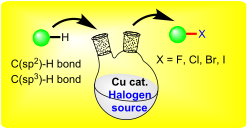
- ]. Halogenation of the alkene C(sp2)–H bond Beside the arene C–H bond, the alkene C–H is another typical C(sp2)–H bond. However, unlike the arene C–H bond, the alkene C–H bond tends to undertake difunctionalization via the cleavage of the π-bond in the presence of halogen source. Therefore, the halogenation of




Switching the reaction pathways of electrochemically generated β-haloalkoxysulfonium ions – synthesis of halohydrins and epoxides
Beilstein J. Org. Chem. 2015, 11, 242–248, doi:10.3762/bjoc.11.27

- . Keywords: DMSO; electrosynthesis; epoxides; halohydrins; halogen cations; Introduction Alkene difunctionalization through three-membered ring halonium ion intermediates [1] is an important transformation in organic synthesis. Usually the halonium ions such as bromonium or iodonium ions are generated by
- . Recently, we reported that dimethyl sulfoxide (DMSO) can also be used to effectively stabilize halogen cations (Scheme 1) [22]. The pools of stabilized halogen cations enable alkene difunctionalization. We previously reported that the reaction of alkenes with DMSO-stabilized halogen cations such as Br+ and


Visible-light-induced bromoetherification of alkenols for the synthesis of β-bromotetrahydrofurans and -tetrahydropyrans
Beilstein J. Org. Chem. 2015, 11, 31–36, doi:10.3762/bjoc.11.5
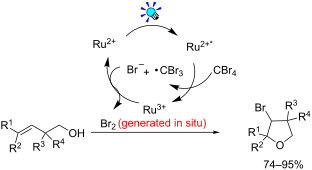
- reported that visible-light-induced photoredox catalysis could serve as a more environmental-friendly alternative reaction system to obtain Br2 in situ from CBr4, an oxidative quencher of photoredox catalyst [16][17][18][19][20][21][22]. Thus, as part of difunctionalization of alkenes, with our continuous


A reductive coupling strategy towards ripostatin A
Beilstein J. Org. Chem. 2013, 9, 1533–1550, doi:10.3762/bjoc.9.175
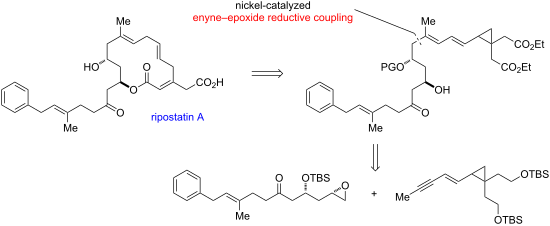
- substitution patterns [12][13][14][15]. Most recently, Sigman and colleagues have reported a palladium-catalyzed 1,4-difunctionalization of 1,4-butadiene with vinylboronic acid and vinyl triflate that can be used to rapidly access the skipped triene of ripostatin A [16]. We recognized that the C11 stereocenter


Homolytic substitution at phosphorus for C–P bond formation in organic synthesis
Beilstein J. Org. Chem. 2013, 9, 1269–1277, doi:10.3762/bjoc.9.143

- phosphorus always culminates in difunctionalization of a multiple bond. Therefore this methodology will find application in the synthesis of complex phosphines including bidentate ones. Radical substitution of halogen in organic halide with phosphorus will be an alternative to classical ionic substitution


Recent advances in transition-metal-catalyzed intermolecular carbomagnesiation and carbozincation
Beilstein J. Org. Chem. 2013, 9, 278–302, doi:10.3762/bjoc.9.34
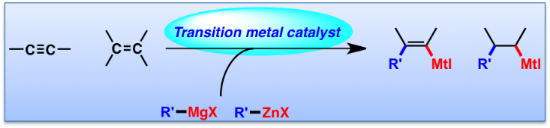
- ). The versatile 1,4-migration reactions were widely applicable for the 1,2-difunctionalization of arenes. In 2012, Gosmini reported similar cobalt-catalyzed arylzincation reactions of alkynes, which provided tri- or tetrasubstituted alkenes with high stereoselectivity [117]. Their catalytic system was


Alkoxide-induced ring opening of bicyclic 2-vinylcyclobutanones: A convenient synthesis of 2-vinyl-substituted 3-cycloalkene-1-carboxylic acid esters
Beilstein J. Org. Chem. 2012, 8, 650–657, doi:10.3762/bjoc.8.72
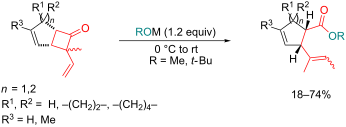
- [18][19][20][21][22][23]. Ring-opening reactions of cyclobutanones are expected to be a valuable methodology for vicinal difunctionalization of double bonds. A prerequisite for this reaction to take place is the presence at C-2 of substituents capable of stabilizing the developing vicinal carbanion [6


Other Beilstein-Institut Open Science Activities



