


Search results
Search for "diyne" in Full Text gives 54 result(s) in Beilstein Journal of Organic Chemistry.
Construction of cyclic enones via gold-catalyzed oxygen transfer reactions
Beilstein J. Org. Chem. 2011, 7, 606–614, doi:10.3762/bjoc.7.71
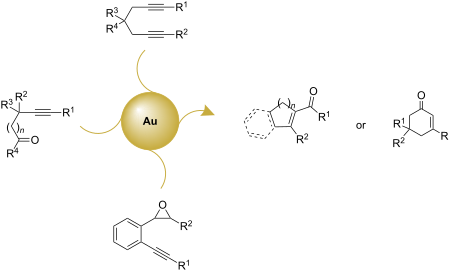
- the diacid 1,6-diyne (R1 = R2 = COOH) was employed in the reaction, only the esterified product (R1 = R2 = COOMe) was isolated, albeit in low yield. The authors also carried out this gold-catalyzed transformation in an ionic liquid [49]. This modification enabled the separation of the gold catalyst




Allene chemistry
Beilstein J. Org. Chem. 2011, 7, 394–395, doi:10.3762/bjoc.7.50
- ...” [1]. I first became interested in allenes as a graduate student with Professor Ray Funk at Pennsylvania State University while working on the preparation of ene–diyne systems. Interestingly, I always seemed to isolate allenes instead of the compounds I was hoping to obtain. My interests in allenes
Recent advances in the development of alkyne metathesis catalysts
Beilstein J. Org. Chem. 2011, 7, 82–93, doi:10.3762/bjoc.7.12
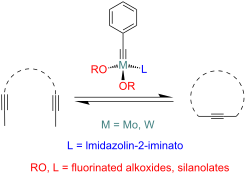
- metathesis polymerization (ROAMP) and acyclic diyne metathesis polymerization (ADIMET) are known (Scheme 2). In contrast to olefin metathesis, the number of catalysts for alkyne metathesis is far more limited. The first catalyst for alkyne metathesis was a heterogeneous system based on WO3/silica, which was
- = NMe2) was hardly successful in the presence of 2 mol % of the catalyst, whereas 14e was isolated in 90% yield with a catalyst loading of 5 mol %. Further detailed studies are required to fully explain this ostensibly odd behavior. Catalyst 5 was used in the RCAM of 6,15-dioxaeicosa-2,18-diyne (15) and




(−)-Complanine, an inflammatory substance of marine fireworm: a synthetic study
Beilstein J. Org. Chem. 2009, 5, No. 12, doi:10.3762/bjoc.5.12
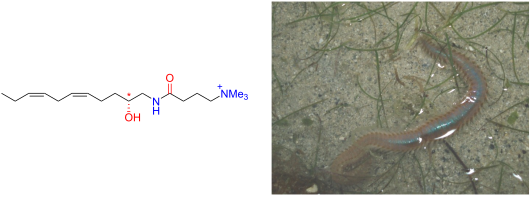
- acetylene 4 in 51% yield [7]. The bromomagnesium salt of 4 generated with EtMgBr was successively treated with 1-iodopent-2-yne in the presence of CuI to give the corresponding diyne compound 5 in 43% yield [8]. The partial reduction was achieved by using Lindlar catalyst to give the desired Z olefin, which
- ), 1.69 (1H, m), 1.57 (4H, m), 0.84 (3H + 3H, t, J = 7.6 Hz, overlapped). Synthesis of diyne 5: To a solution of the alkyne (4, 445 mg, 2.45 mmol) in THF (2.0 ml), 1.6 M solution of ethylmagnesium bromide (Aldrich, 2.45 ml, 3.92 mmol) was added under N2, and the resulting solution was stirred at ambient
- extractive workup and column chromatography (SiO2, hexane/ethyl acetate 98 : 2 to 95 : 5) gave the desired diyne compound 5 as a pale yellow oil (258 mg, 43%). 5: [α]D26 +2.7 (c 0.26, CHCl3); HRMS (ESI) calcd for C16H24O2Na [(M + Na)+] 271.1674, found 271.1696; 1H NMR (600 MHz, CDCl3) δ 4.17 (1H, m), 4.09


Other Beilstein-Institut Open Science Activities



