


Search results
Search for "hydride-shift" in Full Text gives 58 result(s) in Beilstein Journal of Organic Chemistry.
Synthesis of a novel chemotype via sequential metal-catalyzed cycloisomerizations
Beilstein J. Org. Chem. 2012, 8, 1338–1343, doi:10.3762/bjoc.8.153

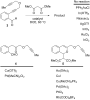
- 1,2-hydride shift to intermediate 27 followed by elimination of the metal catalyst [25] to afford the observed cyclopropane product 6. An alternative reaction pathway may be invoked for the ethyl-substituted substrate 22 leading to product 23 (Scheme 4). After initial cyclization of the enol ether




When gold can do what iodine cannot do: A critical comparison
Beilstein J. Org. Chem. 2011, 7, 847–859, doi:10.3762/bjoc.7.97
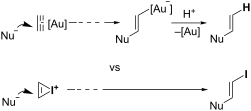
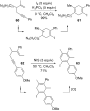
- migration of R3 are strictly limited to compounds that bear a quaternary center (R3 = alkyl, R2 ≠ H). As shown for the gold(I)-catalyzed reaction of 1,5-enyne 53, the formation of the bicyclo[3.1.0]hexene 54 is driven by the release of ring strain. Enynes with R3 = H undergo exclusively a hydride shift to








Isotopic labelling studies for a gold-catalysed skeletal rearrangement of alkynyl aziridines
Beilstein J. Org. Chem. 2011, 7, 839–846, doi:10.3762/bjoc.7.96
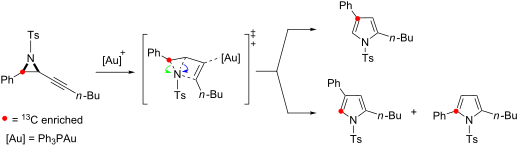
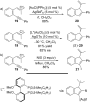
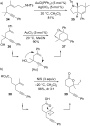
- 1,2-aryl shift in preference to either proton elimination or a 1,2-hydride shift. We therefore sought to validate this proposal experimentally by isotopic labelling. Results and Discussion A deuterium labelled precursor Alkynyl aziridine 4 was selected as the initial probe for the mechanism which


Molecular rearrangements of superelectrophiles
Beilstein J. Org. Chem. 2011, 7, 346–363, doi:10.3762/bjoc.7.45
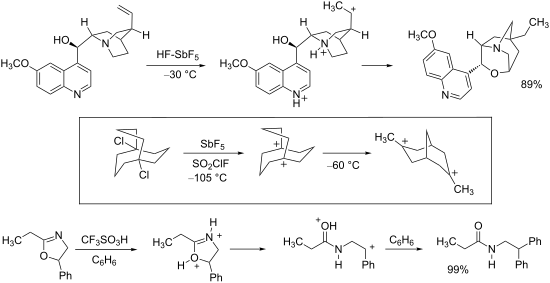
- superelectrophile, which undergoes rearrangement via the protonated cyclopropyl derivative 49. Final reaction steps include a hydride shift and deprotonations to give 50. Jacquesy and coworkers [24] have investigated the chemistry of polycyclic ketones in HF-SbF5-CCl4, a powerful reagent combination for
- hydride migration in 70 to give dication 71. This step should be favorable because it increases the distance between charge centers. Although a hydride shift is the most direct route from 70 to 71, this isomerization may also occur through deprotonation and reprotonation steps. As noted by the authors of
- -diprotonated species 93. Migration of the methyl group leads to separation of the charge centers and the formation of dication 94. Theoretical calculations show that hydride shift for the dications (94 → 95) is energetically unfavorable, presumably due to the closer proximity of the charges. In the final steps


Addition of lithiated enol ethers to nitrones and subsequent Lewis acid induced cyclizations to enantiopure 3,6-dihydro-2H-pyrans – an approach to carbohydrate mimetics
Beilstein J. Org. Chem. 2010, 6, No. 75, doi:10.3762/bjoc.6.75

- 10). Sodium azide presumably acts as base to initiate the reaction by deprotonation of the hydroxylamine moiety. A hydride shift from the benzylic position to the 3-position of the pyran ring produces the nitrone moiety of 21 and simultaneously displaces the axially positioned bromo substituent by an


A review of new developments in the Friedel–Crafts alkylation – From green chemistry to asymmetric catalysis
Beilstein J. Org. Chem. 2010, 6, No. 6, doi:10.3762/bjoc.6.6
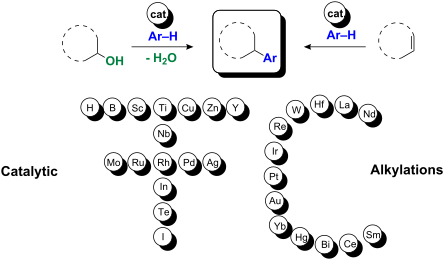
- intermediate which subsequently undergoes an intramolecular [1,3]- or [1,5]-hydride shift resulting in the desired diarylmethanes 9 in good yields. Electron donating and electron withdrawing functional groups of aldehyde moiety are tolerated in this reductive Friedel–Crafts alkylation procedure. However, there
- is no clear correlation between the electron deficiency of the arenecarbaldehyde and the reaction yield [4]. Further mechanistic investigations were performed with 1,3-propanediol-1,1,3,3-d4 in order to provide more information about the observed hydride shift. Indeed deuterium was incorporated into


Diastereoselective functionalisation of benzo-annulated bicyclic sultams: Application for the synthesis of cis-2,4-diarylpyrrolidines
Beilstein J. Org. Chem. 2009, 5, No. 69, doi:10.3762/bjoc.5.69

- carbocation rearrangement takes place faster than any nucleophilic interception of species 21 and 22. (A hydride shift from the bridging CH2 to carbocation 21 was also considered; however, based on the regioselective formation of compound 19b this mechanism was discounted.) The remarkable contrasting


The tert- amino effect in heterocyclic chemistry: Synthesis of new fused pyrazolinoquinolizine and 1,4-oxazinopyrazoline derivatives
Beilstein J. Org. Chem. 2007, 3, No. 43, doi:10.1186/1860-5397-3-43

- undergoing a 1,5-(4 → 5) hydride shift prior to cyclization to yield a 6-membered ring product 6 (Scheme 2). This is in contrast to an earlier report by Sandhu et al to obtain pyrrolo [2,3-d]pyrimidines from 6-tert-amino-substituted uracils and dimethyl acetylenedicarboxylate.[32] However, further work is in


Other Beilstein-Institut Open Science Activities



