


Search results
Search for "hydrogen transfer" in Full Text gives 52 result(s) in Beilstein Journal of Organic Chemistry.
Part 2. Mechanistic aspects of the reduction of S-alkyl- thionocarbonates in the presence of triethylborane and air
Beilstein J. Org. Chem. 2007, 3, No. 46, doi:10.1186/1860-5397-3-46

- In this note, we wish to report our findings concerning the intriguing question of the origin of the hydrogen atom that replaces the radicophilic group in the reduction of S-alkyl-thionocarbonates. Several hypotheses may reasonably be proposed. The first possibility is a hydrogen transfer from the
- role of water or alcohols and solvents in the reduction of S-alkylxanthates and related compounds. Hydrogen transfer from the O-H bond present in water or in an alcohol is not an obvious hypothesis in radical chemistry because of the high BDE of the O-H bond. Our results corroborate Wood's findings
- O-H bond, whereas in the absence of water, this hydrogen transfer could happen by hydrogen abstraction from the solvent (provided that it is a reasonably good hydrogen atom donor). However, despite all our efforts to operate under strictly anhydrous conditions, we observed good yield of hydrogen


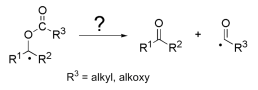
Do α-acyloxy and α-alkoxycarbonyloxy radicals fragment to form acyl and alkoxycarbonyl radicals?
Beilstein J. Org. Chem. 2006, 2, No. 10, doi:10.1186/1860-5397-2-10
- radical translocation occurs by 1,6-hydrogen transfer and the rebound cyclization is 1,6. The cascade in Figure 2 is a self-terminating, non-chain process if the radical X• does not continue on to propagate a chain in some way. Stable radicals such as X = NO2• or SO3•- and others are not expected to





Other Beilstein-Institut Open Science Activities



