


Search results
Search for "imides" in Full Text gives 53 result(s) in Beilstein Journal of Organic Chemistry.
Mitomycins syntheses: a recent update
Beilstein J. Org. Chem. 2009, 5, No. 33, doi:10.3762/bjoc.5.33

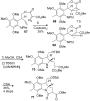
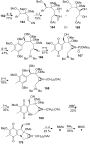
- the requisite 5-halopyrrolidinone precursor. 5.5. Cha. Dialkoxytitanacyclopropane addition to imides This methodology provides a very elegant way to install the C9a hydroxyl group, which remains the biggest challenge of mitomycin synthesis. Based on the precedent of ester cyclopropanation in presence






N-Arylation of amines, amides, imides and sulfonamides with arylboroxines catalyzed by simple copper salt/EtOH system
Beilstein J. Org. Chem. 2008, 4, No. 40, doi:10.3762/bjoc.4.40
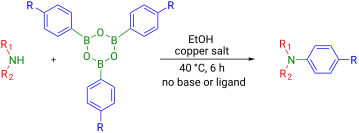
- , imides and sulfonamides catalyzed by a copper salt/EtOH system has been developed. In the absence of a base or additive the corresponding N-arylation products were obtained in moderate to excellent yields. Keywords: N-arylation; arylboroxine; copper salt; cross-coupling; ethanol; Introduction The
- ]. Moreover, the reaction rates of these reactions were generally slow, even requiring 3 d for completion [5][6][7]. An attractive alternative to this approach is to develop a simple and efficient catalytic system under mild reaction conditions. Thus, a simple copper salt-catalyzed N-arylation of imides with
- ). Furthermore, we expand the substrate scope of this reaction: a variety of amines, amides, imides and sulfonamides with arylboroxine can also participate in this catalytic system to give the corresponding N-arylation products in moderate to excellent yields. To the best of our knowledge, N-arylation of NH


Total synthesis of the indolizidine alkaloid tashiromine
Beilstein J. Org. Chem. 2008, 4, No. 8, doi:10.1186/1860-5397-4-8
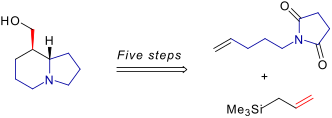
- sidechain found in tashiromine. The synthesis of azabicyclic assemblies by intramolecular allylsilane/N-acyliminium cyclisations was first studied by Hiemstra and Speckamp [16], who prepared their functionalised allylsilane cyclisation precursors (such as 3) by alkylation of cyclic imides with reagent 4 (X


Other Beilstein-Institut Open Science Activities



