


Search results
Search for "molybdenum" in Full Text gives 54 result(s) in Beilstein Journal of Organic Chemistry.
Synthesis and crossover reaction of TEMPO containing block copolymer via ROMP
Beilstein J. Org. Chem. 2010, 6, No. 59, doi:10.3762/bjoc.6.59
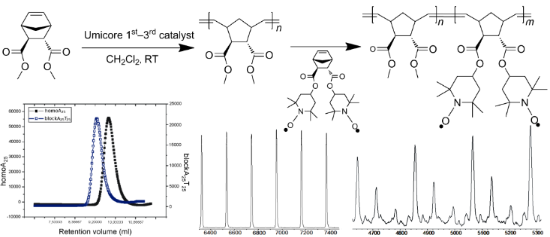
- catalysts for ROMP were based on molybdenum alkylidene catalysts, however, the true breakthrough of the method was hampered by the restricted functional group tolerance of Schrock initiators due to their sensitivity towards protic solvents and air [6]. With the advent of the Grubbs’ catalyst G1 (see Scheme
- molybdenum catalysts [7][8][9]. Often, the polydispersity indices of the resulting polymers obtained with initiator G1 are large with values ranging between 1.3 and 1.5 arising from an unfavorable rate of initiation (ki) relative to propagation (kp) as well as considerable secondary metathesis (backbiting


Trifluoromethyl ethers – synthesis and properties of an unusual substituent
Beilstein J. Org. Chem. 2008, 4, No. 13, doi:10.3762/bjoc.4.13

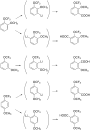
- pentachloride (Scheme 3). The latter compounds can be obtained directly when treated with molybdenum hexafluoride [22]. Unfortunately, the high percutaneous toxicity of the chlorothionoformates 1 prohibited any industrial exploitation so far. W. Sheppard described in 1964 the syntheses of aryl




Desymmetrization of 7-azabicycloalkenes by tandem olefin metathesis for the preparation of natural product scaffolds
Beilstein J. Org. Chem. 2007, 3, No. 48, doi:10.1186/1860-5397-3-48
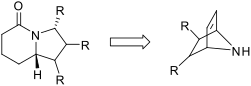
- accomplished while generating a double bond as a valuable functional group for further manipulations. In addition, the common ruthenium (Figure 1) and molybdenum based catalysts for olefin metathesis are well known for their broad functional group tolerance. The application of RCM to the synthesis of
- desymmetrization of bis-olefin 10 with the known chiral ruthenium catalyst 3.[67] This reaction gave enantioenriched 11 in good yield (Scheme 5). However, the enantioselectivity of this reaction is only moderate compared to similar reactions using molybdenum based precatalysts and different azabicycloalkene


The use of silicon- based tethers for the Pauson- Khand reaction
Beilstein J. Org. Chem. 2007, 3, No. 21, doi:10.1186/1860-5397-3-21
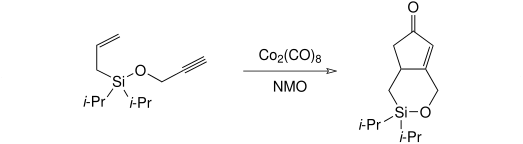
- tethers did not seem to be compatible with the Pauson-Khand reaction. Fortunately her research discovered that by combining the silicon tether with the allenic Pauson-Khand reaction mediated by molybdenum hexacarbonyl the corresponding bicyclic cyclopentenone could be formed although with poor yields
- being reacted with each of molybdenum hexacarbonyl/DMSO[21]; tungsten pentacarbonyl/THF[22]; chromium hexacarbonyl and rhodium cycloooctadiene chloride dimer/pentafluorobenzaldehyde[23][24]. None of the promoters gave any Pauson-Khand adducts, although an interesting THF-insertion adduct was obtained


Other Beilstein-Institut Open Science Activities



