


Search results
Search for "near infrared" in Full Text gives 54 result(s) in Beilstein Journal of Organic Chemistry.
Synthesis, photophysical and electrochemical characterization of terpyridine-functionalized dendritic oligothiophenes and their Ru(II) complexes
Beilstein J. Org. Chem. 2013, 9, 866–876, doi:10.3762/bjoc.9.100

- 0.15 and 0.24, respectively. Excitation of complexes 1 and 2 at their respective 1MLCT band in deaerated acetonitrile resulted in weak emissions at 693 nm and 755 nm and extended to the near-infrared region. For complexes on the basis of their structureless emission and low fluorescence quantum yields


Fluorescent hexaaryl- and hexa-heteroaryl[3]radialenes: Synthesis, structures, and properties
Beilstein J. Org. Chem. 2012, 8, 71–80, doi:10.3762/bjoc.8.7
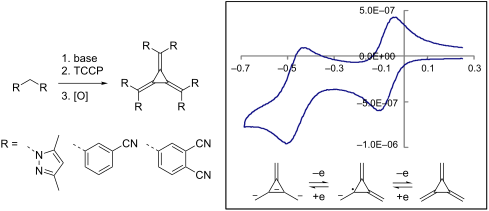
- electron deficient derivatives, 2 and 3, along with the previously synthesised compounds hexa(2-pyridyl)[3]radialene, hexa(3-pyridyl)[3]radialene, and hexakis(4-cyanophenyl)[3]radialene, show a weak absorption in the near infrared (around 800 nm). This is consistent with spectra observed for the radical


Hybrid biofunctional nanostructures as stimuli-responsive catalytic systems
Beilstein J. Org. Chem. 2010, 6, 922–931, doi:10.3762/bjoc.6.98
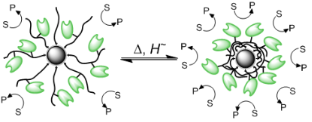
- this respect is the change of temperature. Polymeric materials show a wide range of thermoresponsive effects that can be explored for a discontinuous change of diffusion or reaction rate [1][2][3]. The temperature increase can for example be restricted locally by using near infrared (NIR) irradiation


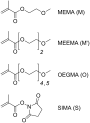


![[Graphic 1]](/bjoc/content/inline/1860-5397-6-98-i6.png?max-width=637&scale=0.1536366) ).
).


Conjugated polymers containing diketopyrrolopyrrole units in the main chain
Beilstein J. Org. Chem. 2010, 6, 830–845, doi:10.3762/bjoc.6.92
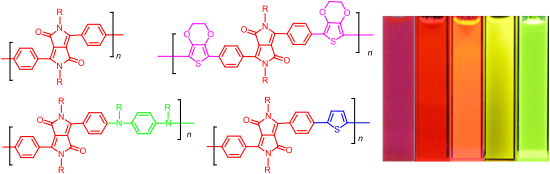
- ; photoluminescence; solar cell; Introduction A useful strategy in the design of new polymers for electronic applications is to incorporate chromophores which are highly absorbing and emitting in the visible and near infrared region into π-conjugated polymers chains. Potentially useful chromophores for electronic
- )DPP] by Yamamoto coupling of a dibrominated thiophenylDPP derivative such as M-3. An ambipolar near-infrared light-emitting transistor (LET) could be prepared from this material which exhibited hole and electron mobilities of 0.1 cm2 V−1 s−1 and up to 0.09 cm2 V−1 s−1, respectively. These values were




Other Beilstein-Institut Open Science Activities



