


Search results
Search for "silyl enol ethers" in Full Text gives 52 result(s) in Beilstein Journal of Organic Chemistry.
A review of new developments in the Friedel–Crafts alkylation – From green chemistry to asymmetric catalysis
Beilstein J. Org. Chem. 2010, 6, No. 6, doi:10.3762/bjoc.6.6
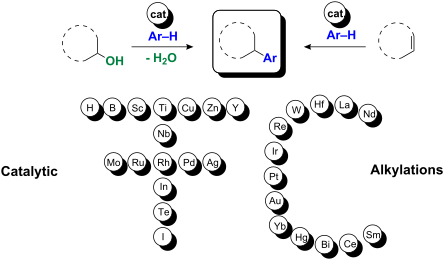
- ]. In addition to arenes and heteroarenes, other nucleophiles including allylsilane, tosylamine, TMS-cyanide, acetylacetonates and silyl enol ethers were successfully used as nucleophilic components giving the substituted 3-phenylbutanoates 112 in high yields and with excellent diastereoselectivities
- (Scheme 41). The reaction could be performed at ambient temperatures and in sharp contrast to the previous described HBF4-mediated procedure, high anti-selectivity was observed in the formation of 112. Similar methods using silyl enol ethers were subsequently developed involving Bi(OTf)3 as Lewis acid
- catalyst [117][118]. While bismuth-catalyzed arylation of benzyl alcohols proceeded only at temperatures between 55 and 100 °C, the reaction of p-methoxybenzyl acetates 113 with silyl enol ethers 114 took place even at ambient temperatures to give the desired products 115 (Scheme 42) [118]. Again different


End game strategies towards the total synthesis of vibsanin E, 3-hydroxyvibsanin E, furanovibsanin A, and 3-O-methylfuranovibsanin A
Beilstein J. Org. Chem. 2008, 4, No. 34, doi:10.3762/bjoc.4.34

- procedure based on the epoxidation of silyl enol ethers. Ketone 23 was smoothly converted into the TBS enol ether 27 (85% yield) with TBS triflate, which was then treated with dimethyldioxirane (DMDO). When work up was restricted to a simple 1 M hydrochloric acid wash (i.e. separatory funnel) only the
- oxidation on diketone 40, but to first protect the ketone functionality as silyl enol ethers as was undertaken in Scheme 7 (i.e. 27–48). Treating diketone 40 with t-butyldimethylsilyl trifluoromethanesulfonate afforded only the monoprotected product 53 (crude yield 55%), which smoothly underwent reduction


Other Beilstein-Institut Open Science Activities



