


Search results
Search for "Horner–Wadsworth–Emmons" in Full Text gives 82 result(s) in Beilstein Journal of Organic Chemistry.
Fused bicyclic piperidines and dihydropyridines by dearomatising cyclisation of the enolates of nicotinyl-substituted esters and ketones
Beilstein J. Org. Chem. 2010, 6, No. 22, doi:10.3762/bjoc.6.22
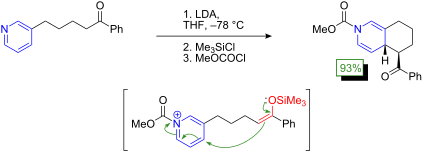
- deficient pyridines in the presence of trimethylsilyl triflate, tetrabutylammonium fluoride or a montmorillonite clay. The cyclisation precursor was synthesised by using the procedure of Hayashi [48] employing a Horner–Wadsworth–Emmons olefination between nicotinaldehyde and phosphonate 10. The resulting


Enantioselective synthesis of tricyclic amino acid derivatives based on a rigid 4-azatricyclo[5.2.1.02,6]decane skeleton
Beilstein J. Org. Chem. 2009, 5, No. 81, doi:10.3762/bjoc.5.81

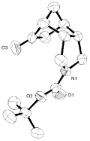
- 12% yield from 9). The preparation of the amino acid 8a•HCl and the N-tosylamide 8b•HCl required the attachment of an endo-oriented acetic acid substituent at the position of the keto group in 9 (Scheme 5). Initial attempts to introduce such a side chain by Wittig or Horner-Wadsworth-Emmons reactions




An expedient synthesis of 5-n-alkylresorcinols and novel 5-n-alkylresorcinol haptens
Beilstein J. Org. Chem. 2009, 5, No. 22, doi:10.3762/bjoc.5.22

- few papers have reported Wittig reactions in water without an organic solvent, although the related Horner-Wadsworth-Emmons reactions, using ester enolate type stabilized phosphonate ylids, have often been conducted in aqueous solutions [29]. The existing cases have mostly been targeted for the


Convenient methods for preparing π-conjugated linkers as building blocks for modular chemistry
Beilstein J. Org. Chem. 2009, 5, No. 11, doi:10.3762/bjoc.5.11
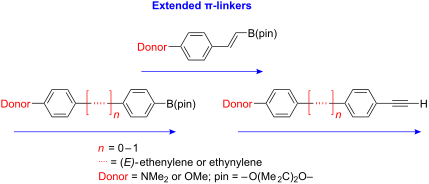
- easily accessible as a pure (E)-product from the pinacol ester of 4-formylphenylboronic acid and diethyl benzylphosphonate through the Horner–Wadsworth–Emmons reaction in 76% yield [36], methoxy and N,N-dimethylamino substituted (E)-4-bromostilbenes were synthesized from the corresponding benzaldehydes
- and 4-bromobenzyl(triphenyl)phosphonium bromide [37] by the Wittig reaction [37][38] in 37 and 54% yields, respectively. In contrast to the Horner–Wadsworth–Emmons reaction, this procedure afforded both (E)- and (Z)-stilbenes that were isomerized by heating with traces of iodine in toluene to afford
- the Horner–Wadsworth–Emmons reaction described above. These substituted 4-bromostilbenes could be most effectively converted to target pinacol esters 5a–c via borylation (Scheme 1, Method C) utilizing bis(pinacolato)diboron (pin2B2) [39] in a mixed solvent system DMSO/dioxane ensuring good solubility


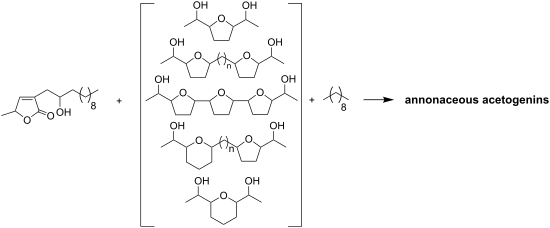
Recent progress on the total synthesis of acetogenins from Annonaceae
Beilstein J. Org. Chem. 2008, 4, No. 48, doi:10.3762/bjoc.4.48


Combining two-directional synthesis and tandem reactions, part 11: second generation syntheses of (±)-hippodamine and (±)-epi-hippodamine
Beilstein J. Org. Chem. 2008, 4, No. 4, doi:10.1186/1860-5397-4-4
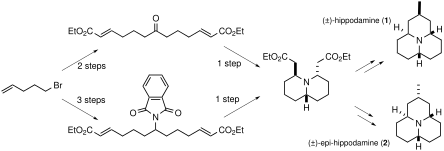
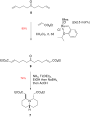
- sensitive dialdehyde 5 . Whilst we were able to purify compound 5, this resulted in a significant loss of material through degradation of the dialdehyde on the purification media, be it silica gel or neutral alumina. Thus, we found that use of the crude dialdehyde in the subsequent Horner-Wadsworth-Emmons


New modification of the Perkow reaction: halocarboxylate anions as leaving groups in 3-acyloxyquinoline- 2,4(1H,3H)-dione compounds
Beilstein J. Org. Chem. 2005, 1, No. 17, doi:10.1186/1860-5397-1-17
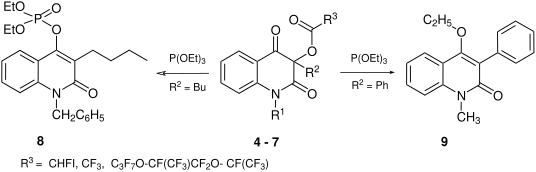
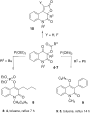
- the corresponding 4-ethoxyquinolin-2(1H)-one. In both reactions, the fluorocarboxylate anion acts as the first observed leaving group. This observation restricts the application of the intramolecular Horner-Wadsworth-Emmons synthesis to modify quinoline-2,4(1H,3H)-diones by the annulation of
- annulation of the fluorobutenolide cycle. An analogous Horner-Wadsworth-Emmons synthesis using ethyl (diethoxyphosphoryl)-fluoroacetate prepared from ethyl fluoroiodoacetate has been reported for the preparation of the α-fluoro-α,β-unsaturated acyclic esters and lactones. [14] However, when 1-benzyl-3-butyl
- -3-(fluoroiodoacetoxy)quinoline-2,4(1H,3H)-dione (4) was reacted with triethyl phosphite an unexpected product 9 (Scheme 3) was obtained instead of the desired Horner-Wadsworth-Emmons intermediate 1-benzyl-3-butyl-3-(diethoxyphosphoryl)fluoroacetyloxy-quinoline-2,4(1H,3H)-dione. We assume the newly




Other Beilstein-Institut Open Science Activities



