


Search results
Search for "Knoevenagel condensation" in Full Text gives 80 result(s) in Beilstein Journal of Organic Chemistry.
Zeolite catalyzed solvent- free one-pot synthesis of dihydropyrimidin- 2(1H)-ones – A practical synthesis of monastrol
Beilstein J. Org. Chem. 2009, 5, No. 4, doi:10.3762/bjoc.5.4
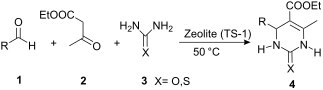
- conditions, even on using excess of ethyl acetoacetate (2 mmol), no side product arising through Knoevenagel condensation [41] was observed. This methodology was effective for aliphatic as well as aromatic aldehydes in the preparation of dihydropyrimidones (4a–4l) with uniformly high yields (Table 1). This


Catalytic synthesis of (E)-α,β-unsaturated esters from aldehydes and 1,1-diethoxyethylene
Beilstein J. Org. Chem. 2009, 5, No. 3, doi:10.3762/bjoc.5.3
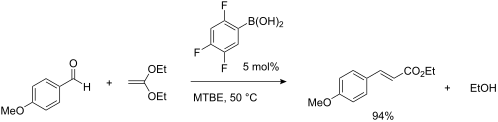
- satisfactory with respect to the demand for atom economy is still needed [2][3][4][5][6][7][8][9][10][11][12][13][14][15][16][17][18][19][20][21][22]. We have recently developed a new approach based on the Knoevenagel condensation of readily available and inexpensive malonate half esters with aldehydes which


Sordarin, an antifungal agent with a unique mode of action
Beilstein J. Org. Chem. 2008, 4, No. 31, doi:10.3762/bjoc.4.31

- dioxenone 47. This allowed the Knoevenagel condensation to be performed directly. In both the racemic and asymmetric syntheses, tricyclic compound 48 was prepared by Cu(I)-catalyzed conjugate addition of vinylmagnesium chloride to 45 in the presence of TMSCl, followed by enol acetylation (Scheme 10


The tert- amino effect in heterocyclic chemistry: Synthesis of new fused pyrazolinoquinolizine and 1,4-oxazinopyrazoline derivatives
Beilstein J. Org. Chem. 2007, 3, No. 43, doi:10.1186/1860-5397-3-43

- effect, which generalizes cyclization of certain derivatives of 3-methyl-1-phenyl-2-pyrazolin-5-ones. Using this strategy a variety of fused heterocycles is obtained by the Knoevenagel condensation of 5-tert-amino-3-methyl-1-phenylpyrazolone-4-carboxal-dehyde 3 with active methylene compounds such as
- Knoevenagel condensation reactions with malonodinitrile to give the corresponding pyrazolin-5-ylmethylenemalonodinitriles 4a, which in turn cyclized in the presence of anhydrous zinc chloride to get the corresponding pyrazolinoquinolizines 6a and 1,4-oxazinopyrazolines 6e in refluxing toluene (Scheme 1). The


An efficient synthesis of novel pyrano[2,3-d]- and furopyrano[2,3-d]pyrimidines via indium- catalyzed multi- component domino reaction
Beilstein J. Org. Chem. 2006, 2, No. 11, doi:10.1186/1860-5397-2-11
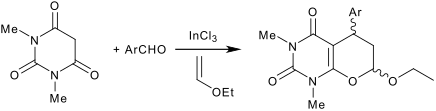
- respectively for diastereomer A. The configuration of diastereomer A may therefore be assigned as trans and cis for the diasteromer B. The formation of these heterocycles 5 can be rationalized by initial formation of a conjugated electron-deficient heterodiene by standard Knoevenagel condensation of the
- [2,3-d]pyrimidine 7 in excellent yields. Knoevenagel condensation of the aromatic aldehyde with 1,3-dimethylbarbuturic acid occurs first with the formation of an electron-deficient, sterically fixed 1-oxo-1,3-butadiene 3 which then reacts with 2,3-dihydrofuran in a Diels-Alder reaction with inverse
- comparable yields. The structure of all the products thus obtained were characterized by elemental and spectral analyses. Conclusion In conclusion, we have shown that the multicomponent domino Knoevenagel condensation/hetero-Diels-Alder reaction of aromatic aldehydes with 1,3-dimethylbarbituric acid and


Other Beilstein-Institut Open Science Activities



