


Search results
Search for "Mitsunobu reaction" in Full Text gives 80 result(s) in Beilstein Journal of Organic Chemistry.
N-1 regioselective Michael- type addition of 5-substituted uracils to (2-hydroxyethyl) acrylate
Beilstein J. Org. Chem. 2007, 3, No. 40, doi:10.1186/1860-5397-3-40
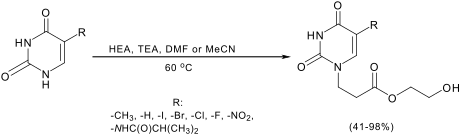
- ] Mitsunobu reaction;[8] or reactions that operate through ANRORC-mechanisms that require the presence of strongly electron-withdrawing groups.[9] Recently, we have described an N1- and N3-regioselective Michael-type addition of 5-substituted uracil derivatives to methyl acrylate and acrylonitrile.[10


A convenient allylsilane- N-acyliminium route toward indolizidine and quinolizidine alkaloids
Beilstein J. Org. Chem. 2007, 3, No. 32, doi:10.1186/1860-5397-3-32
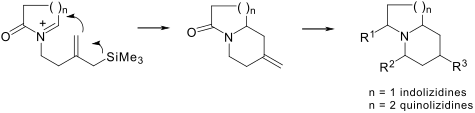
- hydroxyalkylallylsilane 32 is accomplished in 40% yield following Trost's procedure. [48] Reaction of glutarimide with alcohol 32 under Mitsunobu reaction conditions afforded imide 33 in 67% yield. Reduction of 33 was carried out with an excess of sodium borohydride in methanol at 0°C to give 34 as a mixture of two
- , (-)-lasubine II and (+)-subcosine II A similar strategy was attempted from (+)-(3R)-ethyl 3-hydroxy-3-(3,4-dimethoxyphenyl)propionate but racemisation was observed during the Mitsunobu reaction. [69] So we developed another strategy to prepare these natural optically active compounds based on the


The use of silicon- based tethers for the Pauson- Khand reaction
Beilstein J. Org. Chem. 2007, 3, No. 21, doi:10.1186/1860-5397-3-21
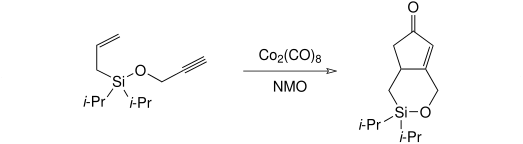
- both for the formation of the silyl ethers and from the Pauson-Khand reaction were the corresponding silanols, we wondered if it would be possible to use these compounds for the preparation of our desired ethers via a Mitsunobu reaction. There are examples in the chemical literature in which silanols
- may be used analogously to alcohols in the Mitsunobu reaction.[29] Unfortunately, neither triisopropylsilanol (synthesised by the hydrolysis of commercially available triisopropylsilyl chloride) or diisopropyl(1-methylallyl)-silanol and but-2-enyldiisopropylsilanol gave any product and quantitative


ADDP and PS-PPh3: an efficient Mitsunobu protocol for the preparation of pyridine ether PPAR agonists
Beilstein J. Org. Chem. 2006, 2, No. 21, doi:10.1186/1860-5397-2-21

- at the Mitsunobu reaction between pyridinol 2 and alcohol 3, utilizing a modification of the conditions originally reported by Mitsunobu,[18] afforded pyridyl ether 4 in 54% yield (Scheme 1). Interestingly, the reaction did not reach completion and pyridinol 2 was recovered, despite the fact that it
- Information File 1 and Supporting Information File 2]. With the above result in hand, we then pursued a variety of targets by performing the modified Mitsunobu reaction of 2 and a variety of primary alcohols (Table 1). In general, a variety of diverse alcohols afforded the expected products in excellent yield
- modified Mitsunobu coupling of pyridinols and alcohols proved to be versatile, efficient and amenable to parallel synthesis. A full account of the medicinal chemistry of these compounds will be given elsewhere. Thiazolidine-2,4-dione mimic & chosen lead scaffold. Proposed mechanism of the Mitsunobu


Methods for the synthesis of polyhydroxylated piperidines by diastereoselective dihydroxylation: Exploitation in the two-directional synthesis of aza-C-linked disaccharide derivatives
Beilstein J. Org. Chem. 2005, 1, No. 2, doi:10.1186/1860-5397-1-2
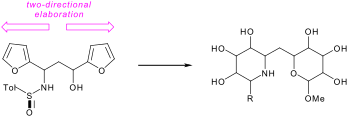
- ] although the reducing agent still approaches the ketone from a pseudo-axial direction, the net stereochemical outcome is different (see Figure 6). The configuration of both alcohols in the bis-allylic alcohols trans-27 and cis-27 was cleanly inverted using a Mitsunobu reaction, and the resulting diesters





Other Beilstein-Institut Open Science Activities



