


Search results
Search for "Suzuki–Miyaura cross-coupling" in Full Text gives 82 result(s) in Beilstein Journal of Organic Chemistry.
Air-stable, recyclable, and time-efficient diphenylphosphinite cellulose-supported palladium nanoparticles as a catalyst for Suzuki–Miyaura reactions
Beilstein J. Org. Chem. 2011, 7, 378–385, doi:10.3762/bjoc.7.48

- (Figure 4a). The TEM image of the used catalyst indicates that the size and morphology of the nanopalladium has suffered slightly from agglomeration in the recovered catalyst after being reused six times (Figure 4b). Suzuki–Miyaura cross-coupling reactions To explore the efficiency of the
- diphenylphosphinite cellulose-supported nanopalladium catalyst, it was initially used in the Suzuki–Miyaura cross-coupling reaction, which is a versatile and a well studied method for the generation of Csp2–Csp2 bonds in organic synthesis. The influence of base, solvent and amount of catalyst on Suzuki–Miyaura cross
- –Pd0). General procedure for the Suzuki–Miyaura cross-coupling reaction In a typical experiment, the Cell–OPPh2–Pd0 catalyst (0.005 mmol of Pd) was added to a mixture of aryl halide (1.0 mmol), arylboronic acid (1.2 mmol), and K2CO3 (2.0 mmol) in 95% ethanol (5 cm3), and the reaction mixture was


Suzuki–Miyaura cross-coupling reaction of 1-aryltriazenes with arylboronic acids catalyzed by a recyclable polymer-supported N-heterocyclic carbene–palladium complex catalyst
Beilstein J. Org. Chem. 2010, 6, No. 70, doi:10.3762/bjoc.6.70
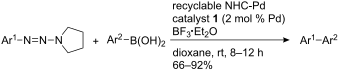
- Suzuki–Miyaura cross-coupling reaction of 1-aryltriazenes with arylboronic acids catalyzed by a recyclable polymer-supported Pd–NHC complex catalyst has been realized for the first time. The polymer-supported catalyst can be re-used several times still retaining high activity for this transformation
- ; recyclable catalyst; Suzuki–Miyaura reaction; Introduction The unsymmetrical biaryls feature in a diverse range of organic compounds, such as natural products, advanced materials, liquid crystals, ligands and molecules of medicinal interest [1][2][3][4]. The palladium-catalyzed Suzuki–Miyaura cross-coupling
- electrophilic component [5][6][7][8][9][10][11][12][13][14][15][16][17][18]. As an additional candidate for the electrophilic coupling partner, arenediazonium salts have also been used in place of aryl halides in the Suzuki–Miyaura cross-coupling reaction, and show higher activity than the corresponding aryl


Solvent-free and time-efficient Suzuki–Miyaura reaction in a ball mill: the solid reagent system KF–Al2O3 under inspection
Beilstein J. Org. Chem. 2010, 6, No. 7, doi:10.3762/bjoc.6.7
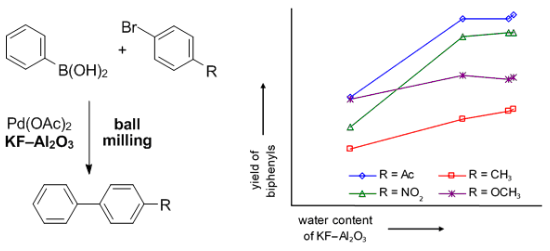
- applied in solvent-free Pd-catalyzed Suzuki–Miyaura cross-coupling reactions of aryl bromides with phenylboronic acid, and the performances of the individual SRS were compared [33][34][36][37][38][39][40][41][42]. Results and Discussion Incorporation of KF–Al2O3 as a basic component in organic synthesis
- beakers (V = 45 ml), 6 agate milling balls (d = 15 mm) per beaker, 800 rpm, 10 min; batch: 5 mmol aryl bromide, 124 mol % phenylboronic acid, 3.6 mol % Pd(OAc)2]. Dependence of the yield of Suzuki–Miyaura cross-coupling product (Scheme 1) from water content (Karl-Fischer titration) of KF-loaded aluminas


Diastereoselective functionalisation of benzo-annulated bicyclic sultams: Application for the synthesis of cis-2,4-diarylpyrrolidines
Beilstein J. Org. Chem. 2009, 5, No. 69, doi:10.3762/bjoc.5.69

- above proving inefficient, palladium chemistry was subsequently considered. The vinyl bromide 24a was reported to participate in Sonagashira alkynylation chemistry; however, yields of the resultant enyne were low [20]. Therefore, we decided to investigate Suzuki–Miyaura cross-coupling reaction as a
- . Possible explanation for the products formed in the dibromination of 5a and 5b. Lithiation–CO2 quench approach for the synthesis of 26 from vinyl bromide 24a. Suzuki–Miyaura cross-coupling of 24a and the diastereoselective hydrogenation of the resultant styrene adducts. Attempted sulfonamide double


Polyionic polymers – heterogeneous media for metal nanoparticles as catalyst in Suzuki–Miyaura and Heck–Mizoroki reactions under flow conditions
Beilstein J. Org. Chem. 2009, 5, No. 21, doi:10.3762/bjoc.5.21
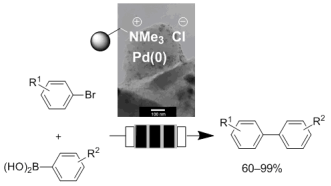
- nanoparticles (7–10 nm in size and a palladium content of 0.03 weight% Pd on polyionic polymer). Suzuki–Miyaura cross coupling reactions In our earlier work we showed that these materials are well suited for transfer hydrogenations under flow conditions [23][24]. Recently, the Suzuki–Miyaura reaction and other
- ] these clusters exert pronounced catalytic activity in solution at very low concentrations. This view is further supported by the fact that the catalytic species operating in the present case is able to promote Suzuki–Miyaura cross coupling reactions with aryl bromides while aryl chlorides are not good
- for the generation of metal nanoparticles. The ionic nature of the resin has a positive impact on the stabilization of the Pd species which results in extended use for Suzuki–Miyaura cross coupling reactions as well as Heck reactions without substantial reduction of activity even when solvents such as


Convenient methods for preparing π-conjugated linkers as building blocks for modular chemistry
Beilstein J. Org. Chem. 2009, 5, No. 11, doi:10.3762/bjoc.5.11
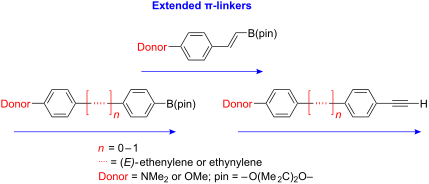
- ′-bromobiphenyl intermediates necessary for the preparation of 4a–c were synthesized by the Suzuki–Miyaura cross-coupling of 1-bromo-4-iodobenzene with the corresponding boronic acids/esters 1a–c in the yields of 82, 84, and 91%, respectively. A routine procedure involving a lithiation and reaction with


Mechanistic aspects of the isomerization of Z-vinylic tellurides double bonds in the synthesis of potassium Z-vinyltrifluoroborate salts
Beilstein J. Org. Chem. 2008, 4, No. 9, doi:10.1186/1860-5397-4-9
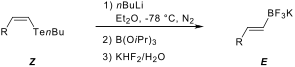
- acids and boronate esters are the most commonly used derivatives in Suzuki-Miyaura cross-coupling reactions. Recently, Molander et al. [1] and our group [2] have explored the use of potassium organotrifluoroborate salts as an alternative to the usual organoboron reagents in alkenyl-alkenyl [3], aryl


Other Beilstein-Institut Open Science Activities



