


Search results
Search for "agonist" in Full Text gives 83 result(s) in Beilstein Journal of Organic Chemistry.
Synthesis of compounds related to the anti-migraine drug eletriptan hydrobromide
Beilstein J. Org. Chem. 2012, 8, 1400–1405, doi:10.3762/bjoc.8.162

- Chemistry Department, AU College of Engineering, Andhra University, Visakhapatnam-530003, Andhra Pradesh, India 10.3762/bjoc.8.162 Abstract Eletriptan hydrobromide (1) is a selective serotonin (5-HT1) agonist, used for the acute treatment of the headache phase of migraine attacks. During the manufacture of
- , Figure 1) is a second-generation drug serotonin (5-HT1) agonist [4][5] used in the management of sensations of tightness, pain, pressure and heaviness in the precordium, throat and jaws. Eletriptan is more lipophilic than other triptans and absorbed more quickly than sumatriptan in the intestinal


Control over molecular motion using the cis–trans photoisomerization of the azo group
Beilstein J. Org. Chem. 2012, 8, 1071–1090, doi:10.3762/bjoc.8.119
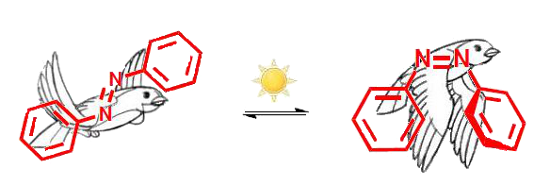
- , azobenzene and glutamate derivative (MAG) was used as a photochromic agonist of an ionotropic glutamate receptor (iGluR) (Figure 5a) [89][90][91]. The chromophore consists of a terminal maleimide unit, which is associated covalently to the protein via a cysteine residue, a central azobenzene unit and a


Synthesis and characterization of Sant-75 derivatives as Hedgehog-pathway inhibitors
Beilstein J. Org. Chem. 2012, 8, 841–849, doi:10.3762/bjoc.8.94
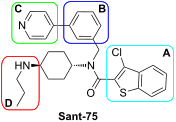
- carcinoma. In addition, a number of man-made inhibitors with a Smo binding affinity have been identified and reported [2][28][29][30][31][32][33][34], and some of them have entered phase I development. SAG is a synthetic Hh pathway agonist that directly targets Smo in a manner that antagonizes cyclopamine
- action, and thus it may serve as an interesting scaffold for drug development [35][36]. Recently, we have identified a Smo antagonist Sant-75 through zebrafish-based screening of a SAG-derived chemical library [37]. Interestingly, this antagonist differs from agonist SAG only in the chain length of the


Novel synthesis of pseudopeptides bearing a difluoromethyl group by Ugi reaction and desulfanylation
Beilstein J. Org. Chem. 2011, 7, 1070–1074, doi:10.3762/bjoc.7.123

- reported of the preparation and bioassay of pseudopeptides and peptidomimetics bearing difluoromethyl groups. For example, compound I can act as bradykinin B1 antagonist or inverse agonist and can be used in the prevention of inflammation and pain [19]. Compound II is an inhibitor of microsomal


An overview of the key routes to the best selling 5-membered ring heterocyclic pharmaceuticals
Beilstein J. Org. Chem. 2011, 7, 442–495, doi:10.3762/bjoc.7.57
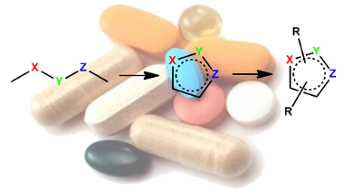
- structure, mutation studies have shown that the AT2 antagonists such as losartan bind to an active site located within the membrane-bound part of the receptor, which is different to that of the peptide agonist. Further studies led to the discovery of valsartan, where the imidazole ring of losartan is
- , and is part of the imidazopyridine class of pharmaceuticals. It is an agonist for the target receptor of γ-aminobutyric acid (GABA), an inhibitory neurotransmitter. Zolpidem binds to GABA receptors at the same site as typical benzodiazepines. This drug is preferred to benzodiazepines for long term use
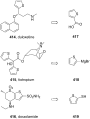
- , Arimidex) and 5-HT1 agonist triptan drugs such as rizatriptan (76, Maxalt) which are prescribed for migraine headaches. The large scale syntheses of all these compounds use the commercially available 1,2,4-triazolyl sodium salt 258 in an alkylation reaction with the corresponding benzyl bromide derivative







Palladium- and copper-mediated N-aryl bond formation reactions for the synthesis of biological active compounds
Beilstein J. Org. Chem. 2011, 7, 59–74, doi:10.3762/bjoc.7.10

- A-366833, a selective α4β2 neural nicotinic receptor agonist. A new route to oxcarbazepine. Synthesis of key intermediates for norepinephrine transporter (NET) inhibitors. N-Annulation yielding substituted indole for the synthesis of demethylasterriquinone A1. Palladium-catalysed double N-arylation




Transition- metal/Lewis acid free synthesis of acyl benzothiophenes via C-C bond forming reaction
Beilstein J. Org. Chem. 2007, 3, No. 35, doi:10.1186/1860-5397-3-35

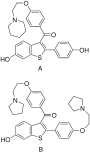
- , Raloxifene, [2-(4-hydroxyphenyl)-6-hydroxybenzo[b]thien-3-yl] [4-[2-(1-piperidinyl)ethoxy]phenyl]-methanone hydrochloride (A, Figure 1), is representative of a class of compounds known as selective estrogen receptor modulators[1] (SERMs) that possess estrogen agonist-like actions on bone tissues and serum



8-epi-Salvinorin B: crystal structure and affinity at the κ opioid receptor
Beilstein J. Org. Chem. 2007, 3, No. 1, doi:10.1186/1860-5397-3-1
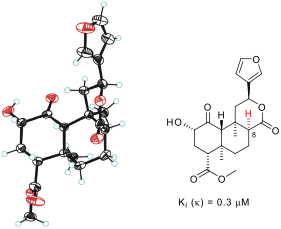
- hallucinogenic sage Salvia divinorum,[1] is a potent and selective κ opioid receptor (KOR) agonist.[2] Because it is the first known non-nitrogenous compound to have biologically significant actions at mammalian opioid receptors, 1a enables new approaches to studies of endogenous opioid receptor systems. KOR


Other Beilstein-Institut Open Science Activities



